China's first deep-sea green intelligent technology test ship, "Weilai," or "Future", has carried more than 20 sets of critical new marine equipment on board to conduct sea tests since its official delivery in July 2025.
The test ship is about 110 meters long with a displacement of about 7,000 tons, and powered by full electric propulsion to ensure a range of up to 10,000 nautical miles.
Dubbed as a floating lab, the ship aims to accelerate the transition of homegrown marine equipment from prototypes to commercial products and viable industries.
One of its key test subjects is a domestically developed intelligent steering system, a market long controlled by foreign suppliers. This system, which directs the ship's course, is critical for safe navigation. The rapid response and precise control of the steering system are crucial, particularly in complex conditions such as entering or leaving ports and navigating narrow channels,
Over the past few months, the vessel has focused on testing the self-developed intelligent steering system's course-changing performance, course-keeping ability, and autonomous deviation correction capability under complex flow fields.
"During the tests, through the MarineNet information system independently developed by the Taihu Laboratory. We collected key data in real time, such as steering frequency and steering amplitude. The 'value' of this data is very high. They are not simulated signals collected in a laboratory, but data collected under real navigation conditions in complex environments like wind and waves, salt fog, and electromagnetic interference," said Lyu Jiang, a senior engineer with the Taihu Laboratory of Deepsea Technological Science in the city of Wuxi, east China's Jiangsu Province.
To accelerate the technological iteration, improvement, and upgrading of the homegrown intelligent steering system, a mature imported intelligent steering system has also been installed on the vessel as a benchmark for comparison.
"This ship can serve as an exam room where both systems can compete side by side. The goal is to improve our marine equipment through such comparison," Lyu said.
Beyond steering gear, the vessel is also testing other innovations such as an intelligent medium-speed engine.
"Take the domestically produced intelligent medium-speed engine as an example. By running it on the vessel for an extended period, we can test its power response and fuel efficiency under different sea conditions and loads. We have already fed the complete set of test data back to the equipment's research and development unit, enabling them to further improve our homegrown equipment and systems," he said.
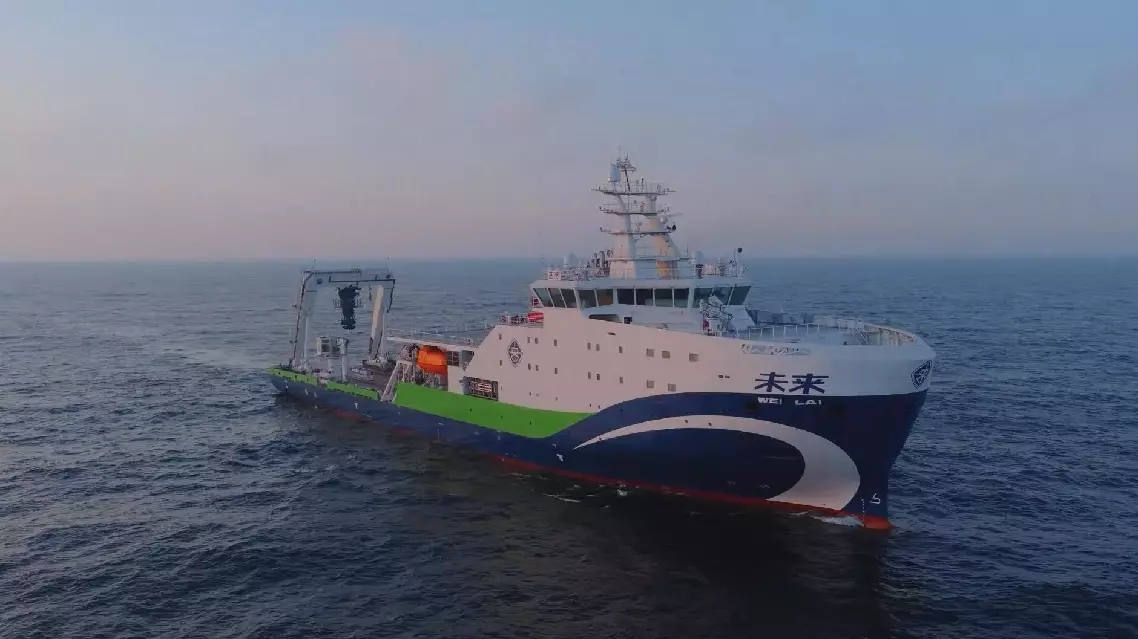
China's smart technology test ship accelerates sea tests for homegrown marine equipment