With the spring farming in north China getting underway, farmers in provinces of Shanxi, Shaanxi, and Hebei have been using scientific and precise water dispatching and automated equipment to carry out irrigation in a more efficient manner.
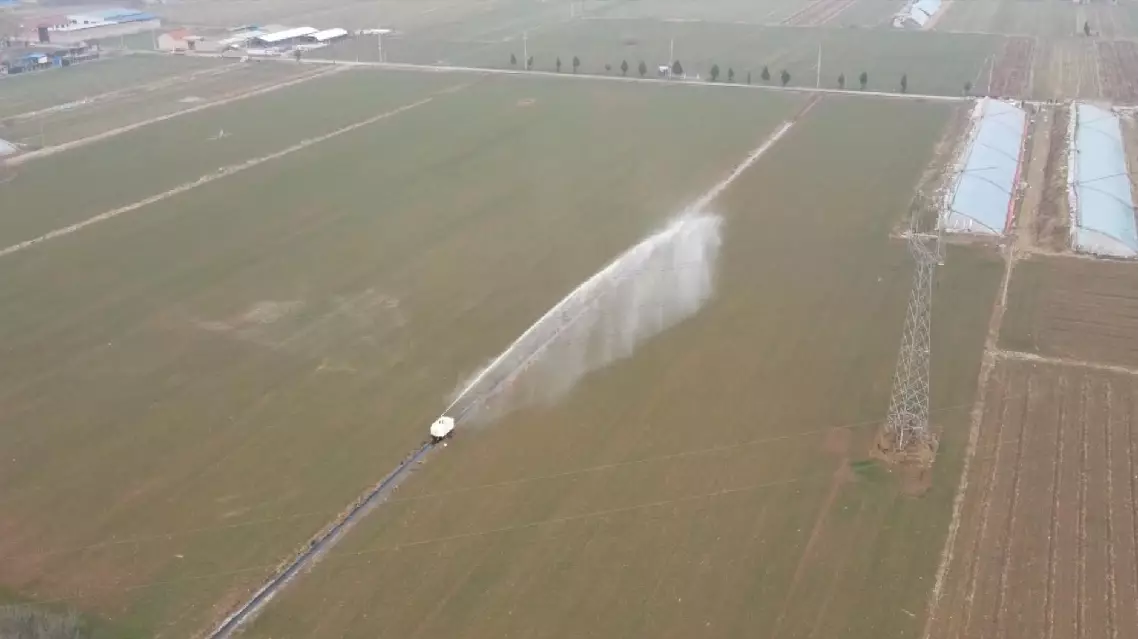
In Quwo County, Shanxi Province, autonomous sprinkler robots are busy working in wheat fields to carry out precision irrigation.
"The autonomous sprinkler robot adopts BeiDou Navigation Satellite System. Its spraying radius can reach up to 90 meters, conserving about 55 percent of water and improving labor efficiency by over 85 percent," said Hu Jinjin, a local farmer.
In addition to sprinkler robots, local agricultural authorities are encouraging wider use of water-saving facilities.
"Our county has 259,300 mu (about 17,300 hectares) of wheat, including 100,000 mu dedicated to water-saving irrigation. By adopting methods such as drip irrigation, micro-spray irrigation, and smart irrigation robots, we can achieve around 45 percent water savings and reduce fertilizer use by 20 to 30 percent," said Wang Zhongqiu, director of the modern agricultural development center in Quwo County.
Meanwhile, Donglei Pumping Project Phase II of the Yellow River Irrigation System in Fuping County, northwest China's Shaanxi Province, has fully activated automated sluice gates to ensure a stable and reliable water supply for farmland.
"This year, we have implemented automation across all sluice gates. Compared with the traditional methods, they have enhanced efficiency in water resource allocation, not only reducing water loss but also improving the accuracy and reliability of water supply," said Jia Fangfang, deputy head of the Liuqu General Station under the project's management center.
Latest data from the Ministry of Water Resources show that so far 16 provinces in China have launched spring irrigation, supplying a cumulative 4.9 billion cubic meters of water to irrigate a total of 57 million mu of farmland.
Spring irrigation in full swing in China