Hong Kong Customs seizes suspected smuggled live turtles worth about $1 million
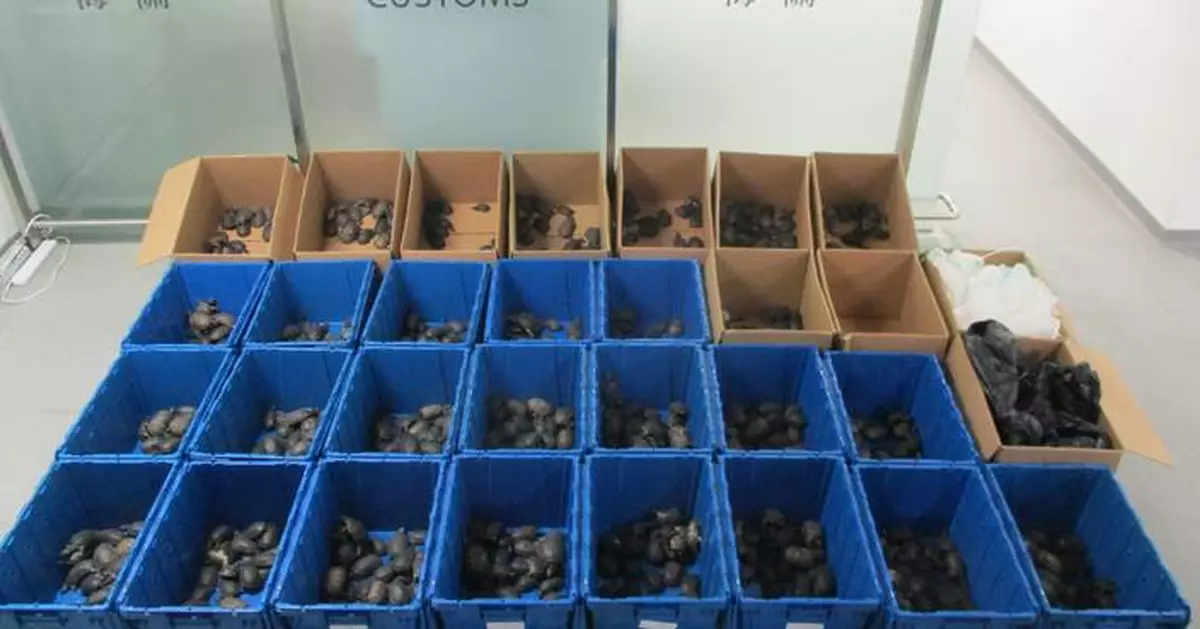
Hong Kong Customs yesterday (March 17) detected a suspected live turtle smuggling case involving an outgoing private car at the Hong Kong-Zhuhai-Macao Bridge Hong Kong Port and seized 986 live turtles, with a total estimated market value of about $1 million.
Based on risk assessment, Customs yesterday intercepted an outgoing private car at the aforementioned control point. Upon inspection, the batch of suspected smuggled live turtles was found in seven black plastic bags placed in the trunk of the vehicle.
A 42-year-old male driver and a 50-year-old male passenger were arrested. They were charged by Customs with one count of attempting to export unmanifested cargo and were charged by the Agriculture, Fisheries and Conservation Department with one count of cruelty to animals. The case will be brought up at the West Kowloon Magistrates' Courts tomorrow (March 19).
Customs will continue to combat cross-boundary smuggling activities with firm enforcement action based on risk assessment and intelligence analysis.
Smuggling is a serious offence. Under the Import and Export Ordinance, any person found guilty of importing or exporting unmanifested cargo is liable to a maximum fine of $2 million and imprisonment for seven years.
Also, according to the Prevention of Cruelty to Animals Ordinance (Cap. 169), any person who, by wantonly or unreasonably doing or omitting to do any act, causes any unnecessary suffering to any animal commits an offence and will be liable to a maximum fine of $200,000 and imprisonment for three years upon conviction.
Members of the public may report any suspected smuggling activities to Customs' 24-hour hotline 182 8080 or its dedicated crime-reporting email account (crimereport@customs.gov.hk) or online form (eform.cefs.gov.hk/form/ced002).
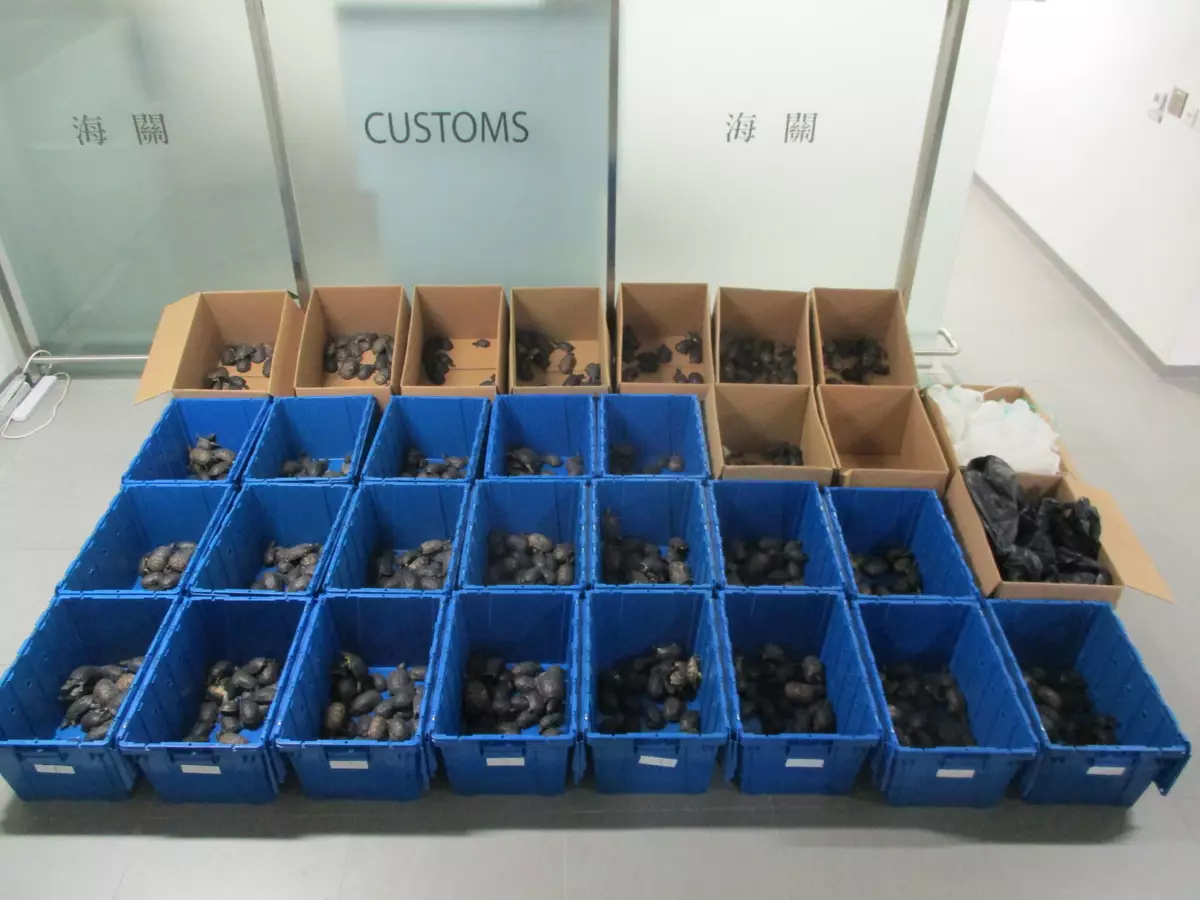
Hong Kong Customs seizes suspected smuggled live turtles worth about $1 million Source: HKSAR Government Press Releases
FEHD releases third batch of gravidtrap indexes for Aedes albopictus in March
The Food and Environmental Hygiene Department (FEHD) today (March 18) released the third batch of gravidtrap indexes and density indexes for Aedes albopictus in March, covering 19 survey areas, as follows:
District |
Survey Area |
March 2026 |
First Phase Gravidtrap Index |
First Phase Density Index |
Central and Western |
Sheung Wan and Sai Ying Pun |
3.7% |
1.0 |
Southern |
Pok Fu Lam |
0.0% |
N/A |
Tai Po |
Tai Po East |
0.0% |
N/A |
Kwai Tsing |
Kwai Chung West |
0.0% |
N/A |
District |
Survey Area |
March 2026 |
Area Gravidtrap Index |
Area Density Index |
Eastern |
Chai Wan |
0.8% |
1.0 |
North Point and Quarry Bay |
0.0% |
N/A |
Shau Kei Wan and Sai Wan Ho |
0.0% |
N/A |
Kwun Tong |
Kwun Tong Central |
0.0% |
N/A |
Mong Kok |
Mong Kok and Tai Kok Tsui |
0.0% |
N/A |
Sham Shui Po |
Lai Chi Kok |
0.0% |
N/A |
Wong Tai Sin |
Ngau Chi Wan and San Po Kong |
0.0% |
N/A |
North |
Sheung Shui |
0.0% |
N/A |
Sai Kung |
Tseung Kwan O East |
0.0% |
N/A |
Tseung Kwan O North |
1.1% |
1.0 |
Tseung Kwan O West |
0.0% |
N/A |
Sha Tin |
Ma On Shan |
1.6% |
1.0 |
Tsuen Wan |
Ma Wan and Sham Tseng |
0.9% |
1.0 |
Tsuen Wan Town |
0.0% |
N/A |
Tuen Mun |
Tuen Mun North |
0.0% |
N/A |
Among the third batch of First Phase Gravidtrap Indexes covering four survey areas and Area Gravidtrap Indexes covering 15 survey areas in March, most of the areas recorded 0 per cent, indicating that the distribution of Aedes albopictus mosquitoes was not extensive.
The FEHD has so far released three batches of gravidtrap indexes for Aedes albopictus in March 2026, covering 32 survey areas. Among these 32 survey areas, 24 recorded a decrease or remained unchanged as compared to the Area Gravidtrap Index last month (i.e. February 2026), representing that the areas' mosquito infestation improved or maintained a low level. Eight other areas recorded a slight increase, but the indexes were lower than 10 per cent.
The warm and humid weather of spring is favourable for mosquito breeding. Members of the public should strengthen prevention work against mosquito breeding before the rainy season, and eliminate potential mosquito breeding sites in advance, with a view to avoiding the nuisances caused by rapid mosquito breeding during the rainy season and reducing the risk of transmitting mosquito-borne diseases.
Public participation is crucial to the effective control of mosquito problems. The FEHD appeals to members of the public to continue to work together in strengthening personal mosquito control measures, including:
tidy up their premises and check for any accumulation of water inside their premises;
remove all unnecessary water collections and eliminate the sources;
check household items (those placed in outdoor and open areas in particular), such as refuse containers, vases, air conditioner drip trays, and laundry racks to prevent stagnant water;
change water in flower vases and scrub their inner surfaces thoroughly, and remove water in saucers under potted plants at least once a week;
properly cover all containers that hold water to prevent mosquitoes from accessing the water;
properly dispose of articles that can contain water, such as disposable meal boxes and empty cans; and
scrub drains and surface sewers with alkaline detergent at least once a week to remove any mosquito eggs.
Starting in August 2025, following the completion of the surveillance of individual survey areas, and once the latest gravidtrap index and the density index are available, the FEHD has been disseminating relevant information through press releases, its website and social media. It aims to allow members of the public to quickly grasp the mosquito infestation situation and strengthen mosquito control efforts, thereby reducing the risk of chikungunya fever (CF) transmission.
Following recommendations from the World Health Organization and taking into account the local situation in Hong Kong, the FEHD sets up gravidtraps in districts where mosquito-borne diseases have been recorded in the past, as well as in densely populated places such as housing estates, hospitals and schools to monitor the breeding and distribution of Aedes albopictus mosquitoes, which can transmit CF and dengue fever. At present, the FEHD has set up gravidtraps in 62 survey areas of the community, with a surveillance period of two weeks. During the surveillance period, the FEHD will collect the gravidtraps once a week. After the first week of surveillance, the FEHD will immediately examine the glue boards inside the retrieved gravidtraps for the presence of adult Aedine mosquitoes to compile the Gravidtrap Index (First Phase) and Density Index (First Phase). At the end of the second week of surveillance, the FEHD will instantly check the glue boards for the presence of adult Aedine mosquitoes. Data from the two weeks of surveillance will be combined to obtain the Area Gravidtrap Index and the Area Density Index. The gravidtrap and density indexes for Aedes albopictus in different survey areas, as well as information on mosquito prevention and control measures, are available on the department's webpage (www.fehd.gov.hk/english/pestcontrol/dengue_fever/Dengue_Fever_Gravidtrap_Index_Update.html#).
Source: AI-found images