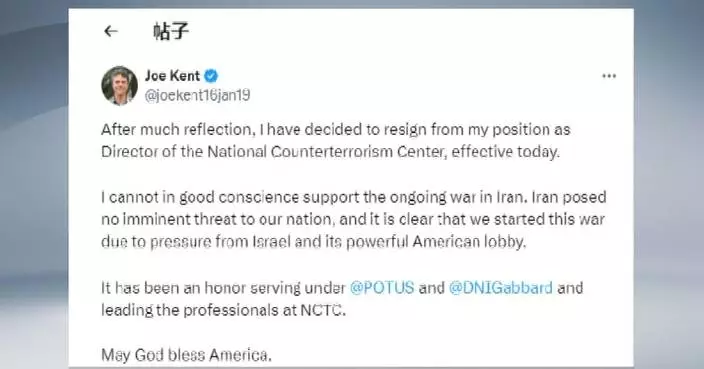
Iranian President Masoud Pezeshkian released a statement on early Wednesday morning following the death of Ali Larijani, secretary of Iran's Supreme National Security Council, vowing to take revenge.
Pezeshkian said that Larijani was fully committed to promoting regional peace and security. His death is an irreparable and huge loss, and the murderer will surely be severely punished.
Seyed Majid Mousavi, chief commander of the Aerospace Division of Iran's Islamic Revolutionary Guard Corps (IRGC), said more intensive attacks will be launched on the enemy.
Iran has appointed three to seven successors to each key position in the country's government and military command, according to Iran's semi-official Fars News Agency.
Spokesperson of the Israel Defense Forces (IDF) Effie Defrin said on Tuesday that the Israeli military will hunt down Iran's new Supreme Leader Mojtaba Khamenei.

Iran's president vows revenge following killing of top security official
The ongoing situation in the Middle East and tensions over the Strait of Hormuz, a vital shipping passage for oil and gas transportation, is likely to not only drive up the price of oil but also impact on a wide range of oil-derived products, a Chinese analyst has warned, adding that the current geopolitical scenario could lead to long-term changes in the global energy landscape.
The Strait of Hormuz, a narrow chokepoint between the Persian Gulf and the Gulf of Oman, is the sole maritime outlet to the open ocean for the oil-producing Gulf States and has become a focal point after Iran threatened to target ships passing through in retaliation for joint U.S.-Israeli strikes.
The strait carries the bulk of crude oil exports from the likes of Saudi Arabia, Iraq, Qatar and the United Arab Emirates (UAE), and is also a crucial artery for liquefied natural gas, not least from Qatar, one of the world's largest suppliers.
During normal times, roughly 20 million barrels of oil pass through the strait each day, about a fifth of global consumption.
Data from Lloyd's List Intelligence showed while there were 1,229 passages between March 1 and 11 last year, there were only 77 vessels transiting during the same period this year, a drop of about 90 percent year on year.
Iranian Foreign Minister Abbas Araghchi told U.S. media that the Strait of Hormuz remains open for international shipping except for vessels belonging to the United States, Israel and their allies, but many ships are avoiding the region altogether due to the high security risks amid the current crisis.
Qu Qiang, a fellow with the Belt and Road Research Center of Minzu University of China, said that the impact could have far-reaching consequences, not just for oil, but for all oil-based products.
"The Hormuz Strait is actually the most critical chokepoint of global energy and also chemistry and raw material supplies -- we're talking about 20 percent of the crude oil and gases actually being shipped through this strait and channel. But now we're looking at basically less than 10 percent of the supply has been maintained and that will very largely boost up the oil prices," he said.
"More than that, we probably have to understand the oil industry is the mother of all the modern chemistry industries, which means every day you're going to use the oil and [its] byproducts to produce fibers, medicines, chemical product and the plastics and all the things that rely on that. So if the chokepoint has been controlled and if that shipment will be curtailed, I think we're going to look at the major rise in everything [in terms of] prices," Qu continued.
To address the oil supply shortage, International Energy Agency (IEA) Executive Director Fatih Birol said on Monday that member states could release additional oil stocks as and if needed.
Last Wednesday, the 32 member countries unanimously agreed to make 400 million barrels of oil from their emergency reserves available to the market in response to disruptions caused by the Middle East conflict.
Qu welcomed the move but expressed doubt about its overall effectiveness as the ensuing uncertainty surrounding the conflict looks set to drag on.
"The supply crunch is going to be there for a very long time. The IEA, yes, has been doing a lot. Basically 400 million barrels is basically one-third of their total reserve for all the IEA members. But yes, a very good gesture, very good move, but barely helped. Because this is only four days of the global consumption and it has already been taken out of one-third of their reserves," said Qu.
Looking ahead, Qu also predicted there could a fundamental shift in the global energy landscape, noting that many nations are turning back towards traditional fossil fuels, and said he expects changes in future "petrodollar" trading practices in the long run.
"I think energy mix is going to be reformed. [The Republic of] Korea is resorting to [carbon-based fuel], it's resorting to the coal again. Japan tried to reactivate its large nuclear power, nuclear power is going to come back. Fossil fuels are going to come back and also the international oil prices are going to come back [down]. Also the whole geopolitical scenario is going to be reformed in the very long-term, like the petroleum-U.S. dollar system will also be further diversified and then [among] many new players, competition is going to pop out," he said.

Hormuz Strait tensions threaten to spike oil, byproduct prices; impact long-term energy landscape: analyst