The president of African soccer’s governing body has defended its integrity and impartiality after Senegal’s government called for an international investigation into “suspected corruption” at the organization after it stripped the country of its Africa Cup of Nations title.
Patrice Motsepe, the president of the Confederation of African Football, sought Wednesday to explain the decision made by its appeals board on Tuesday that ruled Senegal had forfeited the final in January by walking off the field, turning its 1-0 win in extra time into a 3-0 default win for host nation Morocco.
“The CAF disciplinary board took one decision. The CAF appeals board took a totally different position. And I’m told that Senegal is going to appeal, which is very important,” Motsepe said in a video published on the CAF website. “We will adhere and respect the decision that’s taken at the highest level.”
Motsepe said that CAF’s disciplinary and appeals board members are chosen from names proposed by each of its 54 member associations.
“If you look at the composition of those bodies, they reflect some of the most respected lawyers and judges on the continent,” he said. “These are people who have integrity and have a track record. ... the independence is reflected by the decisions that were taken by the two bodies.”
In January, CAF’s disciplinary board imposed fines of more than $1 million against the Senegalese and Moroccan federations together. It issued suspensions against the Senegal coach and several players. But it did not interfere with the outcome of the final.
CAF’s appeals board on Tuesday ruled that Senegal forfeited the Jan. 18 final by leaving the field of play without the referee’s authorization, and that Morocco should consequently be awarded a 3-0 win.
Most of the Senegal team left for almost 10 minutes while Senegal fans battled stewards behind one of the goals in protest against a controversial penalty call for Morocco after Senegal had a goal ruled out. The players returned, Morocco missed the penalty, and Senegal won the match by scoring in extra time.
“What happened in that final match is it undermines the good work that CAF has done over many, many years to ensure that there’s integrity, that there is respect, that there’s ethics, that there’s governance, as well as credibility in the results of our football matches,” said Motsepe, who said the incidents in the final had exposed the work CAF was doing to address suspicion and distrust.
“It’s a legacy issue. When I became president one of the major concerns was the impartiality, the independence, and the respect of referees and match commissioners, and a lot of good, good work has been done,” he said. “That there continues to be suspicions because it’s a legacy issue, it’s something that has been there for many, many years and we consistently deal with that because that’s critically important.”
The Senegalese soccer federation said it will appeal Tuesday’s decision at the Court of Arbitration for Sport in Lausanne, Switzerland, and the Senegalese government slammed what it called a “manifestly erroneous interpretation of the regulations, leading to a grossly illegal and deeply unjust decision.”
Motsepe defended CAF against perceptions of favoritism toward Morocco, which is a 2030 World Cup co-host and has invested heavily to become a soccer superpower.
“Not a single country in Africa will be treated in a manner that is more preferential, or more advantageous, or more favorable than any other country on the African continent,” Morsepe said. “We take what has happened at the final match in Morocco … we take it very, very seriously.”
He said CAF had already taken steps to address deficiencies.
“We have very high standards that we set for ourselves. It is important for us that ordinary football supporters and spectators in every one of the 54 countries in Africa, in their judgment — not in CAF’s judgment, not in my judgment — regard the decisions of our judicial bodies as fair,” Motsepe said.
AP soccer: https://apnews.com/hub/soccer

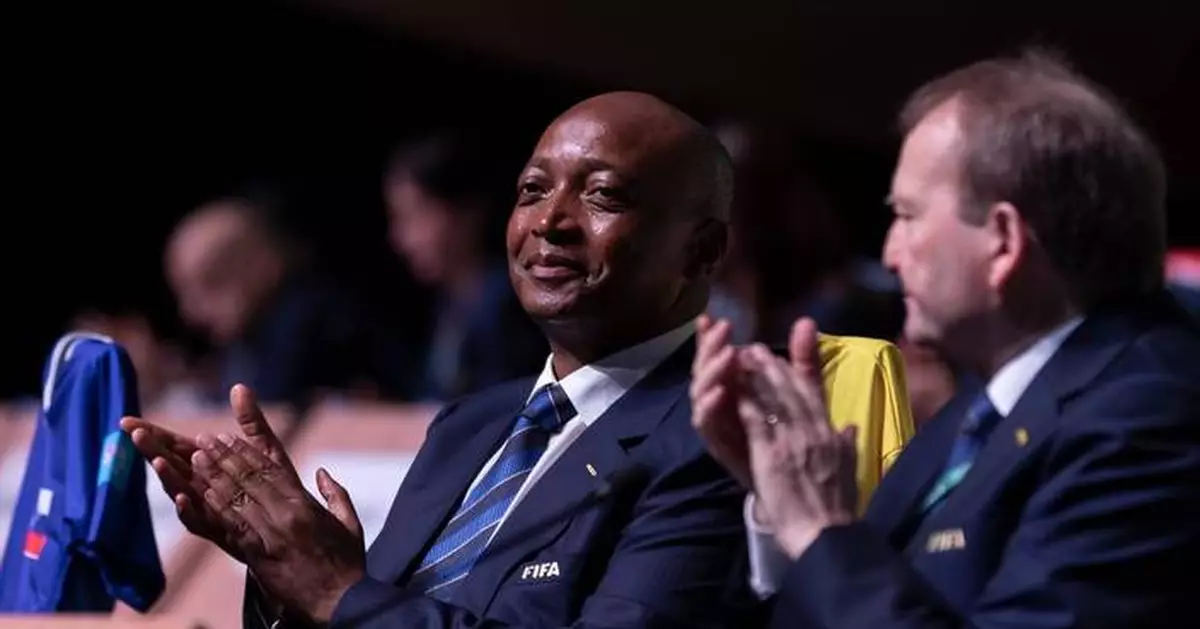
FILE - Confederation of African Football (CAF) President Patrice Motsepe claps during the 73rd FIFA Congress, in Kigali, Rwanda, March 16, 2023. (AP Photo, File)
Labor rights activist Dolores Huerta revealed she was among women and girls who say they were sexually abused by César Chavez, the widely admired Latino icon who brought to light the struggles of farmhands while leading the United Farm Workers union.
The stunning allegations against Chavez, who died more than three decades ago, drew immediate calls to alter memorials honoring the man who in the 1960s helped secure better wages and working conditions for farmworkers and has been long revered by many Democratic leaders in the U.S.
In a statement released Wednesday, Huerta said she stayed silent for 60 years out of concern that her words would hurt the farmworker movement.
Huerta described two sexual encounters with Chavez, one where she was “manipulated and pressured” and another where she was “forced against my will.”
“I carried this secret for as long as I did because building the movement and securing farmworker rights was life’s work. The formation of a union was the only vehicle to accomplish and secure those rights and I wasn’t going to let César or anyone else get in the way,” she said.
Huerta, who is a labor rights legend in her own right, joined Chavez in 1962 to co-found the National Farm Workers Association, which became the United Farm Workers of America.
For many, they were akin to Martin Luther King. Jr. and Rosa Parks because of their work advocating for racial equality and civil rights.
The New York Times first reported Wednesday that it found Chavez groomed and sexually abused young girls who worked in the movement, including Huerta, who was in her 30s at the time.
Huerta later said both sexual encounters with Chavez led to pregnancies, which she kept secret, and that she arranged for the children to be raised by other families. “No one knew the full truth about how they were conceived until just a few weeks ago,” she said in her statement.
Huerta said she did not know that Chavez hurt other women and condemned his actions but emphasized that the farmworker movement is bigger than one person.
“César’s actions do not diminish the permanent improvements achieved for farmworkers with the help of thousands of people,” Huerta said in her statement. “We must continue to engage and support our community, which needs advocacy and activism now more than ever.”
Streets, schools and parks across the Southwest bear Chavez’s name. California became the first state to commemorate his birthday, and in 2014, then-President Barack Obama proclaimed March 31 as national César Chavez Day.
President Joe Biden had a bronze bust of Chavez installed in the Oval Office when he moved into the White House.
But on Wednesday, reaction to the allegations came swiftly from many in both parties.
Republican Texas Gov. Greg Abbott said the state will not observe the César Chavez Day holiday and that he will urge the state legislature to remove it altogether.
Days before the allegations were revealed publicly, several César Chavez celebrations in San Francisco, Texas and in his home state of Arizona were canceled at the request of the César Chavez Foundation. Organizers of canceled events did not immediately respond to the AP’s requests for comment.
California Gov. Gavin Newsom on Wednesday said he was still processing the news. The Democratic governor wouldn’t commit to making any changes to the state holiday.
The farmworker movement “was much bigger than one man,” Newsom said. “It’s about labor. It’s about social justice, economic justice, racial justice.”
A a spokesperson for Arizona Gov. Katie Hobbs said she has declined to recognize March 31 as César Chavez Day as she has in the two prior years. César Chavez Day isn’t a state holiday in Arizona.
Albuquerque Mayor Tim Keller ordered a review of how Chavez is recognized across the city.
“This new information demands we widen our lens,” Keller said, acknowledging that Chavez has meant a great deal to many families. “No one’s historic stature puts them beyond accountability.”
U.S. Sen. Ben Ray Luján, a New Mexico Democrat, said abuse of any kind, especially against children, is a betrayal of the values that Latino leaders have championed for generations.
“His name should be removed from landmarks, institutions and honors,” Luján said of Chavez. “We cannot celebrate someone who carried out such disturbing harm.”
Born in Yuma, Arizona, Chavez grew up in a Mexican American family that traveled around California picking lettuce, grapes, cotton and other seasonal crops. He died in California in 1993 at age 66.
Chavez is known nationally for his early organizing in the fields, a hunger strike, a grape boycott and eventual victory in getting growers to negotiate with farmworkers for better wages and working conditions.
Latino leaders and community groups are now weighing the impact of Chavez's actions on the labor rights movement while emphasizing that the farmworker movement was led by thousands who came together to fight for justice.
Voto Latino leaders said in a statement that no matter his legacy or historical framing Chavez’s actions are inexcusable. Similarly, LULAC released a statement condemning any form of sexual violence stating that “no individual, regardless of statue or legacy is above accountability.”
While the news of these allegations are devastating to the Latino community, Voto Latino said it does not erase the work done by others.
“The women who organized, marched, and sacrificed alongside farmworkers carried this movement on their backs,” Voto Latino said. “Dolores Huerta — a fighter, a giant of the labor movement, and someone who is among the survivors of this abuse — helped build everything this movement stands for.”
U.S. Congresswoman Teresa Leger Fernández, chair of the Democratic Women’s Caucus, issued a statement saying she was heartbroken and deeply disturbed by the stories of women who say they were abused.
Leger Fernández said the farmworker and civil rights movement was built by people who sacrificed for a better future.
“Honoring that legacy means facing painful truths and continuing the work for justice with honesty and humanity,” the New Mexico congresswoman said. “A movement rooted in justice must address all injustice.”
The United Farm Workers union quickly distanced itself from annual celebrations of its founder, calling the allegations troubling.
In a statement Tuesday, the union said allegations of “abuse of young women or minors” were concerning enough to urge people around the country to participate in immigration justice events or acts of service instead of the typical events in March to commemorate Chavez’s legacy.
Associated Press writers Susan Montoya Bryan in Albuquerque, New Mexico; Trân Nguyễn in Sacramento, Calif.; Dorany Pindea in Los Angeles; Felicia Fonseca and Jacques Billeaud in Arizona contributed to this report.
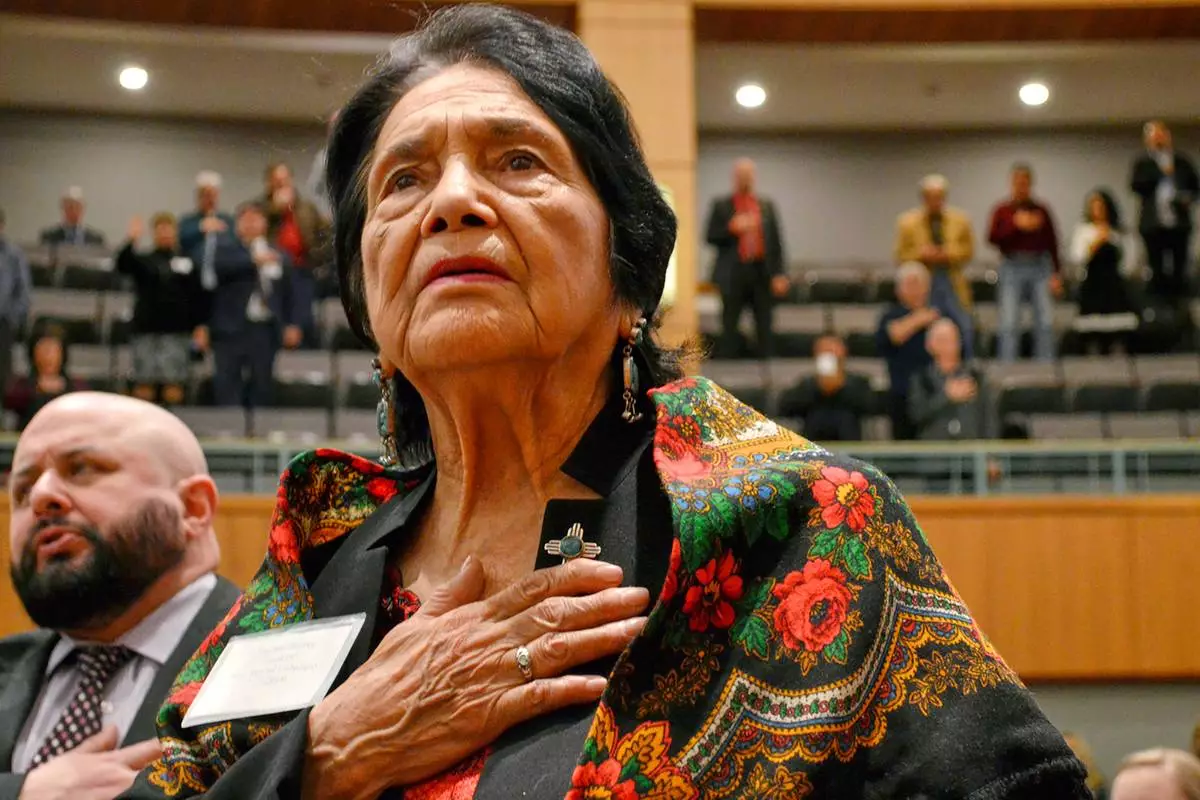
FILE - Dolores Huerta, the Mexican-American social activist who formed a farm workers union with Cesar Chavez, stands for the Pledge of Allegiance in Spanish while visiting the New Mexico Statehouse in Santa Fe. N.M., on Feb. 27, 2019. (AP Photo/Russell Contreras, File)
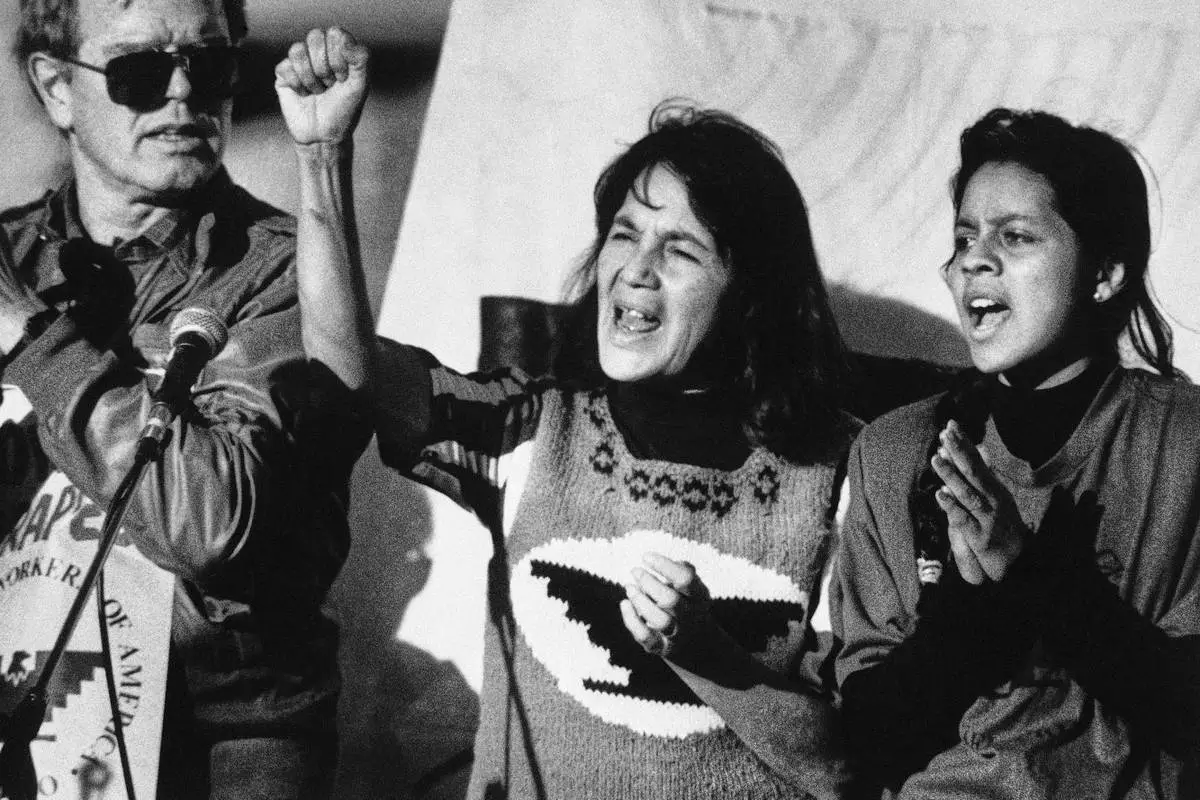
FILE - United Farm Workers leader Dolores Huerta, center, leads a rally in San Francisco's Mission District on Nov. 19, 1988, along with Howard Wallace, president of the San Francisco chapter of the UFW, left, and Maria Elena Chavez, 16, the daughter of Cesar Chavez, right, as part of a national boycott of what the UFW claims is the dangerous use of pesticides on table grapes. (AP Photo/Court Mast, File)
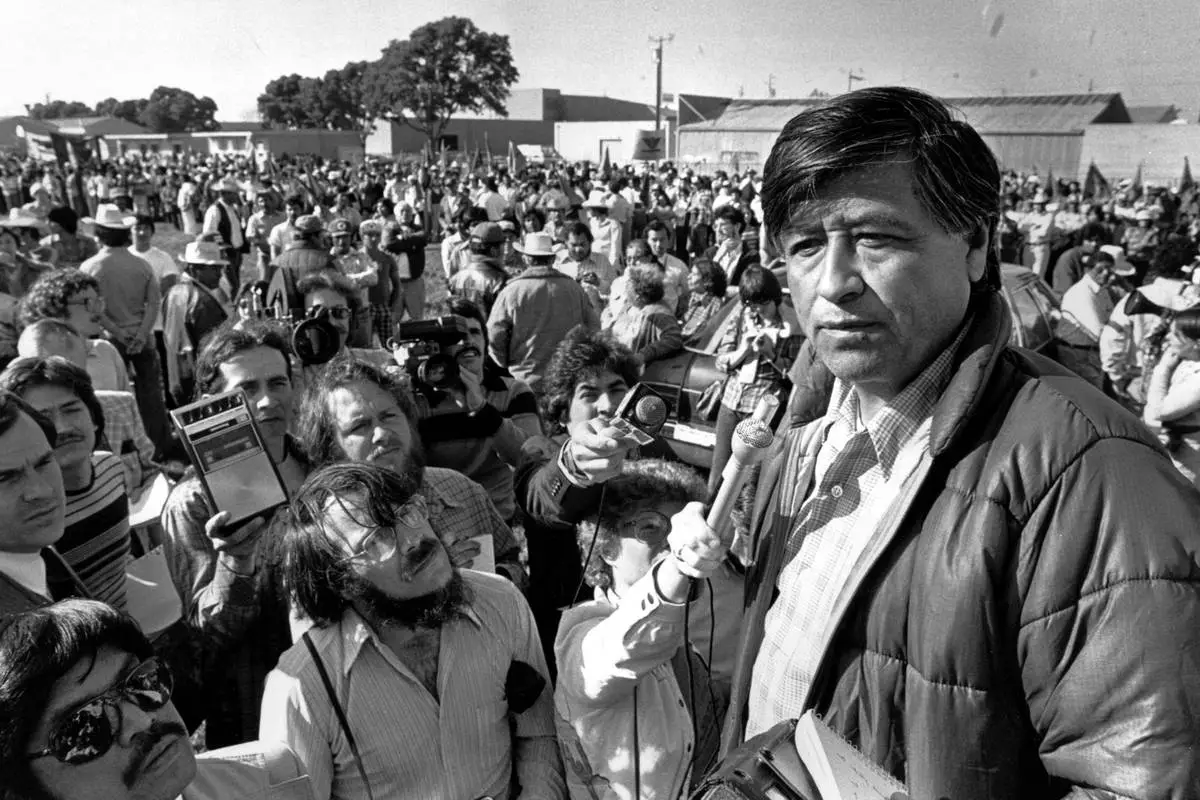
FILE - United Farm Workers President Cesar Chavez talks to striking Salinas Valley farmworkers during a large rally in Salinas, Calif., on March 7, 1979. (AP Photo/Paul Sakuma, File)
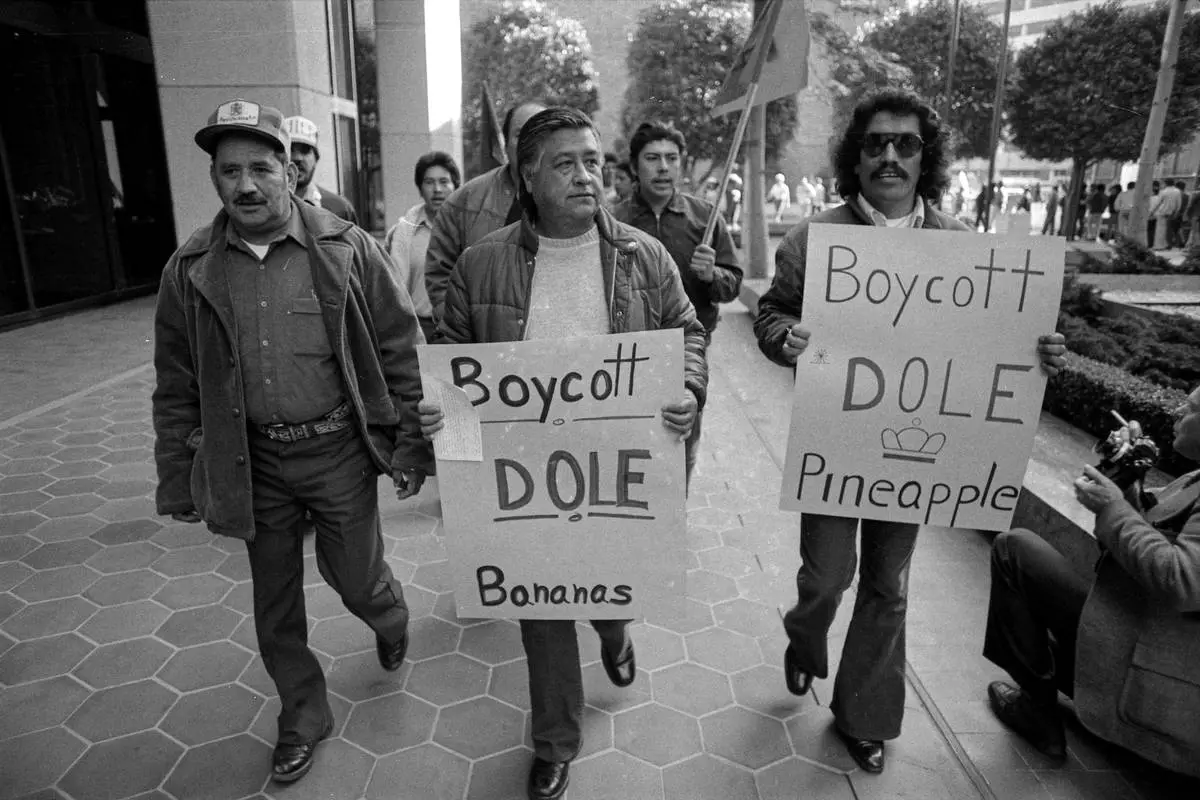
Civil rights leader Cesar Chavez leads a picket against Dole in front of the offices of Castle & Cooke, its parent company, at 50 California St. in San Francisco on Feb. 3, 1982. The United Farm Workers are sponsoring a consumer boycott on Dole products where 300 union members from Ventura, Calif., have been on strike since November. (Steve Ringman/San Francisco Chronicle via AP)
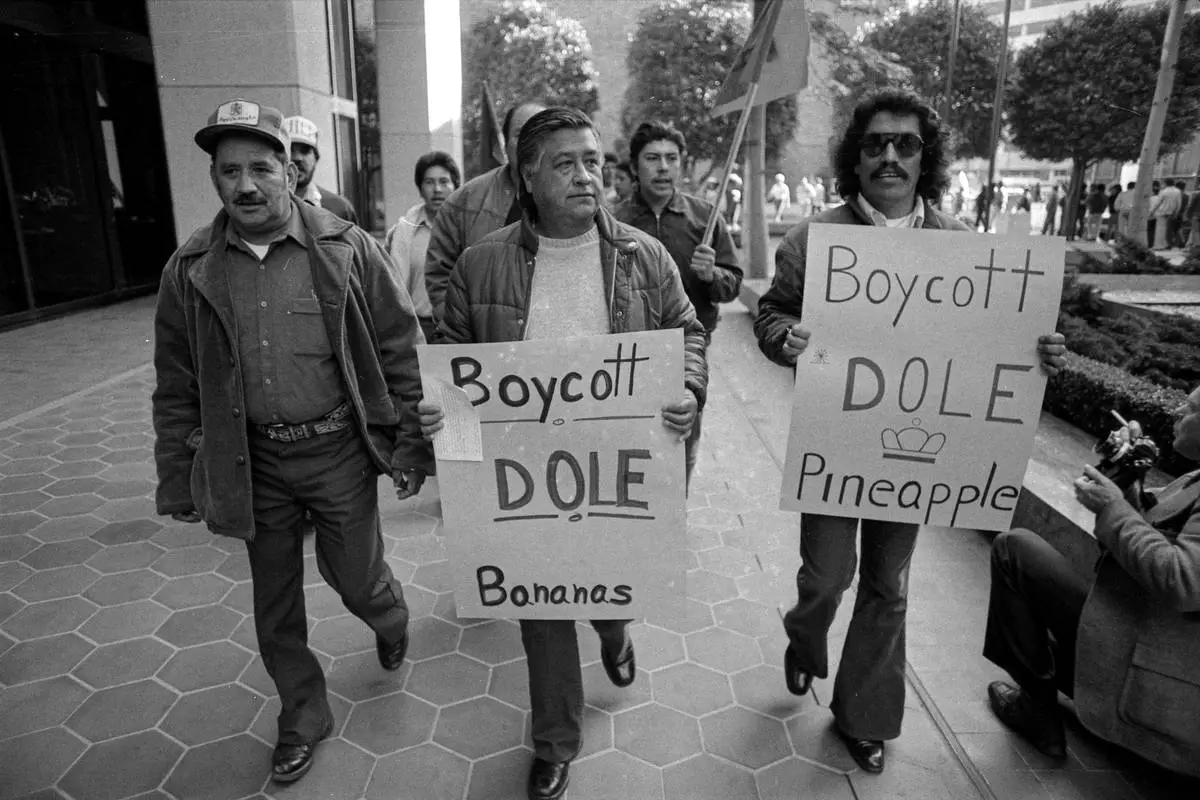
Civil rights leader Cesar Chavez leads a picket against Dole in front of the offices of Castle & Cooke, its parent company, at 50 California St. in San Francisco on Feb. 3, 1982. The United Farm Workers are sponsoring a consumer boycott on Dole products where 300 union members from Ventura, Calif., have been on strike since November. (Steve Ringman/San Francisco Chronicle via AP)
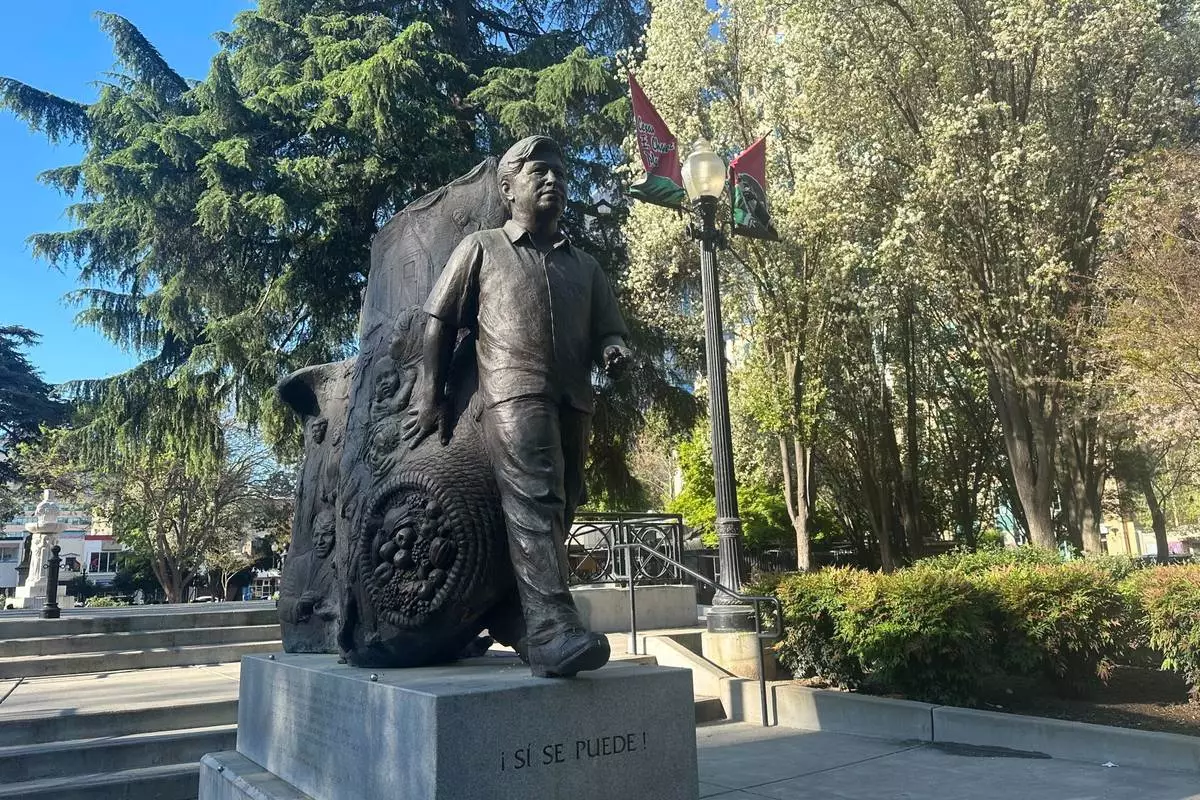
A statue of farmworker union leader César Chávez stands in a plaza named after him in Sacramento, Calif., Wednesday, March 18, 2026. (AP Photo/Tran Nguyen)
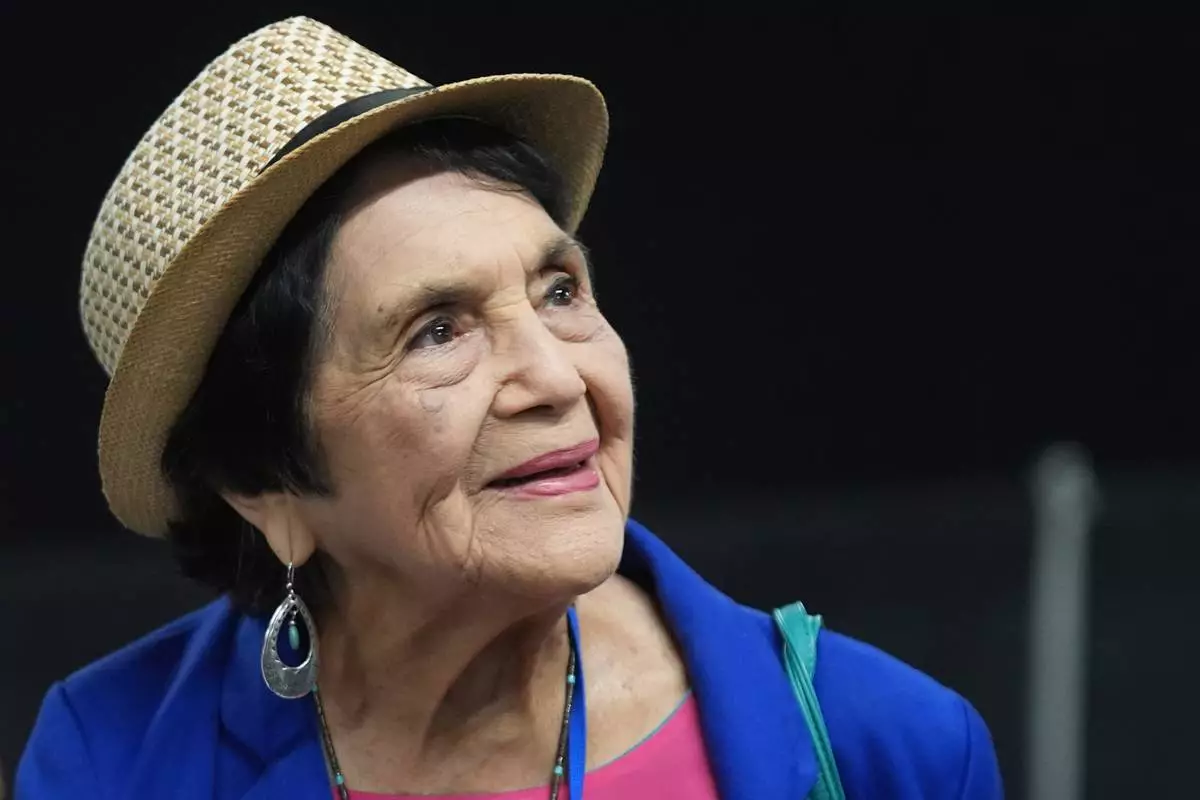
FILE - Dolores Huerta, the labor leader, civil rights activist and co-founder of the National Farm Workers Association, is seen at the California Democratic Party's 2025 State Convention at the Anaheim Convention Center in Anaheim, Calif., May 31, 2025. (AP Photo/Damian Dovarganes, File)
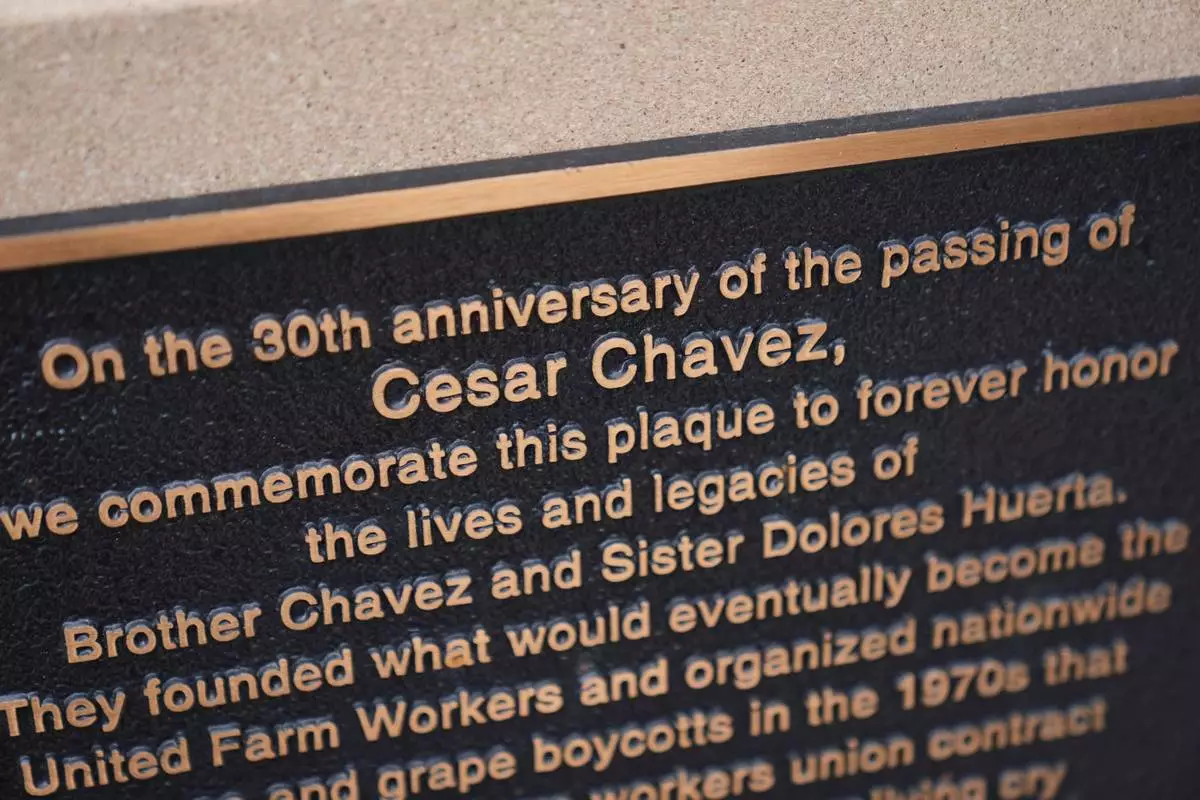
A plaque dedicated to the 30th anniversary of the passing of Cesar Chavez, honoring Chavez and Sister Dolores Huerta, is part of the Haymarket Memorial, seen Wednesday, March 18, 2026, in Chicago. (AP Photo/Erin Hooley)
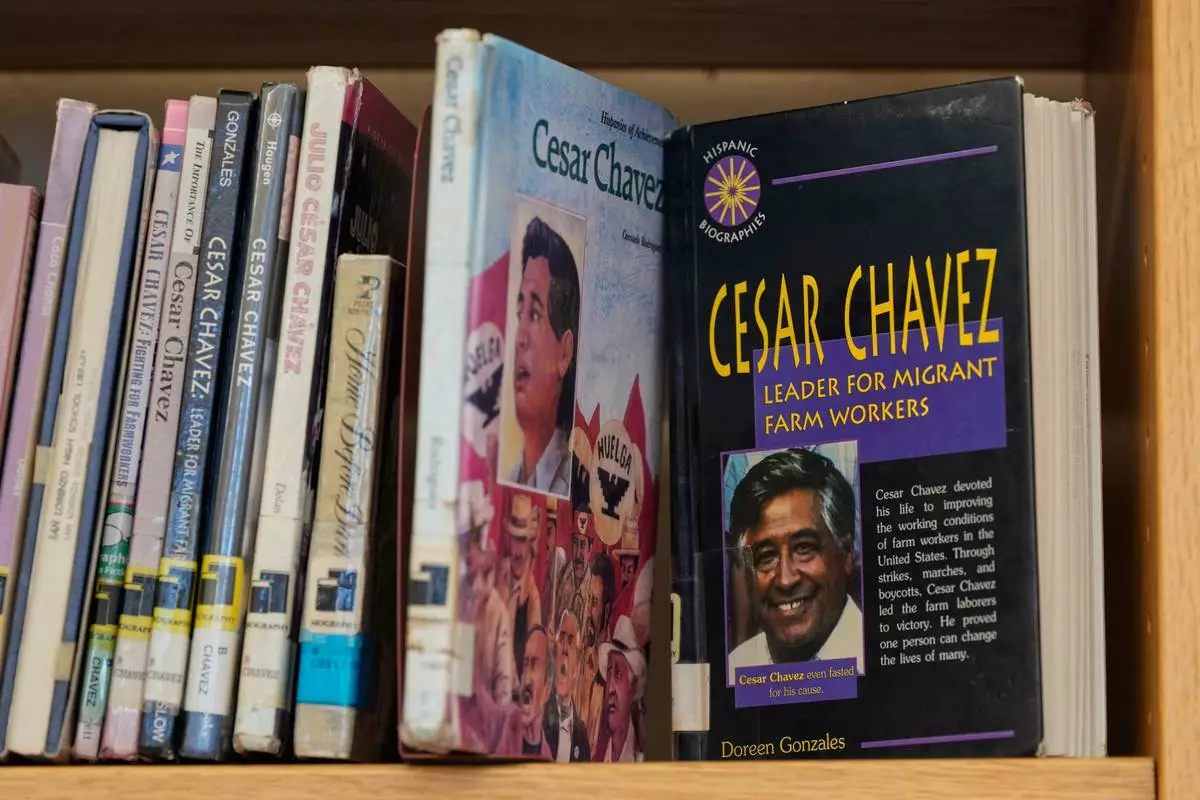
Books about Cesar Chavez are seen on a library shelf at San Lorenzo High School Wednesday, March 18, 2026, in San Lorenzo, Calif. (AP Photo/Godofredo A. Vásquez)
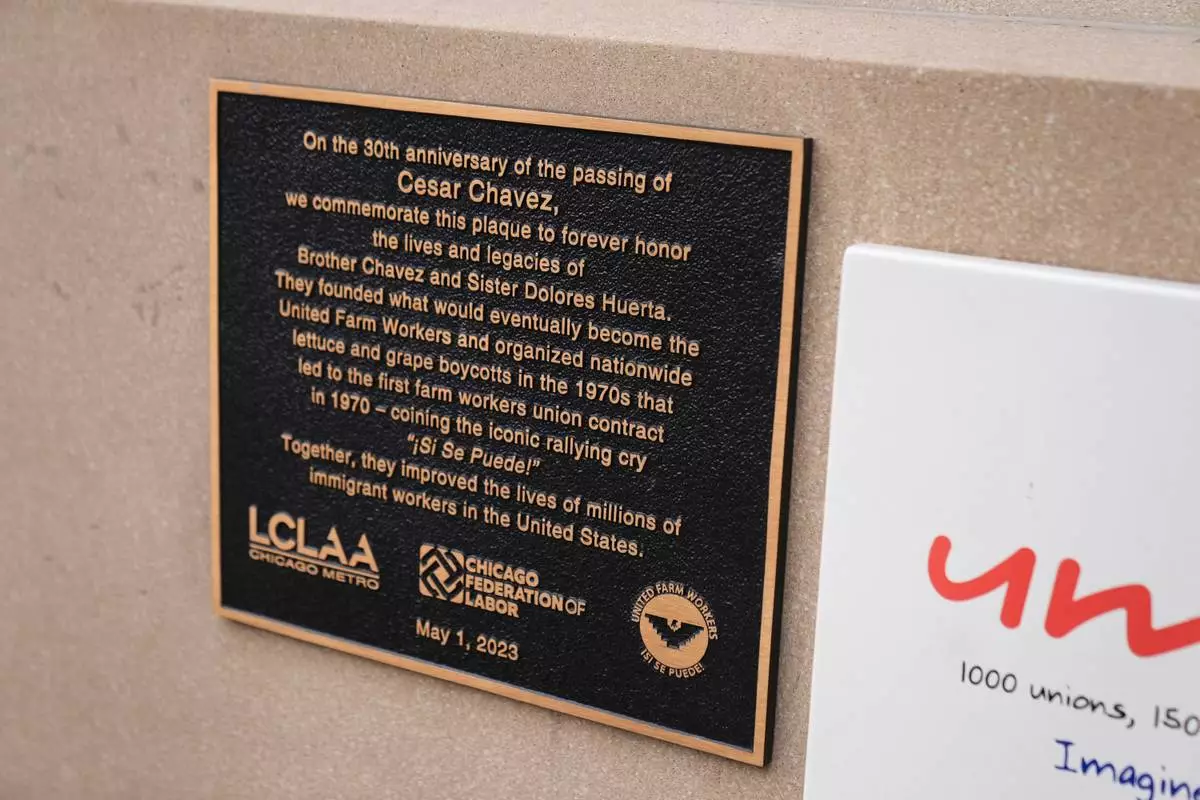
A plaque dedicated to the 30th anniversary of the passing of Cesar Chavez, honoring Chavez and Sister Dolores Huerta, is part of the Haymarket Memorial, seen Wednesday, March 18, 2026, in Chicago. (AP Photo/Erin Hooley)
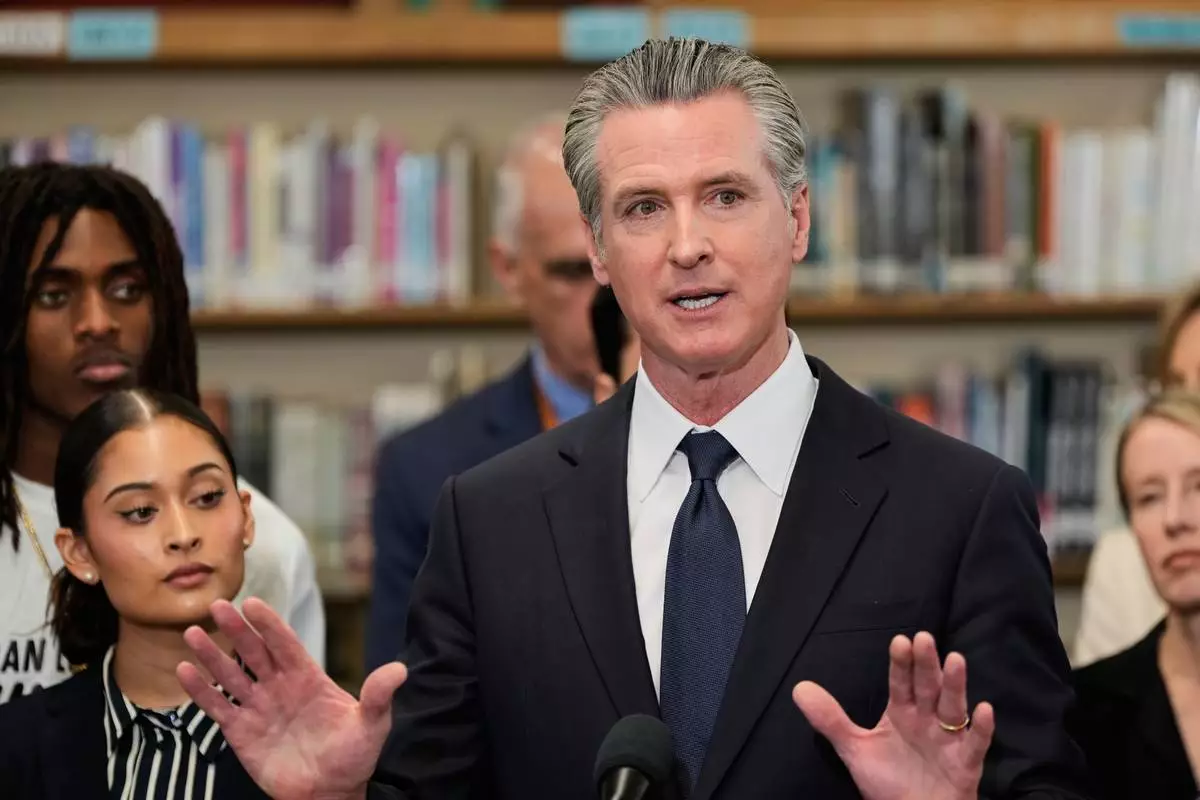
Governor Gavin Newsom speaks about the sexual assault allegations against Cesar Chavez during a press conference at San Lorenzo High School, Wednesday, March 18, 2026, in San Lorenzo, Calif. (AP Photo/Godofredo A. Vásquez)
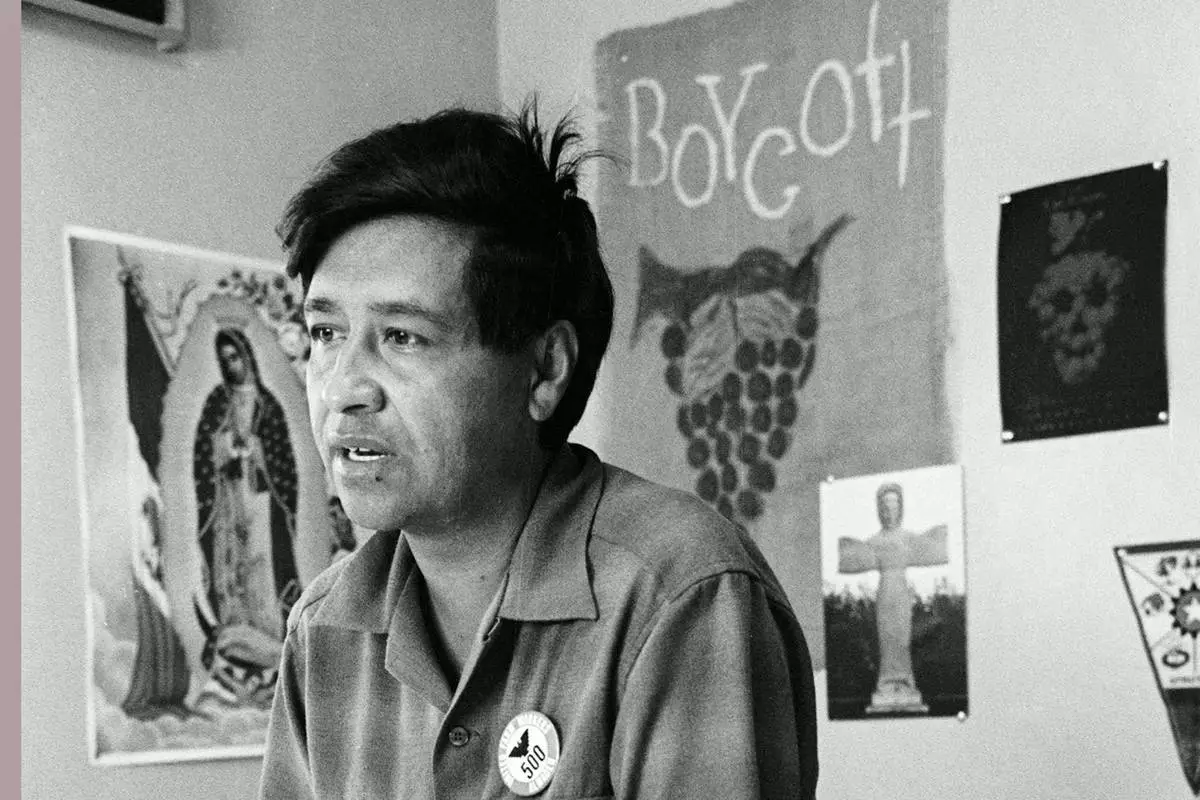
FILE - Cesar Chavez, a farm worker, labor organizer and leader of the California grape strike, is seen in a California works office in 1965. (AP Photo, George Brich, File)