BARCELONA, Spain (AP) — The body of James “Jimmy” Gracey, a college student from Illinois who went missing while in Spain on spring break, was found Thursday in the water off a Barcelona beach, police said.
Gracey's body was found by police divers and positively identified, the press office for Catalonia’s regional police in Barcelona told The Associated Press. The University of Alabama student's body was found near where he was last seen outside a nightclub with his friends early Tuesday. He was visiting friends in Barcelona for spring break.
Catalan police say that their investigation continues into the cause of death.
Gracey, 20, was last seen outside the Shoko nightclub in Barcelona but separated from friends around 3 a.m. on Tuesday. Gracey never returned to the room he was renting with friends, according to family members who live in the suburb of Elmhurst, about 19 miles (31 kilometers) west of Chicago. They realized something was wrong when police contacted them, saying they had recovered his phone.
In a statement released late Thursday, the Gracey family asked for prayers and privacy.
“Our family is heartbroken as we confirm that Jimmy’s body has been recovered in Barcelona. Jimmy was a deeply loved son, grandson, brother, nephew, cousin, and friend, and our family is struggling to come to terms with this unimaginable loss," the statement said.
"We are profoundly grateful for the outpouring of love, support, and prayers from people around the world. ... As we navigate this painful time, we kindly ask for privacy so that we may grieve together and begin to process this loss as a family.”
In an interview conducted before police confirmation of his death, Gracey's aunt told The Associated Press that he was "just a great kid, a good Catholic boy from the Midwest.”
“Very good student, honors program at University of Alabama, chaplain in his fraternity, you know, just an amazing older brother and role model to his cousins,” Beth Marren O'Reilly said.
O'Reilly said her nephew left Alabama on Thursday and spent the weekend in Amsterdam before arriving Monday in Barcelona. Gracey's family did not immediately know how police came into possession of his phone. Gracey's father, Taras, is in Barcelona and has been working with police, O'Reilly said.
Barcelona is a popular tourist destination that brings in millions of foreign visitors each year. It is generally safe, especially compared with major U.S. cities, where tourists’ biggest worry are normally pickpockets.
Barcelona’s beaches, located in walking distance of its center, are a main draw especially for young visitors. The area where Gracey went out is a stretch of beach with several restaurants and nightclubs that are frequented by locals and foreigners.
The University of Alabama said in a statement that the school community “is heartbroken to learn of the death of Jimmy Gracey. Jimmy’s loss is deeply felt across our campus. Our condolences are with the Gracey family during this devastating time.”
Gracey was a member of the Theta Chi fraternity at the school, and the international organization said that in addition to serving as chaplain for the school's chapter, he was a philanthropy chairperson.
O’Connor reported from Springfield, Illinois, and Raza reported from Sioux Falls, South Dakota. Associated Press videojournalist Laura Bargfeld in Chicago and writer Suman Naishadham in Madrid contributed.

Police officers carry the body of a person found in the waters off the Port of Barcelona, Spain, Thursday, March 19, 2026. (AP Photo/Alfonso Beato)

Police officers carry the body of a person found in the waters off the Port of Barcelona, Spain, Thursday, March 19, 2026. (AP Photo/Alfonso Beato)

Police officers rescue the body of a person found in the waters off the Port of Barcelona, Spain, Thursday, March 19, 2026. (AP Photo/Alfonso Beato)
HOUSTON (AP) — Now more than halfway to the moon, the Artemis II astronauts prepared for their historic lunar fly-around to push deeper into space than even the Apollo astronauts.
On the downside, their toilet is on the blink again.
The three Americans and one Canadian are set to reach their destination Monday, photographing the mysterious lunar far side as they zoom around. It is the first moon-bound crew in more than 53 years, picking up where NASA’s Apollo program left off.
“The Earth is quite small, and the moon is definitely getting bigger,” pilot Victor Glover reported.
Until the Orion capsule's bathroom is fixed, Mission Control has instructed the astronauts to break out more of the backup urine collection bags. The so-called lunar loo malfunctioned following Wednesday’s liftoff and has been hit-and-miss ever since. A version of the Artemis II toilet was tested on the International Space Station several years ago.
Engineers suspect ice may be blocking the line that is preventing urine from completely flushing overboard. The toilet is still open for No. 2 business.
Debbie Korth, NASA’s Orion program deputy manager, said the astronauts have also reported a smell coming from the bathroom, which is buried in the floor of the capsule with a door and curtain for privacy.
“Space toilets and bathrooms are something everybody can understand .. it’s always a challenge,” she said, noting that the space shuttle toilet was also often on the fritz.
John Honeycutt, chair of the mission management team, said it is human nature to be interested in the space commode, and even though it is “in a good state right now,” he’d like it to be working at 100%.
“They’re OK,” he said of the astronauts. “They trained to manage through the situation.”
Artemis II is poised to set a distance record for humans, traveling more than 252,000 miles (400,000 kilometers) from Earth before hanging a U-turn behind the moon and heading home without stopping or entering lunar orbit. The record is currently held by Apollo 13.
The Canadian Space Agency celebrated the country’s role in the mission, speaking from Quebec with astronaut Jeremy Hansen as he headed toward his lunar rendezvous. Hansen is the first non-U.S. citizen to fly to the moon.
“Today he is making history for Canada,” Canadian Space Agency President Lisa Campbell said. “As we watch him taking this bold step into the unknown, let his journey remind us that Canada’s future is written by those who dare to reach for more.”
In the live televised linkup, Hansen said he has already witnessed “extraordinary” views from NASA's Orion capsule.
Hansen, Glover, Reid Wiseman and Christina Koch are the world's first lunar astronauts since Apollo 17's crew of three in 1972. Koch and Glover are the first female and first Black astronauts to the moon, respectively.
Their nearly 10-day mission — ending with a Pacific splashdown on April 10 — is the first step in NASA's bold plans for a sustainable moon base. The space agency is aiming for a landing by two astronauts near the lunar south pole in 2028.
The Associated Press Health and Science Department receives support from the Howard Hughes Medical Institute’s Department of Science Education and the Robert Wood Johnson Foundation. The AP is solely responsible for all content.
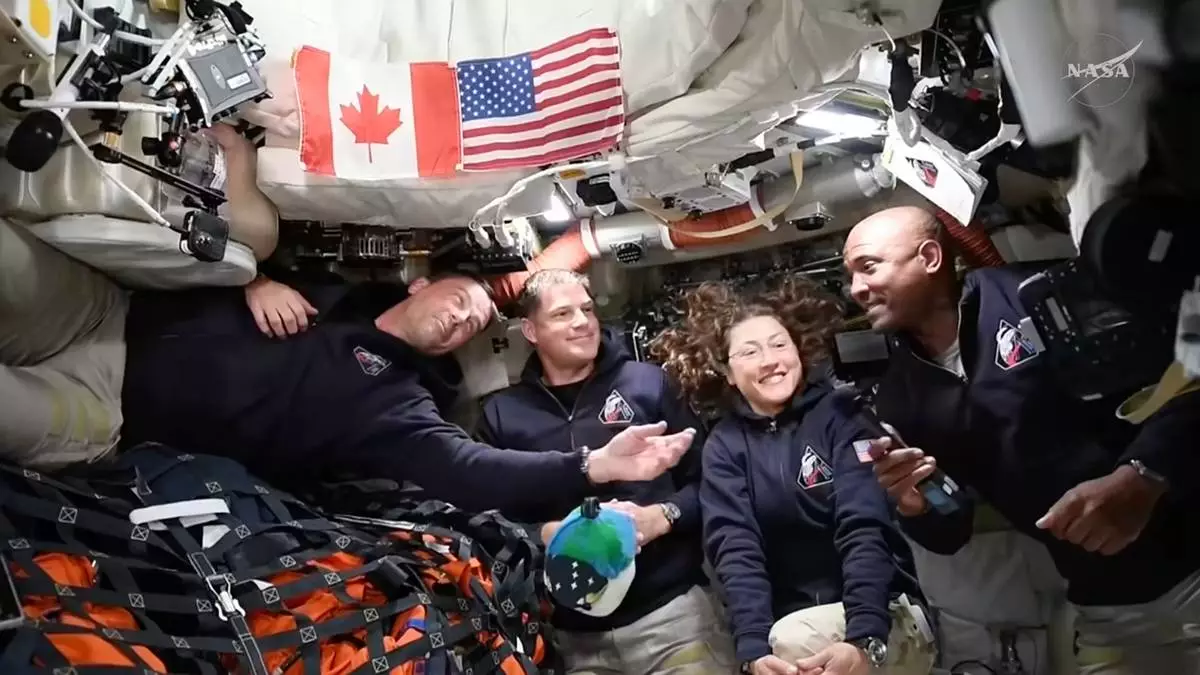
In this image from video provided by NASA, Artemis II astronauts, from left, Reid Wiseman, Jeremy Hansen, Christina Koch and Victor Glover gather for an interview en route to the moon on Saturday, April 4, 2026. (NASA via AP)
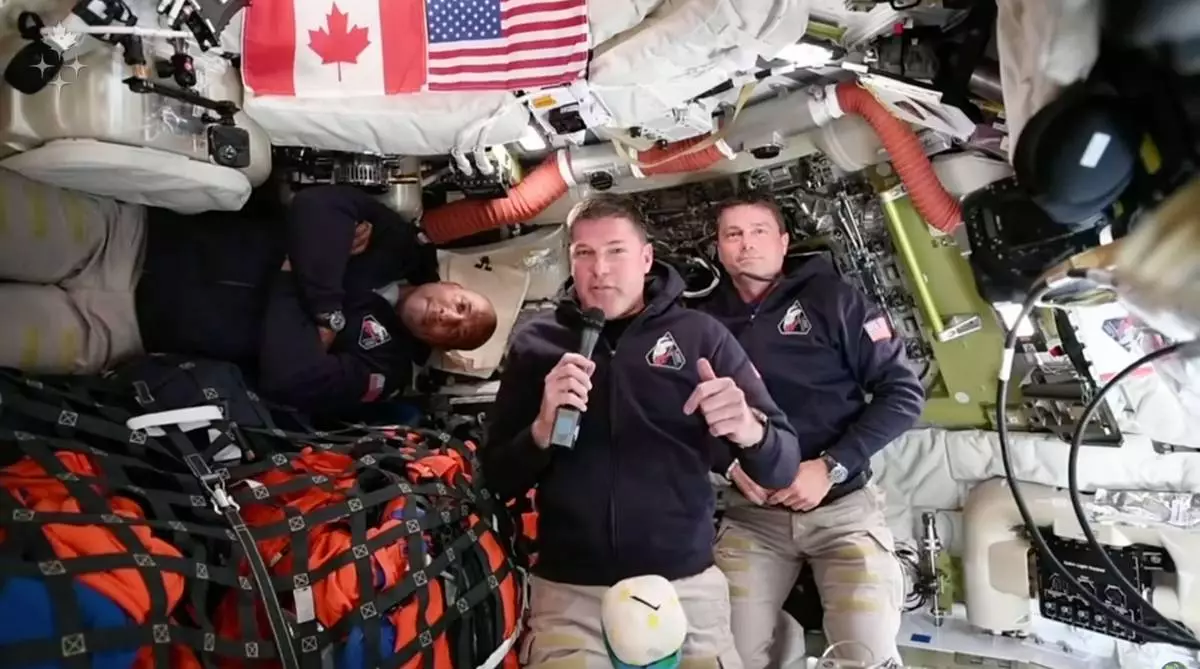
This image provided by the Canadian Space Agency, Artemis II astronaut Jeremy Hansen of Canada, connects live from the Orion spacecraft and speaks with Canadian media along with astronauts Victor Glover, left, and Reid Wiseman on Saturday, April 4, 2026. (Canadian Space Agency via AP)
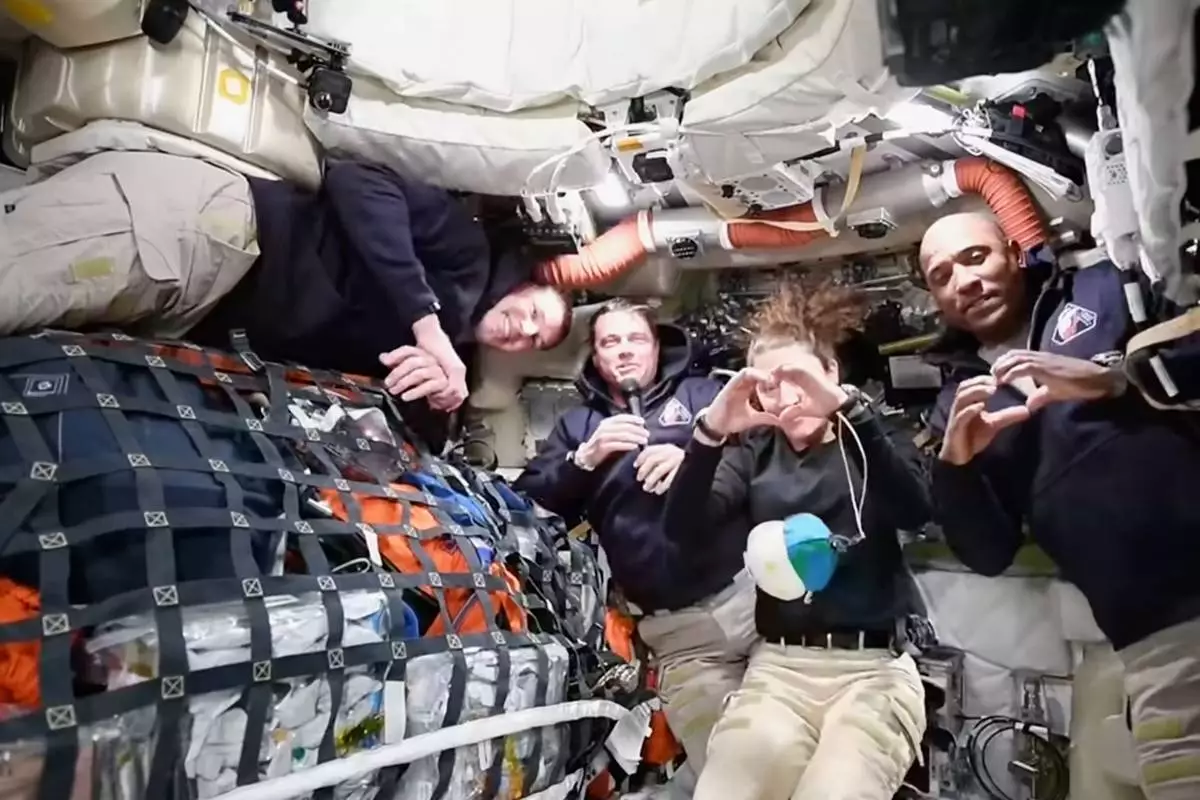
This image from video provided by NASA shows the Artemis II crew Commander Reid Wiseman, second from left, thanking the families of the crew while speaking with NASA Mission Control in a video conference while en route to the moon, Thursday, April 2, 2026, as Canadian astronaut and mission specialist Jeremy Hansen, far left, looks on and mission specialist Christina Koch and pilot Victor Glover, far right, make hearts with their hands. (NASA via AP) CORRECTION: headed to the moon, not in moon's orbit

This image from video provided by NASA shows a view of earth taken by NASA astronaut and Artemis II Commander Reid Wiseman from one of the Orion spacecraft's four windows after completing the translunar injection burn, Thursday, April 2, 2026. (NASA via AP)