Director of Hong Kong Observatory highlights HKO's latest services and annual weather outlook
The Director of the Hong Kong Observatory (HKO), Dr Chan Pak-wai, hosted a press briefing today (March 23) to recap the weather in 2025 and elaborate on the weather outlook for Hong Kong this year as well as the HKO's latest services.
Dr Chan said that, according to the World Meteorological Organization's assessment, 2025 was the second or third warmest year on record globally. Locally, 2025 was the sixth warmest year on record. In particular, October 2025 was exceptionally warm, breaking the records of monthly mean temperature, monthly mean minimum temperature, and number of hot days and hot nights for October. Hong Kong also experienced the warmest winter on record from December 2025 to February 2026, with the winter mean temperature reaching 19.3 degrees, 2.0 degrees above the normal. In addition, there were five Black Rainstorm Warnings, breaking the annual number on record since the rainstorm warning system began operation in 1992. 14 tropical cyclones necessitated the issuance of tropical cyclone warning signals, the highest annual number since 1946.
Looking ahead to 2026, the tropical cyclone season in Hong Kong is expected to start in June or later and cease in October or before this year. There will likely be about 4 to 7 tropical cyclones coming within 500 kilometres of Hong Kong during the year, which is near normal. With the possibility of El Niño development later this year and the continued warming of the climate, the annual mean temperature in Hong Kong is expected to be above normal this year with a high chance of reaching the warmest top 10 on record. The annual rainfall in Hong Kong is expected to be near normal, ranging from 2 100 millimetres to 2 700 millimetres. However, Hong Kong would still be affected by rainstorms and localised heavy rain. Members of the public are reminded to be prepared for the rain and tropical cyclone seasons.
Dr Chan highlighted the continual enhancement of the HKO's various services. In order to keep members of the public informed of the changes in coastal sea levels, the HKO launched a new webpage for Coastal Sea Level (Trial), providing total water level forecasts for the next 12 hours for 14 existing tide stations in Hong Kong. In addition to astronomical tides, the forecast also includes sea level anomalies caused by storm surges associated with tropical cyclones and other meteorological factors, such as monsoons. The Realtime Tides charts on the "MyObservatory" mobile application have also been enhanced with the total water level forecast information, facilitating planning of activities near the shore and allowing for appropriate advance precautionary measures against seawater inundation when the situation warrants.
The coastal sea level forecasts do not include wave effects such as overtopping waves. However, considering wave overtopping as one possible cause of sea flooding in coastal regions, the HKO will include forecast information on overtopping waves in the tropical cyclone warning bulletins to alert members of the public of the direction of the coast that may be affected when significant overtopping waves are expected to affect Hong Kong.
Meanwhile, following the launch of Greater Bay Area weather information on the "MyObservatory" mobile application at the end of 2024, the HKO will introduce progressively a trial version of location-specific weather information for cities in the Republic of Korea and Thailandin the second half of this year to provide current weather and weather forecasts. Users can stay updated on the latest official local weather through the "MyObservatory" app even when they are travelling in these countries to better prepare for their travel plans.
To strengthen information dissemination service to assist the public to cope with the hot and humid weather, the HKO will launch on its website Hong Kong Heat Index data, which reflects the combined effect of temperature, humidity, wind speed and solar radiation of more districts in the second quarter of this year.
On communication with the public, the HKO is committed to sharing a wide range of weather information and scientific knowledge through various social media platforms. In response to the advancements in artificial intelligence, the HKO will gradually utilise AI technology to assist in video production of "Weather Family", such as festival weather outlooks, in order to enrich the content and enhance presentation quality.
To enhance students' interest in meteorological science, the HKO will collaborate with the Hong Kong Meteorological Society to organise the "Young Weather Presenter" competition in the second half of this year, inviting local upper primary students to participate via their schools. Through the competition, students can deepen their understanding of weather, enhance their scientific communication skills, and raise the awareness of climate change. Outstanding participants will have the opportunity to represent Hong Kong in the Guangdong-Hong Kong-Macao "Young Weather Presenter" competition held in Guangdong, where they can learn and exchange ideas with students from the three places.
Dr Chan's speech at the press briefing is available on the HKO's website at:https://www.hko.gov.hk/en/dhkovoice/files/speech20260323e.pdf
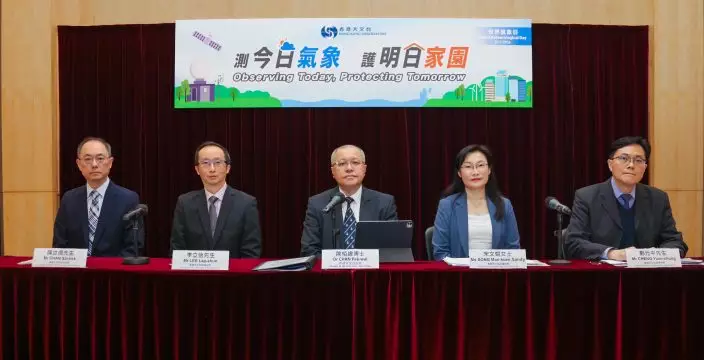
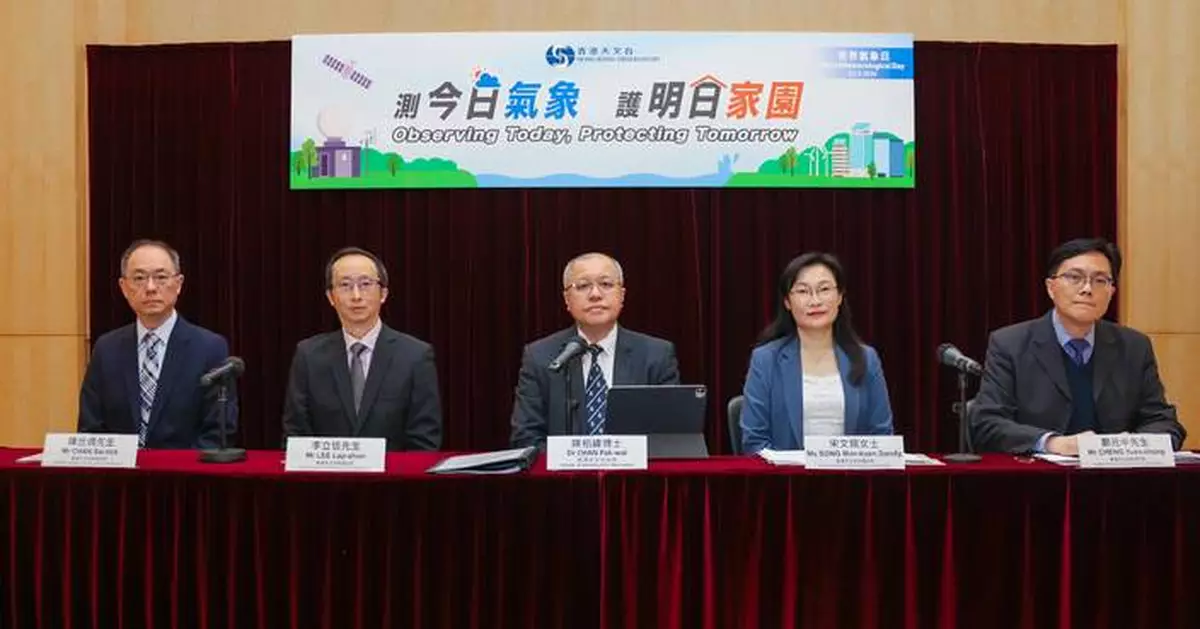
The Director of the Hong Kong Observatory (HKO), Dr Chan Pak-wai (centre), attended the press briefing today (March 23) with the Assistant Director (Radiation Monitoring and Assessment), Mr Lee Lap-shun (second left); the Assistant Director (Development, Research and Administration), Ms Sandy Song (second right); the Assistant Director (Aviation Weather Services), Mr Chan Sai-tick (first left); and the Assistant Director (Forecasting and Warning Services), Mr Cheng Yuen-chung (first right), to report the latest services of the HKO. Source: HKSAR Government Press Releases