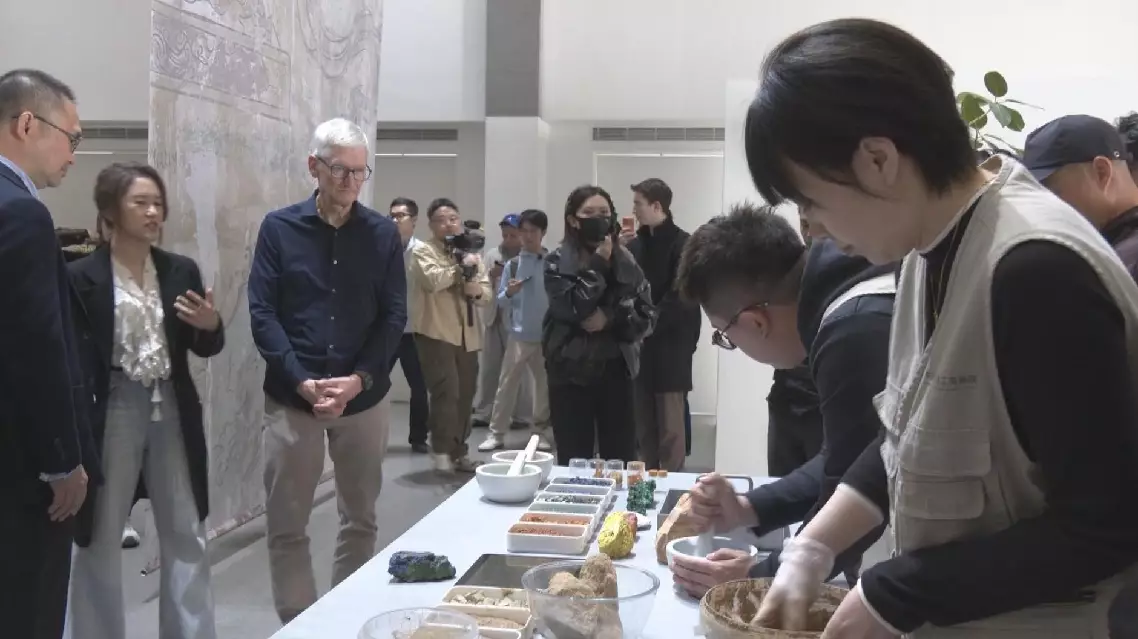
Apple CEO Tim Cook said artificial intelligence (AI) is driving rapid change and should be embraced, not feared, during a visit to an art space in Beijing's Chaoyang District on Saturday.
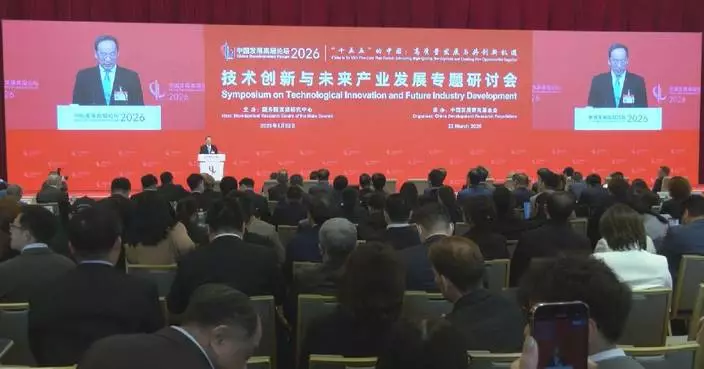
He is in the city for the China Development Forum 2026, which opened Sunday, where global CEOs and business leaders are exploring opportunities for cooperation with China in innovation, services and other growth sectors.
During his tour, Cook witnessed how AI is being applied to cultural preservation, including mural restoration. He said the pace of transformation is especially fast in China.
"We see it as an amplification of the human, not as a replacement of human. So you saw today, some things that were being done that make life much easier in terms of recreation. Some of the cultures that have existed in the history and artifacts, whether it's color correction and some of the things that you saw in post here. All of those things can be driven by AI and so I would advise, don't fear it, embrace it," said Cook.
Cook also met China's Commerce Minister Wang Wentao on Friday before attending the forum sessions on Sunday and Monday. His Beijing trip followed a visit to Chengdu, capital of Sichuan Province, earlier last week, underscoring Apple's continued engagement with China's market and cultural sector.
Apple CEO Cook highlights AI's impact, urges embrace during Beijing trip
China has turned green technologies once confined to textbooks into everyday life, said Milla, a Kazakhstan student in Beijing, as she shared her experiences and perspectives on the country’s green development and the application of new energy in daily life.
Milla described how China's push for sustainability is visible not only in national policy but also in her everyday campus life at Tsinghua University. Navigating the historic grounds, the economics student relies on a bicycle to get between classes, a choice she finds both convenient and environmentally friendly.
She added that the university actively promotes sustainability through initiatives such as recycling systems and water-conservation reminders, noting that shared bicycles have become a practical feature of campus life.
"I really love seeing how Tsinghua University is trying to become greener. There are many small initiatives that encourage students to live more sustainably, such as recycling systems, reminding not to waste water, and shared bicycles all across campus," she said.
Milla's observation extend far beyond the university gates. She noticed the rapid proliferation of electric vehicles, identifiable by their distinctive green license plates. What has left Milla an even deeper impression is the emergence of hydrogen-powered vehicles, a technology she first encountered not on the street, but in a high school textbook.
"Another thing that amazed me even more was seeing hydrogen-powered buses. I was actually so surprised when I first saw one. Hydrogen energy is something I became interested in back in 10th grade, when I first saw it in a textbook. Hydrogen can be used as a clean fuel. When hydrogen is used to produce energy, the main byproduct is water instead of harmful emissions, which makes it one of the most clean energy sources scientists are developing today. Seeing how hydrogen-powered vehicles are working in real life made me realize that technologies we once only read about in textbooks are slowly becoming a part of everyday life," said Milla.
Milla said that witnessing these technologies in action has reinforced a broader understanding of solving environmental problems.
"For me, learning about these technologies is incredibly exciting. It shows that solving environmental problems is not only about reducing emissions but it's also about innovating and thinking about new ways, how to make energy. Studying economics while still being interested in environmental protection allows me to see how technology, policy and economic systems can work together to build a cleaner and a more sustainable future," she said.
Her remarks are also being vividly manifested at the upcoming Boao Forum for Asia Annual Conference 2026 prepares to be held in Hainan from March 24 to 27, when green and smart operations will be a key feature. All venues will be powered by 100 percent renewable electricity throughout the conference, with total power consumption expected to reach about two million kilowatt-hours, equivalent to reducing carbon dioxide emissions by around 1,200 tonnes. Meanwhile, a number of AI-powered systems will be deployed for the first time.
Thousands of representatives from government, business and academia will gather under the theme "Shaping a Shared Future: New Dynamics, New Opportunities, and New Cooperation." The conference will spotlight pressing topics and build consensus on cooperation through nearly 50 sub-forums, roundtables and dialogues.

Kazakh student commends China's green tech shift from textbooks to everyday life