|
Peer-reviewed economic analysis finds a combined ESR + CRP testing strategy reduces misdiagnoses and delivers net cost savings compared to CRP alone
SMITHFIELD, R.I., March 24, 2026 /PRNewswire/ --
The $9.95 Million Question: Is ESR Worth Keeping?
A new ALCOR Scientific sponsored peer-reviewed study published in ClinicoEconomics and Outcomes Research makes a powerful economic case for retaining erythrocyte sedimentation rate (ESR) testing alongside C-reactive protein (CRP) for managing patients with inflammatory conditions — directly challenging calls to eliminate ESR in the name of cost savings.
The study found that combining ESR with CRP reduces misdiagnoses and generates substantial net cost savings compared to ordering CRP alone.
For a representative 739-bed academic medical center in the United States, the analysis projects net annual savings of $9.95 million from reduced follow-up costs associated with misdiagnoses — driven primarily by avoided unnecessary workup from false positives associated with CRP.
ESR and CRP Are Not the Same Test
Critics of combined testing have argued that ESR and CRP are redundant. This study challenges that assumption head-on.
"The kinetics of CRP and ESR are fundamentally different," the authors note. CRP rises rapidly within hours of acute inflammation and normalizes within days. ESR, by contrast, increases more slowly over 24–48 hours and remains elevated longer — making it especially valuable for detecting chronic and subacute inflammatory conditions like polymyalgia rheumatica, giant cell arteritis, lupus, and certain malignancies.
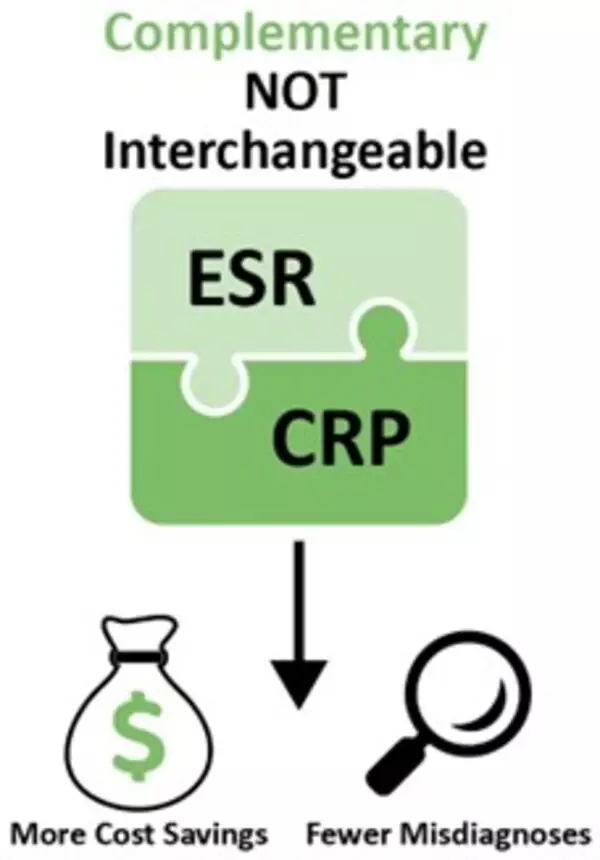
These biological differences mean the two tests provide complementary, not redundant, clinical information. Using both — when interpreted correctly — improves diagnostic accuracy in ways that a single test cannot replicate.
Why This Research Matters
The findings arrive at a pivotal moment in value-based care. The former "Choosing Wisely" initiative pressured hospitals to cut "redundant" laboratory testing, with ESR frequently cited as a target. This initiative began when ESR was still a manual test – not fully automated like it is today – and when there was minimal evidence on the financial impact to health systems.
Automated ESR is reimbursed in the US at just $2.70 per test – less than a cup of coffee – and fully automated testing no longer burdens the clinical laboratory with hands-on time. The incremental investment is minimal when tested alongside CRP. The return — in the form of avoided misdiagnoses and their downstream follow-up costs — is orders of magnitude greater. Lab testing costs are typically well below the reimbursement rate, further strengthening the cost effectiveness of ESR.
"Modern ESR analyzers are fast, automated, and inexpensive," the authors write. "The older argument that ESR is burdensome to laboratory resources no longer holds. The question is whether the diagnostic value justifies the cost — and for the ESR + CRP strategy, the answer is clearly yes."
Study Design and Scope
The study used a decision-tree economic model simulating cohorts of 100 patients, evaluated from the U.S. healthcare system payer perspective. Eight conditions were analyzed: rheumatoid arthritis, inflammatory bowel disease, periprosthetic joint infection, giant cell arteritis, pancreatitis, infection, autoimmune disorders, and cancer.
Sensitivity and specificity data were drawn from published clinical literature. Costs were sourced from Centers for Medicare & Medicaid Services reimbursement rates (ESR: $2.70; CRP: $5.18). Follow-up costs for misdiagnoses were derived from U.S. clinical guidelines and validated by clinicians.
Results were robust across scenario analyses varying test costs, follow-up costs, and diagnostic accuracy inputs.
Takeaway
It turns out cutting ESR to save money has the opposite effect. When ESR and CRP are used together, misdiagnoses fall and follow-up costs fall with them. ESR is fast, automated, and cheap. The argument for dropping it doesn't hold up when the cost to the overall health system is evaluated.
If testing ESR and CRP together - two fully automated, low cost markers of inflammation – helps reduce misdiagnoses, why does the push to reduce ESR testing persist? The real world impact of testing ESR and CRP alongside each other depends on the institution, disease, patient population, disease prevalence, and so on. However, keeping a time-tested, clinically valuable test that costs payers just $2.70 in order to help prevent unnecessary follow up testing just makes sense.
About the Study
Citation: Yarnoff B, Morris W, Zivaripiran H, McCutcheon M, Koshy T. "Economic Evaluation of Combined Testing Strategies Using Erythrocyte Sedimentation Rate and C-Reactive Protein Tests." ClinicoEconomics and Outcomes Research. 2026;18:578961. DOI: 10.2147/CEOR.S578961
Funding: This study was sponsored by ALCOR Scientific LLC.
Media Contact
Lexa Sullivan, ALCOR Scientific
Email: lsullivan@alcorscientific.com
Full study available open-access at https://doi.org/10.2147/CEOR.S578961
Peer-reviewed economic analysis finds a combined ESR + CRP testing strategy reduces misdiagnoses and delivers net cost savings compared to CRP alone
SMITHFIELD, R.I., March 24, 2026 /PRNewswire/ --
The $9.95 Million Question: Is ESR Worth Keeping?
A new ALCOR Scientific sponsored peer-reviewed study published in ClinicoEconomics and Outcomes Research makes a powerful economic case for retaining erythrocyte sedimentation rate (ESR) testing alongside C-reactive protein (CRP) for managing patients with inflammatory conditions — directly challenging calls to eliminate ESR in the name of cost savings.
The study found that combining ESR with CRP reduces misdiagnoses and generates substantial net cost savings compared to ordering CRP alone.
For a representative 739-bed academic medical center in the United States, the analysis projects net annual savings of $9.95 million from reduced follow-up costs associated with misdiagnoses — driven primarily by avoided unnecessary workup from false positives associated with CRP.
ESR and CRP Are Not the Same Test
Critics of combined testing have argued that ESR and CRP are redundant. This study challenges that assumption head-on.
"The kinetics of CRP and ESR are fundamentally different," the authors note. CRP rises rapidly within hours of acute inflammation and normalizes within days. ESR, by contrast, increases more slowly over 24–48 hours and remains elevated longer — making it especially valuable for detecting chronic and subacute inflammatory conditions like polymyalgia rheumatica, giant cell arteritis, lupus, and certain malignancies.
These biological differences mean the two tests provide complementary, not redundant, clinical information. Using both — when interpreted correctly — improves diagnostic accuracy in ways that a single test cannot replicate.
Why This Research Matters
The findings arrive at a pivotal moment in value-based care. The former "Choosing Wisely" initiative pressured hospitals to cut "redundant" laboratory testing, with ESR frequently cited as a target. This initiative began when ESR was still a manual test – not fully automated like it is today – and when there was minimal evidence on the financial impact to health systems.
Automated ESR is reimbursed in the US at just $2.70 per test – less than a cup of coffee – and fully automated testing no longer burdens the clinical laboratory with hands-on time. The incremental investment is minimal when tested alongside CRP. The return — in the form of avoided misdiagnoses and their downstream follow-up costs — is orders of magnitude greater. Lab testing costs are typically well below the reimbursement rate, further strengthening the cost effectiveness of ESR.
"Modern ESR analyzers are fast, automated, and inexpensive," the authors write. "The older argument that ESR is burdensome to laboratory resources no longer holds. The question is whether the diagnostic value justifies the cost — and for the ESR + CRP strategy, the answer is clearly yes."
Study Design and Scope
The study used a decision-tree economic model simulating cohorts of 100 patients, evaluated from the U.S. healthcare system payer perspective. Eight conditions were analyzed: rheumatoid arthritis, inflammatory bowel disease, periprosthetic joint infection, giant cell arteritis, pancreatitis, infection, autoimmune disorders, and cancer.
Sensitivity and specificity data were drawn from published clinical literature. Costs were sourced from Centers for Medicare & Medicaid Services reimbursement rates (ESR: $2.70; CRP: $5.18). Follow-up costs for misdiagnoses were derived from U.S. clinical guidelines and validated by clinicians.
Results were robust across scenario analyses varying test costs, follow-up costs, and diagnostic accuracy inputs.
Takeaway
It turns out cutting ESR to save money has the opposite effect. When ESR and CRP are used together, misdiagnoses fall and follow-up costs fall with them. ESR is fast, automated, and cheap. The argument for dropping it doesn't hold up when the cost to the overall health system is evaluated.
If testing ESR and CRP together - two fully automated, low cost markers of inflammation – helps reduce misdiagnoses, why does the push to reduce ESR testing persist? The real world impact of testing ESR and CRP alongside each other depends on the institution, disease, patient population, disease prevalence, and so on. However, keeping a time-tested, clinically valuable test that costs payers just $2.70 in order to help prevent unnecessary follow up testing just makes sense.
About the Study
Citation: Yarnoff B, Morris W, Zivaripiran H, McCutcheon M, Koshy T. "Economic Evaluation of Combined Testing Strategies Using Erythrocyte Sedimentation Rate and C-Reactive Protein Tests." ClinicoEconomics and Outcomes Research. 2026;18:578961. DOI: 10.2147/CEOR.S578961
Funding: This study was sponsored by ALCOR Scientific LLC.
Media Contact
Lexa Sullivan, ALCOR Scientific
Email: lsullivan@alcorscientific.com
Full study available open-access at https://doi.org/10.2147/CEOR.S578961
** This press release is distributed by PR Newswire through automated distribution system, for which the client assumes full responsibility. **
Ordering Both ESR and CRP Lab Tests Could Save Hospitals Millions Per Year -- New Study Challenges Notion the Tests are Interchangeable
|
ATLANTA, March 24, 2026 /PRNewswire/ -- A home is the foundation on which we build our lives. It leads to better health, education and well-being, more economic growth and less poverty. Yet every day, 1 in 3 people around the world wake up without the security of a safe, affordable home.
jwplayer.key="3Fznr2BGJZtpwZmA+81lm048ks6+0NjLXyDdsO2YkfE="
In 2026, Habitat marks 50 years of building with families and communities, making sure everyone has a safe, affordable place to call home. Through its Let’s Open the Door global campaign, Habitat will bring awareness about the need to create better access to affordable and sustainable housing and how we can work together to open more doors. jwplayer('myplayer1').setup({file: 'https://mma.prnasia.com/media2/2939192/26_LOTD_Main_16x9_FINAL.mp4', image: 'https://mma.prnasia.com/media2/2939192/26_LOTD_Main_16x9_FINAL.mp4?p=thumbnail', autostart:'false', stretching : 'uniform', width: '512', height: '288'});
The housing crisis is one of the most urgent global challenges. Knowing the importance a home has on families and its impact on communities, today with our partners, Habitat for Humanity is launching its Let's Open the Door global campaign to bring awareness of the worldwide housing crisis and to rally people everywhere to take action.
This year, Habitat marks 50 years of bringing people together to build prosperous and healthy communities. Drawing upon this milestone, Habitat's Let's Open the Door campaign, supported by State Farm, Whirlpool, Lowe's, and Wells Fargo will address the global housing need and bring this urgency forward through pop-up installations, on-the-ground builds, and digital storytelling across more than 60 countries.
"Housing has been the core of Habitat's work for 50 years. As a leader in global housing, Habitat understands the keys that will unlock our vision of a world where everyone has a decent place to live," said Jonathan Reckford, chief executive officer of Habitat for Humanity International. "With the support of our partners, the Let's Open the Door campaign will create awareness of the need to increase better access to affordable and sustainable housing, and everyone can play a part. Whether by lending your voice, your time, or your talents, you can help advance housing access, affordability and sustainable solutions, and help open the doors to homeownership for more families around the world."
On April 1, Habitat will launch the first major U.S. activation of the Let's Open the Door campaign. Home is the Key, Habitat's annual fundraising and awareness initiative, inspires partners, advocates, and communities to advance innovative housing solutions across the U.S. Sponsored by Lowe's, Blizzard Entertainment, and Colgate-Palmolive, the monthlong initiative will ignite a movement to open doors to equitable homeownership and stronger, more resilient communities. During April, five local Habitat affiliates – Greater Indy Habitat for Humanity, Habitat for Humanity Greater Orlando & Osceola County, Habitat for Humanity New York City and Westchester County, Habitat for Humanity Seattle-King & Kittitas Counties, and Habitat for Humanity of Washington, D.C. & Northern Virginia – will host events including panel discussions with distinguished housing experts and home dedications to demonstrate the power of collective action and continued commitment to creating housing solutions in the U.S.
"We have been avid supporters of Habitat for more than two decades, both on and off the build site. In that time, we have seen firsthand the transformative power a home can have on a family," said Habitat Humanitarians Drew and Jonathan Scott. "But we also know that it takes more than building to solve the global housing crisis. We are honored to support and participate in Habitat's Home is the Key initiative once again to bring awareness of this growing need, and we stand ready to work alongside everyone to ensure more families have a safe place to call home."
This spring, Habitat is also launching an experiential tour across 10 global cities to call attention to housing and celebrate the organization's decades-long impact. Habitat will seek to spark curiosity and conversations by "popping up" open doors in select markets, each featuring powerful impact and family stories, symbolizing the opportunity an open door brings in the community. Cities include New York, N.Y.; Washington D.C.; Orlando, Fla.; Mexico City, Mexico; Atlanta, Ga.; London, U.K.; Houston, Texas; Los Angeles, Calif.; Oakland, Calif.; and Chicago, Ill. Each door will point visitors to our campaign presence and a digital door experience on habitat.org.
Since 1976, Habitat for Humanity has helped more than 65 million people around the world build, improve or finance places to call home. As we cross the threshold into our next 50 years, Habitat is focused on building a world where everyone has a safe, affordable place to call home. Everyone should have the opportunity to envision their future on their own terms, and it all starts with an open door. Give, volunteer, speak up, get involved. Because a better future starts with home. To learn more about the Let's Open the Door campaign and how to get involved, visit www.habitat.org/open-door.
About Habitat for Humanity
Habitat for Humanity is a movement of people in your local area and around the world, working together to build more prosperous and vibrant communities by making sure everyone has a safe, affordable place to call home. Since our founding in 1976 as a Christian organization, together we have helped more than 65 million people globally build their futures on their own terms through access to decent housing. We've done that by working alongside people of all walks of life to build, repair and finance their homes, by innovating new ways of building and financing, and by advocating for policies that make constructing and accessing housing easier for everyone. Together, we build homes, communities and hope. To learn more, visit habitat.org.
Video - https://mma.prnasia.com/media2/2939192/26_LOTD_Main_16x9_FINAL.mp4
ATLANTA, March 24, 2026 /PRNewswire/ -- A home is the foundation on which we build our lives. It leads to better health, education and well-being, more economic growth and less poverty. Yet every day, 1 in 3 people around the world wake up without the security of a safe, affordable home.
In 2026, Habitat marks 50 years of building with families and communities, making sure everyone has a safe, affordable place to call home. Through its Let’s Open the Door global campaign, Habitat will bring awareness about the need to create better access to affordable and sustainable housing and how we can work together to open more doors. jwplayer('myplayer1').setup({file: 'https://mma.prnasia.com/media2/2939192/26_LOTD_Main_16x9_FINAL.mp4', image: 'https://mma.prnasia.com/media2/2939192/26_LOTD_Main_16x9_FINAL.mp4?p=thumbnail', autostart:'false', stretching : 'uniform', width: '512', height: '288'});
The housing crisis is one of the most urgent global challenges. Knowing the importance a home has on families and its impact on communities, today with our partners, Habitat for Humanity is launching its Let's Open the Door global campaign to bring awareness of the worldwide housing crisis and to rally people everywhere to take action.
This year, Habitat marks 50 years of bringing people together to build prosperous and healthy communities. Drawing upon this milestone, Habitat's Let's Open the Door campaign, supported by State Farm, Whirlpool, Lowe's, and Wells Fargo will address the global housing need and bring this urgency forward through pop-up installations, on-the-ground builds, and digital storytelling across more than 60 countries.
"Housing has been the core of Habitat's work for 50 years. As a leader in global housing, Habitat understands the keys that will unlock our vision of a world where everyone has a decent place to live," said Jonathan Reckford, chief executive officer of Habitat for Humanity International. "With the support of our partners, the Let's Open the Door campaign will create awareness of the need to increase better access to affordable and sustainable housing, and everyone can play a part. Whether by lending your voice, your time, or your talents, you can help advance housing access, affordability and sustainable solutions, and help open the doors to homeownership for more families around the world."
On April 1, Habitat will launch the first major U.S. activation of the Let's Open the Door campaign. Home is the Key, Habitat's annual fundraising and awareness initiative, inspires partners, advocates, and communities to advance innovative housing solutions across the U.S. Sponsored by Lowe's, Blizzard Entertainment, and Colgate-Palmolive, the monthlong initiative will ignite a movement to open doors to equitable homeownership and stronger, more resilient communities. During April, five local Habitat affiliates – Greater Indy Habitat for Humanity, Habitat for Humanity Greater Orlando & Osceola County, Habitat for Humanity New York City and Westchester County, Habitat for Humanity Seattle-King & Kittitas Counties, and Habitat for Humanity of Washington, D.C. & Northern Virginia – will host events including panel discussions with distinguished housing experts and home dedications to demonstrate the power of collective action and continued commitment to creating housing solutions in the U.S.
"We have been avid supporters of Habitat for more than two decades, both on and off the build site. In that time, we have seen firsthand the transformative power a home can have on a family," said Habitat Humanitarians Drew and Jonathan Scott. "But we also know that it takes more than building to solve the global housing crisis. We are honored to support and participate in Habitat's Home is the Key initiative once again to bring awareness of this growing need, and we stand ready to work alongside everyone to ensure more families have a safe place to call home."
This spring, Habitat is also launching an experiential tour across 10 global cities to call attention to housing and celebrate the organization's decades-long impact. Habitat will seek to spark curiosity and conversations by "popping up" open doors in select markets, each featuring powerful impact and family stories, symbolizing the opportunity an open door brings in the community. Cities include New York, N.Y.; Washington D.C.; Orlando, Fla.; Mexico City, Mexico; Atlanta, Ga.; London, U.K.; Houston, Texas; Los Angeles, Calif.; Oakland, Calif.; and Chicago, Ill. Each door will point visitors to our campaign presence and a digital door experience on habitat.org.
Since 1976, Habitat for Humanity has helped more than 65 million people around the world build, improve or finance places to call home. As we cross the threshold into our next 50 years, Habitat is focused on building a world where everyone has a safe, affordable place to call home. Everyone should have the opportunity to envision their future on their own terms, and it all starts with an open door. Give, volunteer, speak up, get involved. Because a better future starts with home. To learn more about the Let's Open the Door campaign and how to get involved, visit www.habitat.org/open-door.
About Habitat for Humanity
Habitat for Humanity is a movement of people in your local area and around the world, working together to build more prosperous and vibrant communities by making sure everyone has a safe, affordable place to call home. Since our founding in 1976 as a Christian organization, together we have helped more than 65 million people globally build their futures on their own terms through access to decent housing. We've done that by working alongside people of all walks of life to build, repair and finance their homes, by innovating new ways of building and financing, and by advocating for policies that make constructing and accessing housing easier for everyone. Together, we build homes, communities and hope. To learn more, visit habitat.org.
Video - https://mma.prnasia.com/media2/2939192/26_LOTD_Main_16x9_FINAL.mp4
** This press release is distributed by PR Newswire through automated distribution system, for which the client assumes full responsibility. **

Habitat for Humanity launches Let's Open the Door campaign to drive awareness of global housing need