Skip to Content Facebook Feature Image

China’s drone swarm system shows precision strike capabilities

China

China

China

China’s drone swarm system shows precision strike capabilities

2026-03-25 19:03 Last Updated At:23:37

China on Wednesday unveiled footage showing the first full-process demonstration of its domestically developed, advanced Atlas drone swarm operations system.

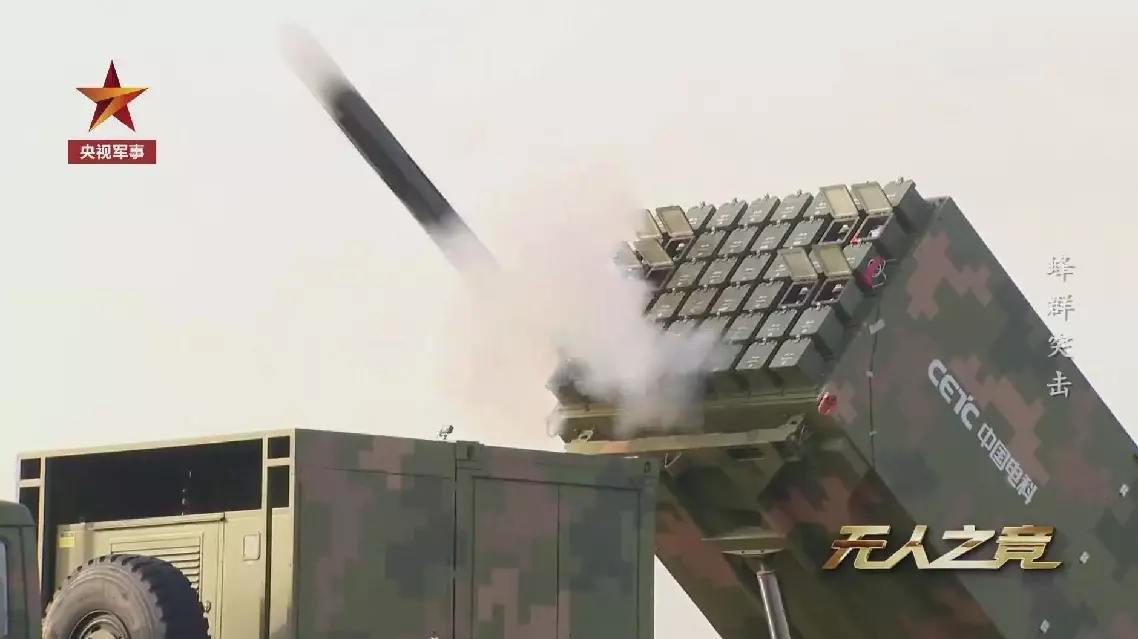
The system, consisting of the Swarm-2 ground combat vehicle, the command vehicle, and the support vehicle, not only demonstrated expanding battlefield applications for drone swarms but also China's rapid advancement in algorithm-driven technologies, which are increasingly reshaping modern warfare.

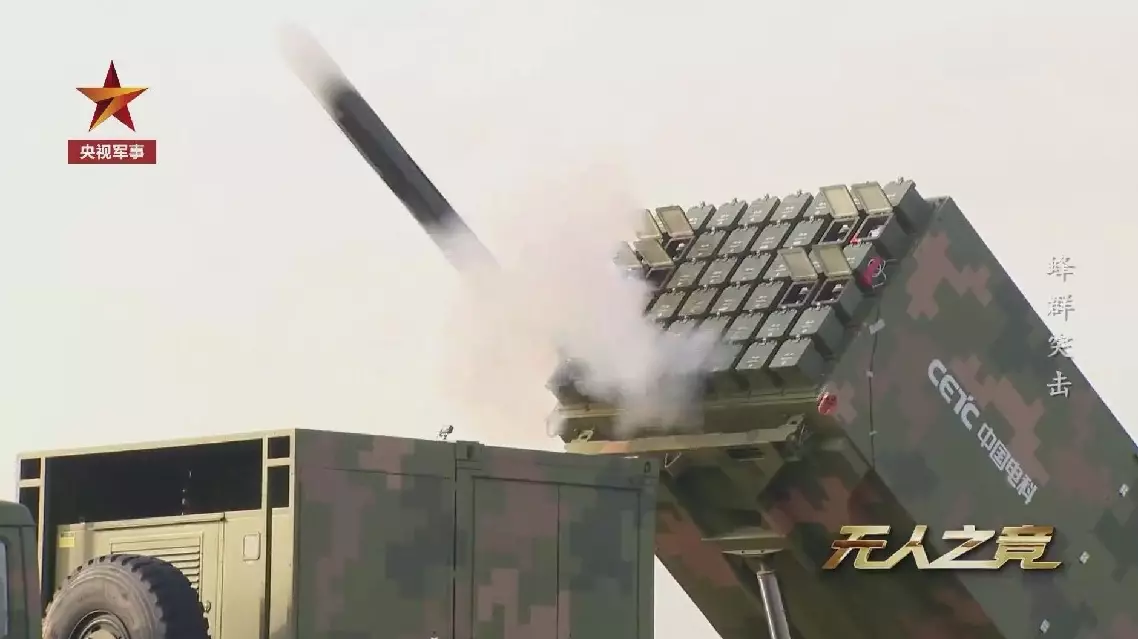
In the footage, three visually similar targets were set up in the strike zone at a test range. The Atlas system rapidly carried out coordinated reconnaissance, autonomously identified the command vehicle among the targets, opened the launcher, and launched a swarm of drones. The drones quickly locked onto the target mid-air and struck it with precision.

The Swarm-2 vehicle, bearing the logo of the China Electronics Technology Group Corp, employed a mechanism with 3-second launch intervals, releasing one drone every three seconds to ensure safe spacing and flight paths for each unit.

A single Swarm-2 ground combat vehicle can carry and launch 48 fixed-wing drones, each capable of carrying a variety of payloads, including electro-optical reconnaissance and strike munitions, and can be flexibly combined into different operational groupings, forming multifunctional swarms capable of complex missions.

In addition, the type and sequence of drone launches can be flexibly configured based on the operational needs. Reconnaissance drones can be deployed first for intelligence gathering, while electronic warfare drones can precede attack drones to suppress adversaries, allowing tailored responses to different combat scenarios.

Powered by swarm intelligence, nearly 100 high-speed drones can form dense and precise formations within a short time during mission execution. They are also capable of autonomously adjusting to environmental factors, such as airflow disturbances, to avoid mid-air collisions.

The system's swarm-control algorithms effectively equip each drone with a "smart brain", enabling communication, information sharing, and real-time positional adjustments to maintain coordinated formations.

Such a large-scale aerial operation can be managed by a single operator controlling up to 96 drones.

The system also features drones of varying sizes, enabling layered, complementary capabilities within the swarm.

The Swarm-2 ground combat vehicle made its debut at the 15th China International Aviation and Aerospace Exhibition, also known as Airshow China, held in Zhuhai City, south China's Guangdong Province, in November 2024.
China’s drone swarm system shows precision strike capabilities
China’s drone swarm system shows precision strike capabilities

China’s drone swarm system shows precision strike capabilities
China’s drone swarm system shows precision strike capabilities

The 79th World Health Assembly (WHA), the highest decision-making body of the World Health Organization (WHO), on Monday decided not to include in its agenda a so-called proposal on Taiwan's participation in the annual assembly as an observer.

This marks the 10th consecutive year that the WHA has rejected such a Taiwan-related proposal.

Addressing the assembly, Jia Guide, China's permanent representative and ambassador to the United Nations Office at Geneva and other international organizations in Switzerland, reiterated that there is but one China in the world, Taiwan is an inalienable part of China's territory, and the Government of the People's Republic of China is the sole legal government representing the whole of China.

Jia said that the issue regarding the Taiwan region's participation in the WHA must be handled in accordance with the one-China principle as affirmed by the UN General Assembly Resolution 2758 and the WHA Resolution 25.1.

Jia said that due to the stubborn adherence to the persistent separatist stance of Taiwan's Democratic Progressive Party (DPP) authorities, the political foundation for the Taiwan region to participate in the WHA no longer exists.

Prior to the opening of this year's WHA, the overwhelming majority of countries in the international community have reiterated to China their firm support for the one-China principle and their opposition to Taiwan's participation in the WHA, Jia noted.

Jia emphasized that the so-called claim of a "gap in the international epidemic prevention system" is sheer nonsense.

China's central government has always attached great importance to the well-being of Taiwan compatriots and has made proper arrangements for the Taiwan region's participation in technical activities of the WHO on the premise of adhering to the one-China principle, he added.

Jia said the Taiwan-related proposal severely violates the basic norms of international relations based on the purposes and principles of the UN Charter.

In order to pursue their own political interests, the separatist forces in the Taiwan region have instigated certain countries to put forward the Taiwan-related proposal to engage in Taiwan secessionist activities at the WHA, Jia said.

Such acts are doomed to gain no support and will inevitably end in failure, he added.

World Health Assembly rejects Taiwan-related proposal for 10th consecutive year

World Health Assembly rejects Taiwan-related proposal for 10th consecutive year

Recommended Articles