Skip to Content Facebook Feature Image

Omdia: Global Cloud Infrastructure Spending Rose 29% in Q4 2025 as Hyperscalers Scaled AI Infrastructure Investment

News

Omdia: Global Cloud Infrastructure Spending Rose 29% in Q4 2025 as Hyperscalers Scaled AI Infrastructure Investment
News

News

Omdia: Global Cloud Infrastructure Spending Rose 29% in Q4 2025 as Hyperscalers Scaled AI Infrastructure Investment

2026-03-26 17:01 Last Updated At:17:20

LONDON--(BUSINESS WIRE)--Mar 26, 2026--

According to Omdia, global spending on cloud infrastructure services reached US$110.9 billion in Q4 2025, reflecting year-on-year growth of 29%. Growth accelerated from the previous quarter, marking the sixth consecutive quarter in which the market expanded by more than 20%. As enterprise AI demand shifts from experimentation to production deployment, hyperscalers are increasing investment to expand AI infrastructure capacity.

This press release features multimedia. View the full release here: https://www.businesswire.com/news/home/20260326200238/en/

Looking ahead to 2026, Omdia forecasts that global cloud infrastructure services spending will grow by 27%, with competitive differentiation increasingly shaped by infrastructure scale, capital efficiency and the strength of AI agent-related platform capabilities.

During the quarter, AWS’s growth accelerated to 24%, while Microsoft Azure and Google Cloud recorded strong year-on-year growth of 39% and 50%, respectively. AI demand is no longer confined to specialized compute such as GPUs, but is also driving broader infrastructure demand across CPUs, storage, and networking. As enterprise AI adoption increasingly centers on agents, workflows, and data integration, organizations require infrastructure environments that can be effectively orchestrated, scaled, and governed. This reinforces the role of cloud platforms as the operational foundation for AI, while continuing to support the migration of both traditional and emerging workloads to the cloud.

Meanwhile, AWS, Microsoft, and Google Cloud all reported backlog growth, pointing to sustained demand and continued enterprise investment in AI and cloud infrastructure. Rising demand is also prompting hyperscalers to step up capital spending to accelerate AI infrastructure expansion. AWS expects capital expenditure to reach US$200 billion in 2026, more than 50% above the nearly US$132 billion recorded in 2025. Microsoft reported quarterly capital expenditure of US$37.5 billion, up by nearly US$15 billion year on year. Google, meanwhile, raised its 2026 capital expenditure guidance to between US$175 billion and US$185 billion, more than double the prior year’s level.

“For cloud vendors, the challenge is no longer just about scaling capacity quickly enough to meet surging demand, but about doing so with discipline across investment pace, resource allocation, and global operational efficiency,” said Rachel Brindley, Senior Director at Omdia. “As AI continues to raise infrastructure requirements while constraints remain, vendors that can expand in a more targeted and efficient way will be best positioned to lead in the next phase of competition.”

At the same time, competition is increasingly extending beyond model access and infrastructure scale toward the application layer, particularly in the development and deployment of AI agents. “For enterprise customers, the key question is whether these capabilities can be embedded into existing systems, workflows, and data environments, and then scaled reliably in production,” said Yi Zhang, Senior Analyst at Omdia. “This is pushing cloud vendors to invest more heavily in tool governance, workflow orchestration, and deployment capabilities, helping AI move closer to operational use at scale.” For example, AWS has introduced productized agent offerings such as Kiro, Amazon Quick, Transform, and Connect, while Microsoft is extending agents into cloud operations and application modernization workflows.

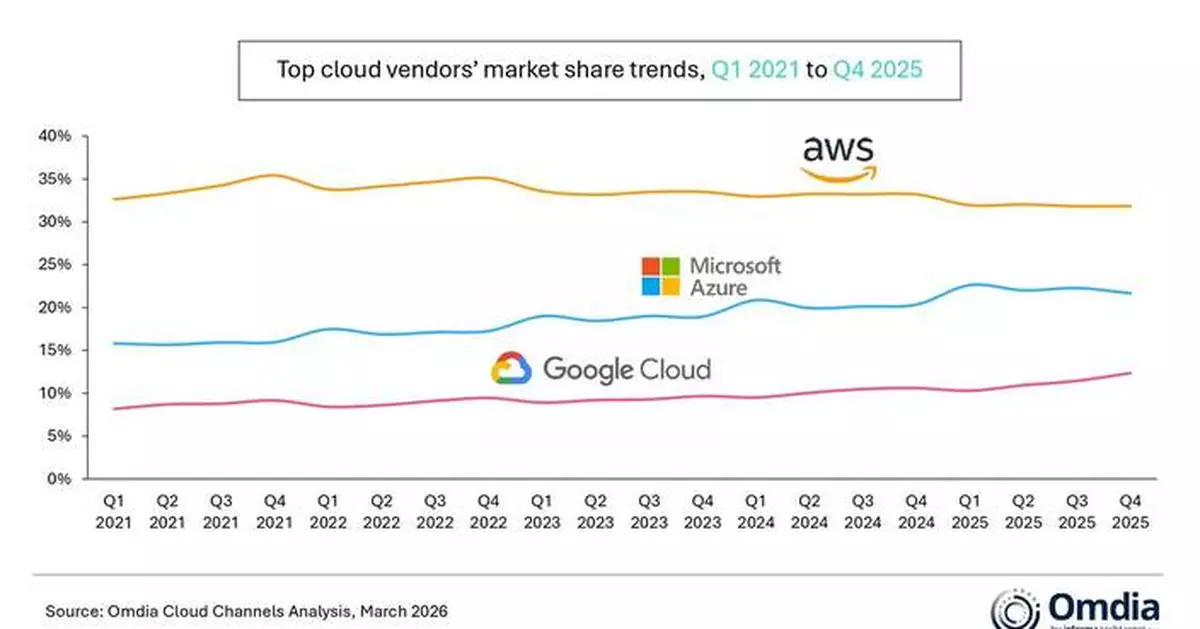
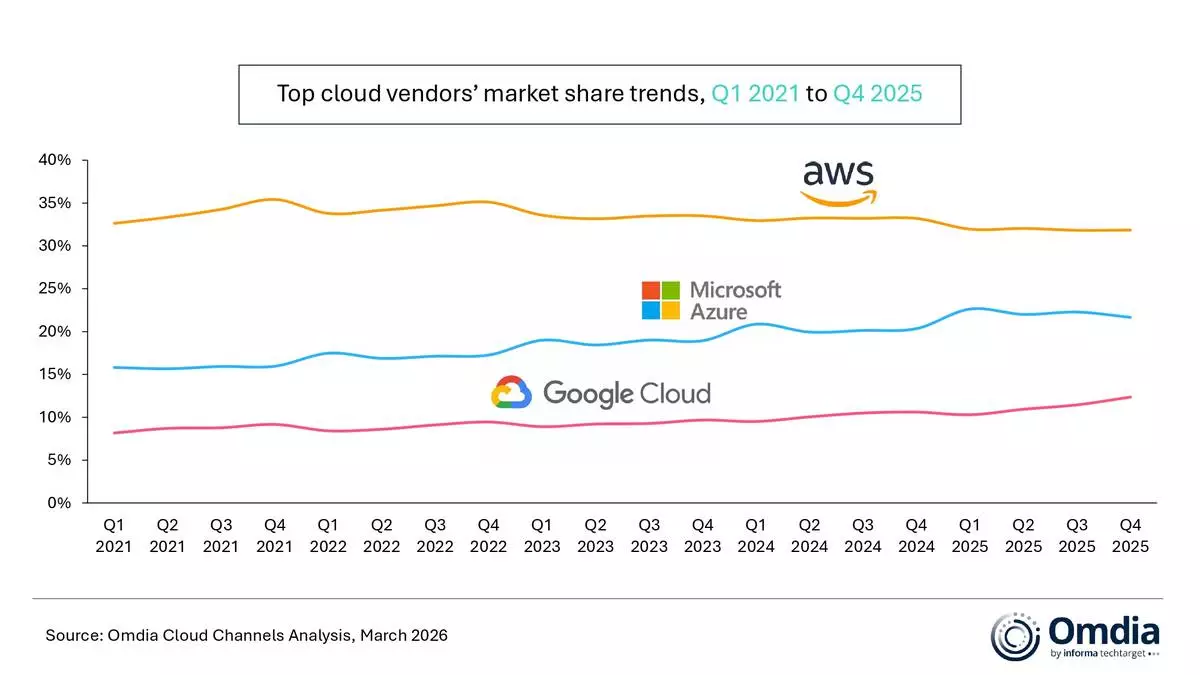
AWS remained the leader in the global cloud infrastructure market in Q4 2025, with a 32% market share and 24% year-over-year revenue growth, up from the previous quarter. It ended Q4 with a total backlog of US$244 billion, underscoring sustained demand. AWS stated that Amazon Bedrock had reached a multi-billion-dollar annualized run rate, with customer spending increasing 60% quarter on quarter. In December 2025, AWS introduced Nova Forge, enabling enterprises to incorporate proprietary data during the early training stages of Amazon Nova models to build customized foundation models, known as Novellas. This supports deeper model customization for enterprise AI agents. AWS has also introduced productized agent solutions including Kiro, Amazon Quick, Transform, and Connect, helping translate AI model capabilities into tangible business value. Meanwhile, AWS continues to expand its global infrastructure footprint, with ongoing investment in data center capacity across Europe and the United States to support growing demand for AI compute.

Microsoft Azure remained the world’s second-largest cloud service provider in Q4 2025, with a 22% market share and year-on-year revenue growth of 39%. Since December 2025, Microsoft has continued to expand the range of models available in Azure AI Foundry, adding models such as Mistral Large 3, GPT-5.2, and Claude Opus 4.6, further reinforcing its position as an enterprise-grade multi-model AI platform. At the same time, Azure is moving agentic AI beyond model access and into enterprise execution. The launch of agentic cloud operations in February 2026 extended Azure Copilot into cloud operations and continuous optimization, while new agentic capabilities introduced in March across Azure Copilot and GitHub Copilot further integrated application modernization into an end-to-end workflow. On the infrastructure front, Microsoft announced in February that its Saudi Arabia East data center region will open in Q4 2026, further extending its localized cloud and AI footprint.

Google Cloud held its position as the world’s third-largest cloud service provider in Q4 2025, delivering robust year-on-year growth of 50% and expanding its market share to 12%. By the end of the quarter, it reported a total backlog of US$240 billion, up sharply from US$157.7 billion in Q3, underscoring improved demand visibility. In January 2026, Google entered a multi-year partnership with Apple to develop the next generation of Apple Foundation Models leveraging Gemini models and Google Cloud technologies. Since December 2025, Google Cloud has continued enhancing its enterprise AI platform, Vertex AI, with additions including Gemini Embedding, Gemini 3.1 Pro, and Nano Banana Pro/2 to further strengthen enterprise capabilities in retrieval, complex reasoning, and multimodal generation. Concurrently, it has strengthened enterprise AI agent readiness through tool governance in Vertex AI Agent Builder and Provisioned Throughput for stable, high-concurrency deployments.

Omdia defines cloud infrastructure servicesas the sum of bare metal as a service (BMaaS), infrastructure-as-a-service (IaaS), platform-as-a-service (PaaS) and container-as-a-service (CaaS) and serverless that are hosted by third-party providers and made available to users via the Internet.

ABOUT OMDIA

Omdia, part of TechTarget, Inc. d/b/a Informa TechTarget (Nasdaq: TTGT), is a technology research and advisory group. Our deep knowledge of tech markets grounded in real conversations with industry leaders and hundreds of thousands of data points, make our market intelligence our clients’ strategic advantage. From R&D to ROI, we identify the greatest opportunities and move the industry forward.
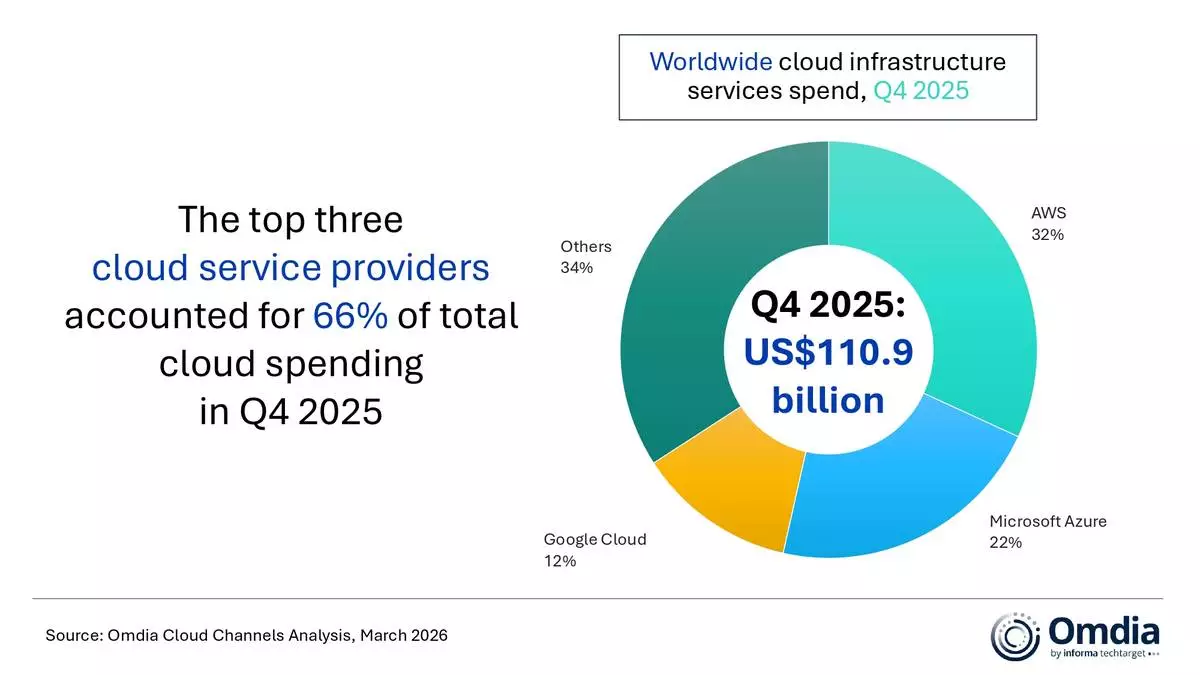
Worldwide cloud infrastructure services spend, Q4 2025
Worldwide cloud infrastructure services spend, Q4 2025

Top cloud vendors’ market share trends, Q1 2021 to Q4 2025

Top cloud vendors’ market share trends, Q1 2021 to Q4 2025

DUBAI, United Arab Emirates (AP) — Iran and the United States hardened their positions as a diplomatic push for a ceasefire in the Middle East war appeared to falter on Thursday. Tehran moved to formalize its control over the crucial Strait of Hormuz while Washington prepared for the arrival of U.S. troops in the region that could be used on the ground in the Islamic Republic.

Sirens over Israel warned of barrages of incoming Iranian missiles and in the United Arab Emirates, two people were reported killed and three were wounded by falling shrapnel from a missile interception over Abu Dhabi on Thursday.

Industry experts say Iran is implementing a “de facto ‘toll booth’ regime,” with some ships paying in Chinese yuan to pass through the Strait of Hormuz, where 20% of all traded oil and natural gas is transported in peacetime.

Meanwhile, a strike group anchored by the amphibious assault ship USS Tripoli drew closer to the Mideast with some 2,500 Marines. Also, at least 1,000 paratroopers from the 82nd Airborne have been ordered to the region.

The troop movements don’t guarantee U.S. President Donald Trump will use force to try and compel Iran to open the strait and halt its attacks on Gulf Arab states.

Trump previously deployed a large force in the Caribbean before the American military captured former Venezuelan leader Nicolás Maduro in January. In the current situation, the U.S. is seen as focused on possibly seizing Iran’s oil terminal at Kharg Island or other sites near the strait.

U.S. Navy Adm. Brad Cooper, who commands the American military in the region, said his forces have hit more than 10,000 targets since Israel and the U.S. started the war Feb. 28, destroying 92% of Iran's largest ships and more than two-thirds of the country's missile, drone and naval production facilities.

“We’re not done yet,” said Cooper, who heads the U.S. Central Command, in a video message. “We are on a path to completely eliminate Iran’s wider military apparatus.”

With its stranglehold on traffic through the Strait of Hormuz, which leads from the Persian Gulf toward the open ocean, Iran has been blocking ships it perceives as linked to the U.S. and Israeli war effort, but letting through a trickle of others.

The Fars and Tasnim news agencies, both close to Iran’s paramilitary Revolutionary Guard, quoted lawmaker Mohammadreza Rezaei Kouchi as saying that parliament was working to formalize the process of charging fees to let ships pass.

“We provide its security, and it is natural that ships and oil tankers should pay such fees,” he was quoted as saying.

Lloyd’s List Intelligence called it a “de facto ‘toll booth’ regime.”

The shipping intelligence firm said vessels have to provide manifests, crew details and their destination to Iran’s Guard for sanctions screening, cargo alignment checks that currently prioritizes oil over all other commodities, and for what is described as ‘geopolitical vetting.’”

“While not all ships are paying a direct toll, at least two vessels have and the payment is settled in yuan,” Lloyd’s List said, referring to China’s currency.

Iran's grip on the strait and relentless attacks on Gulf regional energy infrastructure has sent oil prices skyrocketing and concerns of a global energy crisis surging. Brent crude, the international standard, traded at US$104 early Thursday, up more than 40% from the day the war started.

“To make it crystal clear, this war is a catastrophe for world's economies,” German Defense Minister Boris Pistorius told reporters during a visit to Australia.

Using Pakistan as an intermediary, Washington has delivered to Iran a 15-point ceasefire proposal, which includes the reopening of the Strait of Hormuz.

Trump, speaking at a fundraiser Wednesday night in Washington, insisted that Iran still wants to cut a deal.

“They are negotiating, by the way, and they want to make a deal so badly, but they’re afraid to say it because they figure they’ll be killed by their own people,” Trump said.

Iran’s Foreign Minister Abbas Araghchi said in an interview on state TV, however, that his government has not engaged in talks to end the war, “and we do not plan on any negotiations.”

Araghchi said the U.S. had tried to send messages to Iran through other nations, “but that is not a conversation nor a negotiation.”

Press TV, the English-language broadcaster on Iranian state television, said Iran has its own five-point proposal, which includes “sovereignty over the Strait of Hormuz.”

Israel said it carried out a wave of attacks early on Thursday targeting Iranian infrastructure, and air defenses were heard in Tehran, while heavy strikes were also reported around Isfahan, a city some 330 kilometers (205 miles) south of the Iranian capital.

Ifahan is home to a major Iranian air base and other military sites, as well as one of the nuclear sites bombed by the U.S. during the 12-day war between Israel and Iran in June.

Sirens sounded very early on Thursday morning in parts of Tel Aviv and cities in central Israel and later explosions were heard in Jerusalem. Rescue workers said two people were injured in a blast in Kfar Qasim.

Saudi Arabia's Defense Ministry said it intercepted multiple drones over its oil-rich Eastern Province, and Bahrain reported extinguishing a blaze in a neighborhood that is home to the Bahrain International Airport.

Since the war began, more than 1,500 people have been killed in Iran, its Health Ministry says. Twenty people have been killed in Israel while three Israeli soldiers have also been killed in Lebanon, including one whose death was announced Thursday. At least 13 American troops have been killed. Four people have been killed in the occupied West Bank and 20 in Gulf Arab states.

Nearly 1,100 people have died in Lebanon, authorities said. In Iraq, where Iran-backed militias have entered the conflict, 80 members of the security forces have been killed.

Rising reported from Bangkok. Associated Press writers Julia Frankel in Jerusalem, Rod McGuirk in Melbourne, Australia, and Giovanna Dell'Orto in Miami, Florida, contributed to this report.

Smoke rises from an Israeli airstrike that hit Zibbikin village as seen from Tyre city, Lebanon, Thursday, March 26, 2026. (AP Photo/Hussein Malla)

Smoke rises from an Israeli airstrike that hit Zibbikin village as seen from Tyre city, Lebanon, Thursday, March 26, 2026. (AP Photo/Hussein Malla)

Israeli Iron Dome air defense system fires to intercept missiles from Iran over Tel Aviv, Israel, Thursday, March 26, 2026. (AP Photo/Ohad Zwigenberg) ADDITION: Adding that the missiles came from Iran.

Israeli Iron Dome air defense system fires to intercept missiles from Iran over Tel Aviv, Israel, Thursday, March 26, 2026. (AP Photo/Ohad Zwigenberg) ADDITION: Adding that the missiles came from Iran.

A woman holds a picture of the Iranian Supreme Leader Ayatollah Mojtaba Khamenei during a pro-government gathering in a square in western Tehran, Iran, Wednesday, March 25, 2026. (AP Photo/Vahid Salemi)

A woman holds a picture of the Iranian Supreme Leader Ayatollah Mojtaba Khamenei during a pro-government gathering in a square in western Tehran, Iran, Wednesday, March 25, 2026. (AP Photo/Vahid Salemi)

Pro-government supporters chant slogans and wave Iranian flags during a rally, in a square in western Tehran, Iran, Wednesday, March 25, 2026. (AP Photo/Vahid Salemi)

Pro-government supporters chant slogans and wave Iranian flags during a rally, in a square in western Tehran, Iran, Wednesday, March 25, 2026. (AP Photo/Vahid Salemi)

An Israeli warplane flies over the city of Tyre, south Lebanon, Wednesday, March 25, 2026. (AP Photo/Hussein Malla)

An Israeli warplane flies over the city of Tyre, south Lebanon, Wednesday, March 25, 2026. (AP Photo/Hussein Malla)

A woman who fled Israeli strikes in southern Lebanon sits outside a tent used as a shelter in Beirut, Lebanon, Wednesday, March 25, 2026. (AP Photo/Emilio Morenatti)

A woman who fled Israeli strikes in southern Lebanon sits outside a tent used as a shelter in Beirut, Lebanon, Wednesday, March 25, 2026. (AP Photo/Emilio Morenatti)

Members of a family, who fled Israeli strikes in southern Lebanon, sit around a bonfire outside a tent used as a shelter in Beirut, Lebanon, Wednesday, March 25, 2026. (AP Photo/Emilio Morenatti)

Members of a family, who fled Israeli strikes in southern Lebanon, sit around a bonfire outside a tent used as a shelter in Beirut, Lebanon, Wednesday, March 25, 2026. (AP Photo/Emilio Morenatti)

Pro-government supporters wave national flags as one of them holds a picture of the Supreme Leader Ayatollah Mojtaba Khamenei during a rally in a square in western Tehran, Iran, Wednesday, March 25, 2026. (AP Photo/Vahid Salemi)

Pro-government supporters wave national flags as one of them holds a picture of the Supreme Leader Ayatollah Mojtaba Khamenei during a rally in a square in western Tehran, Iran, Wednesday, March 25, 2026. (AP Photo/Vahid Salemi)

Recommended Articles