Skip to Content Facebook Feature Image

Senegal vows to fight 'unfair administrative robbery' after CAF strips AFCON title

News

Senegal vows to fight 'unfair administrative robbery' after CAF strips AFCON title
News

News

Senegal vows to fight 'unfair administrative robbery' after CAF strips AFCON title

2026-03-26 19:52 Last Updated At:20:00

PARIS (AP) — Senegal was the victim of “the most grossly unfair administrative robbery" in the history of soccer when it was stripped of the Africa Cup of Nations title, Senegalese Football Association president Abdoulaye Fall claimed on Thursday.

At a news conference in Paris, Fall said Senegal will fight to defend its players' “honor” at the Swiss-based Court of Arbitration for Sport.

Lawyer Seydou Diagne said Senegal suffered a “betrayal” and has gathered international lawyers from Switzerland, Spain, France and Senegal to plead the case. The Senegalese FA is challenging a surprise ruling last week by the Confederation of African Football to strip Senegal of the title won in a chaotic final in January and award it to host nation Morocco.

Senegal's legal team said the country still considers itself the champion of Africa despite the CAF’s ruling. The CAF ’s appeals board ruled that Senegal is “declared to have forfeited the final” and its 1-0 win in extra time became a 3-0 default win for host nation Morocco.

“If CAS let this situation happen, the winner of the next World Cup could be decided within a lawyers’ firm,” Diagne said.

Senegal is in France this week to play a friendly against Peru at the Stade de France on Saturday as part of its preparations for the World Cup.

Senegal’s appeal to be reinstated as Africa Cup champion was registered on Wednesday by CAS, which set no timetable for a likely long process toward a verdict. The appeal was promised by the Senegalese government, which also called for an international investigation “into suspected corruption” within the CAF.

Lawyers for the Senegalese FA said during the press conference they were investigating whether members of the CAF appeals panel may have been corrupted and, if so, could file legal action.

CAS said the Senegal federation asked for extra time to file an appeal brief because CAF has not yet given detailed written reasons to explain its decision. Serge Vittoz, one of the federation lawyers, said if there was a procedural flaw regarding the issue of reasoning the legal team will address it. He argued that the CAF disciplinary code required that all decisions be reasoned, so the appeals panel has breached this rule.

"For that reason, we consider that the decision has no effect,” he said.

CAF appeal judges took the title from Senegal two months after the final in Rabat as punishment for players walking off in protest and causing a 15-minute stoppage after Morocco was awarded a penalty that was set to decide the title with the last kick. When Senegal returned to the field and play restarted the Morocco penalty was saved, sending the game into extra time. Senegal scored the only goal in extra time.

The laws of soccer state the referee’s decision on the field of play is final.

The CAF judges, however, cited a tournament rule that any team refusing to play “shall be eliminated for good from the current competition.”

The verdict in Morocco’s appeal of CAF disciplinary rulings from January fueled a perception the country, which will co-host the 2030 World Cup, has increasing influence in international soccer politics.

CAF’s South African president Patrice Motsepe insisted last week “not a single country in Africa will be treated in a manner that is more preferential, or more advantageous, or more favorable than any other.”

An appeal to CAS can typically take months to schedule a hearing then weeks or months more to announce a verdict. Senegal’s lawyers, however, will ask CAS to open an expedited procedure and hope the Moroccan federation and the CAF agree so that the case can be dealt with within two months.

AP soccer: https://apnews.com/hub/soccer

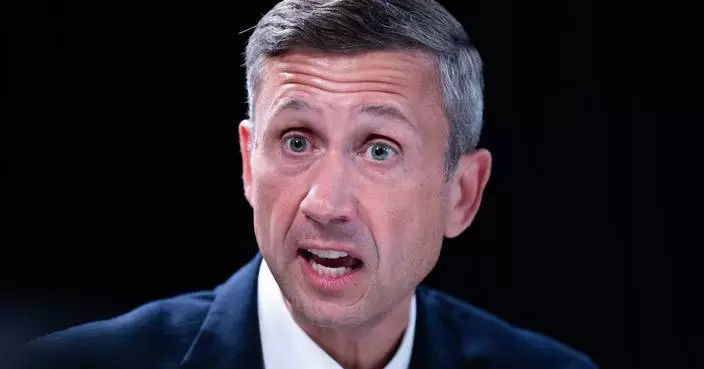
Abdoulaye Fall, president of the Senegalese soccer federation speaks during a press conference in Dakar, Senegal, Thursday, March 19, 2026. (AP Photo/Misper Apawu)
Abdoulaye Fall, president of the Senegalese soccer federation speaks during a press conference in Dakar, Senegal, Thursday, March 19, 2026. (AP Photo/Misper Apawu)

Iran and the United States seemed at diplomatic odds on Thursday as both sides issued conflicting statements over the progress of efforts to end the war, with Tehran putting forth its own proposals even as its military fired multiple missiles at Israel.

U.S. President Donald Trump has said a deal to end the Iran war is near, even after Tehran dismissed his 15-point ceasefire plan.

Iran has been blocking ships it perceives as linked to the U.S. and Israeli war effort from the Strait of Hormuz, but it is letting through a trickle of others through the crucial waterway. Jasem Mohamed al-Budaiwi, of the Gulf Cooperation Council, a bloc of six Gulf Arab nations, said Iran was charging for safe passage through the strait.

The U.S. was preparing for the arrival of thousands of troops that could be used on the ground in Iran.

Two officials from Pakistan described the 15-point U.S. proposal broadly, saying it included sanctions relief, a rollback of Iran’s nuclear program, limits on missiles and reopening the Strait of Hormuz, through which a fifth of the world’s oil is normally shipped.

Iran issued its own plan via state TV, which includes a halt to killings of its officials, means to make sure no other war is waged against it, reparations for the war, the end of hostilities, and Iran’s sovereignty over the Strait of Hormuz.

The death toll from the war has risen to more than 1,900 people in Iran and nearly 1,100 people in Lebanon, with dozens more killed in Israel and elsewhere in the region. Thirteen US. military members have died. Millions of people in Lebanon and Iran have been displaced.

Here is the latest:

An Iranian health official says the death toll from the war in Iran has reached at least 1,937 people.

Iran’s Deputy Health Minister Ali Jafarian gave the figure to the pan-Arab broadcaster Al Jazeera on Thursday. He said 240 of the dead were women and 212 were children.

More than 24,800 others have been wounded so far, he added.

Iran has not offered any official death toll figures in days.

The booms could be heard in Tel Aviv, the central Israel city of Modiin and Jerusalem after the Israeli military warned of another wave of incoming missiles from Iran.

The barrage is the eighth such wave launched at Israel on Thursday.

Pakistan’s top diplomat says indirect talks between the United States and Iran are still ongoing, even as Washington and Tehran offer opposing proposals.

The comment by Ishaq Dar mark the first time Islamabad has publicly acknowledged being the channel by which the two countries were negotiating.

“US-Iran indirect talks are taking place through messages being relayed by Pakistan,” Dar wrote on X.

He said Egypt and Turkey, as well as other countries, are working to back the talks.

Without offering a specific threat, Trump said on Truth Social that Iranian leaders should engage “before it is too late, because once that happens, there is NOT TURNING BACK.”

The post comes a day after Trump insisted a deal is near. He said again Thursday that Iran is “‘begging’ us to make a deal” after the U.S. pitched a 15-point ceasefire plan that Iran rejected.

Israel said Thursday it killed Commodore Alireza Tangsiri, the head of Iranian Revolutionary Guard’s navy.

Israel’s Defense Minister Israel Katz said Tangsiri had been killed along with other senior naval commanders in a strike overnight.

Katz said Tangsiri was responsible for bombing operations that have blocked ships from crossing the Strait of Hormuz. He said the strike should serve as a “clear message” to top Iranian military officials that the Israeli military would hunt them down.

Iran did not immediately acknowledge Tangsiri’s killing.

The secretary-general of the Gulf Cooperation Council said Thursday that Iran is charging fees for ships to safely transit the Strait of Hormuz.

Jasem Mohamed al-Budaiwi is the first top official to accuse Iran of charging for safe passage through the strait, the narrow mouth of the Persian Gulf through which 20% of all natural gas and oil once passed.

Al-Budaiwi oversees the GCC, a bloc of six Gulf Arab nations including Bahrain, Kuwait, Oman, Qatar, Saudi Arabia and the United Arab Emirates. He spoke during a news conference in Riyadh, Saudi Arabia.

The chief of France’s armed forces is gathering counterparts from about 20 nations Thursday to examine how shipping in the Strait of Hormuz could be re-established and safeguarded after the Iran war dies down, an official involved in the planning said.

The official spoke on condition of anonymity to discuss the video meeting hosted by Gen. Fabien Mandon, chief of the French defense staff.

French President Emmanuel Macron has said that “when circumstances permit” and fighting has subsided, he envisions warships escorting oil tankers and other commercial shipping through the narrow strait.

The meeting hosted by Mandon aims to help determine what resources such a mission could expect from countries interested in taking part, including warships, intelligence and other military assistance.

Iraqi officials had initially reported seven soldiers were killed and 13 wounded in Wednesday’s strike on a military clinic in western Iraq’s Anbar province.

Officials took journalists on a tour Thursday at the site of the destroyed clinic, where Iraqi Defense Ministry spokesman Maj. Gen. Tahsin al Khafaj said the number wounded had risen to 23.

The defense ministry has condemned the attack as a violation of international law and affirmed its right to respond. Iraq’s caretaker Prime Minister Mohammed Shia al-Sudani directed the Ministry of Foreign Affairs to summon the Chargé d’Affaires of the U.S. Embassy in Iraq.

When asked about reports of a U.S. strike on an Iraqi medical clinic, a U.S. defense official said the military was aware of the reports but added that U.S. forces did not target a medical clinic in Iraq. The official spoke on condition of anonymity to discuss sensitive military operations.

Witnesses say they heard constant explosions from airstrikes Thursday afternoon in the western Iranian city of Kermanshah.

The release of 30 days’ worth of the state oil reserves is aimed at ensuring a stable oil supply and minimize the fallout from the war in the Middle East.

The release began at the Kikuma national petroleum stockpile base in the western city of Imabari.

It was transferred to a nearby commercial refinery via pipeline, the Japan Organization for Metals and Energy Security said in a statement.

The discharge of the state-held reserves comes 10 days after Japan started releasing 15 days’ worth of oil from private-sector reserves.

In the United Arab Emirates, authorities in Abu Dhabi said two people had been killed and three others wounded by shrapnel from a ballistic missile interception.

An Israeli paramedic who arrived first to the scene in Kfar Qasim described it as “chaos”.

“We arrived within minutes with intensive care units and ambulances. At the scene there was chaos. We began searching inside the house and saw destruction in the center of the home. Five casualties who were inside were injured by the blast,” said Tomer Gussman, according to a statement released by Israel’s rescue services.

Gussman said the injured were evacuated to the hospital in mild condition.

Meanwhile, Israel warned of a third barrage of missiles Thursday incoming from Iran.

Oil prices gained again Thursday and Asian shares were mostly lower as a de-escalation of the Iran war remains uncertain.

Brent crude, the international standard, rose 1.5% to $98.72 per barrel. It was below $95 on Wednesday.

Benchmark U.S. crude was 2% higher at $92.16 a barrel.

The rise in oil prices came as Tehran Wednesday dismissed a ceasefire plan by the U.S., after the Trump administration offered a 15-point proposal to Iran and the American president this week delayed a self-imposed deadline to “obliterate” its power plants in order to force Iran to reopen the Strait of Hormuz.

On Thursday, Tokyo’s Nikkei 225 was down 0.8% to 53,343.25. South Korea’s Kospi lost 3.3% to 5,458.37. Hong Kong’s Hang Seng fell 1.9% to 24,855.12.

Iran’s parliament is working on a bill to formalize the fees it is reportedly charging on some ship transiting through the Strait of Hormuz, local media reported.

The Fars and Tasnim news agencies, both close to Iran’s Revolutionary Guard, quoted lawmaker Mohammadreza Rezaei Kouchi as saying that “that “parliament is pursuing a plan to formally codify Iran’s sovereignty, control and oversight over the Strait of Hormuz, while also creating a source of revenue through the collection of fees.”

“This is entirely natural, just as goods pay transit fees when passing through other corridors, the Strait of Hormuz is also a corridor,” he reportedly said. “We provide its security, and it is natural that ships and oil tankers should pay such fees.”

The Strait of Hormuz, the narrow mouth of the Persian Gulf, is considered an international waterway open to all shipping. Imposing fees would end that and likely be strongly opposed by the Gulf Arab states, the United States and others.

The comment by Sultan al-Jaber, who leads the massive state-run Abu Dhabi National Oil Co., signaled the hardening rhetoric of the United Arab Emirates as the war nears its one-month mark.

“Weaponizing the Strait of Hormuz is not an act of aggression against one nation,” al-Jaber said in a speech for an event hosted by the Middle East Institute in Washington.

“It is economic terrorism against every consumer, every family that depends on affordable energy and food. When Iran holds Hormuz hostage, every nation pays the ransom, at the gas pump, at the grocery store and at the pharmacy. No country can be allowed to destabilize the global economy in this way. Not now. Not ever.”

Sirens sounded about an hour after sunrise across a large swath of central Israel, including areas around Tel Aviv and Jerusalem, and in the occupied West Bank.

Israel’s military said early Thursday morning that Iran had launched missiles toward the country.

The first such alert of the day came after an unusually long lull of more than 14 hours.

Hezbollah rocket fire, however, remained constant overnight in northern Israel, and once reached the Tel Aviv area overnight.

Iran is running a “de facto ‘toll booth’ regime” in Strait of Hormuz, controlling which ships come through and getting payment for their safe passage, a leading shipping intelligence firm said Thursday.

Lloyd’s List Intelligence published an analysis highlighting Iran’s practices through the strait.

It described vessels having to provide manifests, crew details and their destination to Iran’s paramilitary Revolutionary Guard.

The information goes to the Guard’s “Hormozgan Provincial Command for sanctions screening, cargo alignment checks that currently prioritizes oil over all other commodities, and for what is described as ‘geopolitical vetting,’” Lloyd’s List said.

“While not all ships are paying a direct toll at least two vessels have and the payment is settled in yuan,” Lloyd’s List said, referring to China’s national currency.

Such payments likely would run afoul of American and European sanctions on the Guard, a key power center within Iran that controls its ballistic missile arsenal and was key in suppressing nationwide protests in January.

Iran has not directly explained the process for ships to go through the strait, though a Foreign Ministry spokesperson appeared to acknowledge Tehran was receiving payments for some ships in an interview.

Fuel prices in Thailand surged Thursday after the government lifted a cap on diesel prices and reduced fuel subsidies.

The majority of fuel types rose by 6 baht ($0.18) per liter. Diesel prices jumped by about 18%.

The increase is expected to hit the industrial and transportation sectors particularly hard and has raised concerns about a ripple effect on the cost of goods.

Videos and photos shared on social media showed long lines forming at gas stations after the price hike was announced late Wednesday night.

Thai Prime Minister Anutin Charnvirakul said earlier this week the government would allow fuel prices to adjust in line with global market rates, aiming to manage demand following a surge in panic buying.

Australia has temporarily restricted some Iranians from traveling to the country for fear that they would be unwilling or unable to return to their homeland because of the war.

The restrictions apply from Thursday for six months to Iranian Visitor (Subclass 600) visa holders.

The visas have been issued to more than 7,000 Iranians who intend to visit Australia for tourism, business or to see family.

Activists in Iran reported heavy strikes early Thursday morning around Isfahan, a city some 330 kilometers (205 miles) south of Iran’s capital, Tehran.

The pro-reform newspaper Ham Mihan reported online about strikes in the area.

Isfahan is home to a major Iranian air base and other military sites, as well as one of the nuclear sites bombed by the United States during the 12-day war between Israel and Iran in June.

The semiofficial Fars news agency, close to the paramilitary Revolutionary Guard, described the attacks as targeting “two residential areas,” without elaborating.

Earlier, Israel’s military said it had completed “a wide-scale wave of strikes” across Iran, including in Isfahan.

A missile alert sounded on mobile phones in Dubai, United Arab Emirates, on Thursday morning.

Saudi Arabia’s Defense Ministry said it intercepted multiple drones over its oil-rich Eastern Province on Thursday morning.

Kuwait reported it was working to intercept incoming Iranian fire early Thursday morning.

Bahrain sounded its missile alert sirens early Thursday morning. The United Arab Emirates air defenses early Thursday also worked to intercept incoming fire.

U.S. forces have hit more than 10,000 targets so far in the Iran war, the head of the American military’s Central Command said.

U.S. Navy Adm. Brad Cooper made the comments in a video released early Thursday by Central Command.

“If you combine what we’ve accomplished with the success of our Israeli ally, together, we have struck thousands more,” Cooper said. “Our precision strikes have overwhelmed Iranian air defenses and our combat flights are having tangible effects.”

Cooper added that the U.S. has destroyed 92% of “the Iranian navy’s largest vessels.”

“They’ve now lost the ability to meaningly project naval power and influence around the region and around the world,” Cooper said.

Iran maintains its chokehold on the Strait of Hormuz, the narrow mouth of the Persian Gulf, through drone and missile attacks on shipping.

Cooper also said the U.S. has struck over two-thirds of Iran’s munitions plants.

“We are on a path to completely eliminate Iran’s wider military manufacturing apparatus," he said.

Iran has not acknowledged any of its materiel losses through the war.

German Defense Minister Boris Pistorius described the Iran war as an economic “catastrophe” and said Germany did not want to get “sucked into” the conflict.

Pistorius said on Thursday Germany was ready to help secure any peace once that was achieved and appealed for a ceasefire as soon as possible.

“To make it crystal clear, this war is a catastrophe for the world’s economies,” Pistorius told reporters at the Australian Parliament House.

“From the beginning on, we have not been consulted before. Nobody asked us before. It’s not our war and therefore we don’t want to get sucked into that war,” Pistorius added.

Pro-government supporters chant slogans and wave Iranian flags during a rally, in a square in western Tehran, Iran, Wednesday, March 25, 2026. (AP Photo/Vahid Salemi)

Pro-government supporters chant slogans and wave Iranian flags during a rally, in a square in western Tehran, Iran, Wednesday, March 25, 2026. (AP Photo/Vahid Salemi)

People take cover in a bomb shelter as air raid sirens warn of incoming Iranian missile strikes in Bnei Brak, Israel, Wednesday, March 25, 2026. (AP Photo/Ohad Zwigenberg)

People take cover in a bomb shelter as air raid sirens warn of incoming Iranian missile strikes in Bnei Brak, Israel, Wednesday, March 25, 2026. (AP Photo/Ohad Zwigenberg)

Smoke and flames rise following an Israeli military strike on a target in Deir al-Balah, central Gaza Strip, Wednesday, March, 25, 2026.(AP Photo/Abdel Kareem Hana)

Smoke and flames rise following an Israeli military strike on a target in Deir al-Balah, central Gaza Strip, Wednesday, March, 25, 2026.(AP Photo/Abdel Kareem Hana)

Members of the displaced Abd el-Hajj family, and two of their cousins, right, who fled Israeli strikes in southern Lebanon, sit inside a tent used as a shelter in Beirut, Lebanon, Wednesday, March 25, 2026. (AP Photo/Emilio Morenatti)

Members of the displaced Abd el-Hajj family, and two of their cousins, right, who fled Israeli strikes in southern Lebanon, sit inside a tent used as a shelter in Beirut, Lebanon, Wednesday, March 25, 2026. (AP Photo/Emilio Morenatti)

Members of a family, who fled Israeli strikes in southern Lebanon, sit around a bonfire outside a tent used as a shelter in Beirut, Lebanon, Wednesday, March 25, 2026. (AP Photo/Emilio Morenatti)

Members of a family, who fled Israeli strikes in southern Lebanon, sit around a bonfire outside a tent used as a shelter in Beirut, Lebanon, Wednesday, March 25, 2026. (AP Photo/Emilio Morenatti)

Pro-government supporters chant slogans and wave Iranian flags during a rally, in a square in western Tehran, Iran, Wednesday, March 25, 2026. (AP Photo/Vahid Salemi)

Pro-government supporters chant slogans and wave Iranian flags during a rally, in a square in western Tehran, Iran, Wednesday, March 25, 2026. (AP Photo/Vahid Salemi)

Recommended Articles