CE attends plenary of Boao Forum for Asia Annual Conference 2026
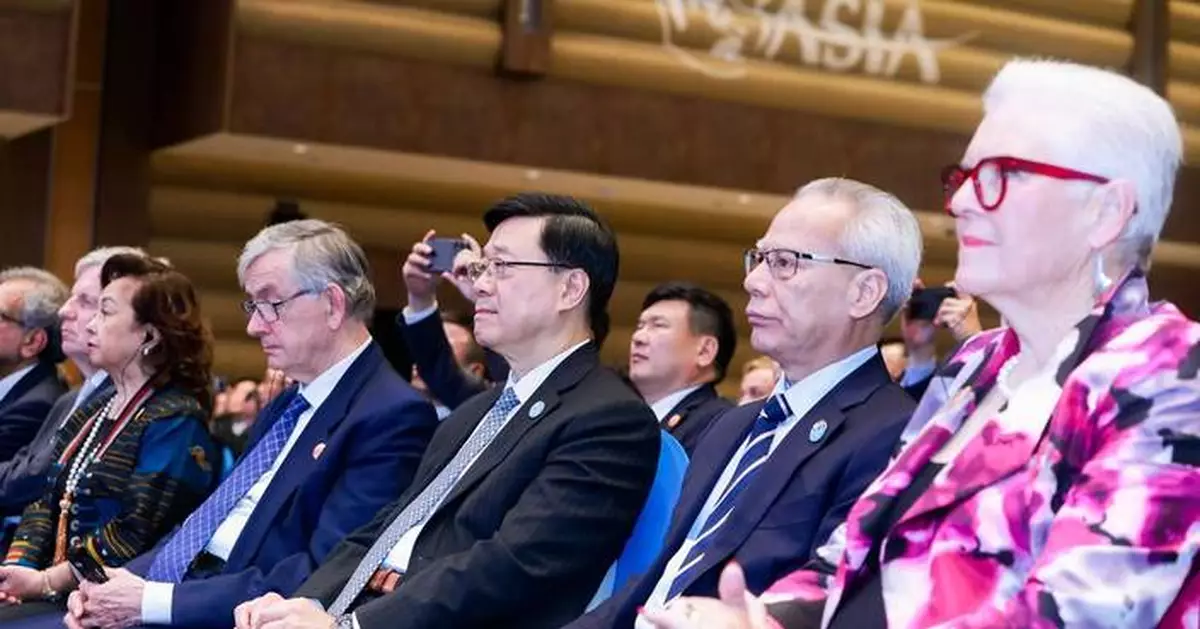
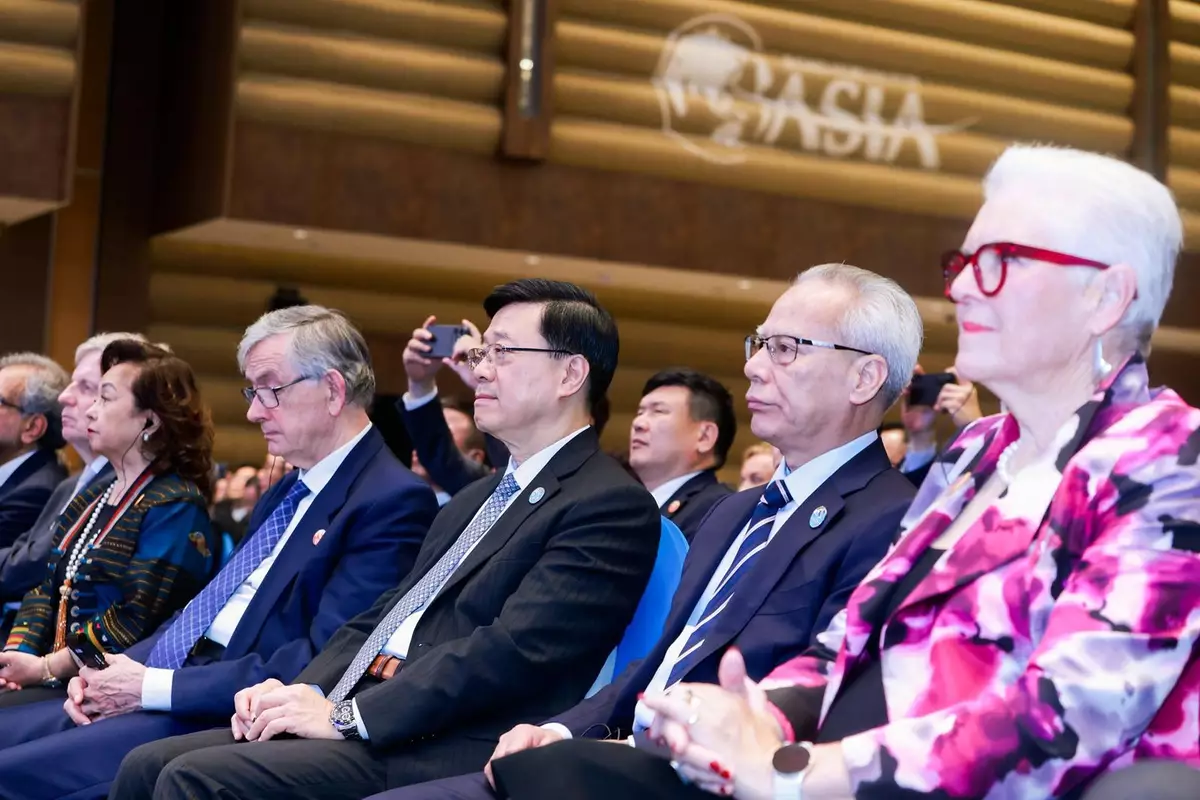
The Chief Executive, Mr John Lee, attended the plenary of the Boao Forum for Asia Annual Conference 2026 in Hainan today (March 26). This year marks the 25th anniversary of the Forum, with the theme "Shaping a Shared Future: New Dynamics, New Opportunities, New Cooperation".
Member of the Standing Committee of the Political Bureau of the Communist Party of China Central Committee and Chairman of the Standing Committee of the National People's Congress, Mr Zhao Leji, delivered a keynote speech at the event. He noted that over the past 25 years, the Boao Forum for Asia, grounded in Asia and oriented to the world, has deepened dialogue and co-operation and built broad consensus, becoming a "golden brand" for promoting exchanges and mutual learning, unity and collaboration in development among Asian countries and the international community. In today's world, people across countries have a stronger desire for peace and development, and calls for fairness and justice are growing louder.
Chairman Zhao stressed that, in the face of changes to the world, to our times and to history, President Xi Jinping has put forward the vision of building a global community of shared future, as well as the Global Development Initiative, the Global Security Initiative, the Global Civilization Initiative and the Global Governance Initiative, pointing the world in the right direction amid the once-in-a-century transformation. He noted that all sides should follow the trend of the times towards peace, development, co-operation and win-win outcomes, work together to build a better home in Asia, and join hands in constructing a global community of shared future. He emphasised the need to reject conflict and confrontation and create a future of peace and tranquillity; reject isolation and exclusion and create a future of co-operation and win-win outcomes; reject power politics and bullying and create a future of fairness and justice; and reject suspicion and discord and create a future of mutual respect and trust.
Mr Lee said that Chairman Zhao's words were truly invaluable. They hit the nail on the head with respect to the current international situation. Under "one country, two systems", Hong Kong has the distinctive advantages of enjoying strong support of the motherland and being closely connected to the world, making it the only open economy that simultaneously benefits from the strengths of both China and the global community. Amid a complex and volatile external environment, Hong Kong has always firmly upheld free trade and multilateralism, resolutely opposed unilateralism and protectionism, and continuously strengthened its resilience to withstand risks and respond to changing circumstances. As such, it has consistently served as the optimal bridge and platform for foreign enterprises seeking to establish a foothold in the Chinese Mainland market and for mainland enterprises looking to expand overseas. With the continued growth of the national economy, Hong Kong should seize this valuable opportunity and proactively pursue breakthroughs in its development.
Mr Lee said that over the past few years, the Hong Kong Special Administrative Region Government has been committed to leading the business sector in exploring markets in the Middle East, Southeast Asia, among others, expanding the landscape for external co-operation. Looking ahead, Hong Kong should direct its focus towards more emerging markets, exploring broader horizons for development. While integrating into and serving the country's overall development, Hong Kong should continue to deepen international engagement and collaboration, working with Asian countries to solidify the foundation of mutual trust, deepen openness and connectivity, pursue mutual benefit and win-win outcomes, and safeguard peace and stability. In doing so, it will contribute to the steady growth of Asia's economy and help steer the global economy towards greater inclusiveness, shared benefits and common progress.
In addition, Chairman Zhao gave an insightful exposition on the current state of China's economic development and its future prospects. He noted that China is always committed to growing the economy, improving people's livelihoods, and, while pursuing its own development, promoting common development among all countries. He pointed out that the outline of the 15th Five-Year Plan sets out the main objectives and major tasks for the country's development over the next five years, and that China will fully, accurately and comprehensively implement the new development philosophy, accelerate the establishment of a new development landscape, and strive to promote high-quality development.
Mr Lee said that Chairman Zhao's keynote speech conveyed a clear and positive signal: China will further expand high-standard opening up and share opportunities with countries around the world; will continue to boost domestic demand and steadily unlock the dividends of its super-sized market; will remain committed to innovative development and continuously unleash new drivers of growth; will uphold free trade and steadily deepen international co-operation; will stay committed to the rule of law and steadily improve the business environment; and welcomes enterprises from around the world to explore and deepen their presence in the Chinese market, which will remain a fertile ground for foreign investment and business growth for years to come. This fully demonstrates the strong resilience and broad prospects of the Chinese economy, and further strengthens confidence in its future development.
Mr Lee said that with the escalation of conflicts in the Middle East and ongoing geopolitical tensions, Hong Kong, as a globally recognised safe harbour for capital stability, possesses a sound financial system and advantages in professional services. It can provide more quality financial services to the business communities of various countries, attract global capital, and jointly pursue high-quality and sustainable development. Amid a complex and severe external environment, Hong Kong should stand firm, proceed with determination, firmly grasp the unique advantages under the "one country, two systems" principle, and make every effort to pursue economic growth, advance development, foster integration, and proactively integrate into and serve the overall national development. The National 15th Five-Year Plan explicitly supports accelerating the development of the Northern Metropolis. Hong Kong will actively advance the preparation of its first five-year plan, steadily progress various development projects, and deepen reforms with a sense of urgency and unwavering determination. Hong Kong will cultivate and strengthen new quality productive forces based on its actual conditions, accelerate the development of an international innovation and technology centre, continuously consolidate and enhance its status as an international financial, shipping and trade centre, and focus on building an international hub for high-calibre talent.
Mr Lee also mentioned that Hong Kong will fully harness the latest frontier technologies and artificial intelligence, continue to invigorate market vitality, advance the development of the Northern Metropolis and the Hong Kong Park of the Hetao Shenzhen-Hong Kong Science and Technology Innovation Co-operation Zone, vigorously promote the high-quality development of the Guangdong-Hong Kong-Macao Greater Bay Area, and deeply align with national strategies. At the same time, Hong Kong will ensure the successful hosting of the AsiaPacific Economic Cooperation Finance Ministers' Meeting, and will continue to strengthen practical co-operation with Asian countries, expand diverse areas of collaboration, jointly explore new paths for development, shape a shared future for Asia, and contribute positively to the country's economic development as well as to regional prosperity and stability in Asia.
Mr Lee returned to Hong Kong today.
CE attends plenary of Boao Forum for Asia Annual Conference 2026 Source: HKSAR Government Press Releases
HKSAR Government strongly condemns and firmly rejects the UK six-monthly report on Hong Kong
The Government of the Hong Kong Special Administrative Region (HKSAR) strongly condemns and must resolutely refute the untruthful remarks, slanders and smears against various aspects of the HKSAR in the so-called six-monthly report on Hong Kong: July to December 2025 of the United Kingdom (UK) today (March 27).
A spokesman for the HKSAR Government stressed, "The HKSAR Government strongly condemns and firmly rejects the UK's attempt through a so-called six-monthly report to make misleading and irresponsible remarks about Hong Kong matters, distort facts and reverse right and wrong, wantonly smear the human rights and rule of law situation of Hong Kong and attempt to interfere in the HKSAR Government's law-based governance by despicable political maneuvers. The HKSAR is an inalienable part of the People's Republic of China, and as a local administrative region that enjoys a high degree of autonomy under the principle of 'One Country, Two Systems', comes directly under the jurisdiction of the Central People's Government. The HKSAR steadfastly safeguards national sovereignty, security and development interests, and fully and faithfully lives up to this top priority of the 'One Country, Two Systems' principle."
"The core essence of the Sino-British Joint Declaration is about China's resumption of the exercise of sovereignty over Hong Kong. It did not authorise the UK to interfere in Hong Kong's affairs after its return to the motherland. The UK has no sovereignty, jurisdiction or right of supervision over Hong Kong after its return to the motherland. The HKSAR Government strongly urges the UK again to discern facts from fallacies, respect the international law and basic norms governing international relations, and immediately stop interfering in Hong Kong matters, which are purely China's internal affairs."
Safeguarding Rights and Freedoms
The HKSAR Government spokesman said, "The HKSAR Government steadfastly safeguards the rights and freedoms enjoyed by Hong Kong people as protected under the law. Since Hong Kong's return to the motherland, human rights in the city have always been robustly guaranteed constitutionally by both the Constitution and the Basic Law. The Hong Kong National Security Law (HKNSL) and the Safeguarding National Security Ordinance (SNSO) also clearly stipulate that human rights shall be respected and protected in safeguarding national security in the HKSAR, and that the rights and freedoms, including the freedoms of speech, of the press, of publication, of association, of assembly, of procession and of demonstration, that Hong Kong residents enjoy under the Basic Law and the provisions of the International Covenant on Civil and Political Rights (ICCPR) and the International Covenant on Economic, Social and Cultural Rights as applied to Hong Kong, shall be protected in accordance with the law. Nonetheless, just as the case with other places in the world, such rights and freedoms are not absolute. The ICCPR also expressly states that some of them may be subject to restrictions as prescribed by law that are necessary for protection of national security, public safety, public order or the rights and freedoms of others, etc. Indeed, Article 19 of the ICCPR specifically requires that journalists must observe and discharge 'special duties and responsibilities' including protection of national security or public order."
"In fact, since the implementation of the HKNSL and the SNSO, the media landscape in Hong Kong has remained vibrant. However, some people with ulterior motives deliberately fabricated facts about freedom of the press and speech in Hong Kong. Like all other places in the world, freedom of the press and speech are not absolute. The media, like everyone else, have an obligation to abide by all the laws. The media continue to enjoy the freedom to comment on and criticise government policies without any restriction, as long as this is not in violation of the law. The court further cited precedents from the European Court of Human Rights regarding press freedom in the reasons for verdict of a relevant case, pointing out that the European Convention on Human Rights does not guarantee a wholly unrestricted freedom of speech even with respect to press coverage on matters of serious public concern. The most crucial point, which is also recognised in the judgments of the courts of the United Kingdom, is that journalists must act in good faith and on accurate factual basis and provide reliable and precise information in accordance with the tenets of 'responsible journalism' in order to enjoy the protection of their rights to freedom of speech and press freedom."
Laws Safeguarding National Security
The HKSAR Government spokesman said, "The HKSAR Government strongly opposes the absurd and false contents in the UK's so-called six-monthly report with regard to the laws and the relevant efforts that safeguard national security in the HKSAR. It is each and every sovereign state's inherent right, under international law and international practice based on the Charter of the United Nations, to enact laws safeguarding national security, and it is also an international practice. There are at least 14 pieces of laws safeguarding national security in the UK, and with a population less than 10 times that of Hong Kong, the UK authorities arrested over 3,000 people in 2025 pursuant to national security and counter-terrorism laws; the UK Government, however, smeared the Hong Kong National Security Law, which targets only a very small number of criminals endangering national security, and other relevant law of the HKSAR, as well as the HKSAR law enforcement, prosecutorial and judicial authorities' performance of their duties in accordance with the law as 'undermining the rights and freedoms', and continued to unscrupulously distort the facts to criticise, which just shows its double standards and hypocritical behavior are utterly ugly and despicable."
"In fact, the implementation of the HKNSL in the past five years or so has enabled the livelihood and economic activities of the Hong Kong community at large to swiftly resume to normal and the business environment to be restored and improved continuously. According to the Economic Freedom of the World 2025 Annual Report, Hong Kong has once again been ranked as the world's freest economy. Hong Kong's ranking improved by two places to third globally in the World Competitiveness Yearbook 2025. Also, Hong Kong continues to rank among the top three international financial centres and comes first in the world in terms of funds raised through initial public offerings in 2025. Hong Kong ranks the 24th out of 143 countries and jurisdictions globally in the 2025 World Justice Project Rule of Law Index. Its overall score (0.72) remained unchanged, matching the scores of the countries ranked 22nd and 23rd, and remains high in the overall ranking and continues to be ahead of some European and American countries which often unreasonably criticise the rule of law and human rights situation of Hong Kong. These internationally recognised achievements are built upon the freedom and stability brought to Hong Kong society by the HKNSL, other relevant laws of the HKSAR, and the work of safeguarding national security."
"Hong Kong is a society underpinned by the rule of law and has always adhered to the principle that 'laws must be obeyed and lawbreakers be held accountable'. Article 5 of the HKNSL and section 2 of the SNSO clearly stipulate that the principle of the rule of law shall be adhered to in preventing, suppressing and imposing punishment for offences endangering national security. The HKSAR law enforcement agencie have been taking law enforcement actions based on evidence and strictly in accordance with the law in respect of the acts of the persons or entities concerned, which have nothing to do with their political stance, background or occupation. All cases are handled strictly on the basis of evidence and in accordance with the law. All defendants will receive fair trial strictly in accordance with laws applicable to Hong Kong (including the HKNSL) and as protected by the Basic Law and the Hong Kong Bill of Rights. Any suggestion that certain individuals or organisations should be immune from legal consequences for their illegal acts is no different from advocating a special privilege to break the law, and this totally runs contrary to the spirit of the rule of law."
"As to the so-called report's malicious smears against the verdict of the case of Lai Chee-ying involving offences endangering national security (Lai's case), the HKSAR Government must stress that the court has conducted 156 days of public hearings, considered up to 2 220 pieces of evidence, over 80 000 pages of documents, and a total of over 1 000 pages of written submissions from all parties, etc.. Lai Chee-ying himself even testified in court for 52 days. These are the testaments to the fact that Lai Chee-ying and other defendants were found guilty only after a fair trial. The court has made it clear in the Reasons for Verdict that Lai Chee-ying was not on trial for his political views of beliefs. The court's publicly released reasons for verdict and sentence have meticulously explained the court's analysis of the relevant legal principles and evidence. Both the conviction verdict and sentence are well-founded and reasoned; there is absolutely no question of "political prosecution". Lai Chee-ying also does not appeal against his conviction or sentence. The open hearing and reasons for verdict of Lai's case revealed that Lai Chee-ying was the mastermind in the case, and repeatedly colluded with foreign forces to beg for sanctions or blockade, or engage in hostile activities against the Central Authorities and the HKSAR Government. Lai's case has nothing to do with freedom of speech and of the press at all, and the defendants, over the years, were using journalism as a guise to commit acts that brought harm to China and Hong Kong."
"Appropriate extraterritorial effect for the offences under the HKNSL and the SNSO fully aligns with the principles of international law, international practice and common practice adopted in various countries and regions. It is both necessary and legitimate, and is also in line with those of other countries and regions around the world. As the law enforcement department of the HKSAR safeguarding national security, the Hong Kong Police are duty-bound to pursue the liability of those who have allegedly endangered national security outside Hong Kong. Those absconders hiding outside Hong Kong are wanted because they continue to blatantly engage in activities endangering national security. Moreover, they continue to collude with external forces to cover for their evil deeds. It is necessary for the Police to take all lawful measures to strongly combat the acts of abscondment, and such actions are fully justified, necessary and legitimate. Quite a number of countries including the UK would also impose measures on wanted criminals to combat the acts of abscondment. It is indeed a demonstration of hypocrisy with double standards by the UK with ulterior motives that, after the HKSAR Government has announced the relevant measures, attack the HKSAR in safeguarding national security dutifully, faithfully and in accordance with the law."
"We noticed that the so-called report mentioned other cases on offences endangering national security. The HKSAR Government has emphasised time and again that as the legal proceedings involving the concerned cases are still ongoing, it is inappropriate for any person to comment on the details of the case in an attempt to interfere with the court to exercise judicial power independently, which might otherwise constitute perverting the course of justice. The UK must stop distorting the truth, blatantly discrediting the judicial system and trials of the HKSAR, in an attempt to glorify criminal behavior and exert pressure on the courts of the HKSAR."
"The HKSAR Government made amendments to the Prison Rule to ensure that we can effectively prevent, suppress and impose punishment for acts and activities endangering national security; continue to strengthen the legal basis for correctional officers in discharging their duties; maintain the security, good order and discipline of prisons; and facilitate the rehabilitation of PICs and protect their lawful rights and interests. The laws of other jurisdictions including the UK also empower correctional authorities to prohibit visits to prisoners or to impose necessary restrictions and conditions in view of considerations of national security and prison security."
Safeguarding Due Administration of Justice and Rule of Law
The HKSAR Government spokesman pointed out, "The HKSAR Government safeguards independent judicial power and fully supports the Judiciary in exercising its judicial power independently, safeguarding the due administration of justice and the rule of law. Articles 2, 19 and 85 of the Basic Law specifically provide that the HKSAR enjoys independent judicial power, including that of final adjudication, and the courts of the HKSAR shall exercise judicial power independently, free from any interference. When adjudicating cases concerning offence endangering national security, as in any other cases, judges remain independent and impartial in performing their judicial duties, free from any interference. The implementation of the HKNSL over the past five years or so has proven that the courts have handled all the cases involving the HKNSL and other laws safeguarding national security in the HKSAR strictly in accordance with the above principles."
"The Department of Justice takes charge of criminal prosecutions, free from any interference by virtue of Article 63 of the Basic Law. All prosecutorial decisions are based on an objective analysis of all admissible evidence and applicable laws. In addition, Article 5 of the HKNSL and section 2 of the SNSO clearly stipulate that the principle of the rule of law shall be adhered to in preventing, suppressing and imposing punishment for offences endangering national security."
"The Judiciary exercises judicial power independently in accordance with the law, and everyone charged with a criminal offence has the right to a fair hearing. The courts decide cases strictly in accordance with the evidence and all applicable laws. Cases will never be handled any differently owing to the profession, political beliefs or background of the persons involved. The prosecution has the burden to prove beyond reasonable doubt the commission of an offence before a defendant may be convicted by the court."
"Owing to the inherent nature of matters concerning national security, the executive authority is in a far better position than the courts to make appropriate judgements. Hence, the courts will afford deference to the judgements made by the executive authority regarding national security matters. This principle is also a general rule for safeguarding national security practised by different places in the world, including in the UK. The so-called report, however, smears this principle as exerting 'political pressure' on the judiciary, which we strongly oppose."
Improved Electoral System
A spokesman for the HKSAR Government said, "the Legislative Council (LegCo) formed following the improvement of the electoral system in 2021 has fully implemented the principle of 'patriots administering Hong Kong', which is consistent with the universally prevailing political tenet of keeping political power in the hands of patriots. The legislature deliberated with efficiency and quality, focusing its efforts on developing the economy and improving people's livelihood, ensuring the steady and successful implementation of 'One Country, Two Systems'. The general election for the eighth term LegCo was successfully held at the end of last year. Voters actively cast their votes, returning a new cohort of LegCo members who are patriotic and love Hong Kong, responsible, capable and committed to serving the community. This has once again exemplified the high-quality and healthy competition under the new electoral system, embodying broad representation and balanced participation. The improved LegCo has proven in practice that this is a democratic electoral system that suits HKSAR's actual circumstances and needs."
Enhancing National Education
The HKSAR Government spokesman pointed out, "Schools are places for students to learn and grow. It is the obligation of schools to provide a safe and orderly school environment and atmosphere, and to maintain a campus free from political interference or illegal activities, for safeguarding students' well-being. National education has been an important part of the curriculum for primary and secondary schools as well as kindergartens, for deepening our students' understanding of the country's development, the history and culture, the Constitution and the Basic Law, as well as national security, thereby building up cultural confidence to foster a sense of national identity, and cultivating them into an able and virtuous new generation with a sense of responsibility, visions and love for the country and the city. Teachers are also important role models of their students, playing a vital role in passing on knowledge and nurturing students' character. The HKSAR Government has the responsibility to ensure the professional conduct of teachers. Implementation of national education, including national security education, is the legitimate duty of education authorities all over the world. Different places attach great importance to implementing national security education and developing their students' sense of national identity, including knowledge of their respective constitution, their own history, culture, geography, etc."
"Academic freedom is an important social value treasured in Hong Kong and the cornerstone of our higher education sector. Since the implementation of the HKNSL, academics or post-secondary education institutions in Hong Kong continue to conduct normal exchange activities with their foreign or external counterparts. Meanwhile, post-secondary institutions in Hong Kong have taken a series of measures to incorporate national security education into students' learning in fulfilment of their statutory duty. These institutions enjoy autonomy on curriculum design, and the HKSAR Government encourages the institutions to provide students with diversified learning opportunities on national security education."

Source: AI-found images