Skip to Content Facebook Feature Image

Zelenskyy visits Saudi Arabia as Ukraine provides expertise against Iranian drones

News

Zelenskyy visits Saudi Arabia as Ukraine provides expertise against Iranian drones
News

News

Zelenskyy visits Saudi Arabia as Ukraine provides expertise against Iranian drones

2026-03-26 23:54 Last Updated At:03-27 00:00

Ukrainian President Volodymyr Zelenskyy arrived Thursday in Saudi Arabia on an unannounced visit, days after revealing that Ukraine is helping five countries in the Middle East and Gulf region counter drone attacks on their territory during the Iran war.

“Arrived in Saudi Arabia. Important meetings are scheduled,” the Ukrainian leader said on X along with a video of his arrival. “We appreciate the support and support those who are ready to work with us to ensure security.”

Zelenskyy provided no more information about his visit but he said last week that Ukrainian officials are helping Saudi Arabia, United Arab Emirates, Qatar, Kuwait and Jordan with drone expertise and helping build a defense system. Ukraine is also looking into whether it can play a role in restoring security in the Strait of Hormuz, he said at the time.

In return, Ukraine is seeking more of the high-end air-defense missiles that Gulf countries possess and which Kyiv needs to stop Russia’s missiles.

Ukraine has quickly grown into one of the world’s leading producers of cutting-edge, battle-tested drone interceptors that are cheap and effective. They are playing a key part in its defense against Russia’s more than 4-year-old full-scale invasion.

Ukrainian officials did not announce nor immediately provide details of Zelenskyy's trip.

A group of northern European countries vowed Thursday to harden the fight against Russia's “shadow fleet” of tankers exporting its sanctioned oil, as Turkish officials said that one of those tankers approaching the Black Sea entrance to the Bosporus Strait was hit by a naval drone.

Russia's shadow fleet is made up of aging tankers that are bought used, often by nontransparent entities with addresses in countries that are not sanctioning Russia. Moscow needs the vessels to dodge Western sanctions and sell the oil and petroleum products that largely finance its more than 4-year invasion of Ukraine.

British Prime Minister Keir Starmer said at a meeting with allies in Finland that "we should go after the shadow fleet even harder.”

Speaking with other members of the Joint Expeditionary Force, a 10-country group that has been tracking the vessels, Starmer said the British military will now be able to board shadow fleet tankers when they transit U.K. waters, joining several other allies in doing so.

“Together, we must close off critical sea routes to this vital trade, to keep up the pressure on (Russian President Vladimir) Putin and to help change the narrative of this war” in Ukraine, Starmer said.

In a recorded video message, Ukrainian President Volodymyr Zelenskyy said that Russia's oil and gas exports are fueling Moscow's effort to take over Ukraine.

“So please keep the pressure on Russia — its tankers and shadow fleet must not feel safe in European waters,” he said.

In Turkey, officials said that none of the 27 Turkish crew members of the Altura tanker was injured when it was attacked early Thursday, causing damage to the bridge and engine room.

The Altura, which reportedly was carrying 140,000 tons of crude oil when it was hit some 14 nautical miles north of the Bosphorus, has been owned by Turkey-based Pergamon Maritime since November.

The tanker has been subject to European Union sanctions since October due to its role in transporting sanctions-dodging Russian oil exports, according to the Open Sanctions website.

Transport Minister Abdulkadir Uraloglu said the tanker was subjected to an “attack by an unmanned sea vessel." He did not say whether Ukraine was suspected to be behind the attack.

In the past, Ukraine’s military has said it used sea drones to sink Russian vessels in the Black Sea. Earlier this month Russia blamed a Ukrainian naval drone for the sinking of a Russian-flagged tanker carrying liquefied natural gas in the Mediterranean Sea off Libya.

Follow AP’s coverage of the war in Ukraine at https://apnews.com/hub/russia-ukraine
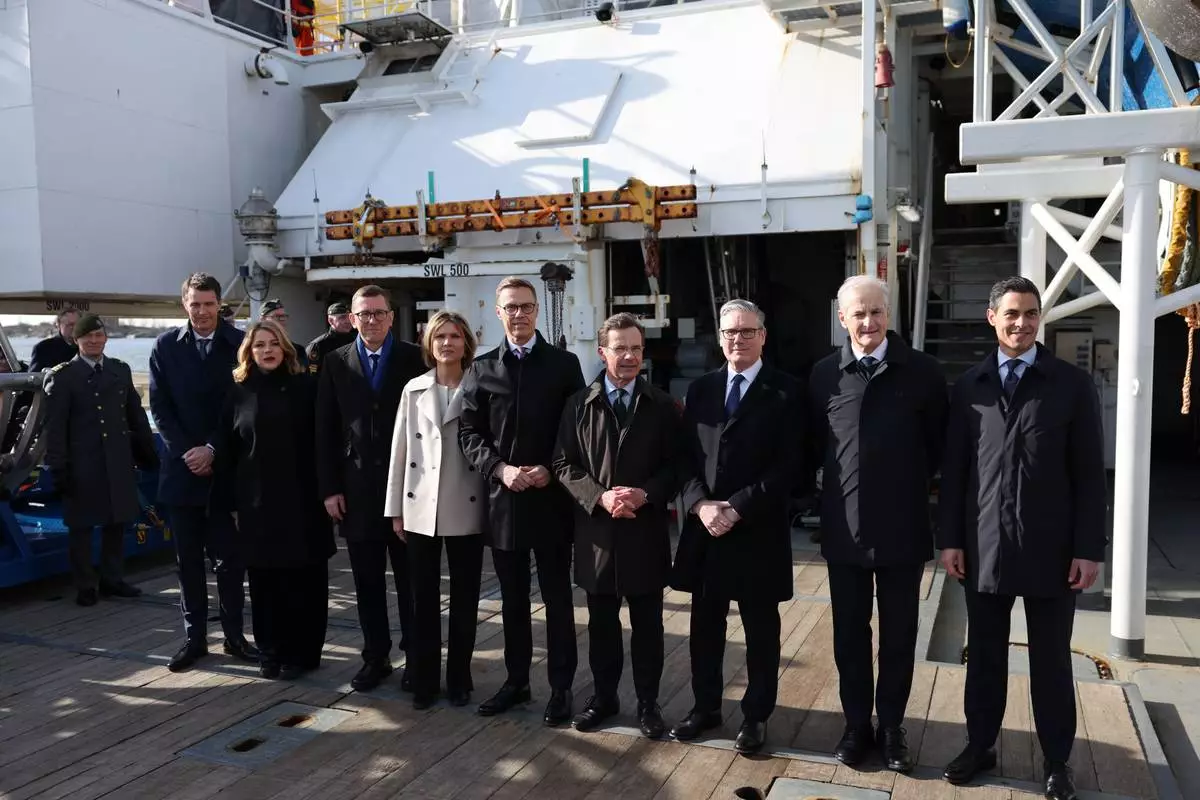
From left, Danish Permanent Under-Secretary of State for Foreign Affairs Anders Tang Friborg, Latvian Prime Minister Evika Silina, Estonian Prime Minister Kristen Michal, Icelandic Prime Minister Kristrun Frostadottir, Finnish President Alexander Stubb, Swedish Prime Minister Ulf Kristersson, British Prime Minister Keir Starmer, Norwegian Prime Minister Jonas Gahr Store and Dutch Prime Minister Rob Jetten pose for a group photo onboard the Finnish Border Guard offshore patrol vessel Turva, prior the Joint Expeditionary Force JEF Leaders' Summit meeting in Helsinki, Finland, Thursday March 26, 2026. (Adrian Dennis, Pool Photo via AP)
From left, Danish Permanent Under-Secretary of State for Foreign Affairs Anders Tang Friborg, Latvian Prime Minister Evika Silina, Estonian Prime Minister Kristen Michal, Icelandic Prime Minister Kristrun Frostadottir, Finnish President Alexander Stubb, Swedish Prime Minister Ulf Kristersson, British Prime Minister Keir Starmer, Norwegian Prime Minister Jonas Gahr Store and Dutch Prime Minister Rob Jetten pose for a group photo onboard the Finnish Border Guard offshore patrol vessel Turva, prior the Joint Expeditionary Force JEF Leaders' Summit meeting in Helsinki, Finland, Thursday March 26, 2026. (Adrian Dennis, Pool Photo via AP)

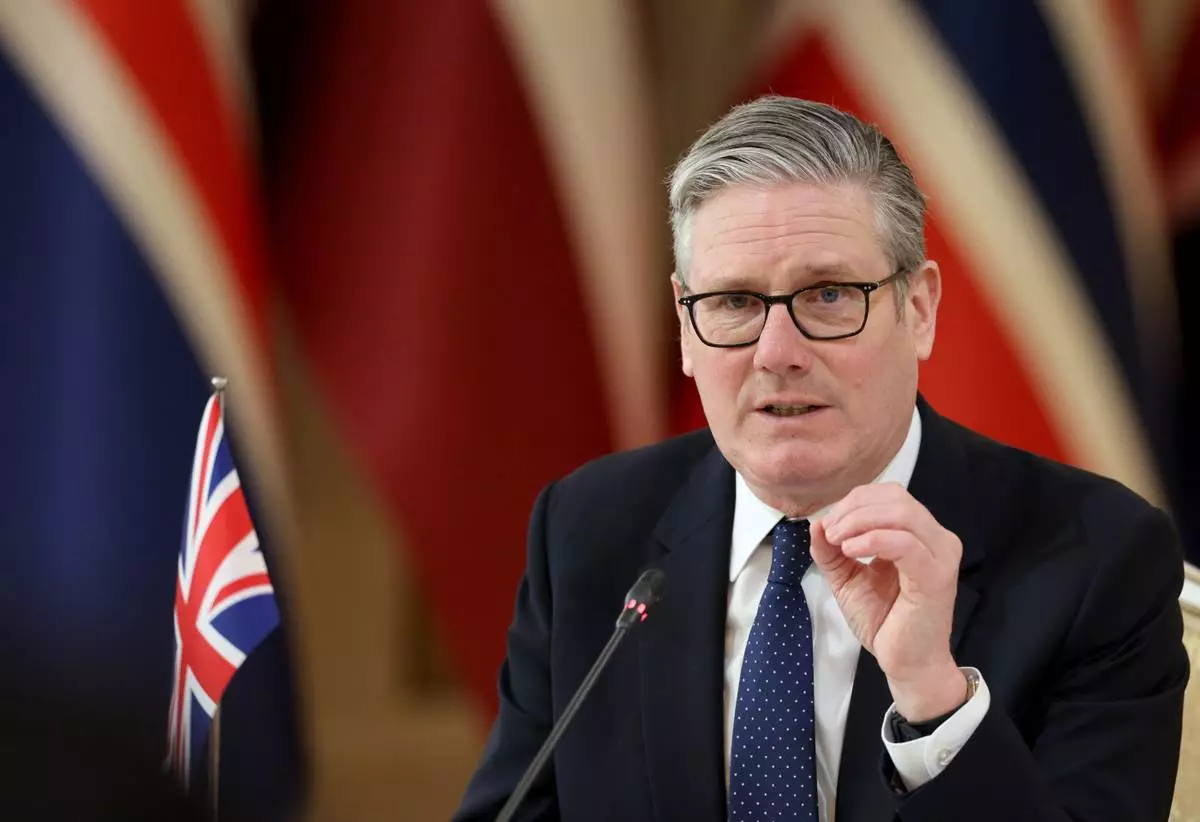
British Prime Minister Keir Starmer speaks as he attends the Joint Expeditionary Force JEF Leaders' Summit in Helsinki, Finland, Thursday March 26, 2026. (Adrian Dennis, Pool Photo via AP)
British Prime Minister Keir Starmer speaks as he attends the Joint Expeditionary Force JEF Leaders' Summit in Helsinki, Finland, Thursday March 26, 2026. (Adrian Dennis, Pool Photo via AP)

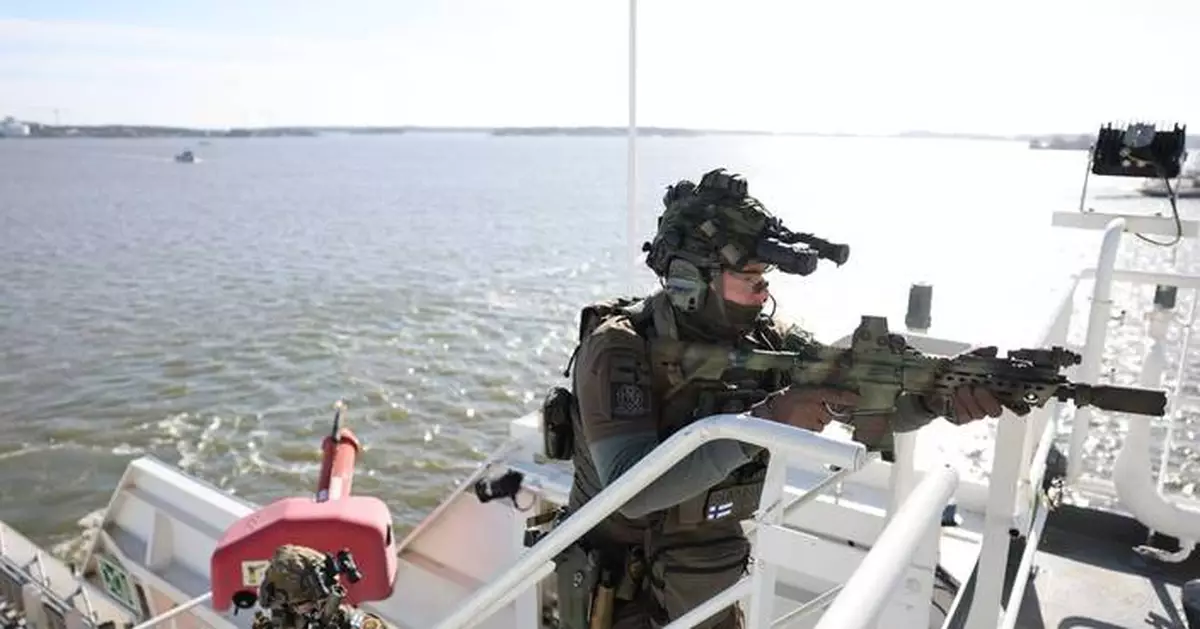
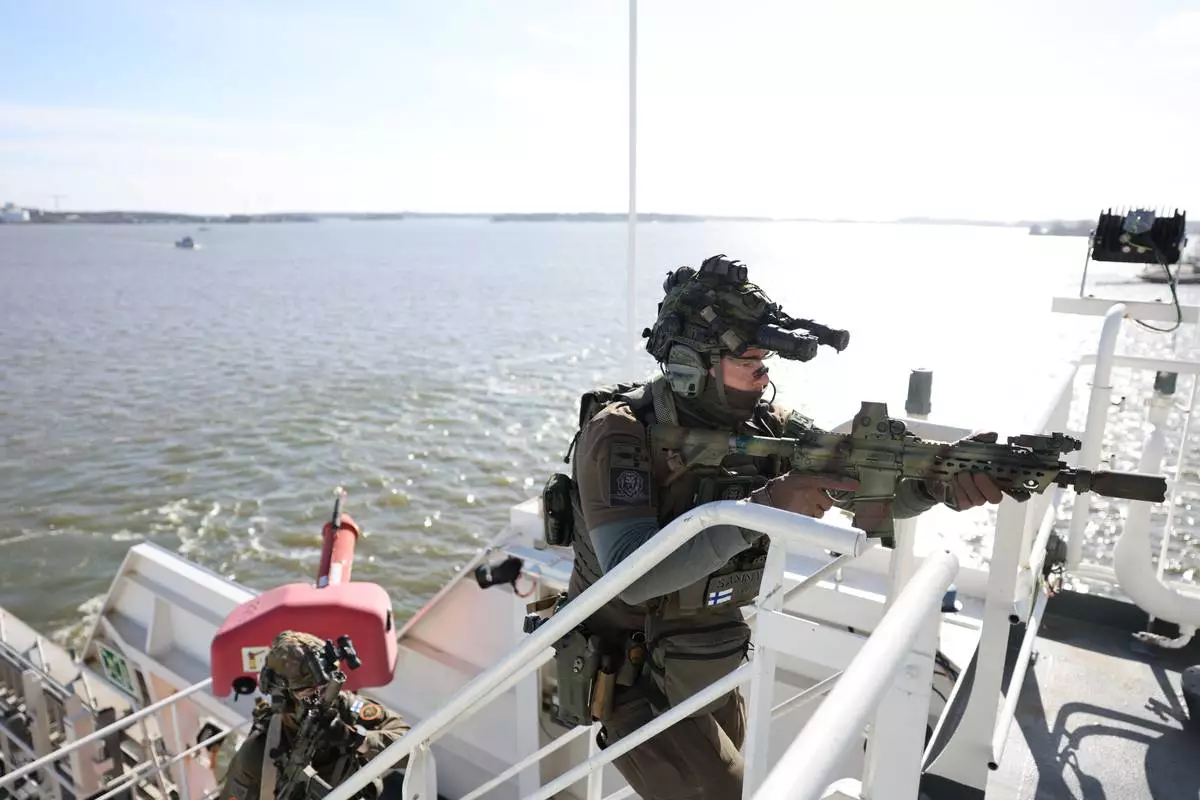
A member of the Finnish Border Guard takes part in an exercise, during the JEF leaders' visit on the Finnish Border Guard offshore patrol vessel Turva, prior to the Joint Expeditionary Force JEF Leaders' Summit in Helsinki, Finland, Thursday March 26, 2026. (Adrian Dennis, Pool Photo via AP)

A member of the Finnish Border Guard takes part in an exercise, during the JEF leaders' visit on the Finnish Border Guard offshore patrol vessel Turva, prior to the Joint Expeditionary Force JEF Leaders' Summit in Helsinki, Finland, Thursday March 26, 2026. (Adrian Dennis, Pool Photo via AP)

A day after Tehran dismissed U.S. President Donald Trump’s 15-point ceasefire plan, the American leader claimed that Iran was “begging to make a deal,” and that he wasn’t the one pushing for negotiations. Earlier Thursday, Trump told Tehran to “ get serious soon ” on negotiating a deal to end the war.

Iran has been blocking ships it perceives as linked to the U.S. and Israeli war effort from the Strait of Hormuz, but it's letting a trickle of others through the crucial waterway. Jasem Mohamed al-Budaiwi, of the Gulf Cooperation Council, a bloc of six Gulf Arab nations, said Iran was charging for safe passage through the strait.

Meanwhile, the U.S. was preparing for the arrival of thousands of troops that could be used on the ground in Iran.

The death toll from the war has risen to more than 1,900 people in Iran and nearly 1,100 people in Lebanon, with dozens more killed in Israel and elsewhere in the region. Thirteen US. military members have died. Millions of people in Lebanon and Iran have been displaced.

Here is the latest:

U.S. Treasury Secretary Scott Bessent said that Iran, by restricting oil and natural gas shipped through the Strait of Hormuz, is “trying to take control of the global economy through a choke point that we believe does not exist.”

Bessent’s phrasing was misleading, as the Strait of Hormuz is critical for global shipments of oil and natural gas, especially for Asia, and energy prices have increased since the war with Iran began.

Still, Bessent said that more tankers are making it through the Strait of Hormuz.

“I am confident that shipping traffic will continue to increase on a daily basis, even before we secure” the strait, Bessent said.

Witnesses heard repeated explosions across most parts of Iran’s capital, along with the activation of air defense systems. Very large blasts are also being reported.

Speaking at a Saudi investment summit in Florida, Jared Kushner on Thursday echoed sentiments made by his negotiating partner Steve Witkoff in dismissing Iranians’ public statements, saying it’s often different than what is being communicated behind closed doors.

“The one thing with the Iranians, and we’re seeing this even now, is you have to ... just ignore a lot of what they say publicly, because I think that their statements are usually more for their domestic audiences,” Kushner, who has been volunteering as a U.S. peace envoy, told the audience at a Future Investment Initiative summit in Miami.

His comments came shortly before Witkoff spoke at Trump’s Cabinet meeting, where he said that despite Iranians assertions that there is no communication with Washington during the ongoing war, the U.S. has presented a 15-point “action list” where there is a “possibility” for a deal between the longtime adversaries.

Secretary of State Marco Rubio is a noted fan of 1990s rap.

During Thursday’s Cabinet meeting, his remarks appeared to borrow a bit from Public Enemy’s “Welcome to the Terrordome.”

Chuck D raps in the track off of the eponymous album “Fear of a Black Planet,” “I got so much trouble on my mind/ I refuse to lose/Here’s your ticket/Hear the drummer get wicked/The crew to you to push the back to Black.”

Rubio, Trump’s chief diplomat, offered, “But every day the Department of War lets the drummer get wicked over every portion of Iran that has these military capabilities, and the results are going to bear fruit for the world,” Rubio said.

The top Iranian envoy to U.N. institutions in Geneva has warned in an interview that any attempt by Israel and the United States to mount a ground invasion of Iran would be a “big” mistake.

Ali Bahreini says Iran is winning the war, and has forced the U.S. and Israel to back off their initial goals. He says those have now been reduced to trying to keep the Strait of Hormuz open for shipments to countries dependent on oil from the Persian Gulf.

Bahreini also says Iran’s supreme leader, Ayatollah Mojtaba Khamenei, is “safe” and running the country. Khamenei has not been seen or directly heard from since he was named to replace his slain father, Ayatollah Ali Khamenei.

Asked why Khamenei hasn’t been seen, the ambassador cited “security arrangements which are very necessary for this particular time.”

“This is stuff for the history books; This is stuff for legacy,” the U.S. defense secretary said during a Cabinet meeting Thursday.

As part of his praise for the decision to engage in the conflict, Hegseth claimed that Iran had “a modern military” but that “never in recorded history has a nation’s military been so quickly and so effectively neutralized.”

The U.S. defense secretary said Thursday that the war in Iran is “unlike Iraq. This isn’t a tie. This is not parity. This is not chaos. This is success. Pure American success.”

Hegseth spoke as he sat next to Trump at a Cabinet meeting. Hegseth noted that the war’s objectives “remain clear: No nukes, no navy, and complete dismantling of their missile program and defense industrial base.”

Trump noted that the Strait of Hormuz, through which 20% of the world’s oil normally flows, remained effectively closed because of the war, although the president predicted the waterway will open up.

Addressing the Cabinet, Vance asserted that the “conventional military” in Iran has been “effectively destroyed” during the war.

Echoing Trump, Vance said Iran no longer has a navy and “they don’t have the ability to hit us like they could of even a few weeks ago.”

“And what that does is that gives us options,” Vance said.

He did not go into detail about those options.

Trump envoy Steve Witkoff said the U.S. has presented a 15-point “action list” to Iran, delivered through Pakistan as a framework for a possible peace deal.

It’s the first time the Trump administration has confirmed the 15-point plan.

Witkoff made the comment Thursday at a Cabinet meeting. He added that Trump directed Witkoff to “maintain confidentiality” as the administration reached out, citing sensitive diplomatic discussions.

“If a deal happens, it will be great for the country of Iran, the entire region and the world at large,” he said.

The top U.S. commander in the Middle East on Thursday hailed an Israeli strike that Israel earlier said killed Iranian naval commander Alireza Tangsiri.

Adm. Brad Cooper, head of U.S. Central Command, said Tangsiri’s killing put Iran’s navy on a path toward “irreversible decline” after weeks of U.S. and Israeli strikes that he said destroyed most of its larger ships and stripped it of much of its ability to project power.

He warned that the United States would keep striking naval targets in Iran. Though the U.S. claims to have destroyed most of Iran’s naval capabilities, it has smaller boats capable of laying mines and anti-ship cruise missiles that can be launched from ashore.

Iran did not immediately acknowledge Tangsiri’s killing.

Palestinians on Thursday mourned a man killed a day earlier during an attack by Israeli soldiers and settlers.

The Palestinian Red Crescent Society said it responded Wednesday to reports of beatings and tear gas. Witnesses told The Associated Press they’d been trying to return to the village of Umm al-Kheir but were blocked by a closed military gate and came under fire.

Israel’s military said a group of vehicles had fled a checkpoint and then lost control, veering off road. It said in a statement that forces fired warning shots in the air as part of an effort to apprehend those in the vehicles. It did not say whether anyone was apprehended.

Israel has erected hundreds of new military gates and checkpoints over the past two and a half years, as part of a broader effort that Palestinians say is to stifle their movement in the occupied West Bank. Violence — often fatal — has surged in the territory as attention and scrutiny has shifted elsewhere.

The president told his cabinet he plans to roll out a “variety” of policies “to support American farmers,” as the war with Iran has increased the cost of fertilizer during planting season.

Trump emphasized that he previously supported farmers by giving them $12 billion in aid when the agricultural sector faced blowback last year after his tariffs started a trade war.

The president, speaking at the start of a Thursday cabinet meeting, said he wanted to “set the record straight” that he isn’t the one pushing for a deal.

“They’re begging to make a deal, not me,” Trump said.

Iranian officials have denied that they’re negotiating with the U.S. as the war continues in its fourth week. Trump insisted they are.

“Anybody would know they’re talking,” he said. “They’re not fools, they’re very smart actually in a certain way. And they’re great negotiators. I say they’re lousy fighters but they’re great negotiators.”

Houthi leader Abdul Malik al-Houthi reiterated the group’s condemnation against the U.S.-Israel war against Iran, describing it as “unjustifiable,” and called for solidarity protests on Friday in Sanaa, Yemen’s capital.

During a lengthy televised speech posted on Telegram on Thursday, the Iran-backed Houthi leader said the Iran war destabilized the region and impacted the global economy, accusing the U.S. and Israel of ignoring such consequences.

Al-Houthi didn’t mention whether the armed rebel group would fight alongside Iran but said “any developments in the fight that necessitate a military response will be met with complete trust in God and reliance upon Him.”

“Our position is clear and unequivocal against America and Israel, and hold no hostile intentions towards any Muslim country,” he added.

Since the war began nearly a month ago, Houthis maintained their support for Iran through statements and protests, despite playing an active role in the Israel-Hamas war when they upended shipping in the Red Sea, through which about $1 trillion worth of goods passed each year before the war.

The stock market wavered Thursday as hopes for an end to the Iran war faded and oil prices surged, with the S&P 500 falling 0.4%, the Nasdaq dropping 0.6% and the Dow little changed. The moves were the latest in a week of volatile swings driven by shifting signals around ceasefire talks between the U.S. and Iran.

A barrel of Brent crude oil climbed 3.8% to $100.93 as hopes dimmed for a potential return to normal for the strait. That’s up from roughly $70 before the war began. Benchmark U.S. crude climbed 3% to $93.05 per barrel.

Rising energy prices have lifted oil and natural gas companies while worsening worries about inflation and weighing on sectors in which higher energy costs threaten to curb demand, including for steel and other industrial goods.

▶ Read more

Uganda’s top general threatened to join the widening war in the Middle East, warning “any talk of destroying or defeating Israel will bring us into the war. On the side of Israel!”

In a series of posts Thursday, Gen. Muhoozi Kainerugaba, chief of Uganda’s Defense Forces, said Uganda would be willing to come to Israel’s assistance if asked, citing the Bible as a basis for the deeply Christian East African nation’s support.

The country has a robust military known for campaigns against militias in Congo and for supplying troops to international forces, including in Somalia. Kainerugaba is known as Uganda’s “tweeting general” and was fired by his father, Ugandan President Yoweri Museveni, in 2022 over provocative posts about faraway wars.

Israel has in recent years attempted to expand its economic inroads in East Africa, including in Somaliland, a breakaway territory in the Horn of Africa, across the Gulf of Aden from Houthi-controlled Yemen. Israel developed an alliance with Uganda decades ago when its early leaders sought allies outside the Middle East.

The Iran war has deflected global attention from Russia’s all-out invasion of its neighbor Ukraine as Europe’s biggest conflict since World War II enters its fifth year and an emboldened Kremlin undertakes a spring offensive.

The past week showed neither side is easing up. Russia on Tuesday fired almost 1,000 drones and 34 missiles at Ukraine in one of the war’s biggest bombardments. The following day Ukraine launched almost 400 drones in the largest reported overnight attack on Russian regions and Crimea.

Ukraine’s fate is still Europe’s top foreign policy issue, fueled by fears that Moscow has wider ambitions. Meanwhile, the Trump administration has wound down talks with Russian and Ukrainian delegations as the Iran war grips its attention. The administration has warned it could turn its back on the conflict if peace efforts come to nothing.

▶ Read more

Iran’s internet shutdown is badly hurting many businesses, as well as limiting access to news of the war inside the country. A designer in her mid-twenties says her fashion products company is “on the verge of closing” as online sales have ground to a halt.

She added a nearby strike had damaged her apartment in central Tehran. Speaking on condition of anonymity, she shared with The Associated Press a photo of her street showing it filled with debris and broken glass from the blast wave.

She said she had gone to stay at her parents' house where she felt safer.

“I don’t leave the house much except to buy necessities. The checkpoints are still in place and every night, a few supporters of the government hold rallies throughout the city. To be honest, I don’t dare go near the damaged or dangerous areas,” she added, referring to security checkpoints set up across the capital.

Iran has repeatedly restricted internet access since security forces shot thousands of anti-government protesters in early January. Rampant inflation has also throttled the economy. The designer said she has been forced to live on her small savings.

“I think we’ve experienced everything bad possible. We’ve seen it all, from the terrible atmosphere of January and the killings and arrests to the war.”

— Amir-Hussein Radjy

The vast majority of Republicans in the AP-NORC poll, 81%, say it’s “extremely” or “very” important for the U.S. to prevent Iran from obtaining a nuclear weapon, lending support to one of the goals Trump has articulated since the war began. But only about half of Republicans see replacing Iran’s government with leaders who are more friendly to the U.S. as a high priority.

Stephen Hauss, 40, is a state Agriculture Department employee in Camden, Delaware, where he manages environmental programs. Hauss described his political views as libertarian-leaning, and he voted for Trump in 2024. But the start of the Iran war has changed his views about the president.

“Before the war I was just kind of like, ‘OK, like, I voted for him. I got to give him, like, some benefit of the doubt,’” he said.

Now, Hauss said he can’t support the U.S. trying to change the leadership of another country. He added, “I don’t think I am on board with this anymore.”

About three-quarters of Republicans approve of Trump’s handling of the presidency, and a similar 70% approve of how he’s handling Iran.

Many Republicans continue to have “a great deal” or “quite a bit” of trust in the president to make the right decisions on foreign issues. About half place a high level of trust in him when it comes to the use of military force outside the U.S. Roughly the same percentage of Republicans have a high level of trust on his dealings with adversaries and allies.

Sharon Fuller, 68, is a firm backer of the president and approves of his handling of the job, as well as the war in Iran.

A retired hospital analyst from Ocklawaha, Florida, Fuller expressed some reservations about the war but called Trump a “huge patriot” and said she’s been impressed with how the stock market has done since he became president again.

“I don’t really agree with the war, but on the other hand, I think it’s a necessity at this point,” she said.

Oil depots spewing black smoke. Debris sinking in the Persian Gulf. Missiles pounding military sites.

The Iran war has unleashed a toxic mix of chemicals, heavy metals and other pollutants that threaten everything from agriculture to drinking water to people’s health — and will leave behind environmental damage and health risks that could persist for decades, experts said.

“All the burning of oil and gas fields in the coastal areas, all the ships that are there, the oil tankers that are being burned or (sunk) — all of these mean pollution,” said Kaveh Madani, an Iranian scientist and director of the United Nations University Institute for Water, Environment and Health. “For someone like me who has fought for sustainability and protection of the environment in that region, this is like going many years backward.”

Documenting the damage has proved daunting, with a full accounting impossible for now, said Doug Weir, director of the Conflict and Environment Observatory, a U.K.-based nonprofit that monitors environmental harms from armed conflicts.

▶ Read more

A US B1 Lancer bomber takes off from RAF Fairford, England, Thursday, March 26, 2026. (AP Photo/Alastair Grant)

A US B1 Lancer bomber takes off from RAF Fairford, England, Thursday, March 26, 2026. (AP Photo/Alastair Grant)

Israeli soldiers carry the flag-draped casket of Staff Sgt. Ori Greenberg who was killed in combat in Lebanon, during his funeral at Mount Herzl military cemetery in Jerusalem Thursday, March 26, 2026. (AP Photo/Mahmoud Illean)

Israeli soldiers carry the flag-draped casket of Staff Sgt. Ori Greenberg who was killed in combat in Lebanon, during his funeral at Mount Herzl military cemetery in Jerusalem Thursday, March 26, 2026. (AP Photo/Mahmoud Illean)

Smoke rises from an Israeli airstrike that hit Zibbikin village as seen from Tyre city, Lebanon, Thursday, March 26, 2026. (AP Photo/Hussein Malla)

Smoke rises from an Israeli airstrike that hit Zibbikin village as seen from Tyre city, Lebanon, Thursday, March 26, 2026. (AP Photo/Hussein Malla)

Children displaced from Beirut's southern suburb of Dahiyeh shelter from the rain inside their tents along the coast in Beirut, Lebanon, Thursday, March 26, 2026. (AP Photo/Emilio Morenatti)

Children displaced from Beirut's southern suburb of Dahiyeh shelter from the rain inside their tents along the coast in Beirut, Lebanon, Thursday, March 26, 2026. (AP Photo/Emilio Morenatti)

Members of a family, who fled Israeli strikes in southern Lebanon, sit around a bonfire outside a tent used as a shelter in Beirut, Lebanon, Wednesday, March 25, 2026. (AP Photo/Emilio Morenatti)

Members of a family, who fled Israeli strikes in southern Lebanon, sit around a bonfire outside a tent used as a shelter in Beirut, Lebanon, Wednesday, March 25, 2026. (AP Photo/Emilio Morenatti)

Pro-government supporters chant slogans and wave Iranian flags during a rally, in a square in western Tehran, Iran, Wednesday, March 25, 2026. (AP Photo/Vahid Salemi)

Pro-government supporters chant slogans and wave Iranian flags during a rally, in a square in western Tehran, Iran, Wednesday, March 25, 2026. (AP Photo/Vahid Salemi)

People take cover in a bomb shelter as air raid sirens warn of incoming Iranian missile strikes in Bnei Brak, Israel, Wednesday, March 25, 2026. (AP Photo/Ohad Zwigenberg)

People take cover in a bomb shelter as air raid sirens warn of incoming Iranian missile strikes in Bnei Brak, Israel, Wednesday, March 25, 2026. (AP Photo/Ohad Zwigenberg)

Smoke and flames rise following an Israeli military strike on a target in Deir al-Balah, central Gaza Strip, Wednesday, March, 25, 2026.(AP Photo/Abdel Kareem Hana)

Smoke and flames rise following an Israeli military strike on a target in Deir al-Balah, central Gaza Strip, Wednesday, March, 25, 2026.(AP Photo/Abdel Kareem Hana)

Members of the displaced Abd el-Hajj family, and two of their cousins, right, who fled Israeli strikes in southern Lebanon, sit inside a tent used as a shelter in Beirut, Lebanon, Wednesday, March 25, 2026. (AP Photo/Emilio Morenatti)

Members of the displaced Abd el-Hajj family, and two of their cousins, right, who fled Israeli strikes in southern Lebanon, sit inside a tent used as a shelter in Beirut, Lebanon, Wednesday, March 25, 2026. (AP Photo/Emilio Morenatti)

Members of a family, who fled Israeli strikes in southern Lebanon, sit around a bonfire outside a tent used as a shelter in Beirut, Lebanon, Wednesday, March 25, 2026. (AP Photo/Emilio Morenatti)

Members of a family, who fled Israeli strikes in southern Lebanon, sit around a bonfire outside a tent used as a shelter in Beirut, Lebanon, Wednesday, March 25, 2026. (AP Photo/Emilio Morenatti)

Pro-government supporters chant slogans and wave Iranian flags during a rally, in a square in western Tehran, Iran, Wednesday, March 25, 2026. (AP Photo/Vahid Salemi)

Pro-government supporters chant slogans and wave Iranian flags during a rally, in a square in western Tehran, Iran, Wednesday, March 25, 2026. (AP Photo/Vahid Salemi)

Recommended Articles