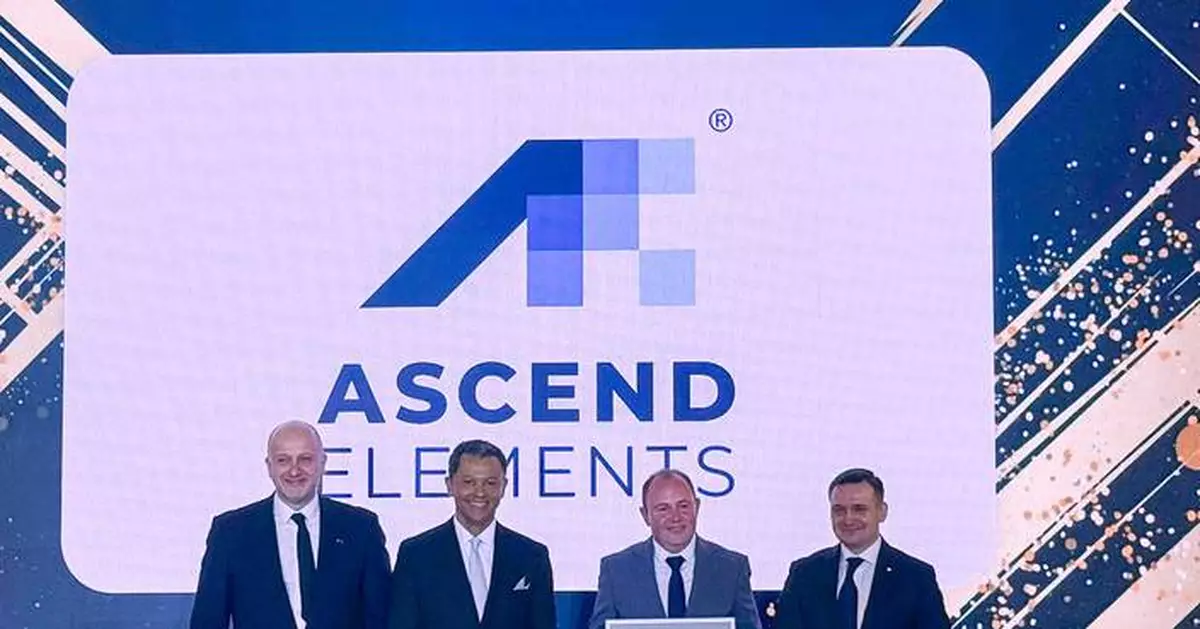
WARSAW, Poland--(BUSINESS WIRE)--Mar 27, 2026--
The Polish Investment and Trade Agency (PAIH) has named Ascend Elements ’ Project Apex 2 its Manufacturing Investment of the Year, focused on the company’s development of the EU’s first fully integrated battery materials refining center that will turn spent lithium‑ion batteries into new, low‑carbon cathode materials using its Hydro‑to‑Cathode® technology. The Republic of Poland has granted Ascend Elements USD 320 million (approximately 1.22 billion PLN) to advance construction of its first European pCAM and Lithium manufacturing facility, one of the largest grant offers ever made by Poland’s Ministry of Economic Development and Technology.
This press release features multimedia. View the full release here: https://www.businesswire.com/news/home/20260326877840/en/
“Project Apex 2 is about more than a single facility; it is about proving that Europe can lead the world in a truly circular, low‑carbon battery economy,” said Linh Austin, President and CEO of Ascend Elements. “By bringing our Hydro‑to‑Cathode® technology to Poland, we are turning spent batteries into new critical materials at industrial scale, strengthening the EU’s strategic autonomy in key raw materials and helping set a global benchmark for sustainable battery manufacturing.”
The honor, announced at the PAIH 2026 Investor’s Gala in Warsaw, underscores the role of foreign direct investment in strengthening Poland’s economy, creating high‑quality jobs and developing future‑oriented industries. The annual Investor’s Gala highlights major investments completed in Poland with PAIH support and brings together representatives of the Polish government, PAIH leadership, foreign investors, local governments and Special Economic Zones.
“The most innovative companies in the global clean‑technology and battery industries are choosing Poland as a location for their investments, and Ascend Elements is further proof of this trend,” said Paweł Pudłowski, Deputy Chairman of the Board, Polish Investment and Trade Agency. “By locating an advanced circular battery materials project here, Ascend Elements is strengthening Poland’s role in the European battery value chain, creating highly qualified jobs and supporting the EU’s efforts to build secure, sustainable supply chains for critical raw materials.”
Ascend Elements’ Project Apex 2 will be an advanced manufacturing facility designed to refine separated key cathode raw materials recovered from spent lithium‑ion batteries, known as “black mass,” into lithium carbonate battery-grade materials and precursor cathode active material (pCAM). These products are essential for the production of cathode active material (CAM), a core component of lithium‑ion batteries used in electric vehicles and stationary energy storage systems.
The Project Apex 2 facility will commercialize Ascend Elements’ Hydro‑to‑Cathode® hydrometallurgical technology in Europe, producing sustainable lithium and pCAM materials from recycled battery materials and supporting the EU’s long‑term energy transition and net‑zero goals. The investment will help create an integrated, low‑emission supply chain for lithium‑ion batteries inside the EU, reducing dependence on imported metals and cathode materials from high‑risk markets. Project Apex 2 aligns with the EU Critical Raw Materials Act (CRMA) and circular‑economy objectives, ensuring that strategic metals are recovered and processed within the European Union rather than exported as raw waste.
“Project Apex 2 is exactly the kind of strategic, high‑value investment Poland needs to solidify its position at the heart of Europe’s clean‑energy economy,” said Michał Jaros, Secretary of State at the Polish Ministry of Economic Development and Technology. “By combining advanced recycling with cutting‑edge cathode materials production, Ascend Elements is helping us secure critical raw materials, create highly skilled jobs, and build a more resilient industrial base for Poland and the entire European Union.”
Ascend Elements already operates commercial‑scale hydrometallurgical recycling and lithium recovery facilities in the United States and, in 2025, produced approximately 2,500 tonnes per year of battery‑grade lithium carbonate (Li₂CO₃), with plans to increase global lithium carbonate capacity to more than 15,000 tonnes per year by 2027. By transferring these proven technologies to Poland through Project Apex 2, the company will help close Europe’s growing gap in cathode precursor supply and reinforce the EU’s strategic autonomy in critical battery materials.
About Ascend Elements
Ascend Elements is a North America- and Europe-based battery materials leader converting spent lithium-ion batteries and manufacturing scrap into premium precursor cathode material (pCAM) and battery-grade lithium carbonate through its patented Hydro-to-Cathode® process. With plants operating at scale and a proven technology platform, Ascend delivers circular supply for EV and energy storage markets. For more information, visit www.ascendelements.com.
Forward-looking Statement
This press release contains “forward-looking statements” within the meaning of applicable securities laws. All statements other than statements of historical fact are forward-looking statements, including, without limitation, statements regarding the Company’s strategy, future operations, financial position, projected revenues, costs, prospects, plans, objectives of management, and expected market conditions.
Forward-looking statements are based on current expectations, estimates, forecasts, and projections, as well as the beliefs and assumptions of management, and are subject to a number of risks and uncertainties that could cause actual results to differ materially from those described. Such risks and uncertainties include, but are not limited to, market conditions, competitive dynamics, regulatory developments, supply chain constraints, capital availability, execution risks, and other factors. The Company undertakes no obligation to update or revise any forward-looking statements except as may be required by law.
About the Polish Investment and Trade Agency (PAIH)
The Polish Investment and Trade Agency (PAIH) is an advisory institution belonging to the Polish Development Fund (PFR) Group and serves as the first point of contact for exporters and investors. Operating in Poland and through a network of foreign offices, PAIH promotes Polish products, services and technological solutions abroad, supports the inflow of foreign direct investment to Poland and assists Polish companies in expanding globally. The Agency cooperates closely with national and regional authorities, Special Economic Zones and other partners to ensure professional, end‑to‑end support for strategic investment projects.
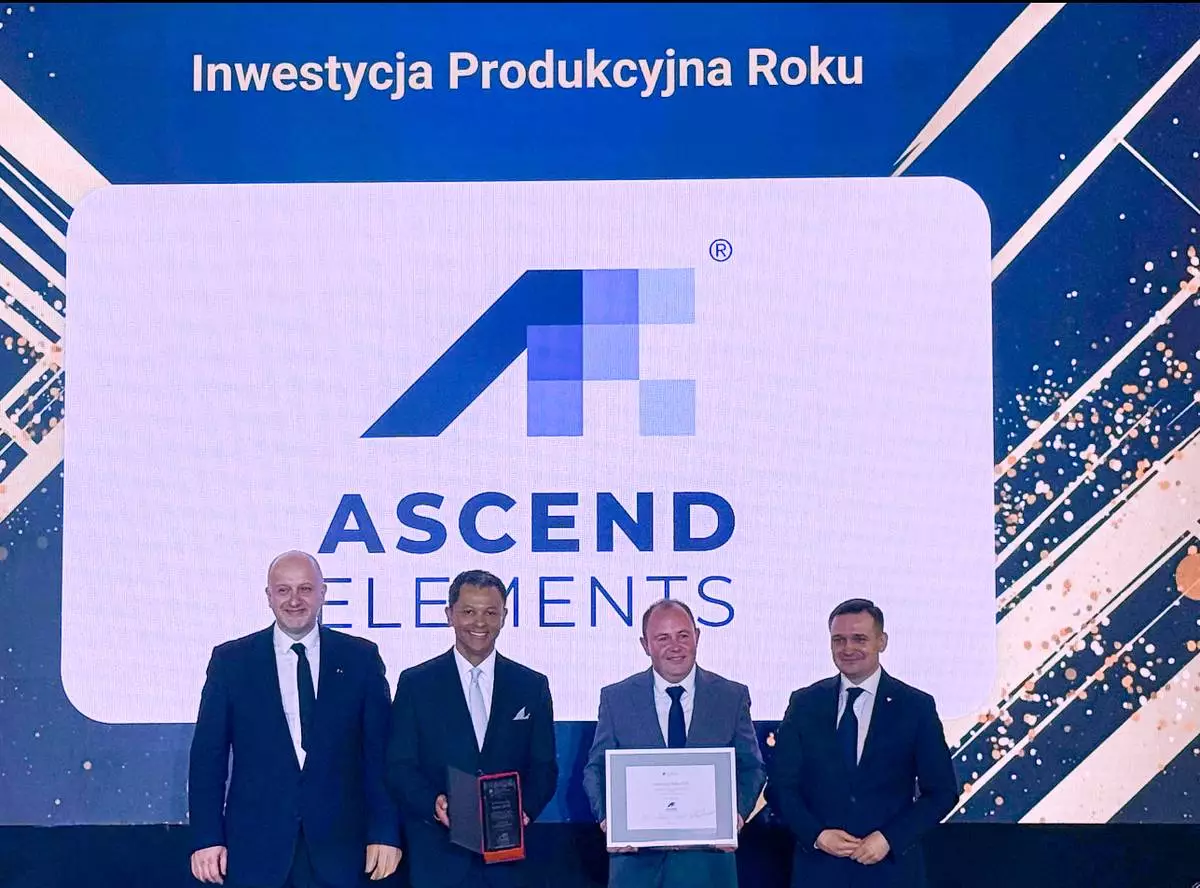
(From left) Andrzej Dycha, Chairman of the Board, Polish Investment and Trade Agency (PAIH), presents Ascend Elements President & CEO Linh Austin and Chief Commercial Officer Tomasz Poznar with the “Manufacturing Investment of the Year” award for the company’s Project Apex 2 at the PAIH 2026 Investors Gala in Warsaw. Michał Jaros, Secretary of State of the Ministry of Economic Development and Technology, stands far right. The award is focused on Ascend Elements’ development of the EU’s first fully integrated battery materials refining center, which will refine spent lithium-ion batteries into new, low-carbon cathode materials, including lithium and pCAM, using its patented Hydro-to-Cathode® technology. Poland’s Ministry of Economic Development and Technology granted Ascend Elements USD 320 million (approximately 1.22 billion PLN) to advance construction of the facility.