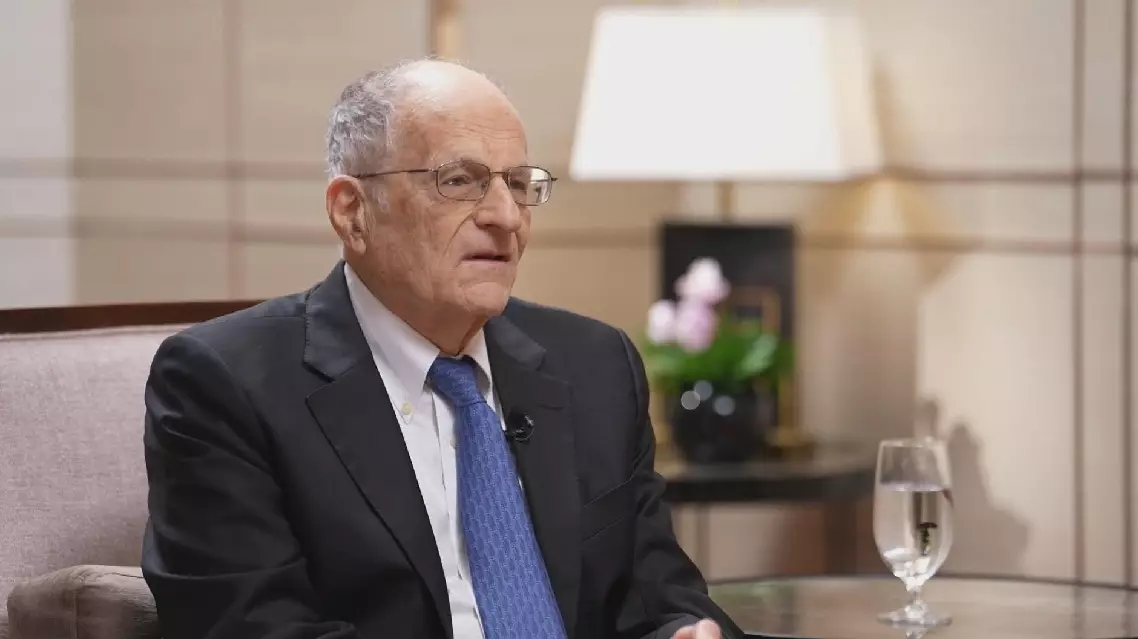
Nobel Laureate Thomas J. Sargent said that a completely economic decoupling is unlikely, arguing that global trade and the cross-border exchange of ideas make such separation unrealistic.
Sargent, who won the 2011 Nobel Prize in Economic Sciences, said in an interview with China Media Group (CMG) in Shanghai that politicians often make appealing but misleading promises, including claims that tariffs can quickly restore large numbers of manufacturing jobs in the United States.
"When politicians say we're going to bring back good manufacturing jobs in the United States, like we had 4 years ago -- if you went to a plant in the United States 4 years ago or a plant in China four years ago, it didn't look like a plant now. If you go to a plant now -- I've been to plenty of plants in China -- it was amazing. There were very few people there, there were robots. So China is a leader in that. If you brought manufacturing back to the United States, you wouldn't bring back a lot of jobs. So that's misleading. There's no evidence that manufacturers are coming back to the United States so far. You could bring some back by putting tariffs so high that you'd close us off. But that's not going to happen. It's not free market economics," he said.
The economist also defended the resilience of scientific and technological cooperation across borders. Sargent said that many intellectual goods are effectively immune to tariffs and trade barriers, adding that exchanges of ideas power progress in fields such as artificial intelligence.
"I use Chinese artificial intelligence, DeepSeek. It's very good. They're giving me ideas. I give them ideas, go back and forth. It's free trade, and scientists, mathematicians, engineers, they like that. And it's not trading secrets. It's like how to use algebra and geometry better. And you cannot stop that. There are scientific ideas. It's actually a wonderful thing. It's a force for cooperation. That's going to go on. So do I think it's going to be completely decoupled? No, because lots of the ideas about engineering and chemistry, physics -- China is a leader in some kinds of physics, pure science. The fact that China is doing that means to me, I think, well, engineers and scientists in other countries are going to want to learn about that. That's a force for not decoupling," he said.
Nobel laureate says full decoupling unlikely, urges free trade