Israel raided an automotive services center in Iran's capital city of Tehran on Saturday, killing at least one people and injuring 27 others, a sales manager at the center said.
The attack, part of a joint large-scale U.S.-Israeli airstrikes across Iran, hit the Hyper Car Company, a car repair shop and dealership, when more than 170 people were working at the site.
More than 200 vehicles were destroyed, and the entire center was burned to the ground.
Arash Ali Mohammadi, a sales manager of the company, condemned the United States and Israel for targeting civilian facilities.
"In the name of God, this is Hyper Car Company, a subsidiary of Iran Rover Company. It is completely private. We are not affiliated with any governmental institution or organization. This company has been entirely privately owned. We are the largest supplier of parts for both domestic and foreign cars, and we also carried out vehicle repairs here," he told the China Global Television Network (CGTN) near the burnt-out vehicles at the site.
Mohammadi said the rebuilding of the center could take at least six months.
According to Israeli officials and security sources, Israel deployed about 200 fighter jets in what they described as the largest operational sortie in the history of the Israeli Air Force on Saturday, as the U.S.-Israeli conflict with Iran approached its one-month mark.
The coordinated U.S.-Israeli strikes hit targets in at least 24 of Iran's 31 provinces, including Tehran, where large explosions were heard.
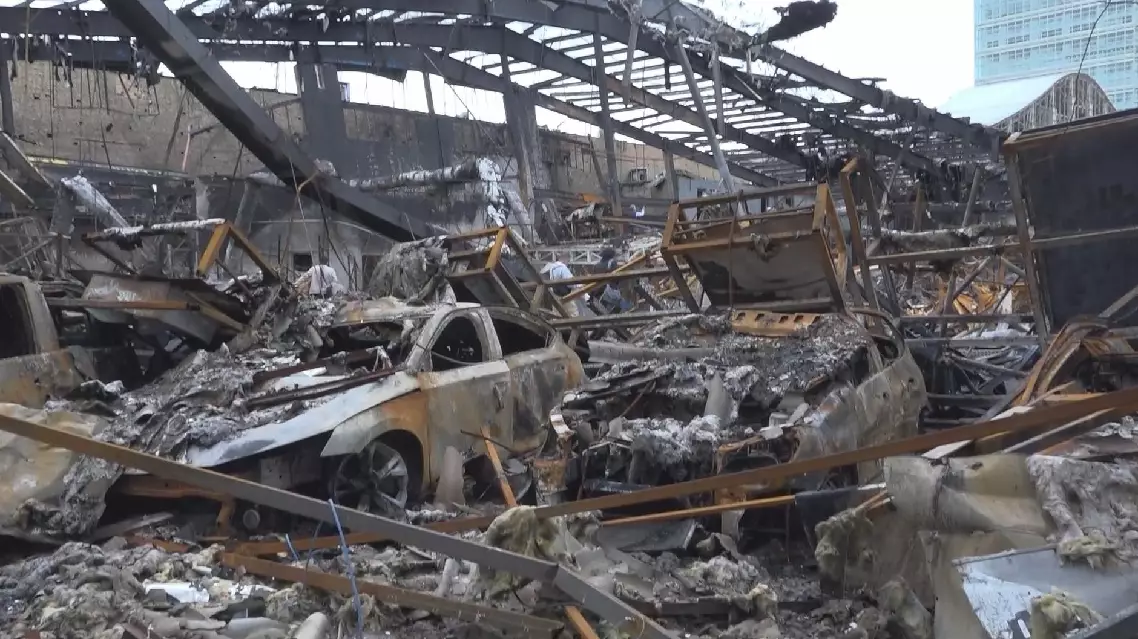
Israel raids car service center in Iranian capital, killing at least one person
Israel raids car service center in Iranian capital, killing at least one person
Israel raids car service center in Iranian capital, killing at least one person
As the diplomatic engagement between the United States and Iran continues despite a faltering ceasefire, a former commander of Iran's Islamic Revolutionary Guard Corps (IRGC) has said that Iran is prepared to use military power to break the U.S. maritime blockade should the negotiations collapse or run on too long.
Mohsen Rezaee, who also currently serves as a member of the Iranian Expediency Discernment Council, struck a confident tone about Iran's current trajectory in an exclusive interview with China Global Television Network (CGTN) in Tehran on Wednesday.
He said the country has withstood over two decades of crippling sanctions and continued to move forward.
"We have been under sanctions for more than 20 years. The number of sanctions likely exceeds 2,000, targeting individuals, enterprises, corporations, ships, insurance companies, and even foreign countries that interacted with us. However, we have managed to find solutions to neutralize these sanctions, and we will continue to do so moving forward," he said.
He said Iran aims to ease the sanctions burden through talks with the U.S., although at the same time, he said, Iran is ready to shift to a military response if the path to a peaceful resolution closes.
"Furthermore, we will compel the U.S. to lift these sanctions. We will force the U.S. to end the maritime blockade -- either through negotiations or, should they resist, through direct action and we will attack U.S. warships. Therefore, despite all the pressures, the future of our economy is bright and promising, while the future of the US economy is bleak," he said.
While any new war against Iran would be a dead end, the best way out for the U.S. is to continue talks, according to the senior official.
"We have prepared ourselves so that if the maritime blockade continues beyond a certain timeframe, we will launch an attack and break the blockade. The Americans have no choice but to negotiate. Continuing this war is a journey into a very dark tunnel for the United States. The more America chooses to fight, the deeper it enters a tunnel with no end. Yet for us, the path is perfectly clear. America is moving toward us in the dark, while we are monitoring their every move," he said.
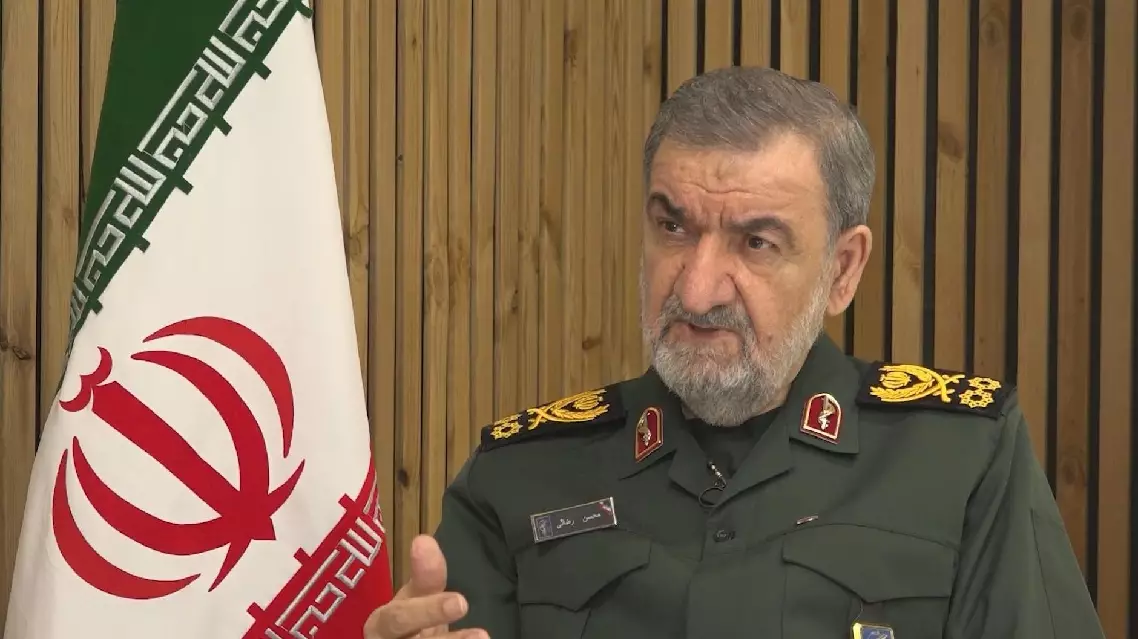
Former IRGC chief says Iran ready to break U.S. naval blockade by force if talks fail