ABOARD AIRFORCE ONE (AP) — President Donald Trump on Sunday night said he has “no problem” with a Russian oil tanker off the coast of Cuba delivering relief to the island, which has been brought to its knees by a U.S. oil blockade.
“We have a tanker out there. We don’t mind having somebody get a boatload because they need … they have to survive,” Trump told reporters as he flew back to Washington.
When asked if a New York Times report that the tanker would be allowed to reach Cuba was true, Trump said: “I told them, if a country wants to send some oil into Cuba right now, I have no problem whether it’s Russia or not.”
On Monday, Russia's Transport Ministry said the oil tanker Anatoly Kolodkin arrived at the Cuban port of Matanzas carrying “humanitarian supplies” of about 730,000 barrels of oil.
The vessel is sanctioned by the United States, the European Union and the United Kingdom following the war in Ukraine.
Kremlin spokesman Dmitry Peskov said Monday that Russia had previously discussed its oil shipment to Cuba with the United States. “Russia сonsiders it its duty not to stand aside, but to provide the necessary assistance to our Cuban friends,” he told reporters.
Trump, whose government has come at its Caribbean adversary more aggressively than any U.S. government in recent history, has effectively cut Cuba off from key oil shipments in an effort to force regime change. The blockade has had devastating effects on the civilians Trump and Secretary of State Marco Rubio say they want to help, leaving many desperate.
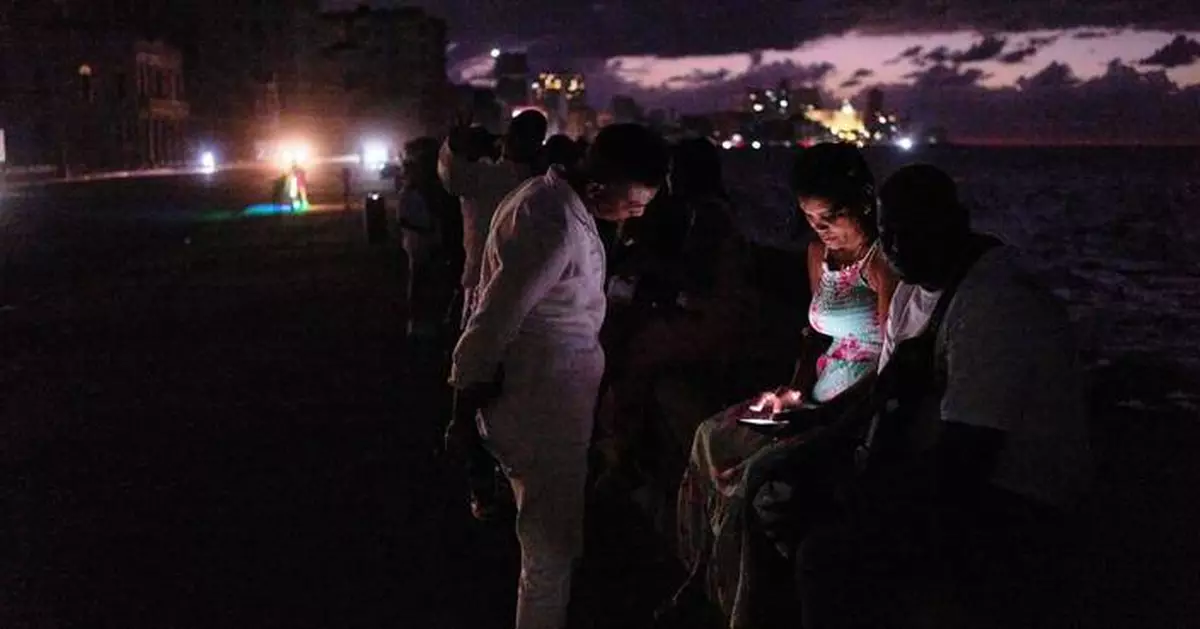
Islandwide blackouts have roiled Cubans already grappling with years of crisis, and a lack of gasoline and basic resources has crippled hospital and slashed public transport.
Experts say the anticipated shipment could produce about 180,000 barrels of diesel, enough to feed Cuba’s daily demand for nine or 10 days.
Cuba has long been at the heart of geopolitical tug-of-war between the U.S. and Russia, dating back decades. Trump on Sunday dismissed the idea that allowing the boat to reach Cuba would help Russian President Vladimir Putin.
“It doesn’t help him. He loses one boatload of oil, that’s all it is. If he wants to do that, and if other countries want to do it, it doesn’t bother me much,” Trump said. “It’s not going to have an impact. Cuba’s finished. They have a bad regime. They have very bad and corrupt leadership and whether or not they get a boat of oil, it’s not going to matter.”
He added: “I’d prefer letting it in, whether it’s Russia or anybody else because the people need heat and cooling and all of the other things.”
Associated Press reporters Megan Janetsky contributed to this report from Mexico City and Andrea Rodríguez contributed from Havana.
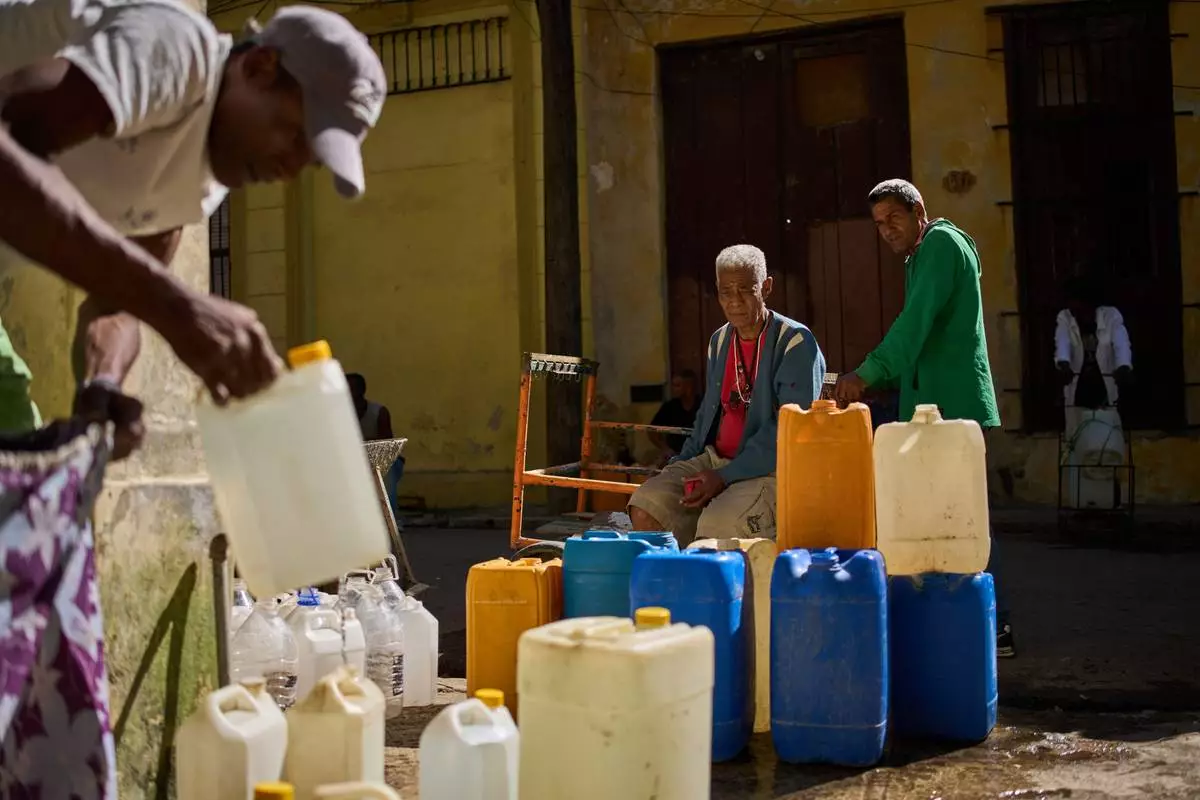
A man fill containers with potable water during a blackout in Havana, Sunday, March 22, 2026. (AP Photo/Ramon Espinosa)
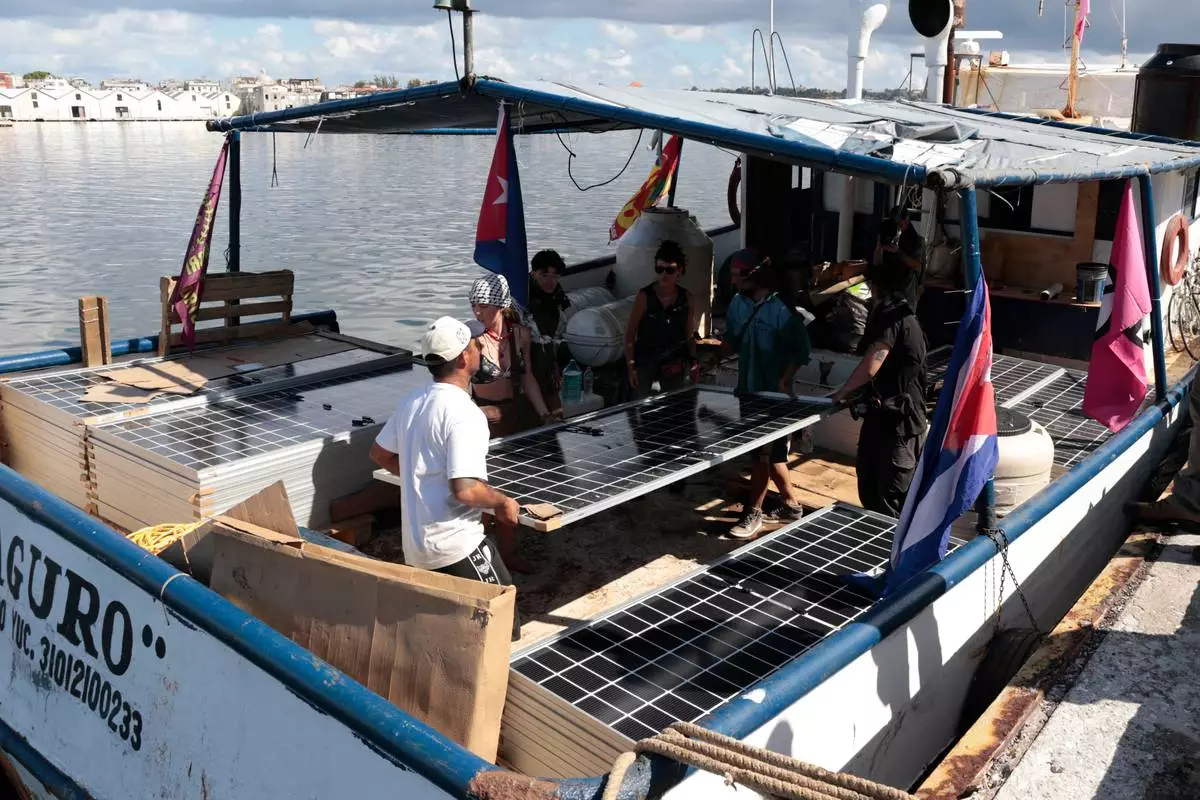
Activists from the vessel Maguro, that arrived from Mexico, unload solar panels and other humanitarian aid from the "Nuestra America," or Our America convoy, at the port in Havana Bay, Cuba, Tuesday, March 24, 2026. (Jorge Luis Banos/IPS via AP, Pool)
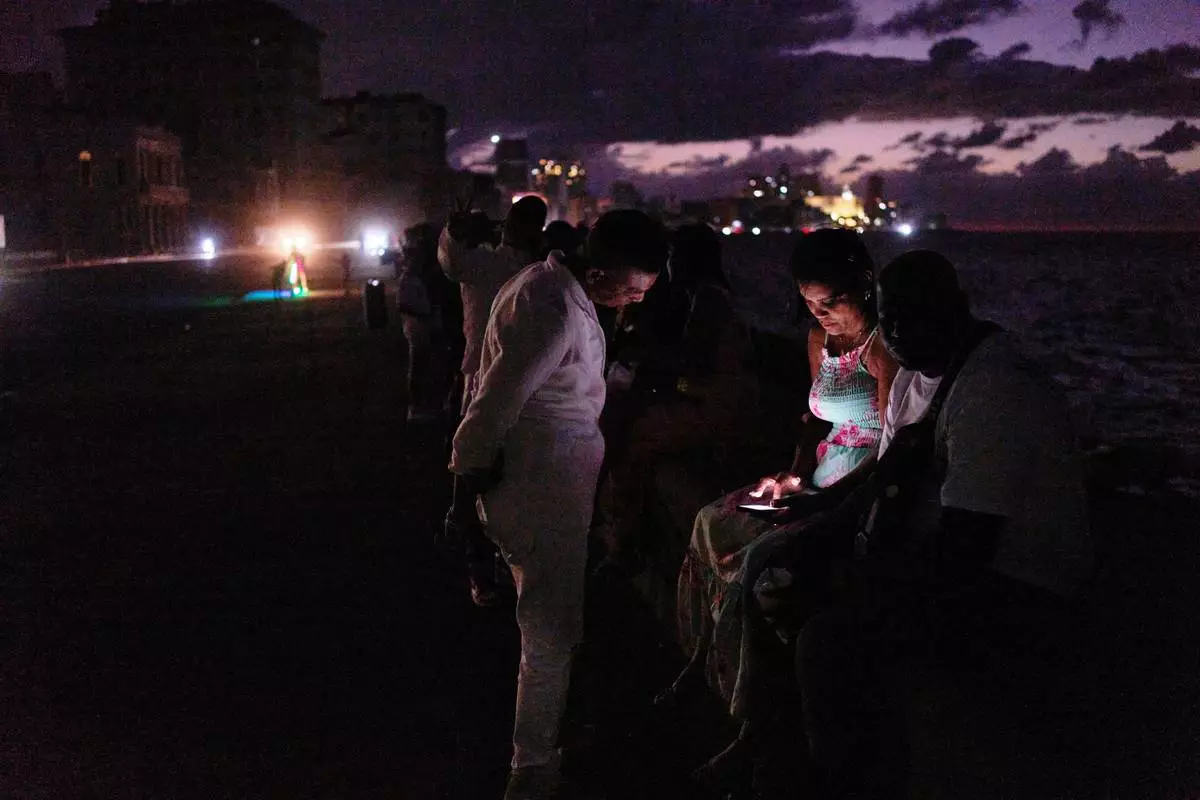
People spend the night in the dark on the Malecon during a blackout in Havana, Cuba, Saturday, March 21, 2026. (AP Photo/Ramon Espinosa)

DUBAI, United Arab Emirates (AP) — Iran launched drone and missile attacks Sunday targeting Bahrain and Kuwait in response to U.S. airstrikes that hit the Islamic Republic, and threatened a “complete halt” in negotiations to end the war if Washington continues its attacks.
Efforts to reopen the Strait of Hormuz without Iran's direct oversight sparked the crossfire now gripping the region and have imperiled negotiations for a lasting ceasefire. A multinational maritime body overseen by the U.S. Navy said Saturday that it would expand a route near Oman for both inbound and outbound traffic, setting up a new flashpoint with Tehran.
The global community has long considered the strait an international passageway, despite its sitting in Iran and Oman's territorial waters. In recent days, Iran has twice attacked vessels going through a route on the Omani side of the strait backed by a United Nations agency.
Iran insists that it alone must govern the strait, the narrow mouth of the Persian Gulf that once carried a fifth of the world’s oil and natural gas. Iranian Foreign Minister Abbas Araghchi reiterated the claim during a state visit to Iraq on Sunday.
“Any interference in this matter, any attempt to establish new or separate arrangements from those currently being carried out by the Islamic Republic of Iran, will only lead to further complications, delay the reopening of the Strait of Hormuz, and increase the level of tension, just as over the past two nights we witnessed incidents in the Strait of Hormuz that led to an increase in tension and confrontation,” he said in Baghdad.
The United States and Iran are still debating the terms of an interim peace deal, including shipping arrangements through the strait, removing a U.S. blockade and sanctions and addressing the future of Iran’s stockpile of highly enriched uranium. Under the memorandum of understanding signed earlier this month, the U.S. and Iran have 60 days to iron out the details.
The strikes threaten to torpedo the deal before it can be finalized. Continued fighting in Lebanon, where an Israeli soldier was killed by Hezbollah fire early Sunday, has also threatened the agreement.
The Kuwaiti military said air defenses intercepted incoming Iranian drones and missiles Sunday morning, just after the U.S. strikes.
Kuwait, which hosts a major U.S. Army base, said it had detected and intercepted two ballistic missiles and there were no reports of injuries or damage.
Bahrain's Interior Ministry said the Iranian strikes damaged a residential building near the international airport and no one was killed. The ministry released photos of an 8-story building, with the top floor destroyed, filled with rubble and its windows blown out.
Bahrain is home to the U.S. Navy’s 5th Fleet, whose base there came under repeated attack during the war. The damaged building on Sunday was not near the fleet's headquarters, in downtown Manama.
Bahrain’s Foreign Ministry denounced what it called “a dangerous escalation that reveals that what Tehran is doing is not a passing act, nor an isolated incident, but rather a deliberate approach and a systematic pattern of repeated aggression."
Iran's paramilitary Revolutionary Guard claimed responsibility for both attacks.
The latest U.S. strikes came after the U.S. and Iran traded attacks earlier in the weekend.
The U.S. military’s Central Command said it struck Iranian military “surveillance infrastructure, communication systems, air defense sites, drone storage facilities and minelayer capabilities” on Sunday, following an attack on a ship at sea early Saturday morning. That ship, the Panamanian-flagged tanker Kiku, carried crude oil for the state-run energy company of Qatar, a key mediator between Iran and the U.S.
In a social media post, Trump said the U.S. had “struck Iranian missile and drone storage locations, and coastal radar sites, for violating the Cease Fire Agreement, AGAIN!” He warned of a point where the U.S. may no longer be able to be reasonable “and will be forced to militarily complete the job.”
“If that happens, the Islamic Republic of Iran will no longer exist!” Trump wrote on Truth Social.
The incident follows a similar back-and-forth that occurred just days prior, when an Iranian drone struck a merchant vessel off the coast of Oman on Thursday, and the U.S. military retaliated with strikes.
Iran has consistently said the ceasefire must include a halt to fighting in Lebanon, where Israel has been battling the Iranian-backed Hezbollah militant group. Days after the U.S. and Israel launched the war against Iran in February, Hezbollah began firing at Israel in solidarity with its Iranian allies. Israel responded with an invasion that has occupied large swaths of southern Lebanon and displaced hundreds of thousands of people. Israel has said it will not withdraw its troops until Hezbollah is disarmed.
Last week, Israel and the Lebanese government signed a framework agreement to end the conflict. But their deal did not include Hezbollah or Iran. Hezbollah has criticized the deal and rejected calls to disarm.
On Sunday, Araghchi again said during a visit to Iraq that the U.S. must force Israel to halt attacks and withdraw. Israel occupies around 600 square kilometers (231 square miles) in southern Lebanon, which it says it needs as a security buffer to halt attacks from Hezbollah.
But sporadic clashes have continued between Israel and Hezbollah.
The leader of the Iran-backed group said Saturday that Hezbollah would continue fighting until Israel withdraws from Lebanon, adding that the group considers the Israeli-Lebanese agreement signed on Friday to be “nonexistent.”
The frequency of Israeli strikes in Lebanon has decreased significantly since the Iran-U.S. deal was signed in mid-June, but strikes have continued, killing at least one person Saturday, according to the Lebanese Health Ministry. Two separate Israeli strikes hit southern Lebanon on Sunday morning — one in the town of Taybeh and another in the Nabatiyeh area, according to Lebanon’s National News Agency. There was no immediate word on casualties.
Overnight, Hezbollah militants killed an Israeli soldier in the village of Deir Siryan in southern Lebanon, according to the Israeli military. Hezbollah did not comment on the incident.
__
Lidman reported from Tel Aviv, Israel. Associated Press writer Sally Abou AlJoud in Beirut contributed to this report.
U.S. Secretary of State Marco Rubio, left, and Bahrain's King Hamad bin Isa Al Khalifa share a word after their meeting, at Al-Sakhir Palace near Zallaq, Bahrain Thursday, June 25, 2026. (Eric Lee/Pool Photo via AP)