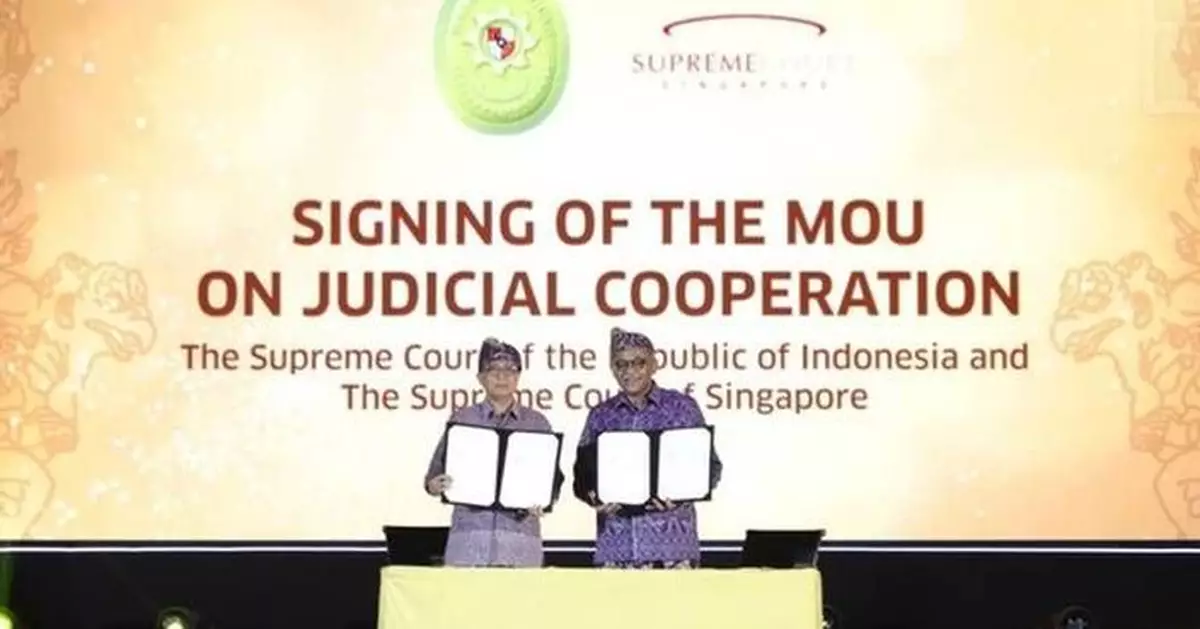
SINGAPORE, April 2, 2026 /PRNewswire/ -- On 30 March 2026, the Supreme Court of Singapore and the Supreme Court of Indonesia signed a Memorandum of Understanding (MOU) to Enhance Cross-Border Communication and Cooperation in Cross-Border Insolvency Proceedings. The signing ceremony was held on the sidelines of the inaugural Judicial Well-Being Workshop for ASEAN Judges in Bali, Indonesia, with The Honourable the Chief Justice Sundaresh Menon of Singapore and Chief Justice Prof. Dr. H. Sunarto, S.H., M.H. of Indonesia as the MOU signatories.
The MOU is another significant milestone in the robust ties between the two jurisdictions, following their first bilateral agreement for judicial cooperation in 2023. Building upon the Model Framework for Communication and Cooperation Between ASEAN Courts in Cross-Border Insolvency Proceedings (Model Framework) approved at the 12th Council of ASEAN Chief Justices Meeting in November 2025, this MOU aims to further improve communication and cooperation in insolvency and restructuring through the designated liaison points, ensuring smoother coordination in the resolution of cross-border insolvency proceedings. By formalising how both courts communicate and providing clarity to stakeholders, the MOU enables more efficient restructuring processes for companies operating across both countries.
Indonesia is the latest ASEAN jurisdiction to join the Singapore judiciary in affirming its commitment to cooperation and communication in cross-border insolvency proceedings by entering into bilateral arrangements. This follows the 2021 protocol on court-to-court communication and cooperation in cross-border corporate insolvency matters with the Federal Court of Malaysia and the 2025 MOU to enhance cross-border communication and cooperation in cross-border insolvency proceedings with the Supreme Court of the Philippines, demonstrating the commitment of ASEAN judiciaries to adopting the Model Framework.
Visit News and speeches (judiciary.gov.sg) for more details.
** This press release is distributed by PR Newswire through automated distribution system, for which the client assumes full responsibility. **
Supreme Courts of Singapore and Indonesia Sign Memorandum of Understanding on Cross-Border Insolvency Cooperation
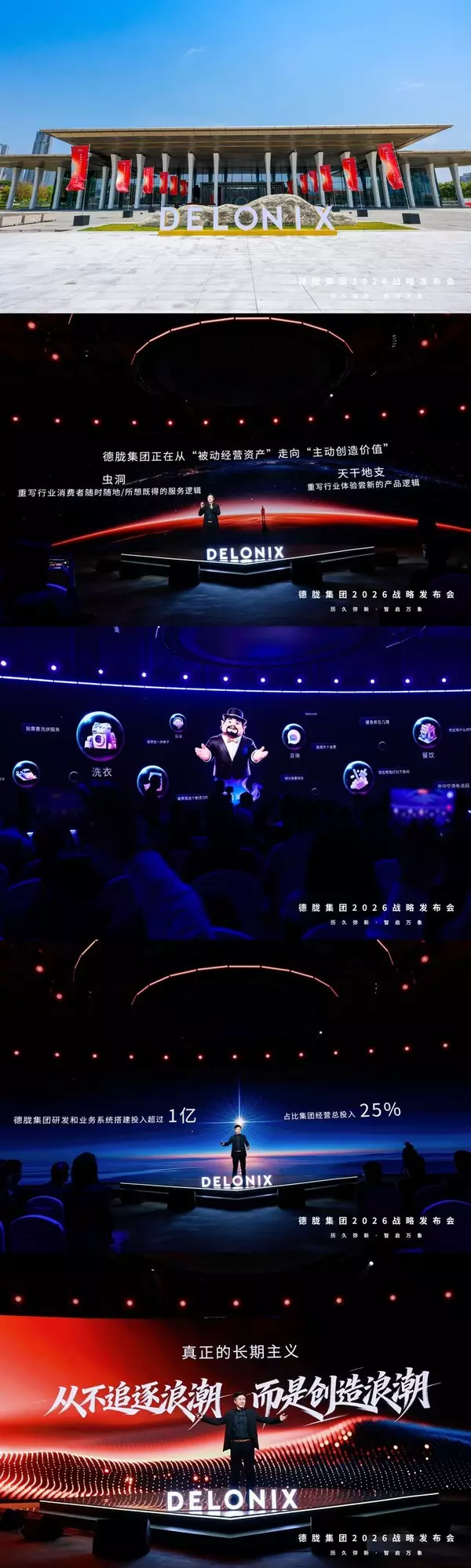
SHENZHEN, China, April 1, 2026 /PRNewswire/ -- On March 30, Delonix Group presented two new initiatives at its 2026 strategy conference: Genie AI, embedded in its Betterwood App, and a customer experience framework known as the Heavenly Stems & Earthly Branches Model.
Individually, they resemble product and service upgrades. Taken together, they suggest something more structural: an attempt to replace the logic on which the hospitality industry has operated for decades.
For most of its modern history, the sector has been governed by a simple equation—growth through physical expansion. More rooms, better locations, higher occupancy. Scale was both strategy and moat.
That equation is beginning to break.
Chairman Zheng Nanyan framed the shift not as cyclical, but structural. The convergence of maturing consumer expectations and rapidly deployable AI systems is eroding the effectiveness of asset-led growth. Standardization, once a tool for efficiency, now produces indistinguishable experiences. Capital intensity, long tolerated, is becoming a constraint.
What is emerging in its place is not a more efficient version of the same model, but a different organizing principle altogether: demand, not supply, as the system's point of origin.
From Capacity to Interpretation
In this emerging model, the central problem is no longer how to build and fill capacity, but how to interpret and respond to fragmented, real-time customer intent.
This is where Delonix is positioning Genie AI.
Unlike most applications of AI in hospitality—which tend to sit at the interface level—Genie AI is designed to sit in the middle of the system, between intent and execution. It does not simply respond to requests; it structures them.
A guest interaction—whether through app input or voice—is translated into a sequence of executable tasks, routed through a centralized decision layer, and distributed to the nearest available human resource, before feeding back into the system as data.
The technical architecture is not unprecedented. What is notable is the ambition to make it foundational.
If it works as intended, service ceases to be a function of individual responsiveness and becomes instead a property of the system itself. Variability, historically managed after the fact, is designed out at the level of coordination.
In that sense, AI is no longer augmenting service. It is defining its boundaries.
Standardization Was the Solution. Now It Is the Constraint.
The industry's previous growth model depended on standardization: replicable rooms, predictable services, consistent delivery across locations. This enabled scale, but at the cost of differentiation.
As consumer expectations evolve, that trade-off is becoming less acceptable.
Delonix's response is not to abandon standardization, but to layer variability on top of it—systematically.
The Heavenly Stems & Earthly Branches Model introduces a framework in which products and services are no longer fixed configurations, but evolving modules. Customer interaction becomes an input into how the product itself is iterated over time.
The implication is subtle but significant.
Hotels are no longer static assets with service attached. They become adaptive systems, where the product is continuously reshaped by usage.
For customers, this promises a form of progression—an experience that accumulates rather than resets. For operators and investors, it suggests a shift from one-off capital deployment to ongoing, incremental reconfiguration.
In both cases, the underlying assumption is the same: value is not embedded in the asset, but generated through interaction.
Control Shifts to the System Layer
What ties these elements together is not technology alone, but control.
In the traditional model, control resided in assets—ownership, location, physical scale. In the emerging model, it moves upward, into the system layer that interprets demand, allocates resources, and continuously adjusts the product.
This shift has implications beyond efficiency.
A system that can interpret intent, coordinate execution, and learn from outcomes begins to set the terms of competition. The advantage no longer lies in having more assets, but in having a better system for deciding how those assets are used.
In that sense, AI is not just infrastructure. It is governance.
An Industry at the Edge of Repricing
China's broader push to integrate AI into industrial and consumer systems provides the backdrop for this shift. Policy frameworks such as the State Council's "AI+" initiative are accelerating deployment, but the more consequential changes are happening at the level of business models.
Hospitality is one of the more exposed sectors.
As the marginal return on physical expansion declines, and as customer expectations become more fluid, the industry is moving toward a repricing of what constitutes value. Scale, once the primary moat, is becoming easier to replicate and harder to defend.
What replaces it is still being defined.
Delonix's approach offers one possible direction: treating demand as a continuously generated input, and building systems capable of capturing and compounding it. Whether this model proves durable remains to be seen. But its premise is clear.
The future of hospitality may depend less on how hotels are built, and more on how they think.
About Delonix Group
Delonix Group is a leading international hospitality and experiential consumption group in the Asia-Pacific region. Ranked 14th globally, the Group partnered with Marriott International to launch the world's first dual-branded luxury property: MajesTang Hotel • A Tribute Portfolio Hotel, while independently creating MaisonLee, a Tang-inspired premium business travel brand. As one of the first Chinese hotel groups to expand overseas, Delonix has established a presence in high-potential markets such as Japan and Indonesia, now spanning more than 200 cities worldwide. Its portfolio encompasses Swiss-Belhotel, Artotel, Model J, hotel MONday, and other brands, positioning the Group at the forefront of building a new generation global platform for high-end hospitality and culturally immersive travel.
** This press release is distributed by PR Newswire through automated distribution system, for which the client assumes full responsibility. **
When Demand Becomes the System: Delonix and the Rewriting of Hospitality's Operating Logic