The recent 2026 Zhongguancun Forum (ZGC Forum) Annual Conference in Beijing has impressed international guests with its focus on deeper integration of technological and industrial innovation, highlighting how China's innovative advances are reshaping daily life.
The five-day forum, themed "Full Integration Between Technological and Industrial Innovation," wrapped up in Chinese capital on Sunday after bringing together more than 1,000 participants from over 100 countries and regions around the world.
More than 560 cutting-edge achievements were unveiled at the event, ranging from embodied intelligent robots and brain-computer interfaces to breakthroughs in quantum applications and 6G research and development.
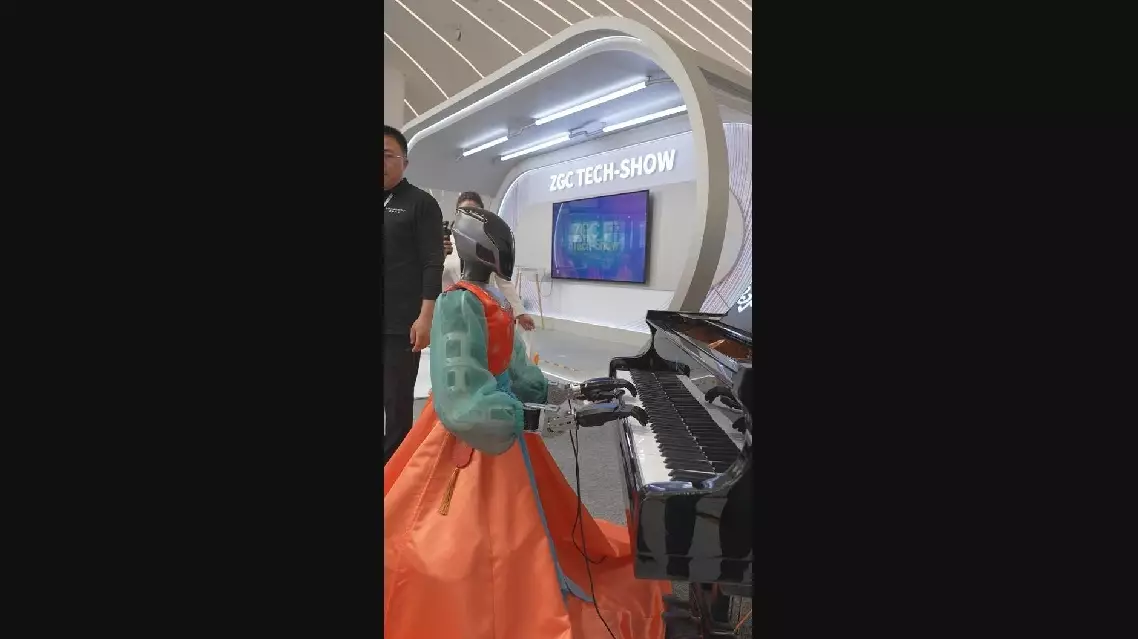
The venue for the forum also showcased a number of these innovative creations to visitors, who were able to enjoy a fresh cup of coffee prepared by a humanoid barista, as well as be throughly entertained by robots performing dances or even playing piano.
Given the presence of these advanced humanoid robots, international participants shared the common view that innovation is no longer confined to laboratories but is now permeating every aspect of daily life.
"The deepest impression is actually to see how much AI is across everywhere," said Anders Karlsson, vice president of Elsevier, a global leader providing advanced information and decision support to accelerate progress in science and healthcare worldwide.
"The Zhongguancun Forum has become a very international window on innovation. We can find out annually how innovation is driving [and a key] component of growth of this wonderful country," said Vincenzo Lipardi, president and co-founder of SPICI, an Italian company assisting businesses and startups with strategic consulting services.
"As a scientist and as a worker of the United Nations system, I'm really pleased to see integration of science, technology and sustainability," said Shahbaz Khan, director of the UNESCO Regional Office for East Asia.
One of the forum's key themes was around opening up and striving for greater cooperation, which demonstrated to the wider world that China's innovation aims to break down barriers and share opportunities, so as to enable the global community to advance together.
"It's my first time attending the forum. And I'm very surprised that you have a very high level of innovation. China is open to ideas. Openness is the way to make innovations," said Prof. Hussein Sherief, a member of the International Committee for Scientific and Technical Data (CODATA).
Int'l guests hail integration of technology, innovation at Beijing forum

Farmers across the U.S. Midwest, a major agricultural hub with over 200 million acres of cropland, are facing unprecedented challenges as the cost of essential agricultural inputs, particularly diesel and fertilizer, has surged in recent weeks.
This sharp increase is largely attributed to the ongoing U.S.-Israeli war with Iran, which began in late February, and its ripple effects on global markets. The rising expenses are casting a shadow over the upcoming planting season, threatening to erode profitability for many.
At a farm in southern Illinois, preparations for planting season are underway, a process that critically relies on the application of fertilizer. However, the cost of this vital resource has escalated dramatically.
Brian Duncan, a farmer in Illinois, highlighted the global nature of the impact.
"The Strait of Hormuz is very important for transit of fuel and fertilizer, and it's a global market. So even if the shipments that were coming here are not impacted, what we will see is a global rise in price because of that insecurity, and it will impact us here," he said.
With many U.S. farmers locking in fertilizer prices last year, the full impact on farmers is only likely to be felt later in the year, if the conflict continues and fertilizer prices remain high.
Robb Ewoldt, a farmer in the neighboring state of Iowa, echoed these concerns. He noted that while farmers have faced high costs before, the current situation is compounded by depressed commodity prices for crops like soybeans and corn, meaning farmers face the prospect of producing at a loss this year.
"We have higher cost, and that's the biggest thing. We have had our costs be higher in the past, but right now, our commodity prices are a little bit depressed, and so it's making it very challenging to be profitable and make a positive cash flow for the year," said Ewoldt.
As fertilizer prices skyrocket, concerns are growing for many farmers. In the longer term, if input costs including fertilizer remain high, the consequences for farmers could be dire.
"The sentiment is, you know, when I go to meetings, we think, well, there's going to be, some of us aren't going to be here next year because we're not going to be in business," said Ewoldt.
"I'd say it's a time of concern, perhaps a time of survival mode, where we're looking to cut costs, not make any new expenditures, and try to hang on for either a better marketplace dynamic or a significant lowering of our input costs," said Duncan.
As the planting season commences, the inherent optimism of farmers will be put to the test against a backdrop of economic uncertainty and geopolitical volatility.
Soaring diesel, fertilizer costs hit US farmers