INDIANAPOLIS (AP) — Tarris Reed Jr. sat at his locker Thursday, fielding questions about his run as the interior-scoring, rebound-snagging force in UConn's latest Final Four push.
Yet he wasn't the main attraction.
That's because across the room, an even bigger gaggle of reporters waited for freshman guard Braylon Mullins — the Indiana kid who hit an all-timer of a shot to send the Huskies back to the sport's biggest stage — to return for his own round of interviews.
“Guards are the ones that hit the big shots,” Reed said Thursday when asked about big men getting their due, adding with a grin: “We just do our job, we do the dirty work — and we're used to doing it our whole life so we have fun doing it.”
Maybe so, but there's no minimalizing the impact of size this week in Indianapolis. Not with the Final Four boasting its biggest quartet of teams going back roughly two decades, starting with guys such as Reed, Michigan's Aday Mara, Arizona's Koa Peat and Illinois' 7-foot Ivisic twins as anchors to lineups with size radiating all the way out to the perimeter.
The average height of the Final Four teams is nearly 79.1 inches, or roughly 6 feet 6, according to KenPom’s analytics site. That edges last year’s average of nearly 78.3 inches for the biggest of any Final Four going back to the start of KenPom’s data in 2007.
Illinois (28-8) is Division I's tallest team with an average roster height of nearly 6-7 (80 inches), while Arizona (36-2) is seventh at nearly 6-6 (79 inches). Michigan (35-3) and UConn (33-5) are in the top 30 nationally with nearly identical averages slightly behind the Wildcats.
Consider it a sign of the premium each team put on building a roster to overwhelm teams inside, on the glass and with game-altering length spanning the gaps between.
That kind of size, strength and wingspan creates trouble cascading through the matchups. ACC Network analyst Luke Hancock said teams are also thriving by finding power forwards and centers capable of stepping outside to stretch defenses further and create space, eliminating the ability for a defense to simply collapse on a lone big man.
“Guards still win in March,” said Hancock, the most outstanding player of the 2013 Final Four in Louisville’s later-vacated title run. "But I think these guys have become almost like a necessary component. If you want to win championships, you need a big 4 and a monster 5.”
And it's manifesting in several ways as March Madness reaches its final act.
The Illini have had the best defensive tournament efficiency of the Final Four teams while dominating the glass to complete those stops. Their roster includes an influx of European talent, including Tomislav (7-1) and Zvonimir Ivisic (7-2), as well as 6-9 forward David Mirkovic from Montenegro.
The Illini also brings 6-9, 235-pound graduate Ben Humrichous off the bench, while the outlier in the big lineup is 6-2 senior guard Kylan Boswell as a strong backcourt defender.
The South Region champion has allowed .976 points per possession in the NCAA Tournament to lead the remaining four teams. Throw in the fact that Illinois is outrebounding opponents by 16.3 per game, and it's been a perfectly timed boost to an already elite offense with those forwards and centers capable of hitting from behind the arc, too.
"Playing in the summer, you could tell it’s a little bit harder to do some things just because you’ve got Z at the rim, who’s 7-foot-2 and a great shot blocker," 6-6 forward Jake Davis said. “You got Tommy down there. So anybody you’re going up against in practice is super tall. ... We’ve just got a bunch of length everywhere. And you could tell early on that we could cause problems for other teams.”
The Illini will be tested against Reed, a 6-foot-11, 265-pound senior whose scoring (21.8) and rebounding (13.5) averages in the tournament are the best of any player still standing.
That included opening the tournament with a video game-type stat line of 31 points and 27 rebounds against Furman, making him the first player with 30-plus points and 25-plus rebounds in an NCAA Tournament game since Houston’s Elvin Hayes did it twice in 1968.
He’s coming off a 26-point showing in the comeback from 19 down to stun Duke in the Elite Eight.
“He’s a monster,” said UConn senior Alex Karaban, who was part of the Huskies’ 2023 and 2024 title winners. “He’s been so dominant. He’s really playing like the most dominant player in college basketball right now.”
When it comes to the No. 1 seeds, the Wolverines have hummed with 90-plus points in four tournament wins. The Wildcats have been right behind in offensive efficiency despite being shooting fewer 3-pointers than just about every other Division I team all season.
Their meeting Saturday matches strengths.
Michigan has used the 7-3, 255-pound Mara to protect the paint, flanked by a pair of versatile 6-9 forwards in Associated Press first-team All-American Yaxel Lendeborg (240 pounds) and Morez Johnson Jr. (250).
“Our size definitely makes it tougher for smaller guards,” Lendeborg said. “Because we’re so versatile ... we can switch and guard point guards, make their life a little harder. And you know, we’re all strong bodies too. So we try to wear down teams.
“And then, toward the end of the game, that’s when we usually make our runs when we need it.”
Michigan will be tested against the Wildcats with 7-2 center Motiejus Krivas (10.4 points, 8.2 rebounds) and Peat, a 6-8, 235-pound freshman considered a strong NBA prospect.
“If you don't have the big to defend other bigs, you can't compete at this level in my opinion,” Hancock said.
“How do you make it so you're really tough to guard and you have an advantage? It’s the 4-men in this Final Four who are just so talented and the diversity of their skill sets — they can do so many things. That is the ultimate to me.”
AP March Madness bracket: https://apnews.com/hub/ncaa-mens-bracket and coverage: https://apnews.com/hub/march-madness

Arizona forward Koa Peat (10) dunks during the second half in the Elite Eight of the NCAA college basketball tournament against Purdue, Saturday, March 28, 2026, in San Jose, Calif. (AP Photo/Kelley L Cox)
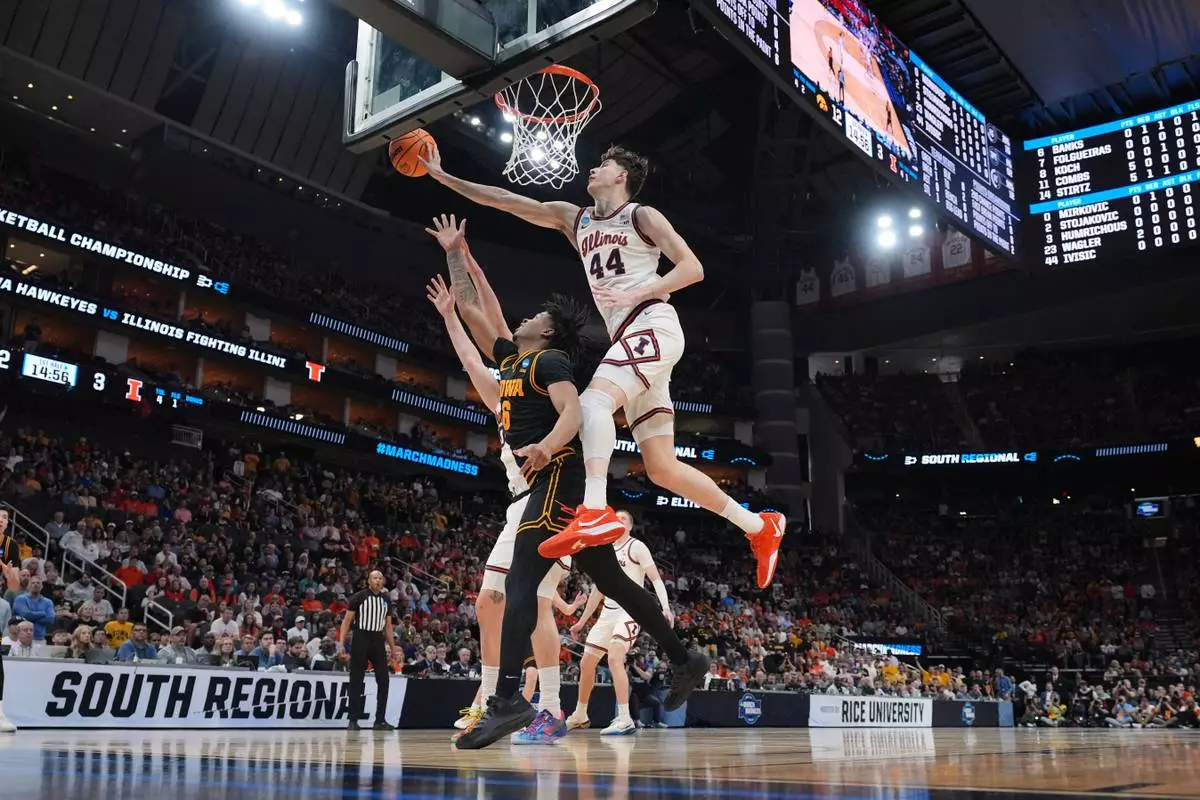
Iowa's Tavion Banks (6) has his shot blocked by Illinois' Zvonimir Ivisic (44) during the first half of an Elite Eight game in the NCAA college basketball tournament Saturday, March 28, 2026, in Houston. (AP Photo/Eric Gay)

UConn forward Tarris Reed Jr. (5) reacts after the team's win against Duke in the Elite Eight of the NCAA college basketball tournament, Sunday, March 29, 2026, in Washington. (AP Photo/Abbie Parr)
WASHINGTON (AP) — President Donald Trump’s White House ballroom won final approval from a key agency on Thursday, despite a federal judge recently ordering a halt to construction unless Congress allows what would be the biggest structural change to the American landmark in more than 70 years.
The 12-member National Capital Planning Commission, the agency tasked with approving construction on federal property in the Washington region, went ahead with the vote because U.S. District Judge Richard Leon’s ruling — which came two days earlier — affects construction activities but not the planning process, said the commission's Trump-appointed chair, Will Scharf.
A vote of 8-1, with two commissioners voting present and one absent, allowed the plan to move forward.
Despite the agency’s approval, however, the judge’s ruling and a legal fight over the ballroom could stall progress on a legacy project that Trump is racing to see completed before the end of his term in early 2029. It’s among a series of changes the Republican president is planning for the nation’s capital to leave his lasting imprint while he’s still in office.
Before the vote, Scharf, a top White House aide, noted that Leon's order has been stayed for two weeks as the administration seeks an appeal. He said, as he understood the decision, it “really does not impact our action here today.”
Reading from notes, Scharf also delivered an impassioned defense of the project that reviewed the full history of the White House — including changes and additions that were criticized at the time they were made but have become beloved with the passage of time. He spoke about the addition of the north and south porticos and the balcony added by President Harry Truman.
Scharf suggested that Trump’s proposed ballroom will similarly come to be viewed as a wise addition — despite drawing contemporary opposition from some members of the public and government officials.
“I believe that, in time, this ballroom will be considered every bit of a national treasure as the other key components of the White House,” Scharf said.
Scharf also said the proposed ballroom has been viewed negatively because of opposition to Trump, instead of the merits, saying, “I feel that we’ve been unfairly slighted in the press and otherwise for the way we’ve gone about reviewing this particular project.”
The vote by the commission, which includes three members Trump gets to appoint, had initially been scheduled for March but was postponed to Thursday because so many people signed up to comment at the commission’s meeting last month. The comments were overwhelmingly opposed to the ballroom.
The lone “no” vote was cast by Phil Mendelson, a Democrat who chairs the Council of the District of Columbia. Linda Argo and Arrington Dixon, the two commissioners appointed by Mayor Muriel Bowser, a Democrat, voted present.
Mendelson criticized the design of the ballroom addition and how fast it was approved.
“It’s just too large,” he said.
Criticism also came from Public Citizen, a nonprofit consumer advocacy organization. One of its attorneys, Jon Golinger, said the commission had discounted opposition from city officials and thousands of people who commented against the project, and ignored the judge's ruling. Several commissioners, including Scharf, had said they took the public feedback seriously.
“This approval is illegitimate and this vote is a joke," Golinger said.
White House spokesperson Davis Ingle, commended the “decision to approve President Trump’s historic vision to build a much need ballroom at the White House.”
“We look forward to seeing the completion of this project on time and under budget," Ingle said in a statement.
Before voting, the commission considered some design changes to the 90,000-square-foot (8,400-square-meter) ballroom addition that the president announced aboard Air Force One on Sunday, as he flew back to Washington from a weekend at his Florida home.
He removed a large staircase on the south side of the building and added an uncovered porch to the west side. Architects and other critics of the project had panned the staircase as too large and basically useless since there was no way to enter the ballroom at the top.
A White House official said the president had considered comments from the National Capital Planning Commission and another oversight entity, the U.S. Commission of Fine Arts, which approved the project earlier this year, as well as members of the public.
The official, who was not authorized to publicly discuss the ballroom design and spoke on the condition of anonymity, said that additional “refinements” had been made to the building’s exterior.
The ballroom, now estimated to cost $400 million, has expanded in scope and price tag since Trump first announced the project last summer, citing a need for space other than a tent on the lawn to host important guests. Trump demolished the East Wing in October with little warning, and site preparation and underground work have been underway since then.
Two other Trump-appointed commissioners, Stuart Levenbach and James Blair, voted for the project.
Levenbach, who serves as vice chairman and is the federal government’s chief statistician, said the White House is currently “not suited” to accommodate large numbers of guests and that the addition will improve the “utility” of the compound.
He said tunnels and other structures underground at the White House made it impossible to place many features of the ballroom there, too, as some have suggested might be possible. Levenbach said the addition is a “multipurpose facility,” noting that, in addition to a ballroom, it will also have offices for the first lady, kitchen space and a theater.
“This is not an expansion for its own sake,” Levenbach said.
Blair, a deputy to White House chief of staff Susie Wiles, said visitors and guests of the president deserve a “better experience."
Scharf and Blair also said Trump will get “very limited use” of the ballroom before his term ends.
Trump went ahead with the project before seeking input from the National Capital Planning Commission and the Commission of Fine Arts, which he reconstituted with allies and supporters.
The National Trust for Historic Preservation, a private nonprofit organization, sued after Trump demolished the East Wing last fall to build the ballroom addition — a space nearly twice as big as the mansion itself.
Trump says it will be paid for with donations from wealthy people and corporations, including him, though public dollars are paying for underground bunkers and security upgrades.
The trust sought a temporary halt to construction until Trump presented the project to both commissions and Congress for approval. Leon agreed but said that his order would take effect in two weeks and that construction related to security would be allowed.

President Donald Trump answers questions from reporters after signing an executive order in the Oval Office of the White House Tuesday, March 31, 2026, in Washington. (AP Photo/Alex Brandon)

Work continues on the construction of the ballroom at the White House in Washington, Wednesday, April 1, 2026. (AP Photo/Allison Robbert)

President Donald Trump holds a rendering of the proposed new East Wing of the White House as he speaks to reporters aboard Air Force One en route from West Palm Beach, Fla., to Joint Base Andrews, Md., Sunday, March 29, 2026. (AP Photo/Mark Schiefelbein)

Work continues on the construction of the ballroom at the White House in Washington, Wednesday, April 1, 2026. (AP Photo/Allison Robbert)

President Donald Trump holds a rendering of the proposed new East Wing of the White House as he speaks to reporters aboard Air Force One en route from West Palm Beach, Fla., to Joint Base Andrews, Md., Sunday, March 29, 2026. (AP Photo/Mark Schiefelbein)