Skip to Content Facebook Feature Image

Spring break coincides with Qingming holiday, fueling tourism boom across China

China

China

China

Spring break coincides with Qingming holiday, fueling tourism boom across China

2026-04-03 14:27 Last Updated At:04-04 11:37

Cities across China are experiencing a significant tourism boom as the three-day Qingming Festival holiday coincides with the first-ever student spring breaks in multiple cities, creating an extended travel period for many families.

Qingming Festival, or Tomb-Sweeping Day, falls on April 5 this year. It is a traditional Chinese festival for honoring the deceased and paying tribute to ancestors. The holiday also provides a short break for Chinese citizens as they engage in outdoor activities and sightseeing. The Qingming Festival holiday will last from April 4 to 6.

In addition, primary and secondary school students in several regions are going to enjoy their first-ever spring break to head beyond the classroom for travel and engaging in a wide range of activities. In some areas, the spring break takes place just before the three-day Qingming Festival in early April, while in others it extends into the five-day May Day holiday, allowing students to combine leave into six- to eight-day mini-breaks.

With spring in full bloom, many families are venturing into nature to enjoy the spring scenery and experience the spring atmosphere in mountains and fields.

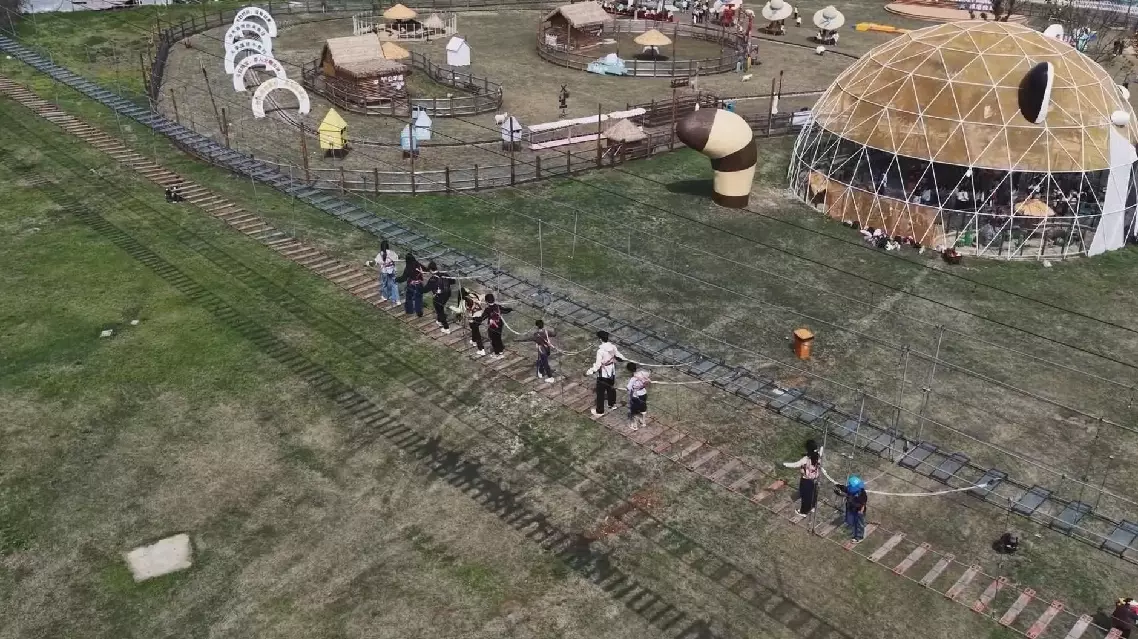
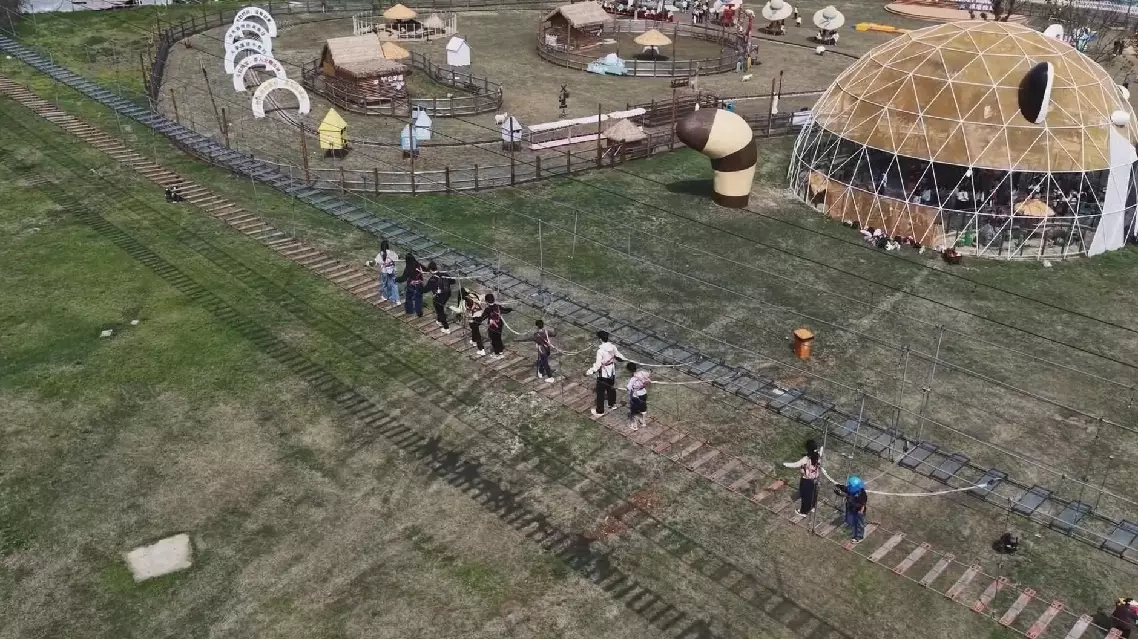
At Maoshan Forest World, a scenic spot in Changzhou, east China's Jiangsu, families from surrounding cities such as Nanjing, Nantong, and Zhenjiang are coming in groups. They interacted with adorable animals and experienced digging for bamboo shoots. Under the guidance of the staff, children identified and dug bamboo shoots, experiencing the joyful moments of labor.

"I want my child to get closer to nature, feel the breath of spring, and experience the joy of labor," said Deng Jie, a tourist.

During the holiday, traveling to famous destinations featured in textbooks has become a popular choice for many families.

In east China's Zhejiang Province, several scenic spots have introduced free admission for primary and secondary school students. At the Yanguan Ancient Town in Haining, many students can experience the spectacular sight of magnificent tidal waves of Qiantang River described in textbook.

"We just rode a bamboo raft and are going to watch the Qiantang River tidal bore tomorrow," said Zhao Ziyu, a tourist.

Integrating educational content with holiday vibes, study tours remain popular during the holiday.

At the Wujiangzhai Scenic Spot in Zunyi, southwest China's Guizhou Province, after watching an ethnic performance, many young visitors went to a lantern shop to experience making intangible cultural heritage lanterns. From constructing bamboo frames to pasting paper and coloring, a teacher guided them step by step, and the visitors incorporated the scenic area's landscapes and their own life expectations into their creations.

In Liangdancheng (city of nuclear bombs), the site where China's first atomic and hydrogen bombs were designed, in Zitong County of Mianyang, southwest China's Sichuan Province, a large number of students visited the local aerospace science and technology museum. In the interactive experience area, students operated simulated spaceflight equipment, acting as little astronauts exploring a virtual universe. By wearing Mixed Reality (MR) glasses, they can observe the mysteries of planets up close.
Spring break coincides with Qingming holiday, fueling tourism boom across China
Spring break coincides with Qingming holiday, fueling tourism boom across China

Spring break coincides with Qingming holiday, fueling tourism boom across China
Spring break coincides with Qingming holiday, fueling tourism boom across China

Amid the rising fuel costs and airline surcharges linked to the U.S.-Israeli war against Iran, Caribbean tourism officials gathered at the 44th Caribbean Hotel and Tourism Association Forum this month and expressed cautious optimism, citing resilient visitor demand, strategic marketing adjustments, and strong seasonal performance as foundations for continued recovery.

The U.S.-Israeli war against Iran is already affecting Caribbean economies as fuel prices surge and airlines pass costs on to passengers. This not only pressures the region's tourism-dependent economies but also raises the cost of imported food, electricity, and transportation.

Since the start of the conflict, the price of Brent crude has surged nearly 50 percent, prompting airlines to find the ways to share the burden with travelers.

"The impacts are unfolding in stages. In the first place, when the uncertainty, or the disturbance occurred in the Middle Eastern region, it actually cut the supply chain to some extent to the Pacific, and people started to look at the region in particular. We amplified out marketing presence, to ensure that when people are looking for an option or places to rebook, that St. Lucia would turn up. And we've actually seen some of that result," said Louis Lewis, chief executive officer of the Saint Lucia Tourism Authority.

During the International Monetary Fund's Spring Meeting, the international financial institution expressed its concern for Caribbean tourism, warning that it could see a decline as ticket prices increase.

Lewis acknowledged the potential for longer-term disruption.

"The second thing is that if the conflict continues as a prolonged activity, we anticipate that it could impact us. We will have to diversify from our major source markets, hence the reason why we are looking at Latin America," he said.

But some of the region's top tourism officials are seeing positive signs. The region is coming off another successful year, where tourism arrivals grew by 2.5 percent, adding an additional 900,000 visitors over 2024.

"The region has been witnessing a very good winter season, and I have no doubt whatsoever that the forecast that we have for the summer will continue to be very strong," said Ian Gooding-Edghill, minister of tourism of Barbados.

Still, structural vulnerabilities remain. As an import-dependent region, the Caribbean is highly exposed to global price fluctuations. Concerns are mounting that rising prices in the United States could trigger sharper inflationary pressures, including higher operating costs in the tourism sector.

"In Saint Lucia, we just saw the cost of energy increase about 20 percent, and that's having an impact now going into the summer when our rates are lower. It rallies points to the importance of us building a bit more resilience into Caribbean tourism," said Sanovnik Destang, president of the Caribbean Hotel and Tourism Association.

Caribbean tourism shows resilience despite Middle East tension challenges

Caribbean tourism shows resilience despite Middle East tension challenges

Recommended Articles