ATLANTA (AP) — The Georgia General Assembly ended its annual session early Friday without a plan for new equipment to overhaul the state's voting system by a July deadline, plunging into doubt the future of elections in the political battleground.
The lawmakers' failure to offer a solution after months of debate raises uncertainty about how Georgians will vote in November and leaves confusion that could end in the courts or a special legislative session.
“They’ve abdicated their responsibility,” Democratic state Rep. Saira Draper said of inaction by Republicans who control the legislature.
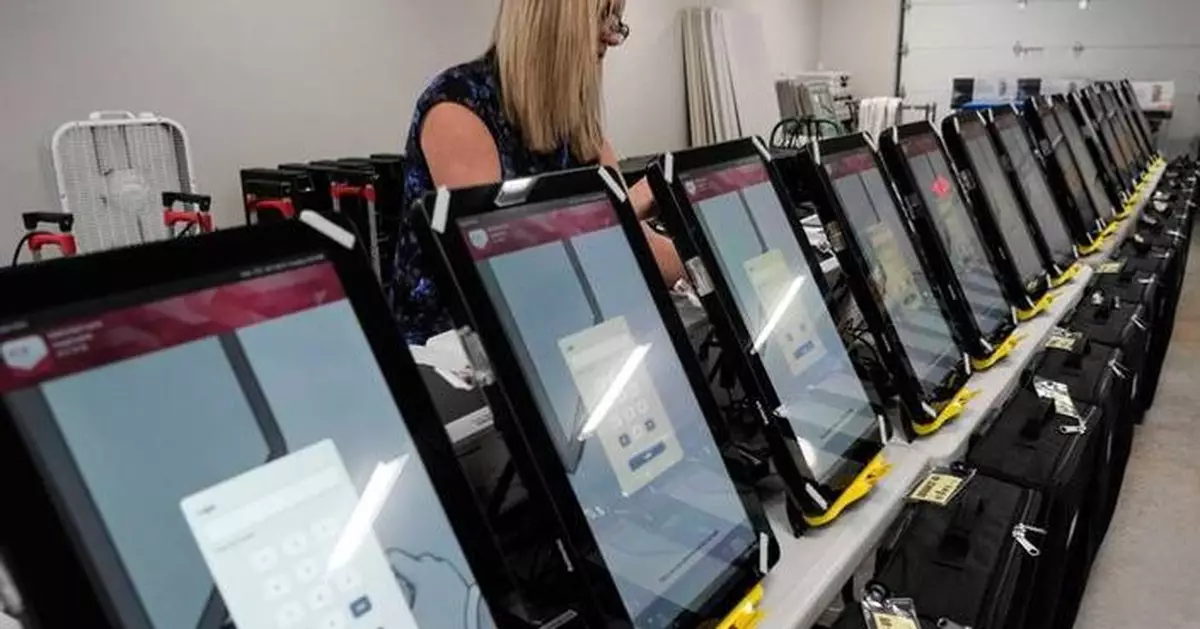
Currently, voters make their choices on Dominion Voting machines, which then print ballots with a QR code that scanners read to tally votes. Those machines have been repeatedly targeted by President Donald Trump following his 2020 election loss, and Trump’s Georgia supporters responded by enacting a law in 2024 that bans using barcodes to count votes.
But state law still requires counties to use the machines. No money has been allocated to reprogram them, and lawmakers failed to agree on a replacement.
“We’ll have an unresolvable statutory conflict come July 1,” said House Governmental Affairs Committee Chairman Victor Anderson, a Cornelia Republican who backed a proposal to keep using the machines in 2026 that Senate Republicans declined to consider.
House Republicans and Democrats backed Anderson's plan, which would have required that Georgia choose a voting process that didn't use QR codes by 2028. Election officials preferred that solution.
“The Senate has shown that they’re not responsible actors,” Draper said. She added that Lt. Gov. Burt Jones, a Trump-endorsed Republican running for governor, seemed more interested in keeping Trump's backing than “doing right by Georgia voters.”
A spokesperson for Jones didn't immediately respond to a request for comment early Friday.
Joseph Kirk, Bartow County election supervisor and president of the Georgia Association of Voter Registration and Election Officials, said he’ll look to the secretary of state for guidance and assumes a judge will rule to instruct election officials how to proceed.
“This is uncharted territory,” he said.
Robert Sinners, a spokesperson for Republican Secretary of State Brad Raffensperger, who is also running for governor, said officials are “ready to follow the law and follow the Constitution.”
Republican House Speaker Jon Burns told reporters that his chamber was seeking to minimize changes this year.
“You can’t change horses in the middle of the stream,” Burns said.
Burns said he would meet with Gov. Brian Kemp and “take his temperature" on the possibility of a special session. A spokesperson for Kemp didn't answer questions about what the outgoing Republican governor would do.
Anderson said without action, the state could be required to use hand-marked and hand-counted paper ballots in November.
Election officials say switching to a new system within just a few months, as advocated by some Republicans, would be nearly impossible.
“They made no way for this to happen except putting a deadline on it," Cherokee County elections director Anne Dover said of the switch away from barcodes. Dover said one problem under some plans is that a very large number of ballots would have to be printed.
Lawmakers seemed more concerned about scoring political points than making practical plans, Paulding County Election Supervisor Deidre Holden said.
“If anyone is resilient and can get the job done, it’s all of us election officials, but the legislators need to work with us, and they need to understand what we do before they go making laws that are basically unachievable for us,” Holden said.
Supporters of hand-marked paper ballots say voters are more likely to trust in an accurate count if they can see what gets read by the scanner.
Right-wing election activists lobbied lawmakers for an immediate switch to hand-marked paper ballots, but the House turned away from a Senate proposal to do so.
Anderson said he wasn’t sure if a special session could escape those political crosswinds, but said Georgia lawmakers must fix the problem.
“This is a legislative problem,” Anderson said. “It’s a legislative solution that has to happen.”
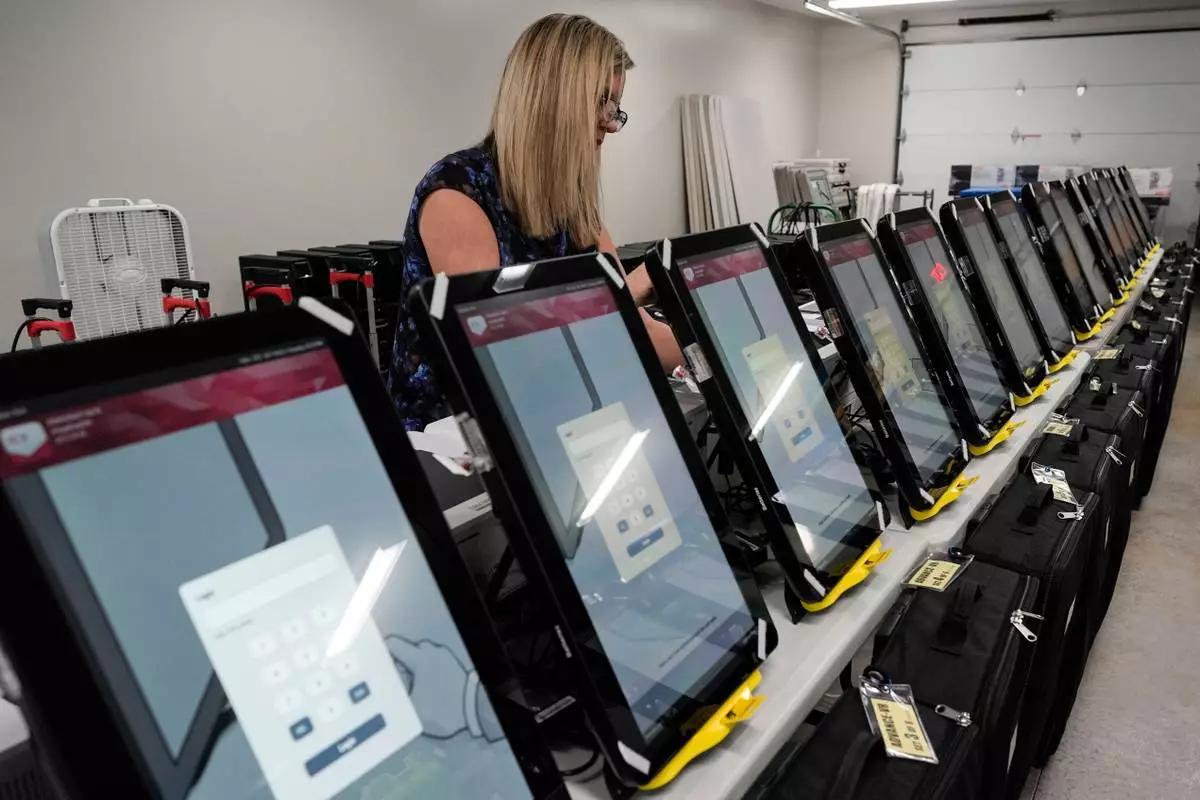
FILE - Voting machines are seen at the Bartow County Election office, Jan. 25, 2024, in Cartersville, Ga. (AP Photo/Mike Stewart, File)
BANGKOK (AP) — Myanmar’s parliament on Friday elected Min Aung Hlaing, a general who ousted Aung San Suu Kyi’s civilian government in 2021 and kept an iron grip on power for the past five years, as the country’s new president.
The move marks a nominal return to an elected government but is widely considered as an effort to keep the army in power after an election organized by the military that opponents and independent observers deemed neither free nor fair.
Transitioning to an elected government is also seen as a way to improve frosty relations with Asian neighbors following the military takeover. China and Russia have supported the military administration, while Western powers imposed sanctions.
Min Aung Hlaing was one of three nominees for the president’s post, but was virtually guaranteed the job as lawmakers from military-backed parties and appointed members from the army hold a commanding majority in parliament.
The vote was held in the newly renovated parliament building in the capital, Naypyitaw, which was damaged in last year’s earthquake.
Aung Lin Dwe, speaker of parliament’s combined upper and lower house, announced that Min Aung Hlaing won 429 out of the 584 votes.
The two runners-up become vice presidents. Nyo Saw, a former general, had served as an adviser to Min Aung Hlaing, and Nan Ni Ni Aye, an ethnic Karen politician from the pro-military Union Solidarity and Development Party, will be the country’s first female vice president. They are expected to be inaugurated next week.
Min Aung Hlaing, who holds the rank of senior general, had earlier relinquished his post of commander-in-chief because the constitution prohibits the president from simultaneously holding the top military position. A close aide, Gen. Ye Win Oo, took over the powerful job.
The 69-year-old Min Aung Hlaing had been the military chief since 2011. Under the military-imposed constitution, he held significant powers even before overthrowing Suu Kyi’s government.
Parliament members were elected in three phases in December and January. Major opposition parties, including Suu Kyi’s former ruling National League for Democracy, were either blocked from running or refused to compete under conditions they deemed unfair. Suu Kyi, 80, is serving a 27-year prison term on charges widely viewed as politically motivated.
Myanmar was under military rule from 1962 until 2016, when Suu Kyi’s party came to power, and won an even greater mandate in the 2020 general election. The army took seized control in 2021, before the new Parliament could convene.
Peaceful protests against military rule were put down with deadly force, pushing pro-democracy activists to turn to armed resistance and ally themselves with ethnic minority groups who have been battling for greater autonomy for decades.
Much of the country has been enmeshed in a bloody civil war. Security concerns meant voting in the recent election could be held in only 263 of the country’s 330 townships.
“If Min Aung Hlaing thinks that an official civilian title will shield him from prosecution for the many grave violations of international law that he is accused of overseeing as head of the military, that is not how international justice works," Amnesty International Myanmar researcher Joe Freeman said in statement.
In 2024, the International Criminal Court in The Hague began an investigation on charges of crimes against humanity after a prosecutor applied for an arrest warrant for Min Aung Hlaing over the military’s brutal persecution of the Rohingya minority.
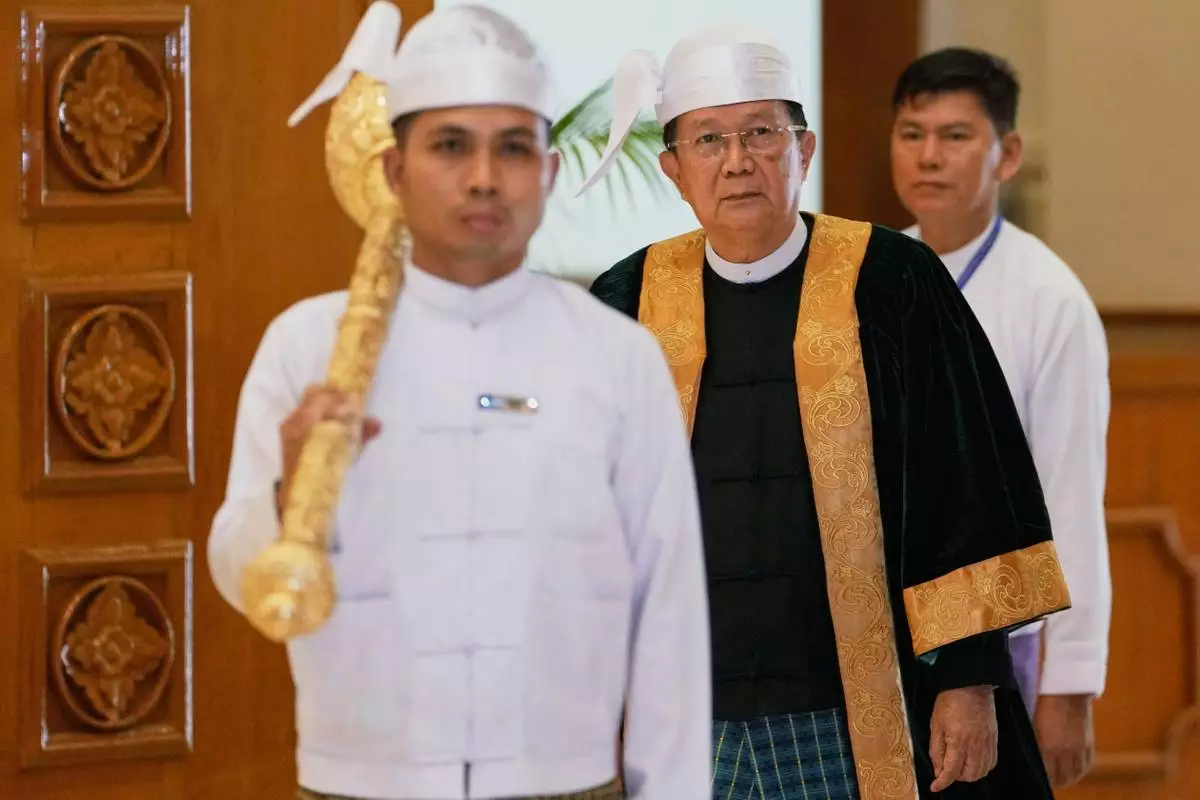
Parliament chairman Aung Lin Dwe, center, arrives for a session of Union Parliament in Naypyitaw, Myanmar, Friday, April 3, 2026. (AP Photo/Aung Shine Oo)
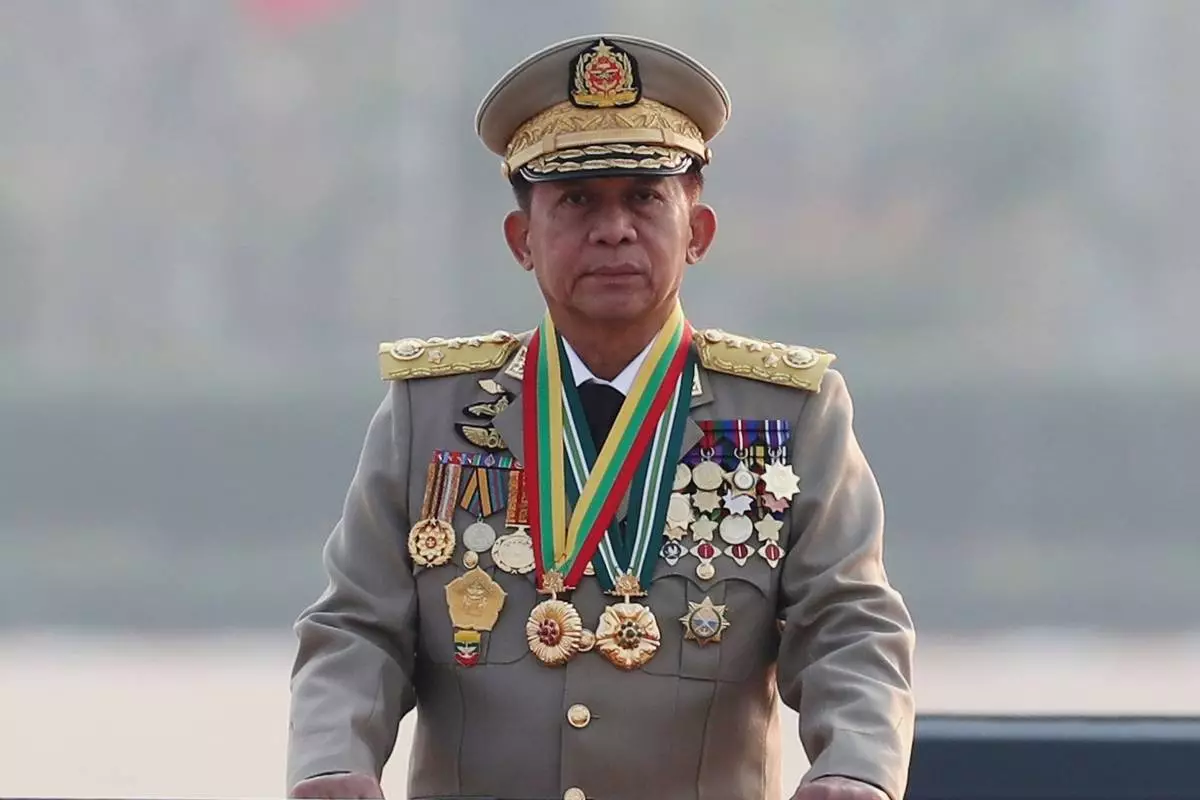
FILE - Senior Gen. Min Aung Hlaing, head of Myanmar's military council, inspects officers during a parade to commemorate Myanmar's 78th Armed Forces Day in Naypyitaw, Myanmar, March 27, 2023. (AP Photo/Aung Shine Oo, File)
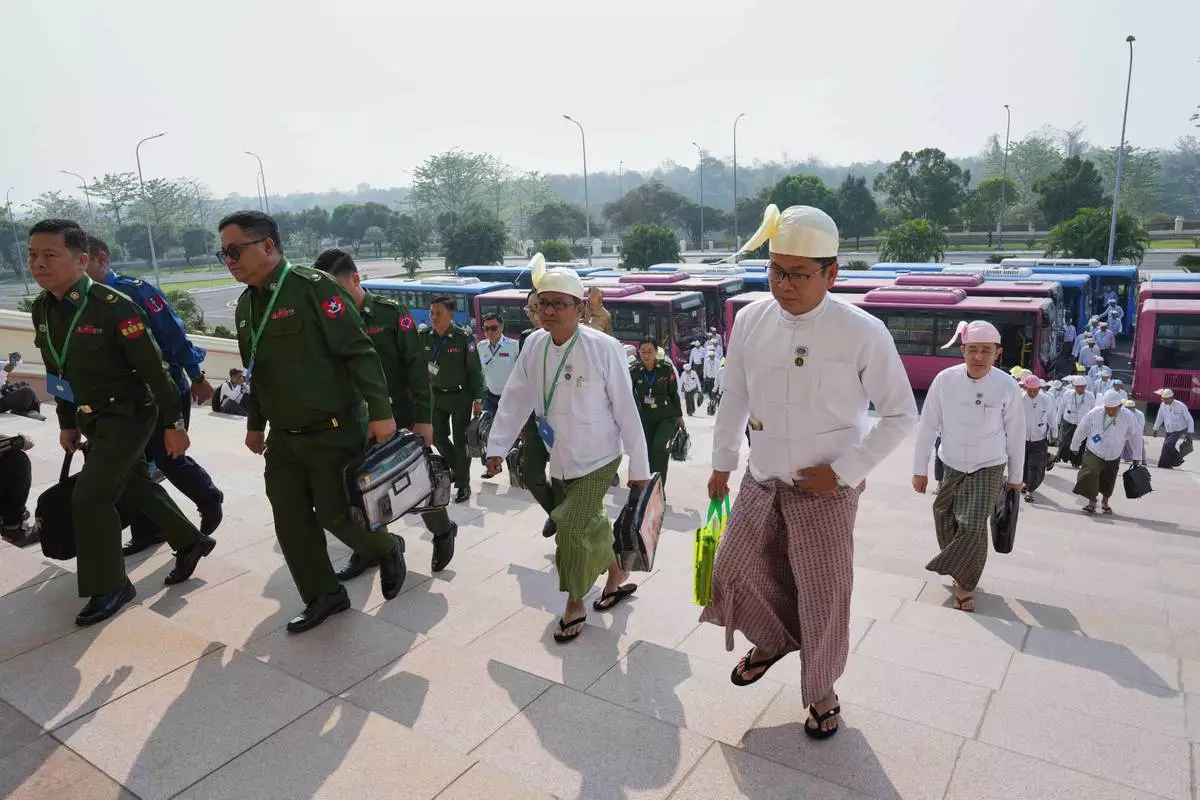
Myanmar's military representatives and lawmakers arrive to attend a session at Union parliament in Naypyitaw, Myanmar, Friday, April 3, 2026.(AP Photo/Aung Shine Oo)
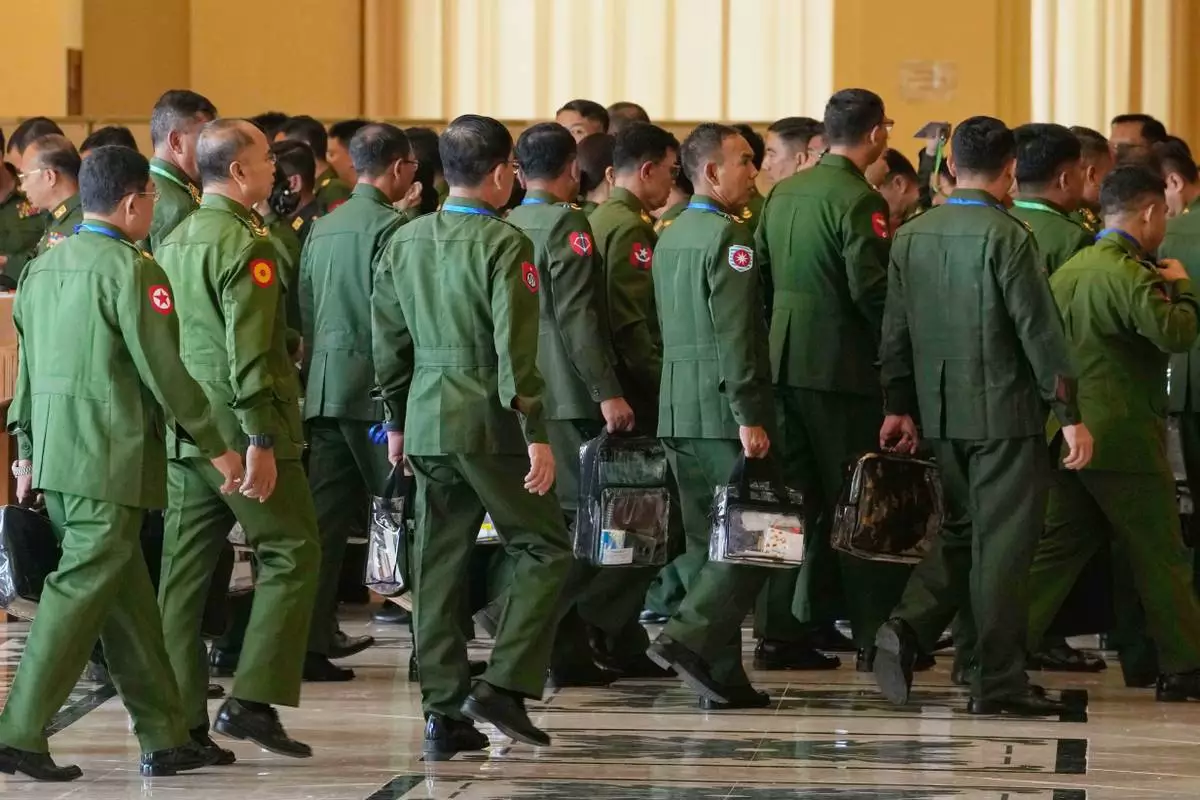
Myanmar's military representatives arrive for a session at Union parliament in Naypyitaw, Myanmar, Thursday, April 2, 2026. (AP Photo/Aung Shine Oo)
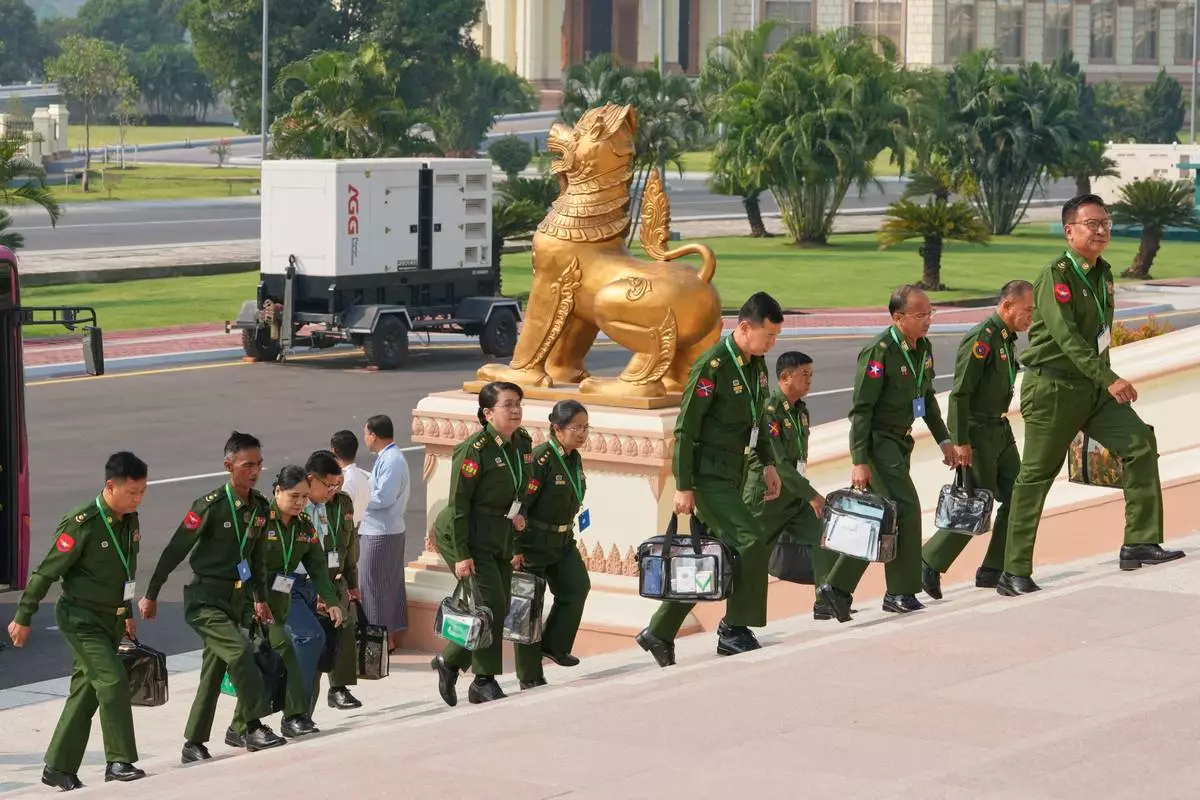
Myanmar's military representatives arrive for a session at Union parliament in Naypyitaw, Myanmar, Friday, April 3, 2026. (AP Photo/Aung Shine Oo)
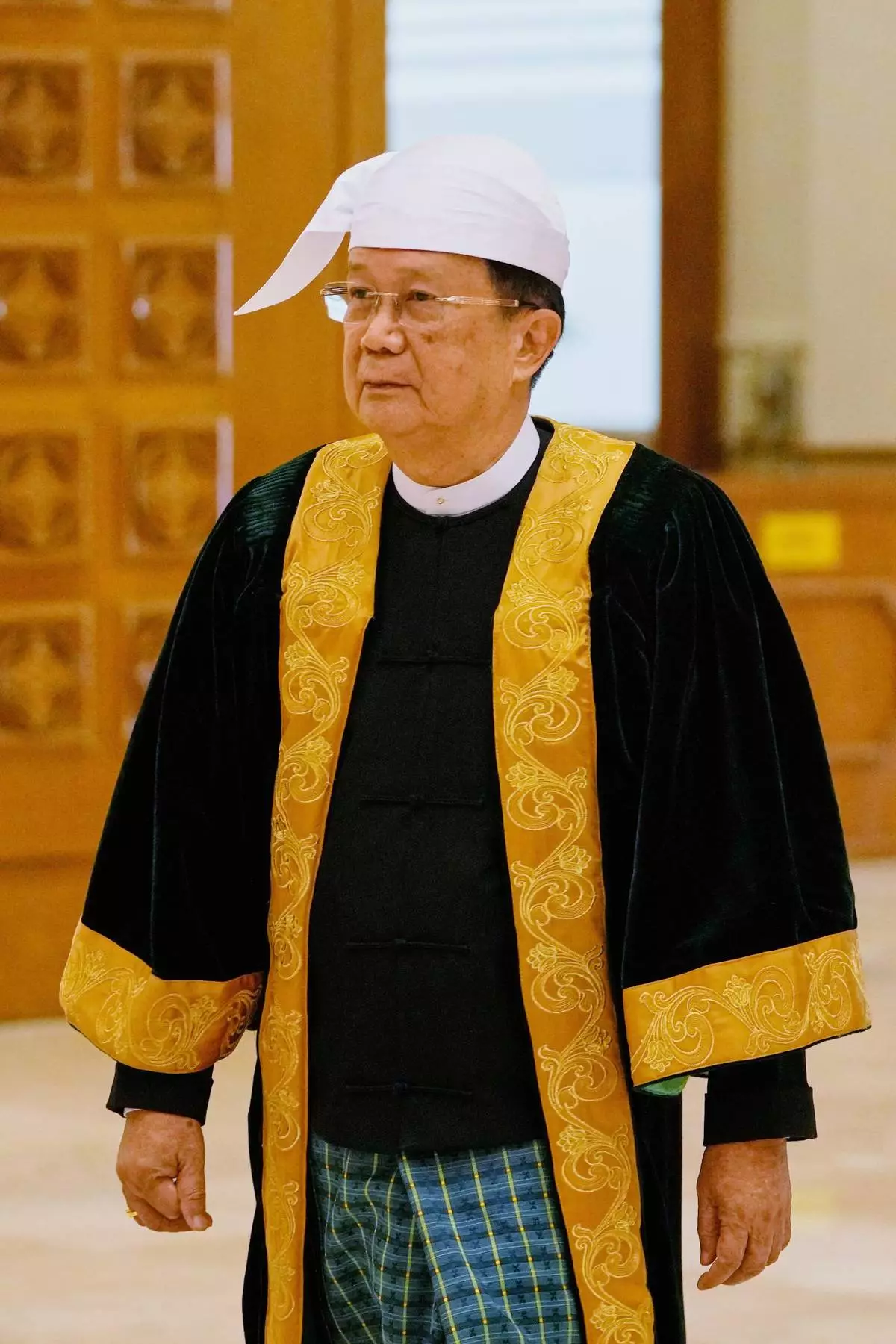
Parliament chairman Aung Lin Dwe arrives for a session of Union Parliament in Naypyitaw, Myanmar, Friday, April 3, 2026. (AP Photo/Aung Shine Oo)
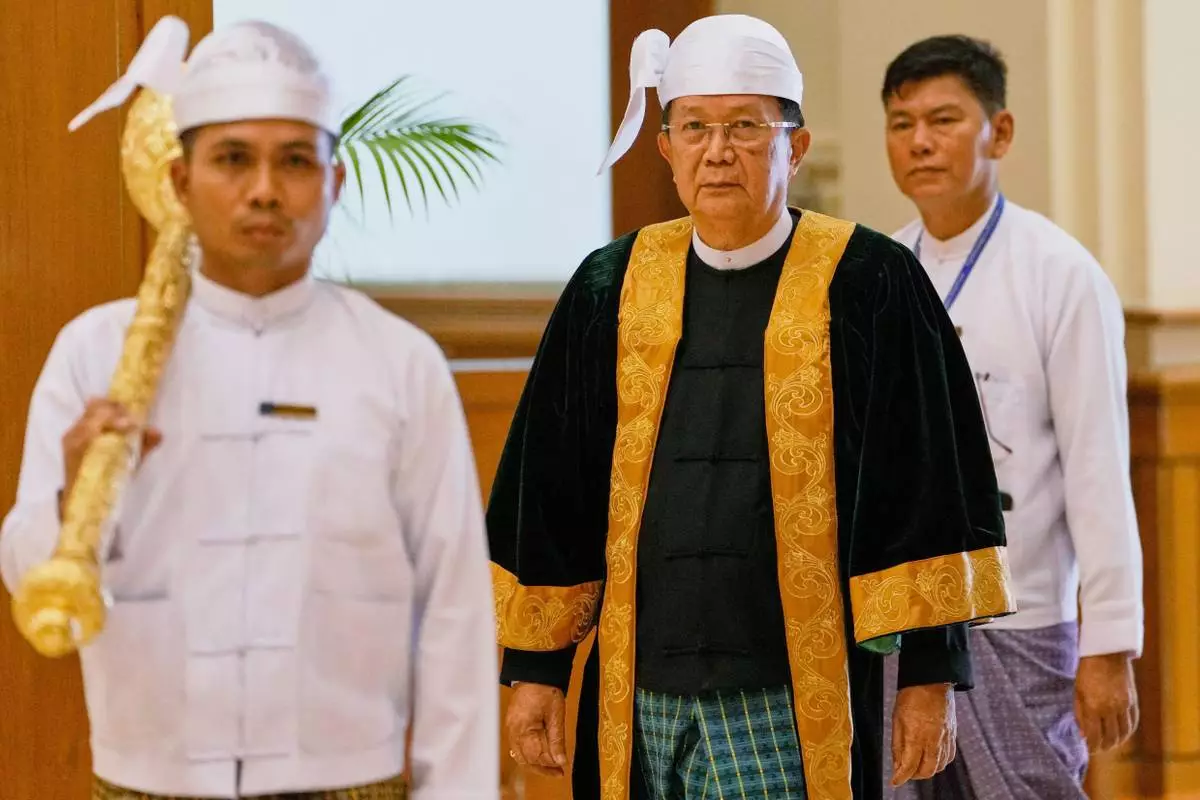
Parliament chairman Aung Lin Dwe, center, arrives for a session of Union Parliament in Naypyitaw, Myanmar, Friday, April 3, 2026. (AP Photo/Aung Shine Oo)