China is accelerating agricultural mechanization with drones and robotic dogs designed to conquer the country's 40+ million hectares of rugged hills, a shift that could reshape food security, rural labor markets, and the global agri-tech race.
Inside the Guangdong headquarters of XAG, one of the country's leading smart-farm technology firms, new drone models are undergoing intensive testing in wind tunnels, computer labs, and darkrooms to sharpen their stability, cognition, and vision.
Engineers are also correcting the drones' vision. Once limited to distinguishing outlines about 10 centimeters wide, the machines are being upgraded to detect objects smaller than one centimeter, a leap from blurry vision to precision that expands operational scenarios.
"We need to explore application scenarios in mountainous areas, where there are more than twice as many common obstacles as in plains. These include power lines, undulating terrain, and many smaller obstacles. Therefore, we must improve the computing power and 'vision' of drones," said Zheng Liqiang, an algorithm engineer from the company.
According to the 15th Five-Year Plan, the blueprint guiding the world's second-largest economy from 2026 to 2030, China will increase mechanization rate of crop production to over 80 percent in the next five years, marking an increase of 3.3 percent from the end of 14th Five-Year Plan period (2021-2025). The greatest potential lies in the more than 40 million hectares of hilly and mountainous areas, long resistant to machines but now central to the innovation agenda.
In a lychee orchard in Zengcheng, south China's Guangzhou, uneven terrain and varying crop heights once made uniform fertilization a major challenge.
This spring, terrain-following drones are navigating the curves of fruit trees with precision, spraying evenly and boosting efficiency, cutting labor costs and opening new opportunities across mountainous farmland.
Lychee grower Liu Guangzhen has become a drone pilot himself. In just a few days, he received orders covering more than 130 hectares of lychee orchards.
"The functions of drones are becoming increasingly powerful, and that gives us a new opportunity. The demand and market for drone spraying and lifting are huge. We are planning to increase our service personnel and build a better service brand," said Liu.
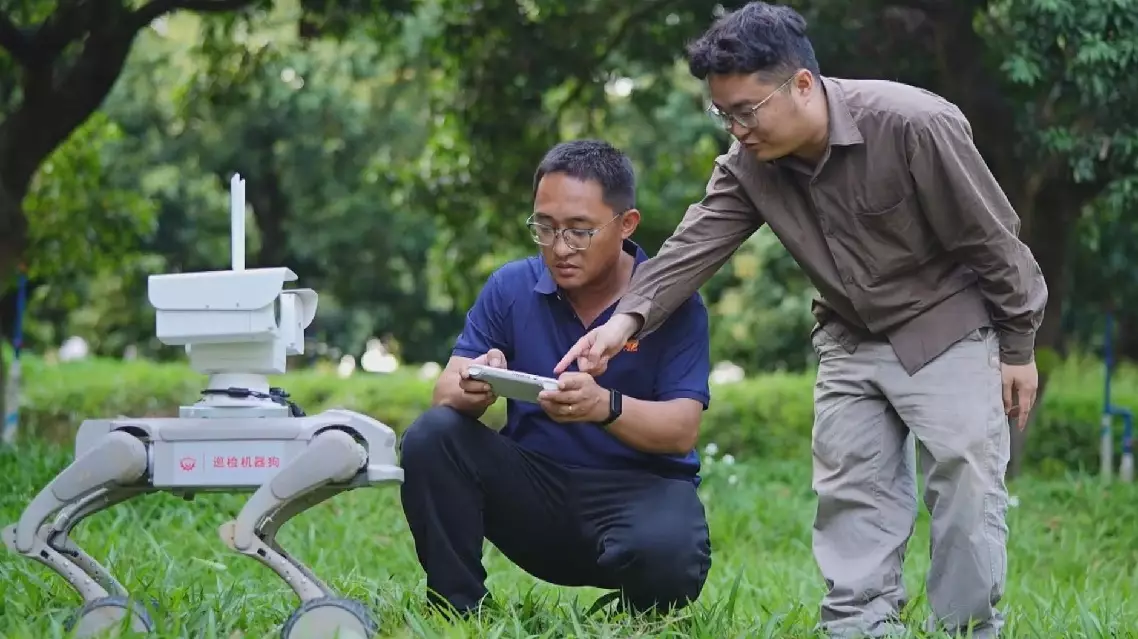
On the ground, researchers are trialing a newly developed robotic dog for patrolling lychee orchards. Dense fruit trees make traditional machinery difficult to enter, leaving field patrols time-consuming and labor-intensive.
To solve this, they integrated modules for soil nutrient testing, pest and disease identification, and crop growth monitoring onto a flexible and compact robotic dog, allowing it to enter the orchard, patrol orchards daily, and automatically generate test reports.
"So far, we can identify more than 20 mainstream economic crops in this hilly and mountainous area, recognize more than 1,300 kinds of pests and diseases, with an accuracy rate of over 90 percent," said Feng Xiaochuan from Guangdong Institute of modern Agricultural Machinery Equipment.
In March, deputies to China's legislature approved the outline of the 15th Five‑Year Plan (2026‑2030), placing innovation at the core of high-quality development alongside growth, well-being, green transition and security. Observers say the continuity of successive plans provides China with a stable framework to pursue long-term growth while adapting to changing circumstances.
China’s agri-tech race targets 40 million hectares of hills with drones, robotic dogs