DAKAR, Senegal (AP) — The Senegalese government has banned all but essential foreign trips for government ministers as part of cost-saving measures triggered by the energy crisis linked to the Iran war.
Senegal, like many African countries, imports most of the petroleum products it consumes, leaving its economy vulnerable to supply disruptions such as the closure of the Strait of Hormuz, which has sent the price of crude soaring.
Prime Minister Ousmane Sonko said Friday that his office was taking steps to limit public expenditure, pointing out that the country’s initial budget forecasts were based on an oil price of $62 per barrel, which is now almost double as a result of the Iran war.
“I have taken a number of drastic measures to restrict everything related to government spending, including the cancellation of all nonessential missions abroad,” the government-owned Le Soleil newspaper quoted Sonko as saying.
He added that he canceled several trips, including to Niger, Spain and France.
“No minister in my government will leave the country except for an essential mission,” Sonko said.
For millions in Africa, soaring fuel prices have worsened the hardships they already face in some of the world’s poorest households. That means not being able to commute to work or afford a meal for many in the region.

FILE - Senegalese opposition leader Ousmane Sonko addresses journalists following his release from police custody in Dakar, Senegal, on March 8, 2021. (AP Photo/Sylvain Cherkaoui, File)
TEL AVIV, Israel (AP) — The U.S. military pressed ahead Saturday in a frantic search for a missing pilot over a remote area in southwestern Iran, after the Middle Eastern country shot down an American warplane and called on people to turn the pilot in, promising a reward.
The plane, identified by Iran as a U.S. F-15E Strike Eagle, was one of two attacked on Friday, with one service member rescued and at least one missing. It was the first time the United States lost aircraft in Iranian territory during the war, now in its sixth week, and could mark a new turning point in the campaign.
The conflict, launched by the U.S. and Israel on Feb. 28, has rippled across the region. It has so far killed thousands, upended global markets, cut off key shipping routes, spiked fuel prices and shows no signs of slowing as Iran responds to U.S. and Israeli airstrikes with attacks across the region.
The downing of the military planes came just two days after President Donald Trump said in a national address that the U.S. has “beaten and completely decimated Iran” and was “going to finish the job, and we’re going to finish it very fast.” The U.S. and Israel had boasted recently that Iran’s air defenses were decimated.
Missile and drone strikes continued Saturday with an apparent Iranian drone damaging the headquarters of the U.S. technology giant Oracle in Dubai. Israel’s military said Iran had launched missiles toward the country.
Meanwhile, the Atomic Energy Organization of Iran said on social media that an airstrike hit near its Bushehr nuclear facility, killing a security guard and damaging a support building. It is the fourth time the facility has been targeted during the war.
Also Saturday, Iran’s top diplomat reiterated his government’s willingness to join talks aimed at stopping the war. Foreign Minister Abbas Araghchi said they “have never refused to go to Islamabad.” Pakistan said last week that it would soon host talks between the U.S. and Iran, but it's not clear when or if they will take place.
Saturday's search for the pilot focused on a mountainous region in the country’s southwestern province of Kohgiluyeh and Boyer-Ahmad.
Neither the White House nor the Pentagon released public information about the downed planes.
In an email from the Pentagon obtained by The Associated Press, meanwhile, the military said it received notification of “an aircraft being shot down” in the Middle East, without providing more details.
A U.S. crew member from that plane was rescued. But the Pentagon also notified the House Armed Services Committee that the status of a second service member on the fighter jet was not known. A U.S. military search-and-rescue operation continued Saturday.
In a brief telephone interview with NBC News, Trump declined to discuss the search-and-rescue efforts but said what happened would not affect negotiations with Iran.
Separately, Iranian state media said a U.S. A-10 attack aircraft crashed in the Persian Gulf after being struck by Iranian defense forces.
A U.S. official who spoke on condition of anonymity to discuss a sensitive military situation said it was not clear if the aircraft crashed or was shot down or whether Iran was involved. Neither the status of the crew nor exactly where it went down was immediately known.
An anchor on a TV channel affiliated with Iranian state television urged residents to hand over any “enemy pilot” to the police.
Throughout the war, Iran has made a series of claims about shooting down piloted enemy aircraft that turned out not to be true. Friday was the first time the Iranian public was urged to look for a downed pilot.
Iranian state media said in a post on the social platform X its military shot down a U.S. F-15E Strike Eagle. The aircraft is a variation of the Air Force fighter jet that carries a pilot and a weapons system officer.
An apparent Iranian drone damaged the Dubai headquarters of Oracle on Saturday after Iran’s paramilitary Revolutionary Guard threatened the firm.
The attack targeted the headquarters, which sits along Dubai’s main Sheikh Zayed Road highway. Footage verified by The Associated Press outside the United Arab Emirates showed damage to the building. A large hole could be seen in the building’s southwestern corner, with the “e” in “Oracle” on a neon sign damaged.
The sheikhdom’s Dubai Media Office, which speaks for its government, said a “minor incident caused by debris from an aerial interception that fell on the facade of the Oracle building in Dubai Internet City," adding there were no injuries.
Oracle, based in Austin, Texas, did not immediately respond to a request for comment.
The Guard has accused some of America’s largest tech companies of being involved in “terrorist espionage” operations against the Islamic Republic and said they were legitimate targets.
Earlier Iranian drone strikes hit Amazon Web Services facilities in both the UAE and Bahrain.
In a social media post late Friday, Mohammad Bagher Qalibaf, Iran’s parliament speaker, issued a veiled threat to disrupt traffic through the Bab-el-Mandeb, a second strategic waterway. The strait, 32 kilometers (20 miles) wide, links the Red Sea with the Gulf of Aden and the Indian Ocean. It is one of the busiest choke-points in global trade, with more than a tenth of seaborne global oil and a quarter of container ships passing through it.
“What share of global oil, LNG, wheat, rice, and fertilizer shipments transits the Bab-el-Mandeb Strait?” Qalibaf wrote. “Which countries and companies account for the highest transit volumes through the strait?”
Iran has already greatly disturbed the flow of oil through the Strait of Hormuz, sending fuel prices skyrocketing and jolting the world economy. World leaders are struggling to end Iran’s stranglehold on the strait as the U.N. Security Council is expected to take up the matter Saturday.
Trump has vacillated on America’s role in the strait, alternately threatening Iran if it does not open the strait and telling other nations to “go get your own oil.” On Friday, he said in a post on social media: “With a little more time, we can easily OPEN THE HORMUZ STRAIT, TAKE THE OIL, & MAKE A FORTUNE.”
More than 1,900 people have been killed in Iran since the war began. In a review released Friday, the Armed Conflict Location and Event Data, a U.S.-based group, said it found that civilian casualties were clustered around strikes on security and state-linked sites “rather than indiscriminate bombardment” of urban areas.
In Gulf Arab states and the occupied West Bank, more than two dozen people have died, while 19 have been reported dead in Israel and 13 U.S. service members have been killed. In Lebanon, over 1,300 people have been killed and more than 1 million displaced. Ten Israeli soldiers have also died there.
Gambrell reported from Dubai, United Arab Emirates and Magdy from Cairo. Associated Press writers Konstantin Toropin, Seung Min Kim, Will Weissert, Michelle L. Price, Lisa Mascaro and Ben Finley in Washington contributed to this report.
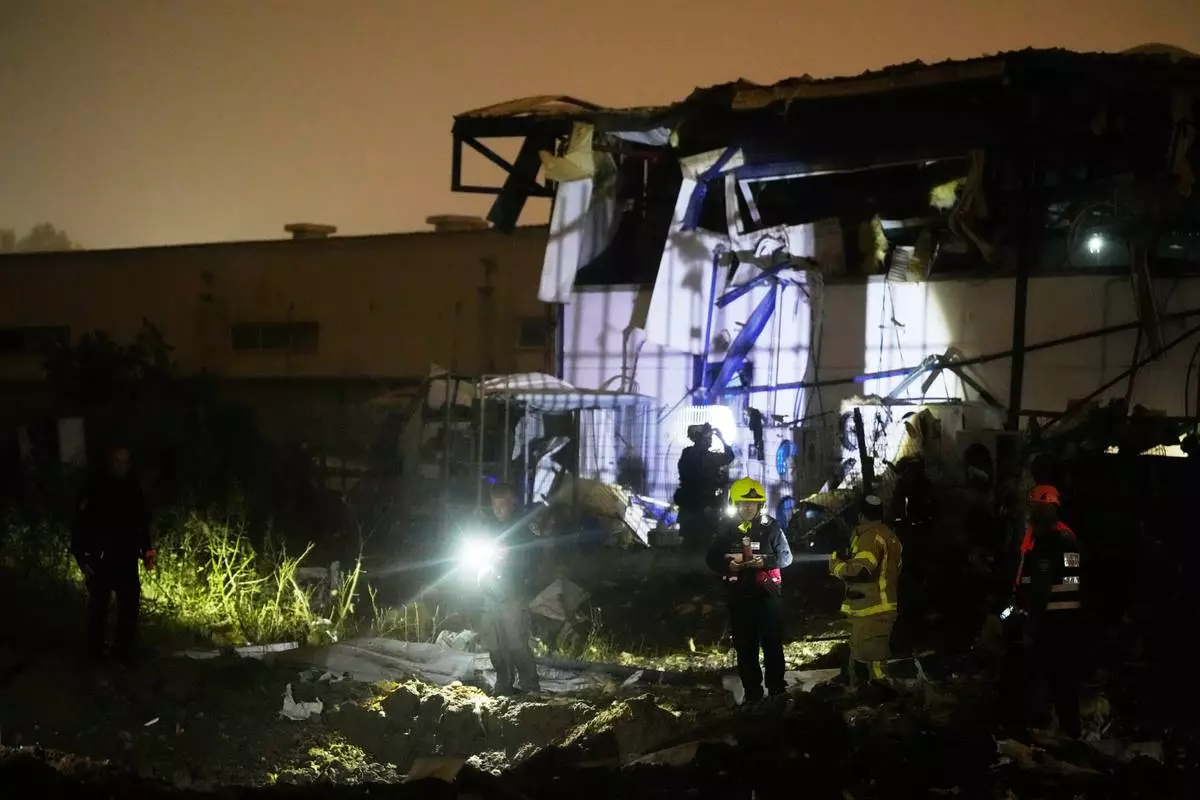
Israeli security forces and rescue teams inspect a site struck by an Iranian missile in Petah Tikva, Israel,Thursday, April 2, 2026. (AP Photo/Ohad Zwigenberg)
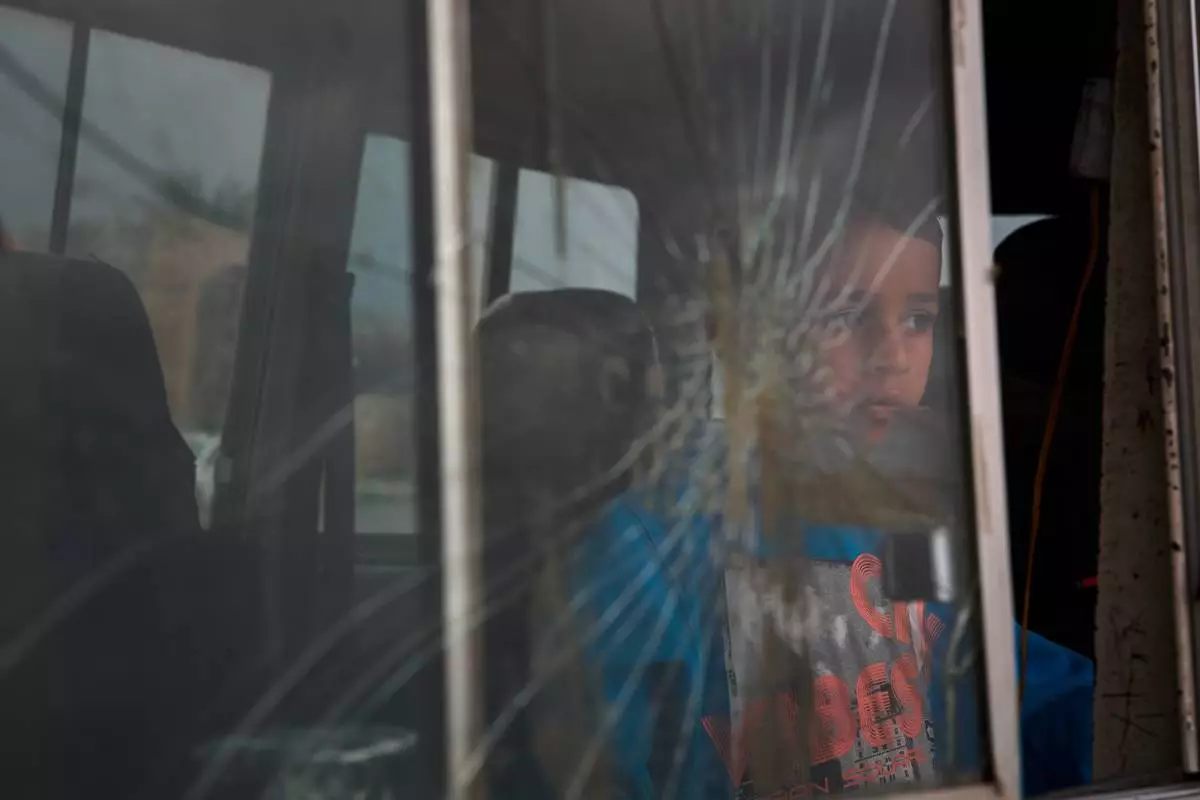
A boy who fled with his family following Israeli strikes in southern Lebanon sits inside the van they are using as shelter in Sidon, Lebanon, Thursday, April 2, 2026. (AP Photo/Emilio Morenatti)
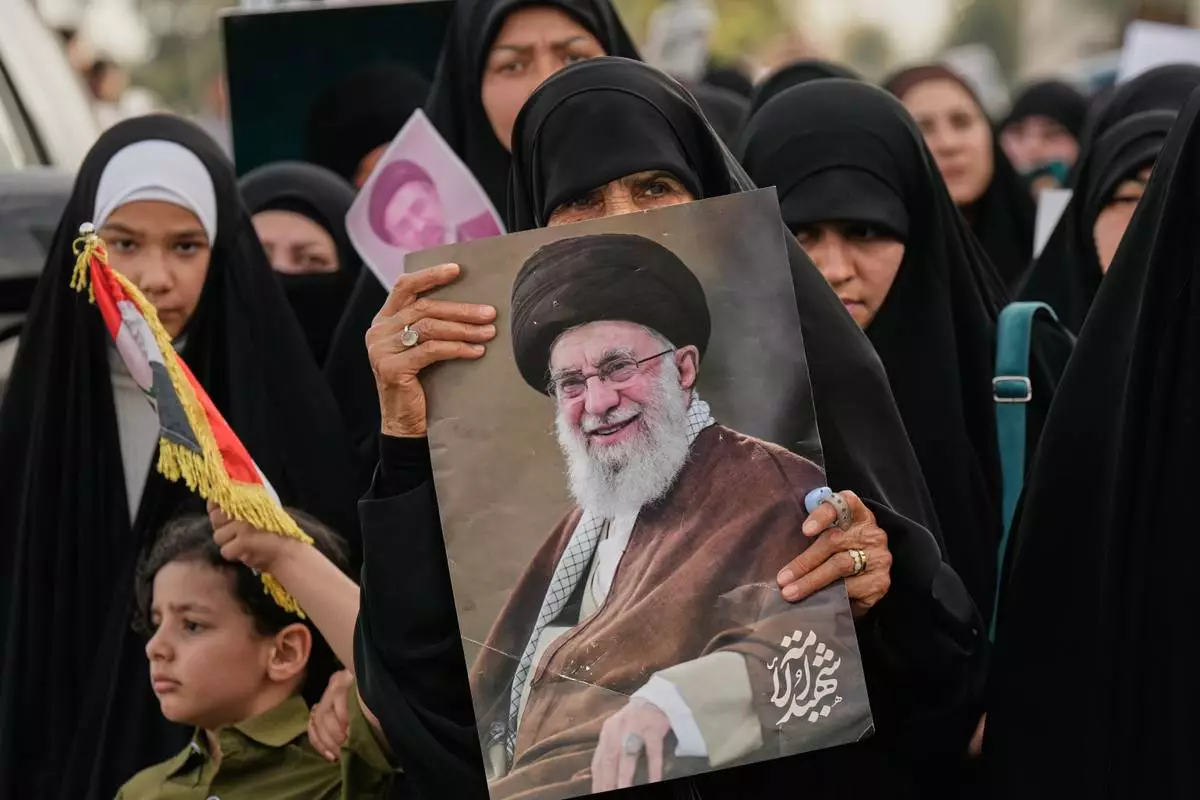
Iraqi women hold a portrait of Iran's late Supreme Leader Ayatollah Ali Khamenei and his son Ayatollah Mojtaba Khamenei, during a protest against U.S. and Israeli attacks on multiple cities across Iran, in the Shi'ite district of Kazimiyah in Baghdad, Iraq, Friday, April 3, 2026. (AP Photo/Hadi Mizban)
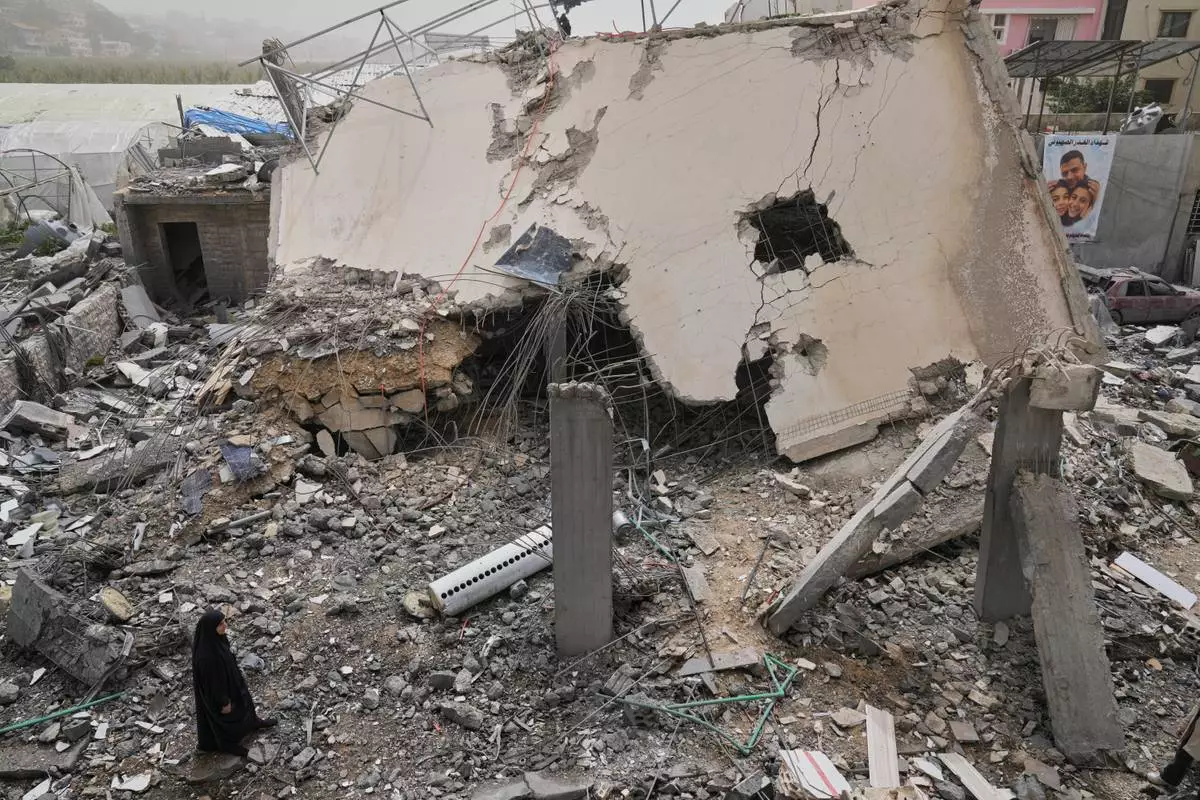
A woman checks a destroyed house that was hit in an Israeli airstrike in Saksakiyeh village, south Lebanon, Friday, April 3, 2026. (AP Photo/Hussein Malla)
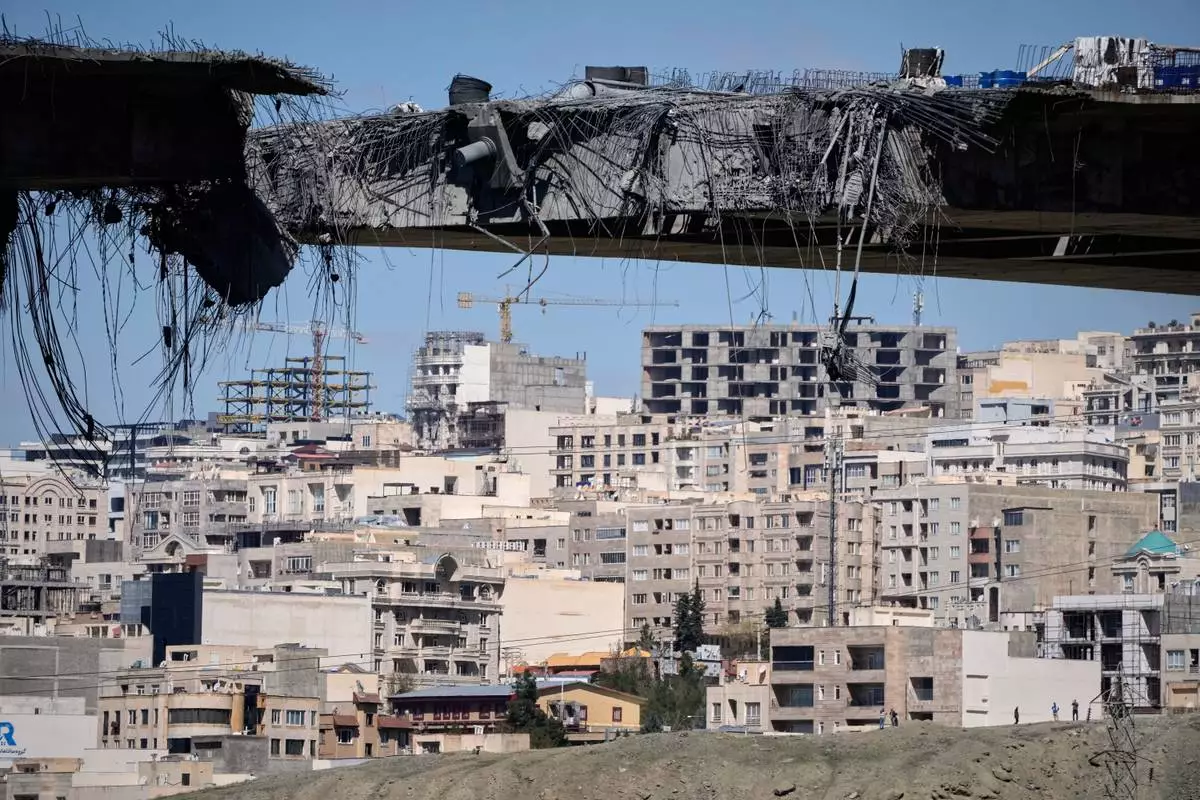
A bridge struck by U.S. airstrikes on Thursday is seen in the town of Karaj, west of Tehran, Iran, Friday, April 3, 2026. (AP Photo/Vahid Salemi)