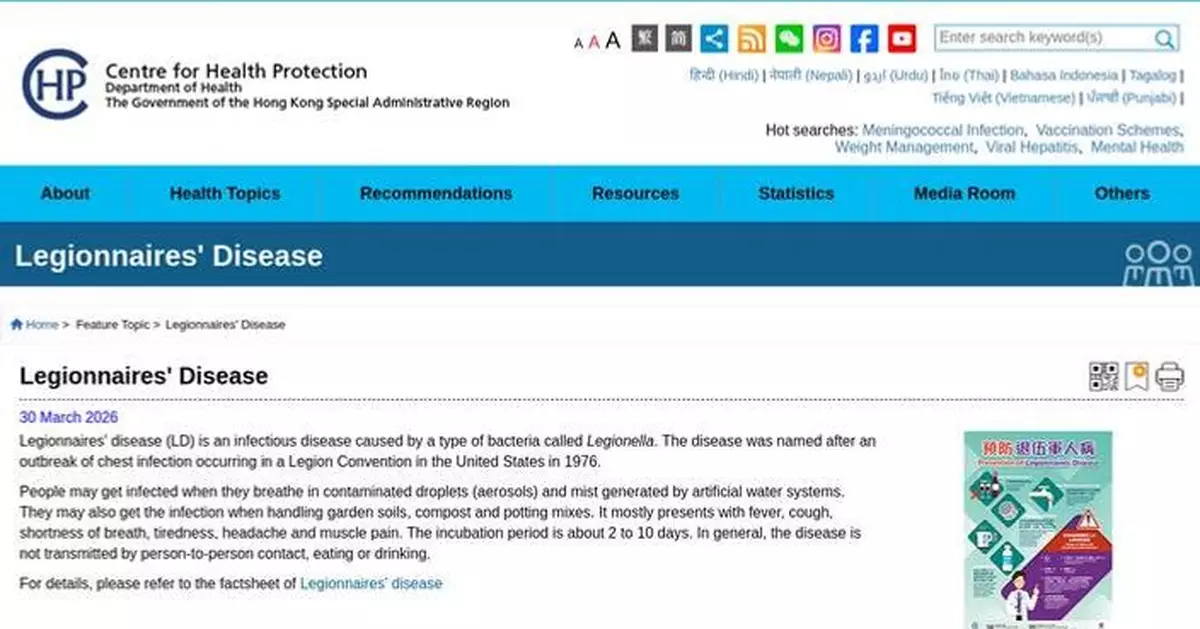
DH announces latest situation regarding Legionnaires' disease case
The Centre for Health Protection (CHP) of the Department of Health (DH) today (April 6) reported the latest number of Legionnaires' disease (LD) cases, and reminded the public of the importance of using and maintaining properly designed man-made water systems, adding that susceptible groups should strictly observe relevant precautions.
From March 29 to April 4, the CHP recorded two community-acquired and one imported LD cases. All of the patients involved had underlying illnesses. The details are as follows:
 a 66-year-old male living in Sham Shui Po District, classified as a community-acquired case;
a 67-year-old male living in Kwai Tsing District, classified as a community-acquired case; and
a 73-year-old male who travelled to the Chinese Mainland during the incubation period, classified as an imported case.
a 66-year-old male living in Sham Shui Po District, classified as a community-acquired case;
a 67-year-old male living in Kwai Tsing District, classified as a community-acquired case; and
a 73-year-old male who travelled to the Chinese Mainland during the incubation period, classified as an imported case.
The CHP is conducting epidemiological investigations to identify the potential sources of infection and high-risk exposure. An initial investigation revealed that the aforesaid community-acquired cases are sporadic cases. No epidemiological linkages have been established between the two cases and other confirmed cases previously recorded in Hong Kong.
As of April 4, 22 LD cases had been recorded this year. In 2025 and 2024, there were 167 and 135 LD cases respectively.
Men, people aged over 50, smokers, alcoholics and persons with weakened immunity are more susceptible to LD. Some situations may also increase the risk of infection, including poor maintenance of water systems; living in areas with old water systems, cooling towers or fountains; using electric water heaters, whirlpool spas or hot water spring spas; and recent stays in hotels or ships.
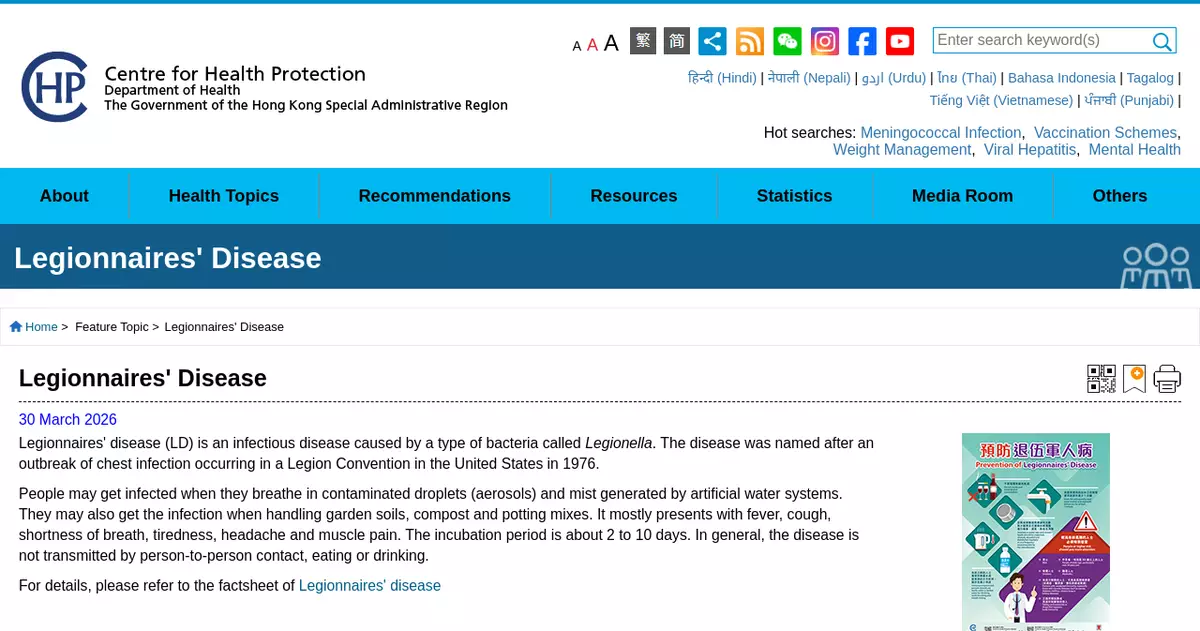
Legionellae are found in various environmental settings and grow well in warm water (20 to 45 degrees Celsius). They can be found in aqueous environments such as water tanks, hot and cold water systems, cooling towers, whirlpool spas, water fountains, humidifiers and home respiratory devices that support breathing. People may become infected when they breathe in contaminated droplets (aerosols) and mist generated by artificial water systems, or when handling garden soil, compost and potting mixes.
Immunocompromised persons should:
Use sterile or boiled water for drinking, tooth brushing and mouth rinsing;
Avoid using humidifiers, or other mist- or aerosol-generating devices; and
If using humidifiers, or other mist- or aerosol-generating devices, fill the water tank with only sterile or cooled freshly boiled water, and not water directly from the tap. Also, clean and maintain humidifiers/devices regularly according to manufacturers' instructions. Never leave stagnant water in a humidifier/device. Empty the water tank, wipe all surfaces dry, and change the water daily.
The public should observe the health advice below:
Observe personal hygiene;
Do not smoke and avoid alcohol consumption;
Strainers in water taps and shower heads should be inspected, cleaned, descaled and disinfected regularly or at a frequency recommended by the manufacturer;
If a fresh-water plumbing system is properly maintained, it is not necessary to install domestic water filters. Use of water filters is not encouraged as clogging occurs easily, which can promote growth of micro-organisms. In case water filters are used, the pore size should be 0.2 micrometres (µm) or less and the filter needs to be changed periodically according to the manufacturer's recommendations;
Drain and clean water tanks of buildings at least quarterly;
Drain or purge for at least one minute infrequently used water outlets (e.g. water taps, shower heads and hot water outlets) and stagnant points of the pipework weekly or before use;
Seek and follow doctors' professional advice regarding the use and maintenance of home respiratory devices and use only sterile water (not distilled or tap water) to clean and fill the reservoir. Clean and maintain the device regularly according to the manufacturer's instructions. After cleaning/disinfection, rinse the device with sterile water, cooled freshly boiled water or water filtered with 0.2 µm filters. Never leave stagnant water in the device. Empty the water tank, keep all surfaces dry, and change the water daily; and
When handling garden soil, compost and potting mixes:
Wear gloves and a face mask;
Water gardens and compost gently using low pressure;
Open composted potting mixes slowly and make sure the opening is directed away from the face;
Wet the soil to reduce dust when potting plants; and
Avoid working in poorly ventilated places such as enclosed greenhouses.
The public may visit the CHP'sLD page, theCode of Practice for Prevention of LDand theHousekeeping Guidelines for Cold and Hot Water Systems for Building Managementof the Prevention of LD Committee, and the CHP'srisk-based strategyfor prevention and control of LD.
Additionally, as smokers and alcoholics are more susceptible to LD, the Government urgesmembers of the public to quit smoking and avoid drinking. Members of the public may call the DH Integrated Smoking Cessation Hotline at 1833 183, which is answered by registered nurses who provide professional counselling and referral to a wide range of free smoking cessation services. The public may also visit the smoking cessation thematic website (www.livetobaccofree.hk) for more information on smoking cessation. The DH has also developed and promulgated the Alcohol Screening and Brief Intervention tool to primary healthcare service providers to facilitate the early identification and management of at-risk drinkers. For information on alcohol-related harm, please visit the DH'sChange for Health website.
Source: AI-found images
CHP investigates imported measles case
The Centre for Health Protection (CHP) of the Department of Health (DH) today (April 6) is investigating an imported measles case and reminds members of the public that vaccination is the most effective way to prevent measles.
The case involves a 30-year-old male who developed a fever, cough and runny nose on March 31. He sought medical attention from a private doctor on the following day (April 1). He attended the Accident and Emergency Department (AED) of the North Lantau Hospital (NLH) on April 4 due to persistent symptoms, where he was admitted for treatment. He developed a rash on the same day after admission, and was immediately transferred to Princess Margaret Hospital for isolation and treatment. His clinical specimen was tested positive today for the measles virus upon nucleic acid testing. The patient is in stable condition.
An epidemiological investigation revealed that the patient works at the airport. He was uncertain whether he had received measles vaccination. He travelled to Indonesia with a household contact during the incubation period. His household contact is asymptomatic to date. Since there are continuous measles outbreaks in Indonesia, the case was classified as an imported case. No epidemiological linkages have been established between the case and other confirmed cases previously recorded in Hong Kong.
During the patient's communicable period (i.e. since March 31), in addition to visiting a private clinic on April 1 and the AED of the NLH on April 4, he worked at the airport on April 3. The CHP has been carrying out contact tracing in the private clinic that the patient had visited, the NLH and his workplace to identify any close contacts and high risk individuals. As of 4pm today, a total of 21 individuals who stayed in the same clinic with the patient, nine patients in the NLH and 238 relevant staff at his workplace at the airport were identified as close contacts. The CHP will continue to conduct medical surveillance for the identified close contacts.
The CHP will continue to investigate and follow up on the case.
"Measles outbreaks are currently occurring in many regions around the world. North America (including the United States, Canada and Mexico) and Southeast Asia (including Indonesia, Cambodia and the Philippines) have seen persistent measles outbreaks in recent years due to low vaccination coverage rates. In the first three months of this year, about 1 600 cases have been recorded in the United States, a figure far higher than during the same period last year. In Europe, the number of measles cases in the United Kingdom and Italy has increased recently, with 336 and 84 cases recorded respectively since January this year. In Asia, the incidence of measles remains high in the Philippines, Indonesia and Cambodia. Japan has also seen a substantial rise in cases this year, with 152 cases recorded as of the end of March, which is higher than in the same period for the past six years. Singapore and Australia have reported 24 and 87 measles cases respectively this year, also higher than in the same period last year. Most of the overseas cases have affected people who were not vaccinated against measles or had an unknown vaccination status, which highlights the importance of maintaining a high vaccination rate and herd immunity within the community," said the Controller of the CHP, Dr Edwin Tsui.
"Despite the abovementioned case is identified as an imported case according to the epidemiological information, airport workers who come into frequent contact with international travellers are at higher risk of contracting measles amid the current global resurgence of the disease. They are strongly advised to review their vaccination history and past medical history, especially those born outside Hong Kong who may not have received measles vaccination during childhood. Individuals who have not received two doses of measles-containing vaccine, or those with unknown vaccination history, should consult their doctor as soon as possible for vaccination. The CHP will work with the Airport Authority Hong Kong to remind all airport workers and their employers of the importance of ensuring that airport staff are fully immune to measles," Dr Tsui added.
The incubation period of measles (i.e. the time from infection to onset of illness) is seven to 21 days. Symptoms include fever, skin rash, cough, runny nose and red eyes. If travellers returning from places with high incidence or outbreak of measles develop symptoms of measles (e.g. fever and rash), they should seek medical advice immediately and avoid contact with non-immune persons, especially pregnant women and infants under one year old. They should also report their symptoms and prior travel history to healthcare workers so that appropriate infection control measures can be implemented at the healthcare facilities to prevent any potential spread.
"Under the Hong Kong Childhood Immunisation Programme, the overall immunisation coverage in Hong Kong has been maintained at a very high level through the immunisation services provided by the DH's Maternal and Child Health Centres and School Immunisation Teams. As evidenced by the findings on vaccination coverage of primary school students and the territory-wide immunisation surveys conducted regularly by the DH, the two-dose measles vaccination coverage has remained consistently high, well above 95 per cent, and the local seroprevalence rates of measles virus antibodies reflect that most people in Hong Kong are immune to measles. However, Hong Kong, as a city with a high volume of international travel, still faces the potential risk of importation of the measles virus and its further spread in the local community. Hence, a small number of people who have not completed a measles vaccination (such as non-local-born people including new immigrants, foreign domestic helpers, overseas employees and people coming to Hong Kong for further studies) are still at risk of being infected and spreading measles to other people who do not have immunity against measles, such as children under 1 year old who have not yet received the first dose of the measles vaccine," Dr Tsui said.
People born before 1967 could be considered to have acquired immunity to measles through natural infection, as measles was endemic in many parts of the world and in Hong Kong at that time. People born in or after 1967 who have not yet completed the two doses of measles vaccination, or whose measles vaccination history is unknown, should consult their family doctors as soon as possible to complete the vaccination and ensure adequate protection against measles.
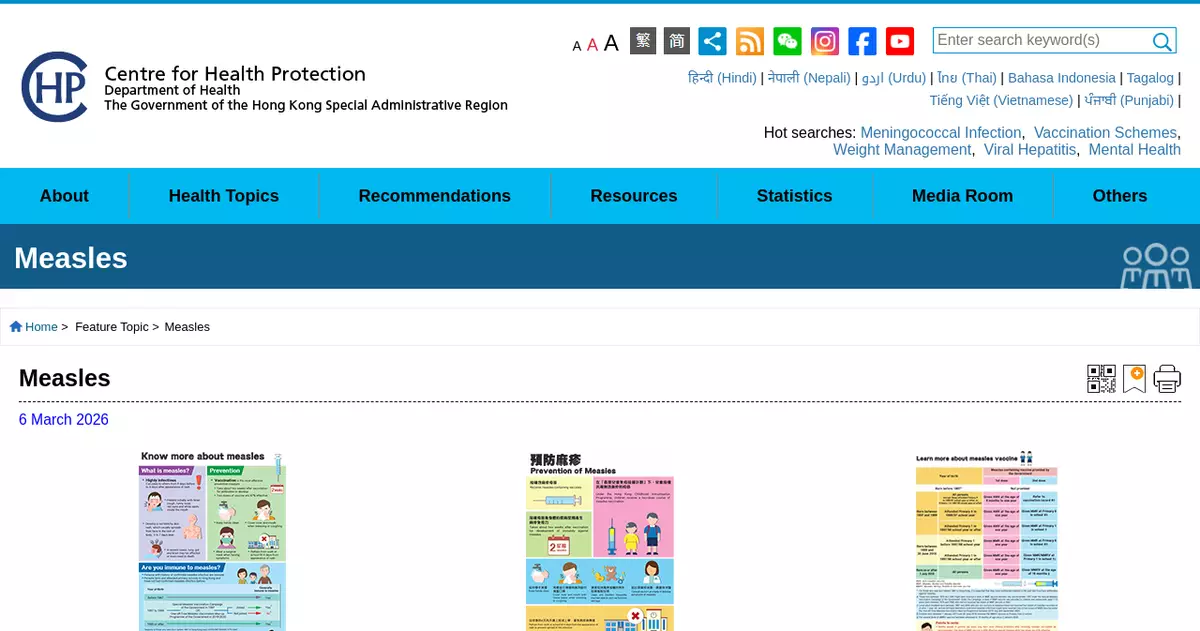
Besides being vaccinated against measles, members of the public should take the following measures to prevent infection:
 Maintain good personal and environmental hygiene;
Maintain good indoor ventilation;
Keep hands clean and wash hands properly;
Wash hands when they are dirtied by respiratory secretions, such as after sneezing;
Cover the nose and mouth while sneezing or coughing and dispose of nasal and mouth discharge properly;
Clean used toys and furniture properly; and
Persons with measles should be kept out of school till four days from the appearance of a rash to prevent the spread of the infection to non-immune persons in school.
Maintain good personal and environmental hygiene;
Maintain good indoor ventilation;
Keep hands clean and wash hands properly;
Wash hands when they are dirtied by respiratory secretions, such as after sneezing;
Cover the nose and mouth while sneezing or coughing and dispose of nasal and mouth discharge properly;
Clean used toys and furniture properly; and
Persons with measles should be kept out of school till four days from the appearance of a rash to prevent the spread of the infection to non-immune persons in school.
For more information on measles, the public may visit the CHP'smeasles thematic page. Members of the public who are going to travel can visit the webite of the DH'sTravel Health Servicefor news of measles outbreaks outside Hong Kong.
Source: AI-found images