China has seen sustained progress in land greening and forest growth in recent years, with its forest coverage reaching approximately 241 million hectares, the equivalent of about 100 trees per person.
During the 14th Five-Year Plan period (2021–2025), China completed over 36.5 million hectares of afforestation.
The country's forest coverage rate has reached 25.09 percent, with forest stock volume totaling almost 20.99 billion cubic meters.
China has called for nationwide participation in afforestation, emphasizing that greening efforts must be persistent and ultimately benefit the people. Innovative methods are transforming ecological liabilities into valuable assets, delivering both environmental gains and tangible benefits for local communities.
In Huainan, east China's Anhui Province, a former coal mining subsidence area has been converted into a vibrant ecological park.
Once scarred by industrial activity, the site now features wetlands, forests and walking trails, effectively improving local living conditions.
"We are now scaling up forestry and new energy industries to boost both ecological and economic benefits, and creating a replicable model for resource-based cities. We've developed a model of 'restoration plus photovoltaics plus tourism.' It not only restores the environment, but also generates clean energy and economic returns, turning ecological burdens into green assets," said Wang Meng, technical lead of Huainan Western Mining Subsidence Area Project.
"This used to be a mining pit with poor conditions. Now it's a beautiful park with clear water and lush trees. We come here every day," said Yang Chunlei, a local resident.
Large-scale greening efforts are also gaining momentum under China's Three-North Shelterbelt Forest Program (TSFP), the world's largest afforestation initiative, launched in 1978 to combat desertification in the country's northwestern, northern and northeastern regions.
In Ulanqab, north China's Inner Mongolia Autonomous Region, people have planted trees across vast sandy and barren lands, working to curb desertification and strengthen China's northern ecological barrier.
This year alone, the city plans to complete afforestation and restoration across approximately 66,700 hectares.
"As a main battlefield for the 'Three-North' project, we will continue advancing the construction of Phase VI, building a more solid green ecological shield in northern China," said Zhang Zhiyong, deputy director with the Forestry and Grassland Bureau of Xinghe County.
From restoring former industrial land to expanding green frontiers in arid regions, China's afforestation drive is shifting toward higher-quality development, aiming to improve ecosystems while delivering lasting benefits to the people.
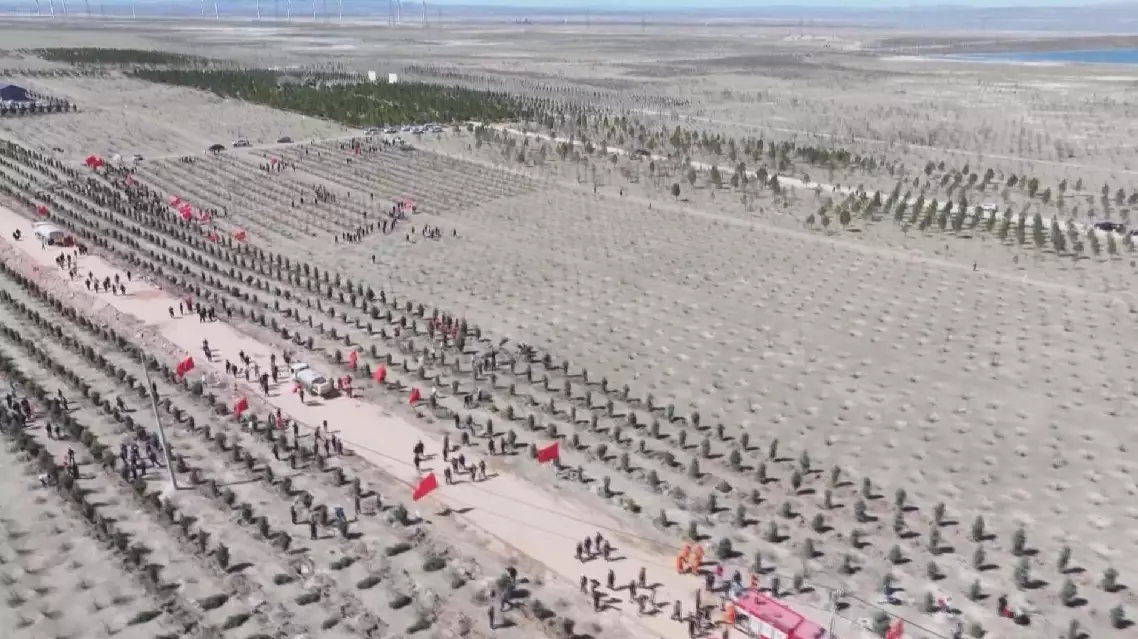
China sees sustained progress in afforestation
Amid the rising fuel costs and airline surcharges linked to the U.S.-Israeli war against Iran, Caribbean tourism officials gathered at the 44th Caribbean Hotel and Tourism Association Forum this month and expressed cautious optimism, citing resilient visitor demand, strategic marketing adjustments, and strong seasonal performance as foundations for continued recovery.
The U.S.-Israeli war against Iran is already affecting Caribbean economies as fuel prices surge and airlines pass costs on to passengers. This not only pressures the region's tourism-dependent economies but also raises the cost of imported food, electricity, and transportation.
Since the start of the conflict, the price of Brent crude has surged nearly 50 percent, prompting airlines to find the ways to share the burden with travelers.
"The impacts are unfolding in stages. In the first place, when the uncertainty, or the disturbance occurred in the Middle Eastern region, it actually cut the supply chain to some extent to the Pacific, and people started to look at the region in particular. We amplified out marketing presence, to ensure that when people are looking for an option or places to rebook, that St. Lucia would turn up. And we've actually seen some of that result," said Louis Lewis, chief executive officer of the Saint Lucia Tourism Authority.
During the International Monetary Fund's Spring Meeting, the international financial institution expressed its concern for Caribbean tourism, warning that it could see a decline as ticket prices increase.
Lewis acknowledged the potential for longer-term disruption.
"The second thing is that if the conflict continues as a prolonged activity, we anticipate that it could impact us. We will have to diversify from our major source markets, hence the reason why we are looking at Latin America," he said.
But some of the region's top tourism officials are seeing positive signs. The region is coming off another successful year, where tourism arrivals grew by 2.5 percent, adding an additional 900,000 visitors over 2024.
"The region has been witnessing a very good winter season, and I have no doubt whatsoever that the forecast that we have for the summer will continue to be very strong," said Ian Gooding-Edghill, minister of tourism of Barbados.
Still, structural vulnerabilities remain. As an import-dependent region, the Caribbean is highly exposed to global price fluctuations. Concerns are mounting that rising prices in the United States could trigger sharper inflationary pressures, including higher operating costs in the tourism sector.
"In Saint Lucia, we just saw the cost of energy increase about 20 percent, and that's having an impact now going into the summer when our rates are lower. It rallies points to the importance of us building a bit more resilience into Caribbean tourism," said Sanovnik Destang, president of the Caribbean Hotel and Tourism Association.

Caribbean tourism shows resilience despite Middle East tension challenges