NEW YORK--(BUSINESS WIRE)--Apr 6, 2026--
Mitchell Silberberg & Knupp LLP (MSK) announced today that it has expanded its national Entertainment Transactions group with the addition of Amy Stein Simonds as a partner in its New York office. With more than a decade of experience, Stein Simonds joins from Pryor Cashman LLP, where she was a partner in the Media + Entertainment group.
This press release features multimedia. View the full release here: https://www.businesswire.com/news/home/20260406236110/en/
Stein Simonds brings deep expertise in production, financing, and distribution across film, television, podcasts, and digital media. She regularly counsels studios, networks, financiers, and production companies across all phases of a project’s lifecycle, from development and rights acquisition through production, financing, and distribution. She has served as business affairs and legal counsel to more than 100 studios, streaming platforms, and independently financed productions. Her expertise extends to foreign co-productions and navigating U.S.-based guild requirements, including SAG-AFTRA, WGA, DGA, and IATSE signatory processes.
“Amy brings exactly the kind of sophisticated, cross-media transactional expertise that our clients need today, and her addition reflects our continued commitment to building a practice that aligns with the future of the entertainment industry,” said Yakub Hazzard, Chair of MSK.
Stein Simonds expands MSK’s ability to advise entertainment production companies across motion picture and television production, interactive entertainment, podcasting, and new media, areas that reflect how content is being created and consumed today. Her work in cross-media transactions and entertainment financing further broadens the firm's ability to support clients throughout the full arc of a project, from concept to execution.
“I’ve watched MSK operate at the center of this industry for years. There’s no better place to do this work,” said Stein Simonds. “The firm’s reach, from major studios to independent creators, means we can meet clients wherever they are in the process, whether that’s their first independent film or a multi-platform studio deal.”
Stein Simonds has been widely recognized for her work in the industry and has been named to Variety’s “Hollywood New Leaders” and “Dealmaker Impact Report.” She earned her J.D. from Pace University School of Law and her B.F.A. from the University of Southern California’s School of Cinematic Arts.
About Mitchell Silberberg & Knupp LLP
Since 1908, Mitchell Silberberg & Knupp LLP (MSK) has been a trusted leader in entertainment, media, and intellectual property law, providing clients with innovative solutions in complex legal matters. With more than 130 lawyers across offices in Los Angeles, New York, and Washington, D.C., MSK is recognized as a premier firm for litigation, transactions, and regulatory matters. The firm’s practice spans Venture Capital, Private Equity, M&A, Corporate Securities, Entertainment & IP Litigation, Labor & Employment, Motion Picture, Television & Music Transactions, Immigration, Regulatory, Tax, Trusts & Estates, Real Estate and International Trade. Relentlessly innovative, our lawyers have developed groundbreaking legislation, established influential precedents and shaped the legal landscape. For more information, visit www.msk.com.

Amy Stein Simonds, Mitchell Silberberg & Knupp
DUBAI, United Arab Emirates (AP) — Saudi Arabia closed the only road linking it to Bahrain on Tuesday after Iranian fired missiles at its oil-rich Eastern Province. Tehran's latest strikes came as Iranian officials urged youths to form human chains around power plants to protect them, as the latest deadline set by U.S. President Donald Trump for Iran to reopen the Strait of Hormuz drew closer.
Trump has threatened to bomb all of Iran's power plants and bridges if Iran does not meet his Tuesday 8 p.m. EDT deadline to allow shipping traffic to fully resume through the strategic waterway, through which a fifth of the world's oil transits in peacetime.
“The entire country can be taken out in one night,” Trump said.
Iran choked off shipping through the strait after Israel and the U.S. attacked on Feb. 28, starting the war. On Monday, Tehran rejected a 45-day ceasefire proposal and said it wants a permanent end to the war.
Early Tuesday, Tehran launched seven ballistic missiles at Saudi Arabia, which authorities said rained debris on the ground near energy facilities as they were intercepted. Defense Ministry spokesman Maj. Gen. Turki al-Malki said the damage was being assessed.
In the meantime, Saudi Arabia said it was closing the King Fahd Causeway, a bridge that links Saudi Arabia to the island kingdom of Bahrain over the threat of more Iranian attacks targeting the Eastern Province.
The 25-kilometer (15.5 mile) bridge is the only connection by road for Bahrain, home to the U.S. Navy’s 5th Fleet, to the Arabian Peninsula.
Elsewhere, activists reported a new wave of strikes on Tehran, for which Israel later claimed responsibility. Iran also fired on Israel, with reports of incoming missiles.
Iran's attacks on the energy infrastructure of its Gulf Arab neighbors, coupled with its stranglehold on the Strait of Hormuz, has sent oil prices skyrocketing and is causing global economic problems.
In early spot trading, Brent crude, the international standard, was above $111 per barrel, up more than 50% since the start of the war.
Under growing pressure at home as consumers feel the pinch, Trump has demanded that Iran open the Strait of Hormuz to all shipping traffic or see power plants and bridges wiped out. The threat to hit civilian infrastructure has sparked widespread warnings about possible war crimes.
New Zealand Prime Minister Christopher Luxon on Tuesday urged Trump not to follow through, saying the “focus needs to be on not seeing this conflict expand any further.”
“Any of those actions including bombing bridges and reservoirs and civilian infrastructure would be unacceptable,” Luxon told Radio New Zealand.
Iran sought to up the ante, calling on “all young people, athletes, artists, students and university students and their professors” to form human chains around power plants ahead of the threatened strikes.
“Power plants that are our national assets and capital, regardless of any taste or political viewpoint, belong to the future of Iran and to the Iranian youth,” Alireza Rahimi, identified by Iranian state television as the secretary of the Supreme Council of Youth and Adolescents, said as he issued the video call in a newscast.
Iran has formed human chains in the past around its nuclear sites at times of heightened tensions with the West.
U.N. Secretary-General António Guterres warned the U.S. that attacks on civilian infrastructure are banned under international law, according to his spokesperson. Trump, speaking with reporters, said he’s “not at all” concerned about committing war crimes with such attacks.
As the deadline neared, efforts were still underway to reach a negotiated solution. Even though Iran has rejected the latest proposal from the U.S., officials involved in the diplomacy say that talks are still ongoing.
More than 1,900 people have been killed in Iran since the war began, but the government has not updated the toll for days.
More than 1,400 people have been killed in Lebanon and more than 1 million people have been displaced. Eleven Israeli soldiers have died there.
In Gulf Arab states and the occupied West Bank, more than two dozen people have died, while 23 have been reported dead in Israel and 13 U.S. service members have been killed.
Japan said Tuesday that one of its citizens who had been detained in Iran since January had been released on bail. Chief Cabinet Secretary Minoru Kihara told reporters in Tokyo that Japan is demanding his full release from Iranian authorities.
Rising reported from Bangkok. Mari Yamaguchi in Tokyo and Rod McGuirk in Melbourne, Australia, contributed to this report.
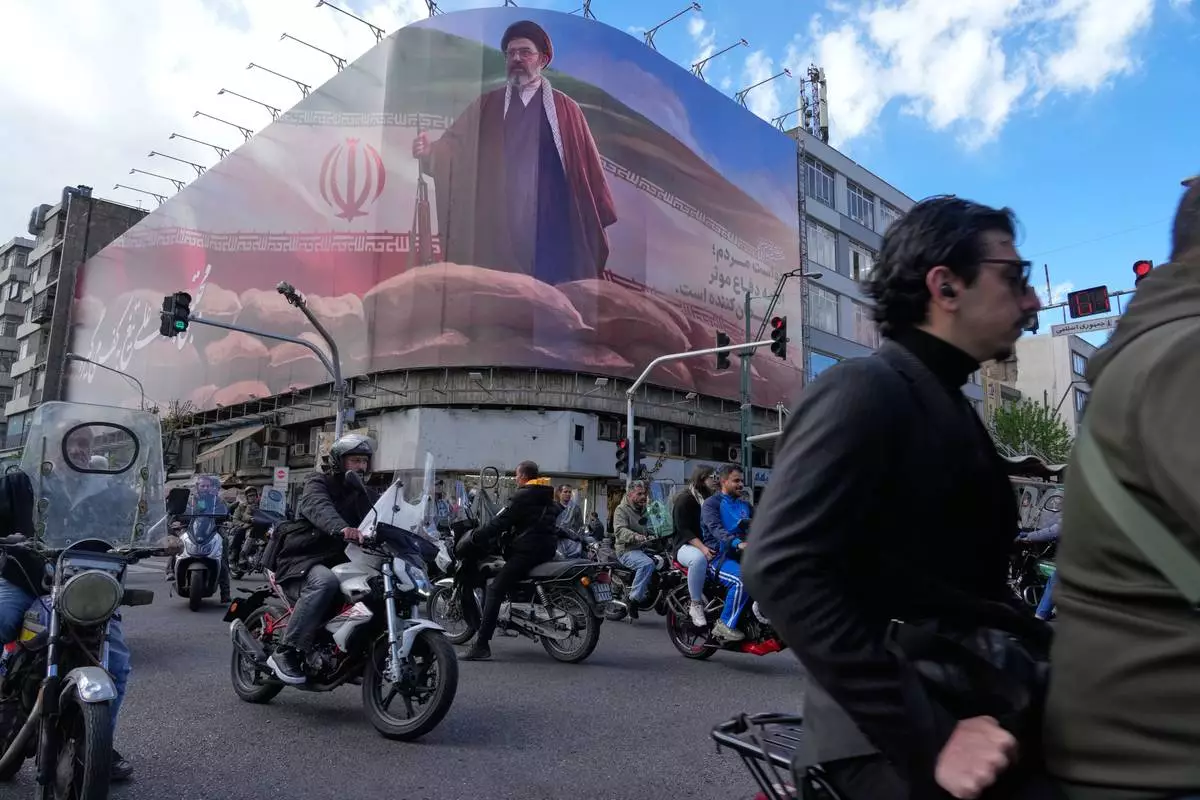
People drive their motorbikes past a billboard that shows a graphic depicting Iran's Supreme Leader Ayatollah Mojtaba Khamenei in downtown Tehran, Iran, Monday, April 6, 2026. (AP Photo/Vahid Salemi)
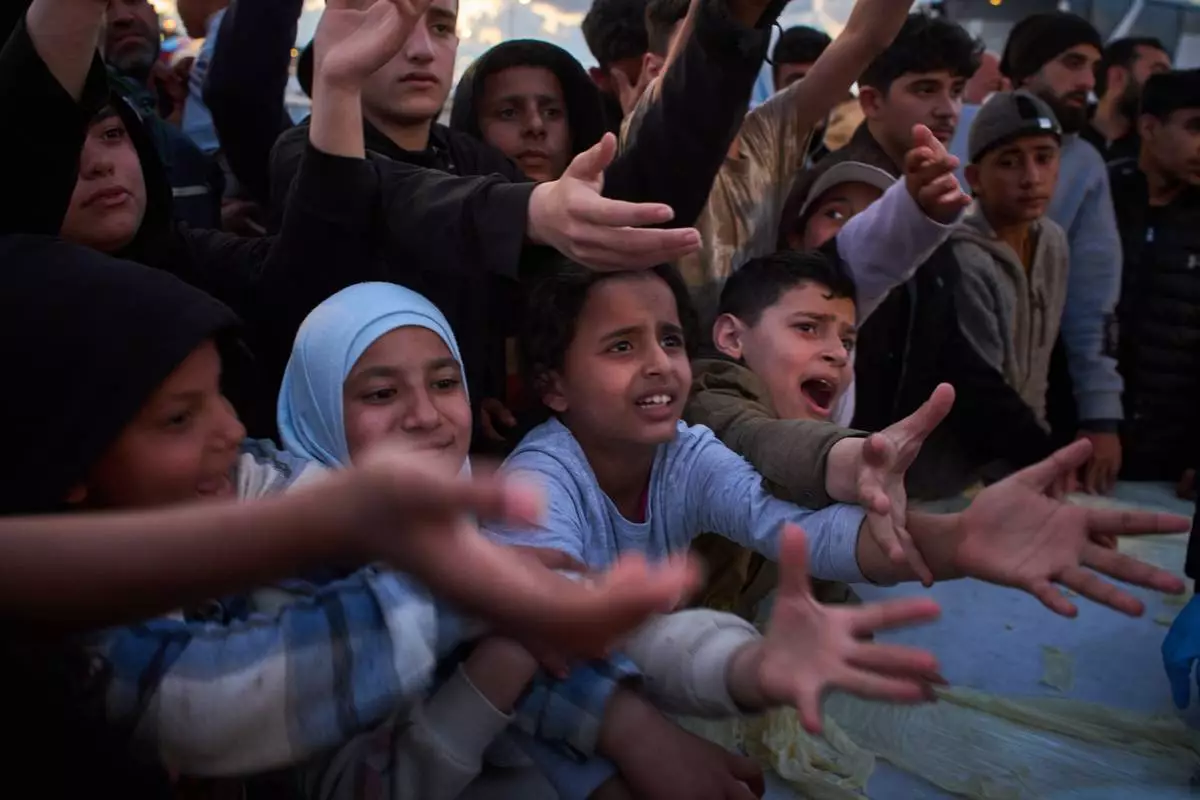
Displaced people wait to receive donated food beside the tents they use as shelters after fleeing Israeli bombardment in southern Lebanon, in Beirut, Lebanon, Monday, April 6, 2026. (AP Photo/Emilio Morenatti)
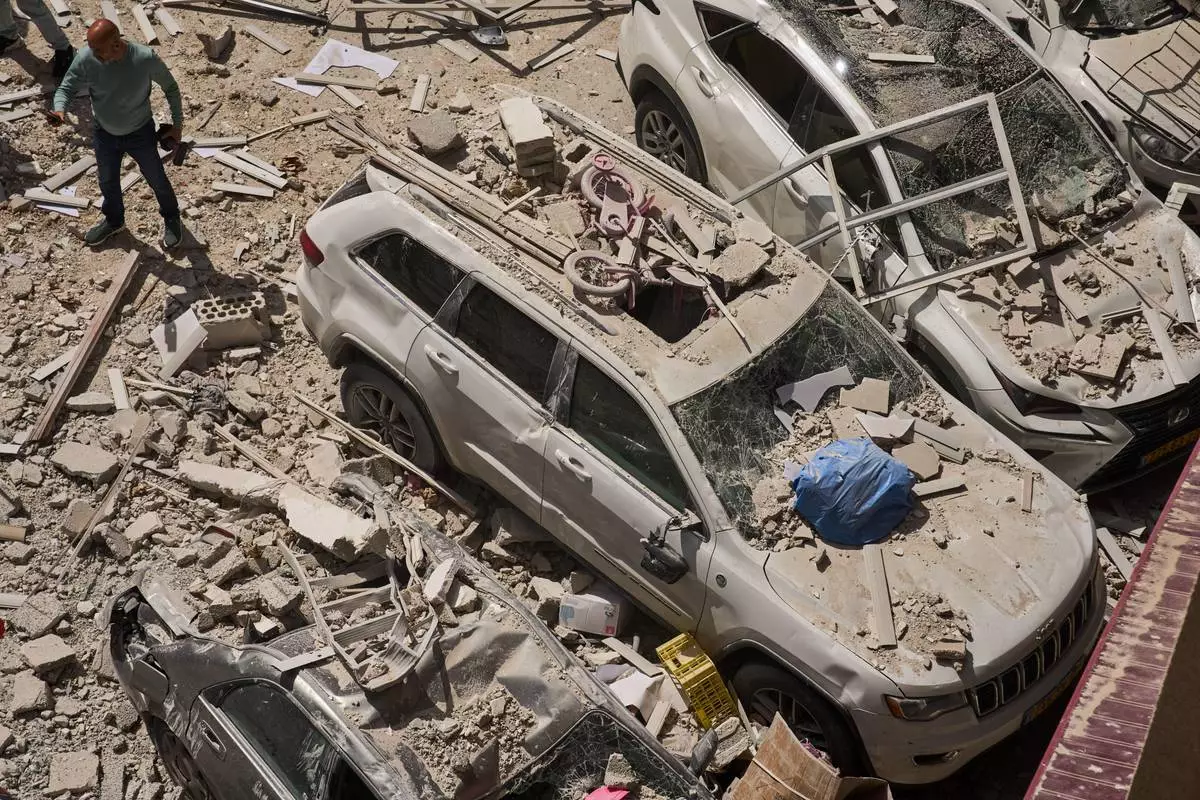
A man inspects the damage to cars and an apartment building struck by an Iranian missile in Ramat Gan, Israel, Monday, April 6, 2026. (AP Photo/Oded Balilty)