IRVING, Texas--(BUSINESS WIRE)--Apr 6, 2026--
Fluor Corporation (NYSE: FLR) announced today that it has entered into a contract with X-energy to support the company’s proposed advanced nuclear project at Dow’s UCC Seadrift Operations in south Texas. Under the agreement, Fluor will initially deliver Front-End Loading Stage 2 (FEL-2) services. FEL-2 focuses on project definition, strategic planning, feasibility assessment, cost control and risk mitigation. Fluor will recognize the undisclosed contract value for this initial portion of work in the first quarter of 2026.
This press release features multimedia. View the full release here: https://www.businesswire.com/news/home/20260406314695/en/
The X-energy project proposes to develop four, 80-megawatt small modular reactor (SMR) units to supply Dow’s Seadrift site with safe, reliable, carbon-free electricity and industrial steam, replacing aging energy and steam infrastructure. The project is supported by the U.S. Department of Energy’s (DOE) Advanced Reactor Demonstration Program (ARDP), which accelerates the commercialization of advanced nuclear technologies through cost-shared partnerships with industry. A construction permit application was submitted in March 2025 and is currently being reviewed by the U.S. Nuclear Regulatory Commission.
“X‑energy’s technology offers a powerful pathway for small modular reactors to deliver safe, reliable and fit-for-purpose baseload power in an industrial setting,” said Pierre Bechelany, Fluor’s Business Group President of Energy Solutions. “With eight decades of nuclear experience, Fluor brings the proven expertise and disciplined execution required to help advance this landmark project.”
X-energy was selected by the DOE in 2020 to develop, license and build its XE-100 advanced SMR and a first TRISO-X fuel fabrication facility. Since then, the company has completed engineering and preliminary reactor design, advanced development and licensing of its fuel facility in Oak Ridge, Tennessee. The Seadrift project is expected to become the first grid-scale advanced nuclear reactor deployed to serve an industrial facility in North America.
Dow’s UCC Seadrift Operations span 4,700 acres and produce more than 4 billion pounds of materials annually for applications including food packaging, footwear, wire and cable insulation, solar cell components, and medical and pharmaceutical packaging.
About Fluor Corporation
Fluor Corporation (NYSE: FLR) is building a better world by applying world-class expertise to solve its clients’ greatest challenges. Fluor’s nearly 23,000 employees provide professional and technical solutions that deliver safe, well-executed, capital-efficient projects to clients around the world. Fluor had revenue of $15.5 billion in 2025 and is ranked 257 among the Fortune 500 companies. With headquarters in Irving, Texas, Fluor has provided engineering, procurement, construction and maintenance services for more than a century. For more information, please visit www.fluor.com or follow Fluor on Facebook, Instagram, LinkedIn, X and YouTube.
#EnergySolutions

Leaders from Fluor, X-energy, and Dow gathered at Fluor’s offices in Houston to kick off the FEL-2 phase of X-energy’s advanced nuclear project in Seadrift, Texas.
NEW YORK (AP) — The U.S. stock market drifted higher in tentative trading ahead of a deadline President Donald Trump has set to bomb Iranian power plants. The S&P 500 rose 0.4% Monday. The Dow Jones Industrial Average added 0.4%, and the Nasdaq composite climbed 0.5%. Like stock indexes, oil prices seesawed through the day amid continued uncertainty about what will happen in the war with Iran and how long it will slow the global flow of crude oil. Trump warned again he will bomb Iran’s power plants if it doesn’t open the Strait of Hormuz. Treasury yields held relatively steady in the bond market.
THIS IS A BREAKING NEWS UPDATE. AP’s earlier story follows below.
NEW YORK (AP) — The U.S. stock market is making only hesitant moves Monday, while oil prices are flip-flopping ahead of a deadline that President Donald Trump has set to bomb Iranian power plants.
The S&P 500 rose 0.4%, coming off its first winning week in the last six. The Dow Jones Industrial Average was up 109 points, or 0.2%, with an hour remaining in trading, and the Nasdaq composite was 0.5% higher.
Oil prices likewise seesawed between gains and losses amid continued uncertainty about what will happen in the war with Iran and how long it will slow the global flow of oil and natural gas. Iran on Monday rejected the latest ceasefire proposal and instead said it wants a permanent end to the war, though the talks may not have collapsed.
“We won’t merely accept a ceasefire,” Mojtaba Ferdousi Pour, head of the Iranian diplomatic mission in Cairo, told The Associated Press. “We only accept an end of the war with guarantees that we won’t be attacked again.”
Fighting is continuing, meanwhile, including an Israeli attack on an Iranian petrochemical plant. And in the background is the clock ticking toward a deadline, which Trump has moved multiple times, where he has threatened to attack Iran's infrastructure if it does not open the Strait of Hormuz. A fifth of the world’s oil typically sails through the strait during peacetime.
“Tuesday will be Power Plant Day, and Bridge Day, all wrapped up in one, in Iran,” Trump said on his social media network over the weekend, threatening Iranian leaders that “you’ll be living in Hell - JUST WATCH!”
Monday also offered the first chance for U.S. stock prices to react to a report from Friday that said U.S. employers hired more workers last month than economists expected. The unemployment rate unexpectedly improved.
They’re encouraging signals for an economy that’s had to absorb painful leaps in costs for gasoline since the war’s beginning. The average price for a gallon of regular gasoline is nearly $4.12 across the country, according to AAA. It was below $3 a couple days before the United States and Israel launched attacks to begin the war in late February.
For countries that don’t produce as much oil as the United States, the pain has been even worse. That’s because they are more reliant on oil coming from the Middle East, and the war has blocked in much of the crude produced in the Persian Gulf area. That oil typically gets to customers around the world by exiting the Strait of Hormuz.
The price for a barrel of benchmark U.S. crude rose 0.8% to settle at $112.41 after erasing an earlier modest dip. Brent crude, the international standard, added 0.8% to $109.77 per barrel and remains well above its roughly $70 price from before the war.
On Wall Street, a split performance for the Big Tech stocks that are the U.S. market’s most influential kept things in check. Apple rose 1.3%, and Amazon added 1.2%. Tesla slid 2.6%, and Microsoft fell 0.3%.
Bank stocks were some of the market’s strongest, including a 1.5% rise for JPMorgan Chase.
CEO Jamie Dimon said in his annual letter to shareholders released on Monday that the U.S. economy continues to be resilient, and businesses still look healthy. He, though, also acknowledged that prices for stocks and other assets are high, which could imply “anything less than positive outcomes could have a dramatic impact on global markets.”
In the bond market, Treasury yields held relatively steady. The 10-year Treasury yield was sitting at 4.33%. That's still well above its 3.97% level from before the war. The rise has pushed up rates for mortgages and other loans going to U.S. households and businesses, which slows the economy.
A mixed report on Monday said that finance, transportation and other U.S. businesses in services sectors grew in March for a 21st straight month of expansion. But the growth was slightly slower than economists expected, and a measure of prices accelerated at its fastest pace since 2022 in a potentially discouraging signal for inflation.
In stock markets abroad, Japan’s Nikkei 225 added 0.5%, and South Korea’s Kospi jumped 1.4%. Many other markets in Europe and Asia were closed for holidays.
AP Business Writers Yuri Kageyama and Matt Ott contributed.
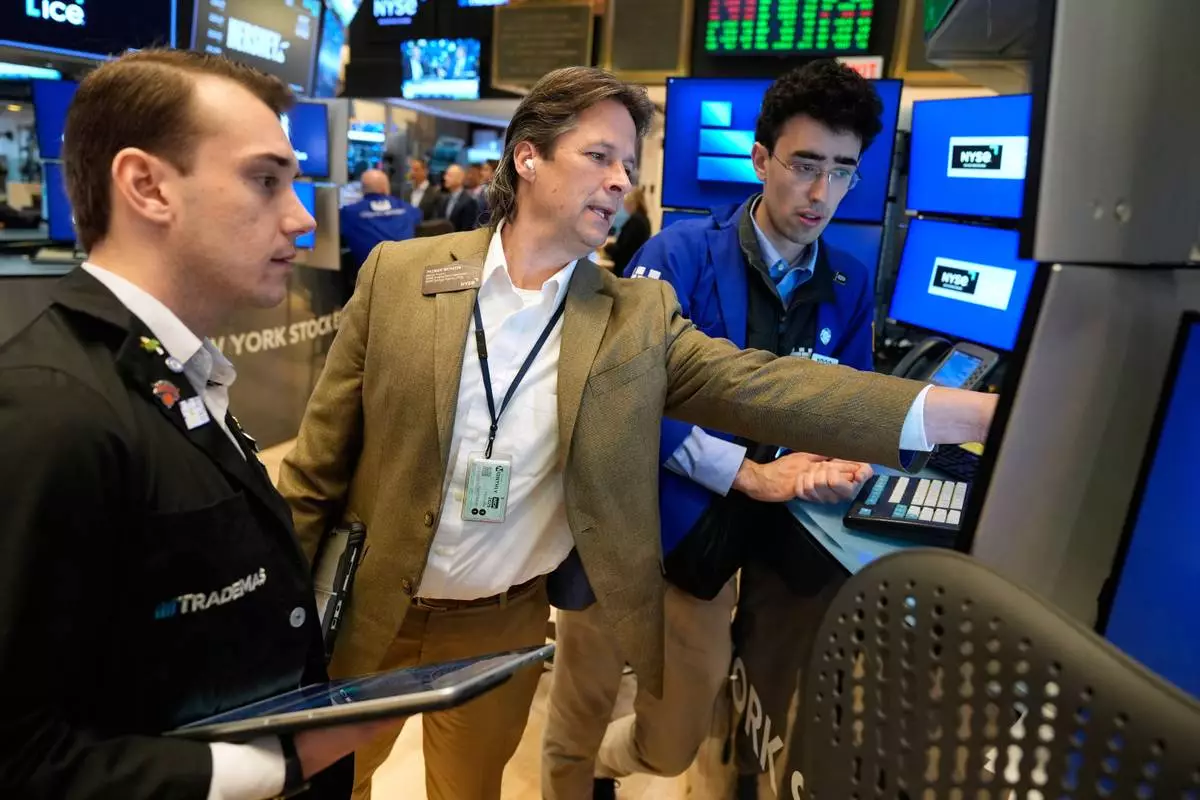
Patrick McKeon, center, works on the floor at the New York Stock Exchange in New York, Tuesday, March 31, 2026. (AP Photo/Seth Wenig)
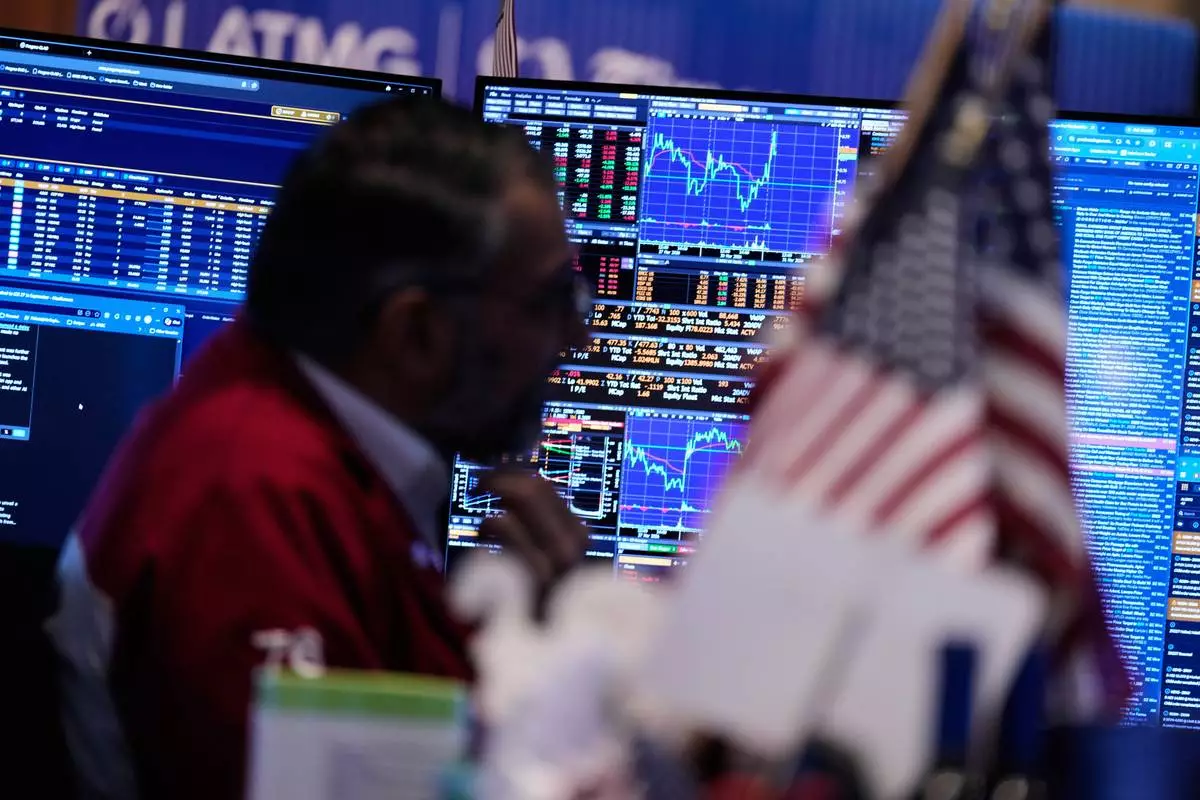
Screens display financial information on the floor at the New York Stock Exchange in New York, Tuesday, March 31, 2026. (AP Photo/Seth Wenig)
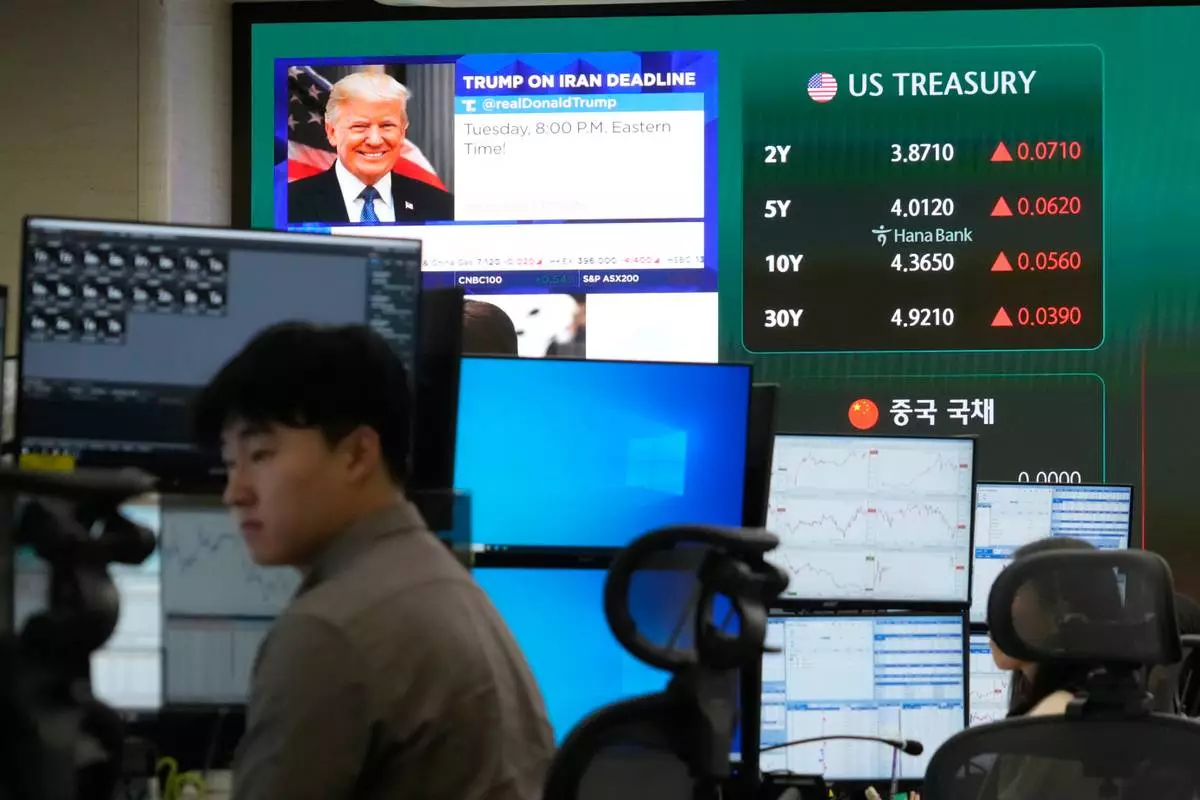
U.S. President Donald Trump is seen on a screen as traders work at the foreign exchange dealing room of the Hana Bank headquarters in Seoul, South Korea, Monday, April 6, 2026. (AP Photo/Ahn Young-joon)
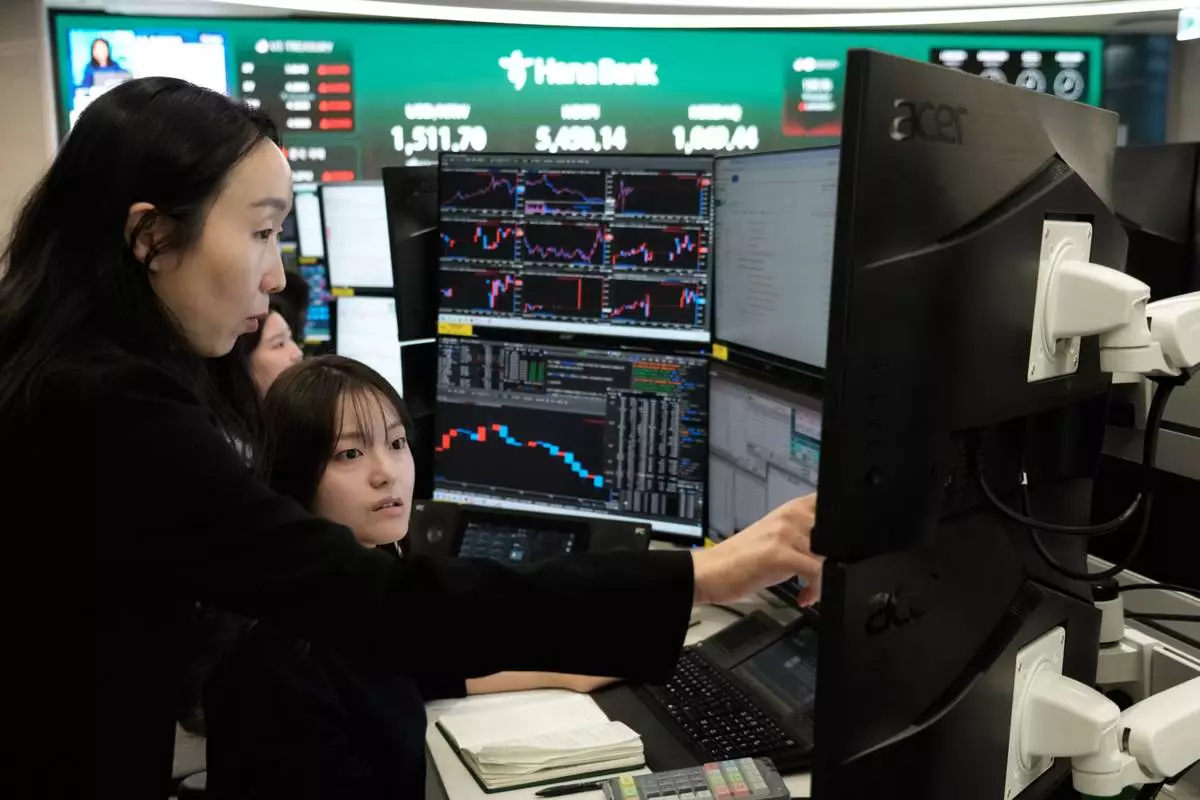
Currency traders watch monitors at the foreign exchange dealing room of the Hana Bank headquarters in Seoul, South Korea, Monday, April 6, 2026. (AP Photo/Ahn Young-joon)