Skip to Content Facebook Feature Image

National Laundry Day: America's Laundry Habits Revealed

Business

National Laundry Day: America's Laundry Habits Revealed
Business

Business

National Laundry Day: America's Laundry Habits Revealed

2026-04-08 22:36 Last Updated At:04-09 12:55

WASHINGTON--(BUSINESS WIRE)--Apr 8, 2026--

To mark National Laundry Day – April 15 – the American Cleaning Institute (ACI) unveiled new survey findings that shed light on how U.S. households approach laundry. From frequency of washes to preferred products, Americans continue to adapt their habits for efficiency and effectiveness.

This press release features multimedia. View the full release here: https://www.businesswire.com/news/home/20260408124834/en/

“Laundry is an essential part of daily life, and our survey highlights how much Americans value both routine and innovation to keep their clothes clean and fresh,” said Brian Sansoni, ACI’s Senior Vice President of Communications. "Whether sorting, treating stains or selecting the right detergents and fabric enhancers, these habits reflect that doing laundry is a way to care for our clothes and our families."

Laundry Loads: How Often Are Americans Washing?

The survey shows that nearly half of U.S. households (43%) do between one and three loads of laundry per week. An additional 37% report washing four to six loads weekly. Only 5% of households do less than one load, while 10% manage seven to ten loads each week. Just 3% handle more than ten weekly loads, and 1% use laundry services instead of washing at home.

Popular Laundry Practices

Among those who wash their clothes at home, more than half (54%) pre-sort their laundry before washing, and 48% treat stains ahead of time. These essential steps help preserve clothing and keep items looking their best for longer.

When it comes to detergent, liquid leads the way, favored by 55% of U.S. households who do laundry at home, compared to just 6% who use powdered detergent. Unit dose detergents, including packets, pods or sheets, are gaining popularity, with 38% of households opting for these convenient options.

After washing, nearly one-third (29%) dry their laundry on a clothesline or rack, and 19% iron their clothes after drying.

Laundry Enhancers

Laundry routines go beyond detergent: 68% of respondents who do laundry at home use fabric softener or dryer sheets, 44% incorporate laundry sanitizers or bleach and 36% add scent beads or boosters. After washing, 29% use fabric enhancers such as wrinkle release sprays or static guards. To help consumers make informed choices, ACI developed a guide on laundry enhancers.

This National Laundry Day, ACI invites everyone to celebrate their laundry routines and the innovations that make cleaner, fresher clothes possible. For more tips on best laundry practices and product safety, visit www.cleaninginstitute.org/clothes.

About the Survey

This ACI survey was conducted by Wakefield Research ( www.wakefieldresearch.com ) among 1,000 nationally representative U.S. adults ages 18+, between Feb. 4 and Feb. 12, 2026, using an email invitation and an online survey. Data has been weighted to ensure an accurate representation of U.S. adults ages 18+.

Results of any sample are subject to sampling variation. The magnitude of the variation is measurable and is affected by the number of interviews and the level of the percentages expressing the results. For the interviews conducted in this particular study, the chances are 95 in 100 that a survey result does not vary, plus or minus, by more than 3.1 percentage points from the result that would be obtained if interviews had been conducted with all persons in the universe represented by the sample.

American Cleaning Institute

The American Cleaning Institute ® (ACI – www.cleaninginstitute.org ) is the Home of the U.S. Cleaning Products Industry® and represents the $60 billion U.S. cleaning product supply chain. ACI members include the manufacturers and formulators of soaps, detergents, and general cleaning products used in household, commercial, industrial and institutional settings; companies that supply ingredients and finished packaging for these products; and chemical distributors. ACI serves the growth and innovation of the U.S. cleaning products industry by advancing the health and quality of life of people and protecting our planet. ACI achieves this through a continuous commitment to sound science and being a credible voice for the cleaning products industry.

A new American Cleaning Institute survey shows that nearly half of U.S. households (43%) do between one and three loads of laundry per week. An additional 37% report washing four to six loads weekly.

A new American Cleaning Institute survey shows that nearly half of U.S. households (43%) do between one and three loads of laundry per week. An additional 37% report washing four to six loads weekly.

LONDON (AP) — U.K. Prime Minister Andy Burnham says his government will consider apologizing for the first time for its role in the trans-Atlantic slave trade as it seeks to strengthen relations with nations in Africa and the Caribbean.

Writing in the Guardian on Saturday, Burnham said Britain needed to acknowledge its “complicated history” in order to protect the Commonwealth, an association of 56 independent nations that grew out of the British Empire. Burnham travels to Antigua and Barbuda next week for a meeting of Commonwealth leaders.

“For years, those members of the Commonwealth affected by the slave trade have asked for an honest conversation about the legacies of slavery,” Burnham said. “By sticking our heads in the sand, we have damaged the ability of the Commonwealth to function.”

Burnham said his government is offering to begin a “structured dialogue” with those affected by slavery and will listen to calls for a formal apology by the British state. But he said Britain would continue to resist calls for it to pay reparations for the slave trade.

“I do not think that British people today can be held liable for historical wrongs, however heinous, that happened in a different age under different laws and in which they played no personal part,” Burnham said.

Instead, the prime minister said he wanted to address the issues that face the Commonwealth and other nations today, including high levels of debt faced by many developing countries.

Burnham said he would work with other wealthy nations and investors to help vulnerable countries pay off their debts over a longer period and at lower interest rates. To help move this initiative forward, former Prime Minister Gordon Brown, a champion of debt relief for developing nations, will attend the Commonwealth meeting, he said.

King Charles III faced calls for Britain to apologize and pay reparations during the first phase of a nine-day trip to the Caribbean that will end with the Commonwealth Heads of Government meeting Sunday through Wednesday in St. John’s, the capital of Antigua and Barbuda.

Speaking in Nassau, the capital of the Bahamas, on Tuesday, Charles acknowledged “the great suffering and injustices of the past” but stopped short of an apology.

The king until now has been prevented from going further because it was government policy not to apologize for the country’s role in the slave trade and Britain’s constitutional monarch speaks on behalf of the elected government.

Burnham’s comments come as Britain seeks to shore up relations with its traditional allies in the Commonwealth in the face of economic, environmental and military challenges around the world.

A change in the government’s position could also respond to younger, more liberal voters at home, where activists have called for Britain to re-examine the legacy of its colonial history.

In 2020, anti-racism protesters in Bristol tore down the statue of Edward Colston, an English merchant and politician, saying the city should no longer glorify the life of a slave trader. Colston was a deputy governor of the Royal African Company, which shipped thousands of enslaved people to English colonies in the Americas.

The descendants of some British people who profited from the slave trade have already apologized and offered compensation. Those include the owner of the Guardian, a liberal newspaper where leaders of Burnham’s Labour Party often lay out policy initiatives.

U.K. politicians have traditionally focused on the country’s role in banning the slave trade in 1807 and outlawing slavery throughout the British Empire in 1833.

But Burnham said it is now time for the country to acknowledge the other side of the story as well.

“We are a country where brave people led the way in abolishing slavery, but we are also a country that participated in the trade in human lives,” he said.

“The trans-Atlantic slave trade was a brutal and barbaric violation of those people. … I want to express my sorrow and regret for the pain and suffering of so many millions of people, and to recognize the way it still shapes our world today.”

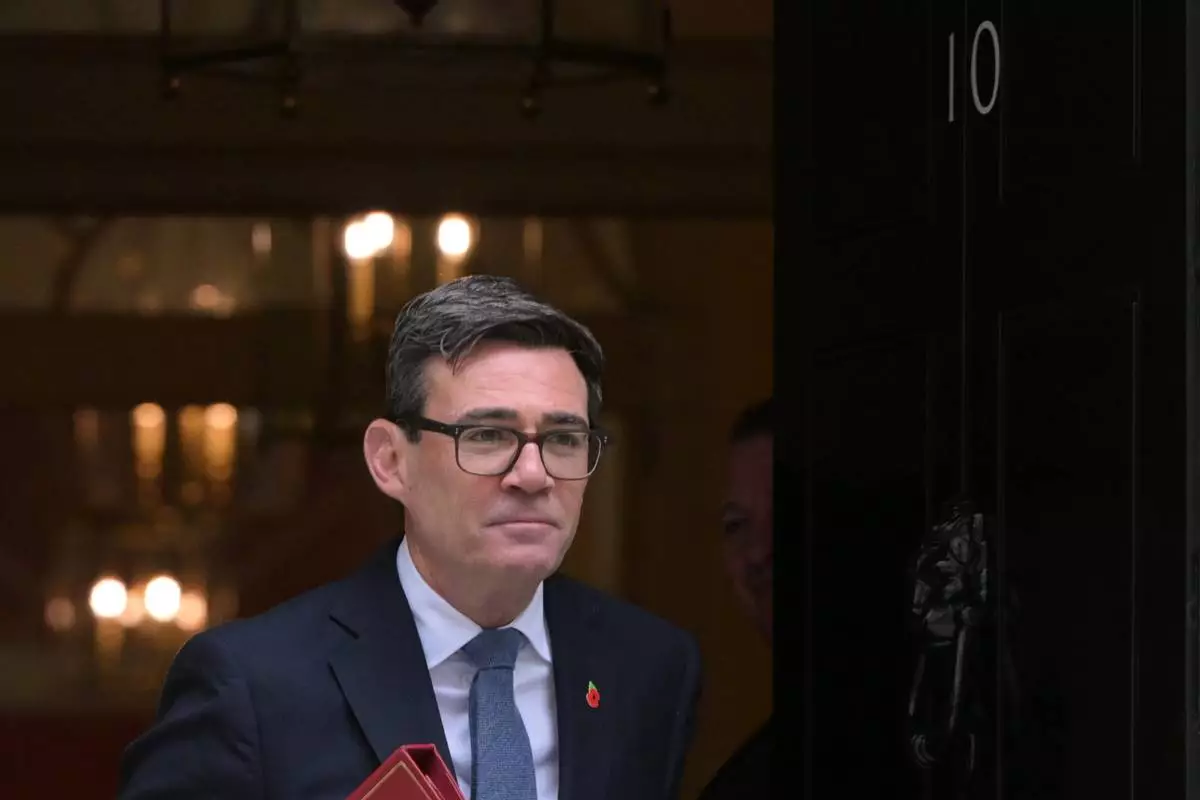
Britain's Prime Minister Andy Burnham leaves 10 Downing Street to attend the weekly Prime Ministers' Questions session in parliament in London, Wednesday, Oct. 28, 2026.(AP Photo/Thomas Krych)

Britain's Prime Minister Andy Burnham leaves 10 Downing Street to attend the weekly Prime Ministers' Questions session in parliament in London, Wednesday, Oct. 28, 2026.(AP Photo/Thomas Krych)

Recommended Articles