The youngest member of the history-making U.S. national table tennis that made a groundbreaking trip to Beijing 55 years ago has reflected on the significance of this famous visit which helped open up a new chapter in China-U.S. relations, saying the spirit of 'Ping-Pong Diplomacy' still offers valuable lessons today.
Nowadays, Judy Hoarfrost is still sharing her skills to table tennis players of all ages at the Paddle Palace, a special sports center she set up just outside the U.S. city of Portland in the state of Oregon.
But her role in the extraordinary tale of "Ping-Pong Diplomacy" still resonates strongly well over half a century later.
Hoarfrost's remarkable story in the sport can be traced all the way back to when she was just a teenager, eagerly vying to earn a spot on the U.S. team for the 1971 World Championships that were set to take place in Nagoya, Japan.
"We had a tryout in the United States. I was 15 years old, and I just barely made the team," she said.
But the championships would become historic for an entirely different reason, as a dramatic chain of events were set in motion completely by accident as U.S. team player Glenn Cowan missed his team's bus back to his hotel.
"Glenn, true to his nature, missed our bus. He came out, and our bus was gone, and he was waved on to the Chinese bus. So he walked on, and there's the Chinese players. And then Zhuang Zedong, who's Team Leader, because he had been three-time World Champion, went up to Glenn and welcomed him and he gave him a gift, a silk scarf," Hoarfrost said.
After this warm encounter, Cowan was keen to give something back to Zhuang Zedong in return for this simple but kind act.
"He told us about it. Then, of course, he was scrambling around, 'I have to get a gift. I have to get a gift,' because he had nothing at that time. So he went and bought a 'Let it be' shirt. Soon after, we were entering the stadium, and there was Zhuang Zedong and the team, and he went up to him and gave him this gift. And there was a lot of press around. And it made the news and I understand it made the news all the way back to Mao Zedong, who said, 'Yes, invite the team to go to China'," Hoarfrost said.
On April 10, 1971, one of the most unlikely and influential chapters in diplomatic history took place. Nine U.S. players, along with supporting staff, became the first official American delegation to visit China since 1949.
"On top of the list, I met Premier Zhou Enlai at the Great Hall of the People, and each of us, one by one, shook hands with him. And then we sat down and had a conversation between our teams and him. And that was pretty amazing. And we played table tennis at the Capital Stadium in front of 20,000 people," Hoarfrost said.
That historic trip to China signaled a major shift in cold war strategy and opened the door for the normalization of relations between China and the U.S., and the following year there was a reciprocal visit to the U.S. by China's table tennis team.
Almost 55 years on, Hoarfrost visited Beijing again and met another 'Ping Pong Diplomat' in Liang Geliang, a six-time world championship gold medalist, and a key figure who witnessed and contributed to this unique chapter in history.
"I was 15 years old but I learned much more about China [compared to] while I was there in the years since. But I didn't really understand the scope of the experience until we left China," said Hoarfrost.
Relations between China and the U.S. have experienced many fluctuations over the years. But it would appear that table tennis is an area where the two countries continue to find common ground, breaking down walls and building bridges.
"One of the lessons we've learned from Ping Pong Diplomacy is the power of sports to break down barriers. People-to-people exchange creates an environment in which we can break down barriers that are maybe political in nature. It helps to break that down so that it makes it easier for our political leaders to come together, to work together on all of our issues," said Hoarfrost.
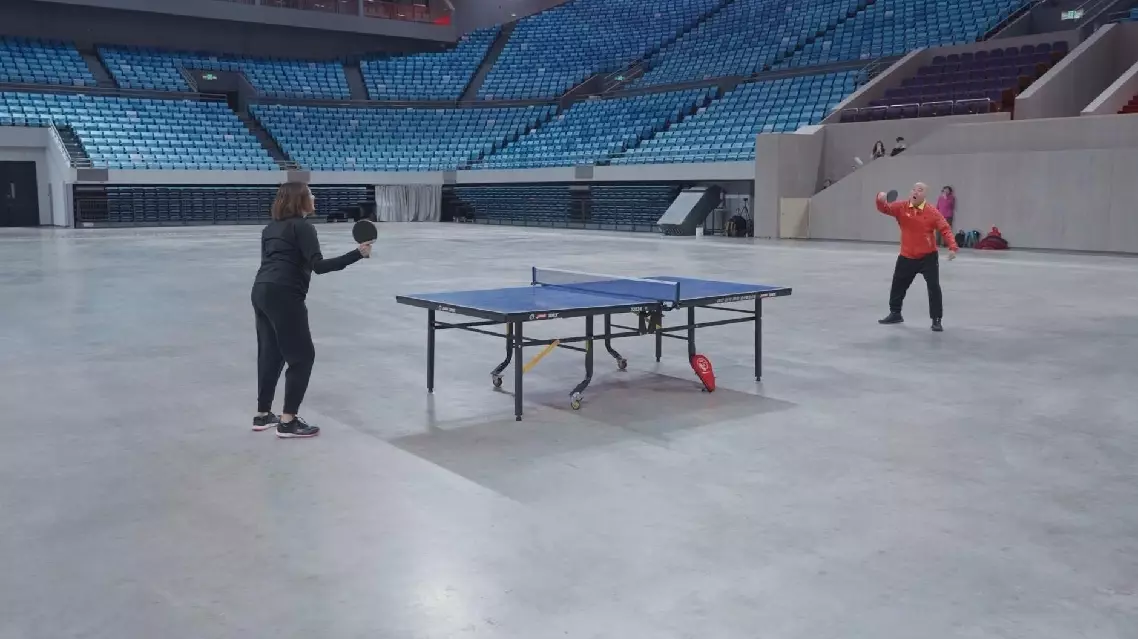
Former US national team player returns to China to retrace historic 'Ping-Pong Diplomacy' journey