Donald Trump is accustomed to criticism from coast to coast — Democrats, disaffected Republicans, late-night comedians, massive protests. Yet in his second presidency, Trump’s most influential American critic doesn’t live in the country but at the Vatican.
It's an unprecedented situation, with the first American pope directly assailing the American president over the war in Iran, where a fragile ceasefire took hold this week. The announcement came after Pope Leo XIV declared that Trump's belligerence was “truly unacceptable.”
Never before has the relationship between Washington and the Vatican revolved around two Americans — specifically, a 79-year-old politician from Queens and a 70-year-old pontiff from Chicago. They come from the same generation and share some common cultural roots yet bring jarringly distinct approaches to their positions of vast power. And the relationship comes with risks for both sides.
“They’re two white guy boomers but they could not be any more different in their life experiences, in their values, in the way they have chosen to live those values,” said theology professor Natalia Imperatori-Lee of Fordham University. “This is a very stark contrast, and I think an inflection point for American Christianity.”
Experts on the Catholic Church emphasized that Leo’s opposition to the war reflects established church teachings, not the reflexive politics of the moment.
“For the last five centuries, the church has been involved in a project of helping develop strong international norms,” including the Geneva Conventions in recent centuries, said Catholic University professor William Barbieri. “It is a very long-standing tradition rooted in Scripture and theology and philosophy.”
Yet the U.S. administration, which has close ties to conservative evangelical Protestant leaders, has claimed heavenly endorsement for Trump’s war on Iran.
Defense Secretary Pete Hegseth urged Americans to pray for victory “in the name of Jesus Christ.” When Trump was asked whether he thought God approved of the war, he said, “I do, because God is good — because God is good and God wants to see people taken care of.”
The Rev. Franklin Graham, son of iconic Baptist evangelist Billy Graham, said of Trump that God “raised him up for such a time as this.” And Graham prayed for victory so Iranians can “be set free from these Islamic lunatics.”
Leo countered in his Palm Sunday message that God “does not listen to the prayers of those who wage war, but rejects them.” He referenced an Old Testament passage from Isaiah, saying that “even though you make many prayers, I will not listen — your hands are full of blood.”
While it's not unusual for popes and presidents to be at cross purposes, it's exceedingly rare for the leader of the Catholic Church to directly criticize a U.S. leader, and Leo later named Trump directly and expressed optimism that the president would seek “an off-ramp” in Iran.
An even stronger condemnation came after Trump warned of mass strikes against Iranian power plants and infrastructure, writing on social media that “an entire civilization will die tonight.” Leo described that as a “threat against the entire people of Iran" and said it was "truly unacceptable.”
Imperatori-Lee said Leo’s direct criticism stands out from the church's more general critiques of political and social systems. For example, Pope Francis urged U.S. bishops to defend migrants without specifically mentioning Trump or his deportation agenda. Leo also previously called for humane treatment of migrants.
“Popes have critiqued unfettered capitalism before, very robustly. The popes have critiqued the Industrial Revolution, right? Things that the U.S. has been at the forefront of,” Imperatori-Lee said, “but it’s never been this specific and localized.”
She said Leo’s commentary resonates in the U.S. — with Catholics and non-Catholics — because he is a native English speaker.
“There’s no question about his inflection and meaning,” she said. "It removes any ambiguities.”
Trump welcomed Leo’s election last May as a “great honor” for the country, and he hasn't responded to the latest criticisms. The White House did not respond to a request for comment.
“What Pope Leo and Donald Trump have in common is they both lived through the post-war polarization,” including the political upheaval of the Civil Rights Movement and Vietnam War, said Steven Millies, a professor at Chicago’s Catholic Theological Union, one of the pope’s alma maters.
He noted that Leo is a subscriber to The New York Times, plays the “Wordle” game, keeps up with U.S. sports and talks regularly with his brothers, including an avowed Trump supporter.
“In some ways he’s just like us,” Millies said, someone “who understands where our domestic political crisis came from,” unlike the Argentinian Francis, “who did not fully understand the peculiarities of the United States” even as he offered implicit criticism.
Barbieri said Leo’s American savvy still does not change an underappreciated reality of Catholicism and the papacy. “The Catholic Church doesn’t neatly fit into either right or left boxes as they’re understood in U.S. politics,” he said.
Leo spent much of his pre-papal ministry, including all his time as a bishop and cardinal, outside the U.S.
He was educated in Rome as a canon lawyer within the church. He was a bishop in poor, rural swaths of Peru. He led the Augustinian order and served as Francis’ prefect for recommending bishop appointees around the world.
Imperatori-Lee said that global reach gave him a first-hand perspective on how Washington's economic and military policies — including backing dictators in Latin America — have negatively affected less powerful nations and their citizens.
His varied experiences made then-Cardinal Robert Prevost uniquely suited to be elected pope despite the College of Cardinals’ traditional skepticism toward the U.S. and its superpower status. Millies argued that Trump and his advisers, even Vice President JD Vance, a Catholic convert, may not appreciate those distinctions.
“This is an administration that seems to think only in terms of transactional politics — who’s for us and who’s against us,” he said.
Relations between Washington and the Vatican have become so strained that a report of an allegedly contentious meeting involving Pentagon and Catholic Church officials sent shockwaves through both cities.
According to the report in The Free Press, a member of Trump's administration warned the church in January not to stand in the way of U.S. military might.
The Vatican on Friday issued a statement rejecting the report's characterization of the meeting, saying it “does not correspond to the truth in any way.”
The U.S. Embassy to the Holy See also pushed back, writing on social media that “deliberate misrepresentation of these routine meetings sows unfounded division and misunderstanding.”
Millies, meanwhile, questioned whether anything the pope or U.S. bishops say can sway individual Catholics. Trump is likely to lose support among Catholics as he loses support across the broader electorate, Millies said, but that's not necessarily because members of Leo's flock are applying church doctrine.
“Partisan preferences always trump the religious commitments,” Millies said, describing a “disconnect” between church leaders and many parishioners who look to other sources, politicians included, when shaping their views of faith and politics.
“The icon of Catholicism in American politics now is JD Vance, and it’s more about winning an argument," he said. "It’s a very different emphasis, but it’s one that may suit the Trump administration very well.”
—-
Associated Press reporters Nicole Winfield in Rome and Konstantin Toropin in Washington contributed.
Associated Press religion coverage receives support through the AP’s collaboration with The Conversation US, with funding from Lilly Endowment Inc. The AP is solely responsible for this content.
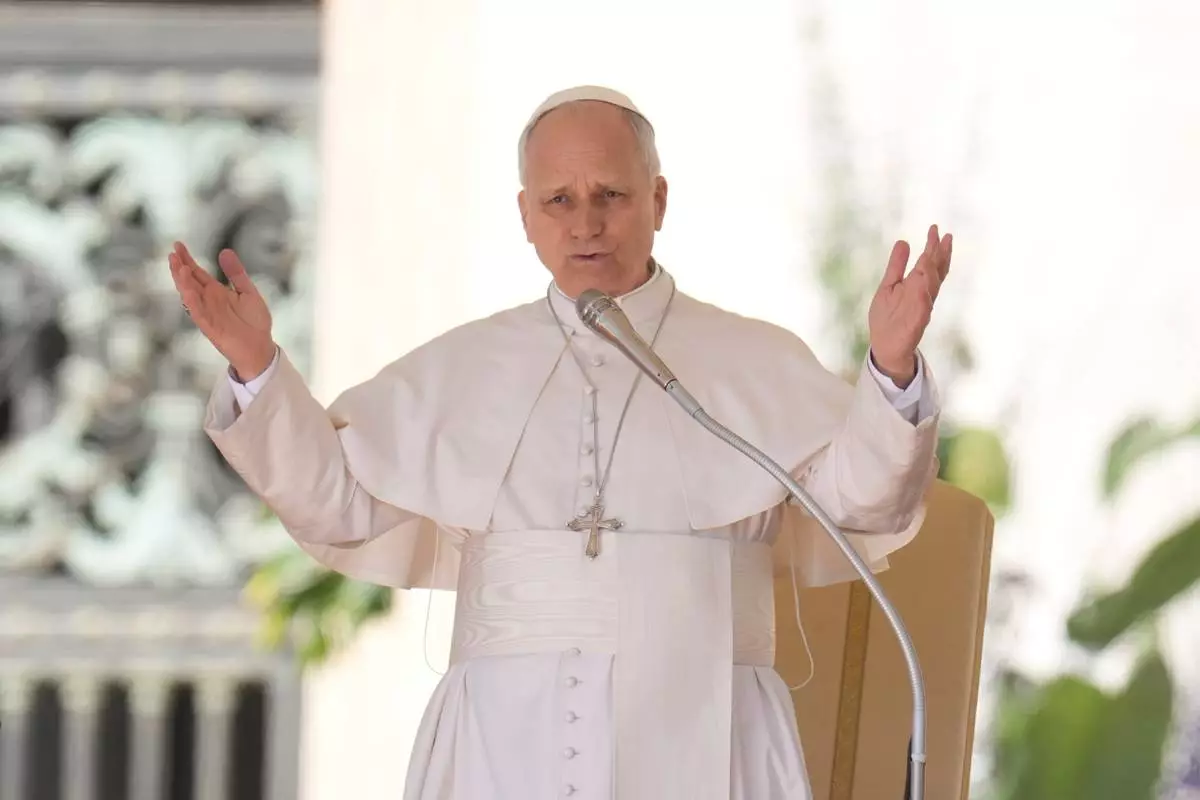
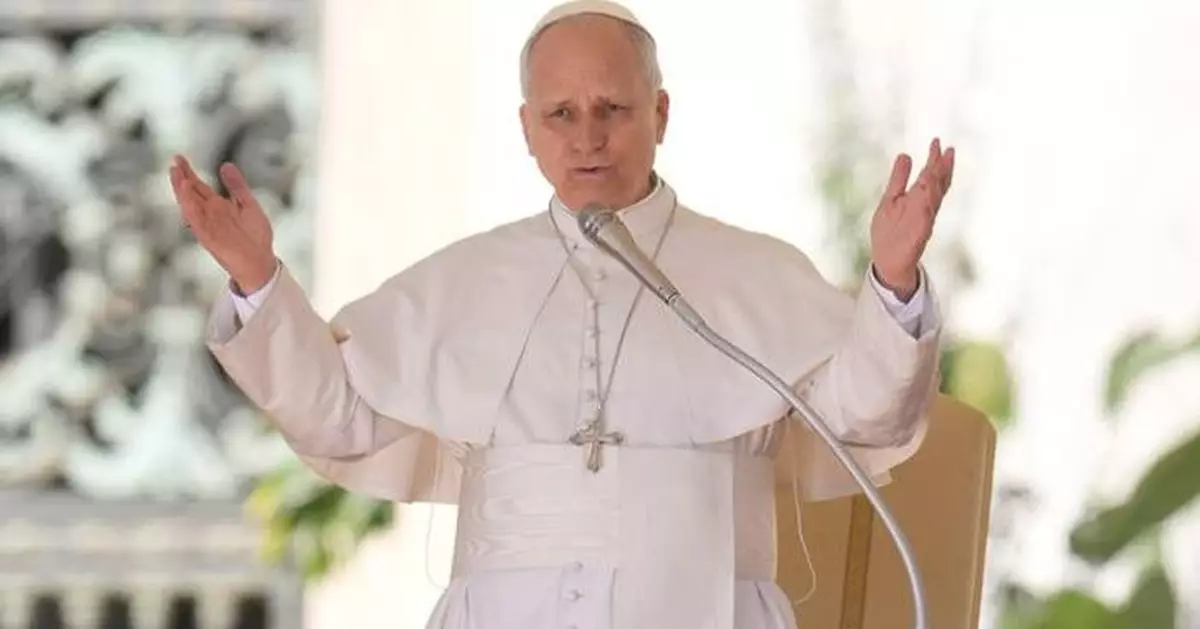
Pope Leo XIV blesses faithful as he starts his weekly general audience in St. Peter's Square, at the Vatican, Wednesday, April 8, 2026. (AP Photo/Gregorio Borgia)
Over four years ago, Belarus' authoritarian President Alexander Lukashenko allowed longtime ally Russia to use his territory to invade Ukraine. Now officials in Kyiv are warning that Lukashenko could again allow his land to serve as a launchpad for more attacks by the Kremlin's forces.
While Belarus has not contributed troops to battle, Lukashenko has backed President Vladimir Putin’s war effort by hosting Russia’s nuclear weapons and military infrastructure, as well as producing components for Moscow’s military industries. Earlier this month, the countries held joint drills of nuclear forces involving Russian weapons deployed in Belarus.
Lukashenko, in power for over three decades, has ruled the nation of 9.5 million with an iron fist, relentlessly cracking down on dissent and relying on its close ties with Russia, as well as subsidies from the Kremlin's coffers, to counteract repeated Western sanctions.
Military cooperation between Moscow and Minsk is increasingly worrying Ukraine’s allies.
When Putin began the full-scale invasion of Ukraine on Feb. 24, 2022, Russian troops that gathered in Belarus under the guise of drills dashed toward Kyiv, only about 90 kilometers (56 miles) south of the border.
Putin’s hope of capturing Kyiv quickly was shattered by staunch Ukrainian resistance, and convoys of Russian tanks stretching along narrow roads became easy prey.
A little over a month after the invasion, Russian troops that suffered heavy losses and struggled to maintain their supply lines pulled back from Kyiv and other areas they captured in northeastern Ukraine in what the Kremlin cast as a “goodwill gesture.”
When Moscow tried to negotiate a quick end to the conflict weeks after its start, Belarus hosted the first talks between Russian and Ukrainian delegations. The talks moved to Istanbul but failed to produce a deal.
As the conflict became a war of attrition, Belarus has played a key role in supporting Moscow’s war effort. Belarusian plants have produced important components, including microchips and other electronics, optical guidance systems, artillery munitions and heavy trucks that carry Russian ballistic missiles.
Ukraine’s presidential envoy on sanctions policy, Vladyslav Vlasiuk, said fragments of an Oreshnik ballistic missile that Russia fired at Ukraine on May 24 contained microchips from Belarus. He urged Western allies to tighten sanctions enforcement against Belarus.
Belarus also provided training grounds for Moscow's troops, hosted joint drills and offered its hospitals to treat wounded Russian soldiers.
BELPOL, a group of former military and law enforcement officers who oppose Lukashenko, said the Belarusian industries have effectively been integrated into the Kremlin’s war machine. It says that over 500 Belarusian industrial plants are involved in manufacturing weapons and ammunition, repairing military equipment and providing logistics.
“Lukashenko’s regime is quite seriously involved in the war,” BELPOL head Uladzimir Zhyhar told The Associated Press. “Lukashenko is helping Russia in every way he can.”
In the Gomel region that borders Ukraine, construction has begun of a big firing range and barracks for large numbers of troops, Zhyhar said. Ukraine has been forced to maintain many forces at the border with Belarus, he added, keeping them from fighting Russian troops along the more than 1,000-kilometer (600-mile) front line.
Belarus, which also borders NATO members Latvia, Lithuania and Poland, has hosted some of Russia's tactical nuclear weapons. In December, Russia announced that its latest intermediate range nuclear-capable Oreshnik missile system entered service in Belarus.
Russia has used a conventionally armed version of the Oreshnik to strike facilities in Ukraine three times — in November 2024 and then again in January and earlier this month.
In 2024, the Kremlin revised its nuclear doctrine, placing Belarus under the Russian nuclear umbrella. Putin has said that Moscow will retain control of its nuclear weapons deployed in Belarus but would allow its ally to select the targets in case of conflict.
Earlier this month, Russia and Belarus held massive drills that included the delivery of nuclear warheads to missile units and launch preparations. As part of the exercise, a Belarusian missile crew test-fired a nuclear-capable Iskander missile from a range in southern Russia.
“Belarus lacks military sovereignty, and as soon as Moscow sees it as necessary for its strategy, Moscow will naturally use Belarus as a launchpad for a new invasion of Ukraine or some kind of armed conflict with NATO countries,” Zhyhar said, noting that Belarus offers a “very convenient springboard” for such an invasion.
Last week, Ukrainian President Volodymyr Zelenskyy said his intelligence services had learned Moscow recently stepped-up efforts to “draw Belarus much deeper into the war and launch additional aggressive operations precisely from Belarusian territory." He said the target could be along the Chernihiv-Kyiv area or against a NATO country bordering Belarus.
Zelenskyy said he ordered the military and security agencies to prepare a response and strengthen northern defenses.
Lukashenko has denied any aggressive plans, declaring Belarus will not enter the conflict unless attacked.
Sergei Shoigu, Russia's former defense minister and now secretary of its Security Council, also rejected Zelenskyy’s claim, describing it as a scare tactic to attract more Western aid for Kyiv.
But in a sign of growing Western concern, French President Emmanuel Macron spoke to Lukashenko on May 24 to underscore the risks for Belarus of being dragged into the war, their first call since the invasion began. Lukashenko said that next week he will host a French envoy for talks on European security and prospects of easing EU sanctions.
Andrii Demchenko, a spokesman for Ukraine’s Border Guard Service, said last week that while intelligence data indicate that Russia has increasingly pressured Belarus to directly enter the war, Ukrainian forces haven’t yet spotted any buildup of troops and weapons near the border.
Belarus’ opposition leader-in-exile, Sviatlana Tsikhanouskaya, visited Kyiv last week and emphasized that “Belarus must never again become a springboard for aggression.”
“Russian tanks must never again march through Belarus to Chernihiv, Zhitomir, Rivne, or Kyiv,” Tsikhanouskaya told AP. “Ukraine is fighting for itself and for all the peoples who have lived in the shadow of empire for too long. It is fighting for the right to live in peace. And the fate of my country, Belarus, also depends on Ukraine’s success.”
According to official data, Belarus' armed forces have 48,600 troops, a tiny force compared with Russia's 1.5 million. In case of war, Belarus is prepared to mobilize 290,000, but they would need weapons and training to become combat-ready.
“The Belarusian army is unfit for offensive action,” said Alexander Alesin, a Minsk-based military analyst. “An attack from Belarus would require ... mobilizing up to 500,000 troops."
That would mean taking all the men from the national economy and then finding arms for them, he said, adding: "I consider this option unlikely.”
Ukraine has built heavy fortifications on the border with Belarus and planted mines that would easily stymie any attempted incursion, he said.
“Even with a small force, the Ukrainians can easily defend themselves and inflict heavy losses on the Belarusian army,” Alesin said. “From a military perspective, it’s impossible to launch an attack from Belarusian territory without suffering heavy losses.”
Lukashenko is comfortable with Belarus’ position as a key supplier of military equipment and would strongly oppose direct involvement in the war, he added.
“The last thing Lukashenko wants is to fight, and he’ll cling to his current position at any cost, so he can avoid fighting while profiting handsomely from the war,” Alesin said.
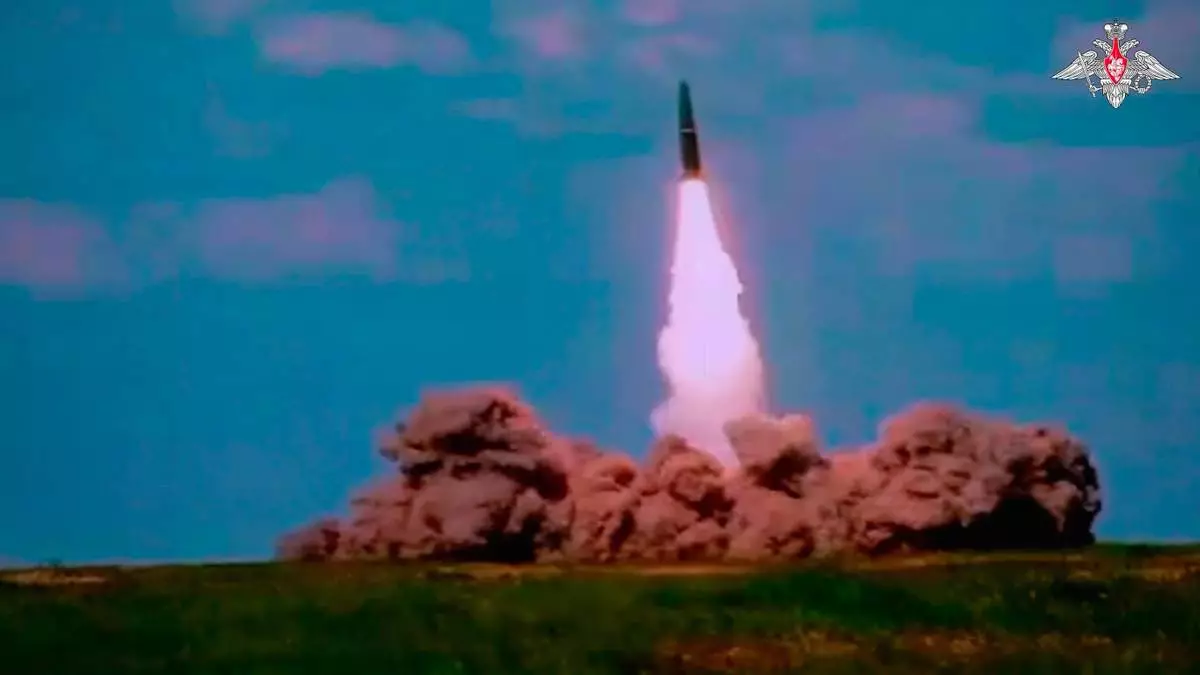
In this image made from video provided by Russian Defense Ministry Press Service on Thursday, May 21, 2026, an Iskander missile is launched by a Belarusian crew from the Kapustin Yar firing range in Russia, during joint nuclear drills conducted by Russian and Belarusian militaries. (Russian Defense Ministry Press Service via AP)
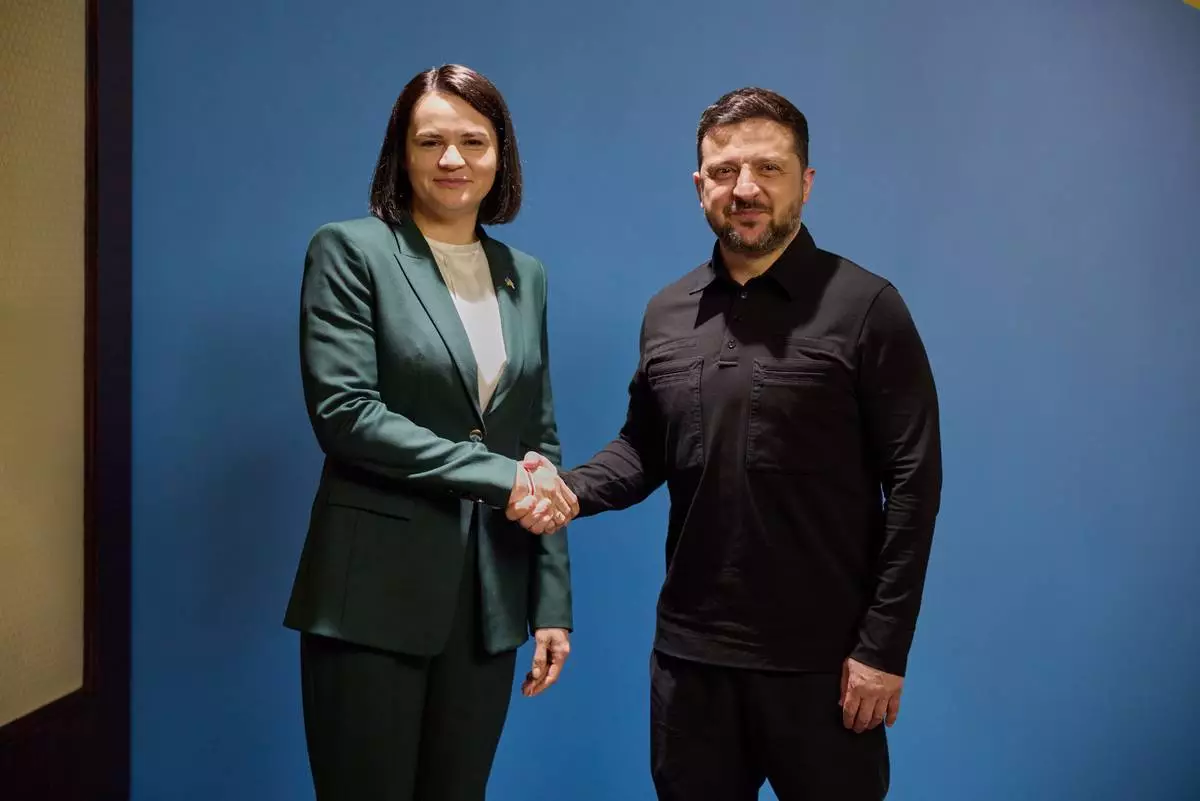
In this photo, provided by the Ukrainian Presidential Press Office, Ukrainian President Volodymyr Zelenskyy, right, shakes hands with Belarusian opposition politician Sviatlana Tsikhanouskaya in Kyiv, Ukraine, Tuesday, May 26, 2026. (Ukrainian Presidential Press Office via AP)
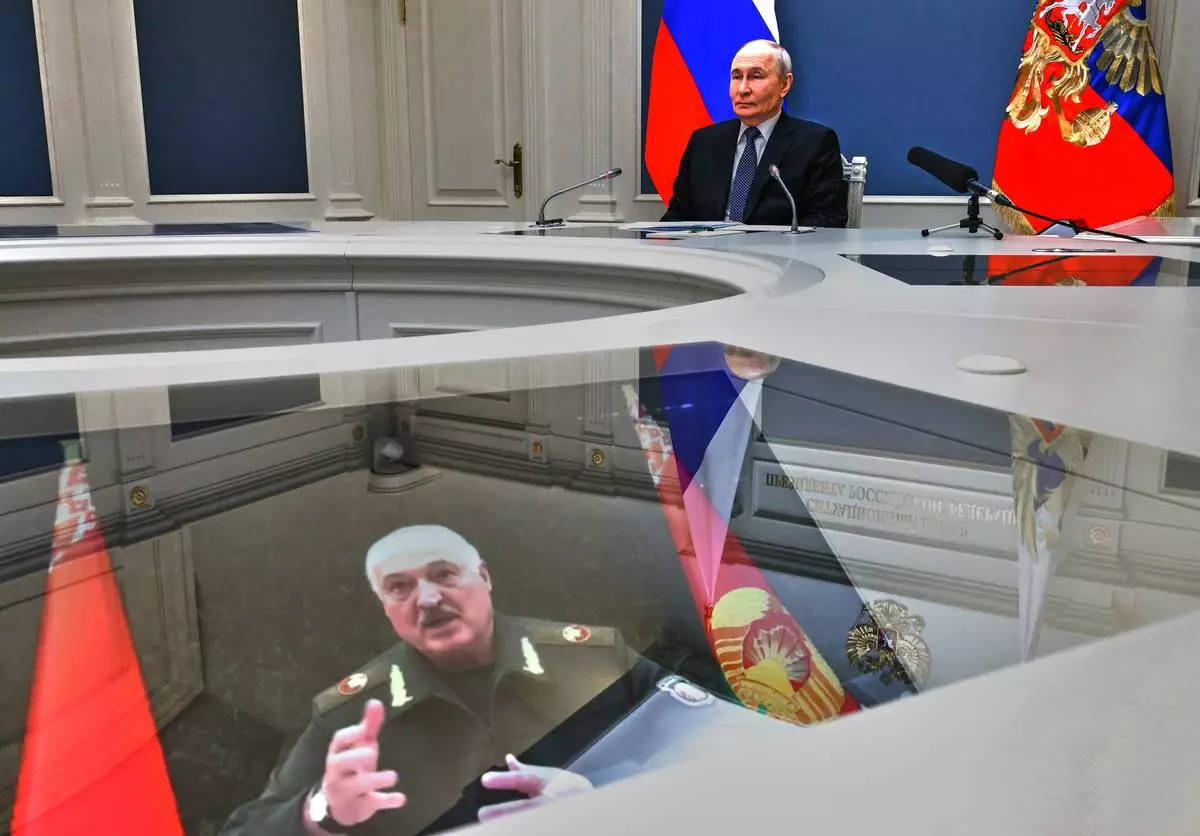
Russian President Vladimir Putin and his Belarusian counterpart Alexander Lukashenko, seen at the screen, take part in a video call as part of joint nuclear drills at the Presidential Situation Centre at the Kremlin in Moscow, Thursday, May 21, 2026. (Mikhail Metzel/Sputnik, Kremlin Pool Photo via AP)
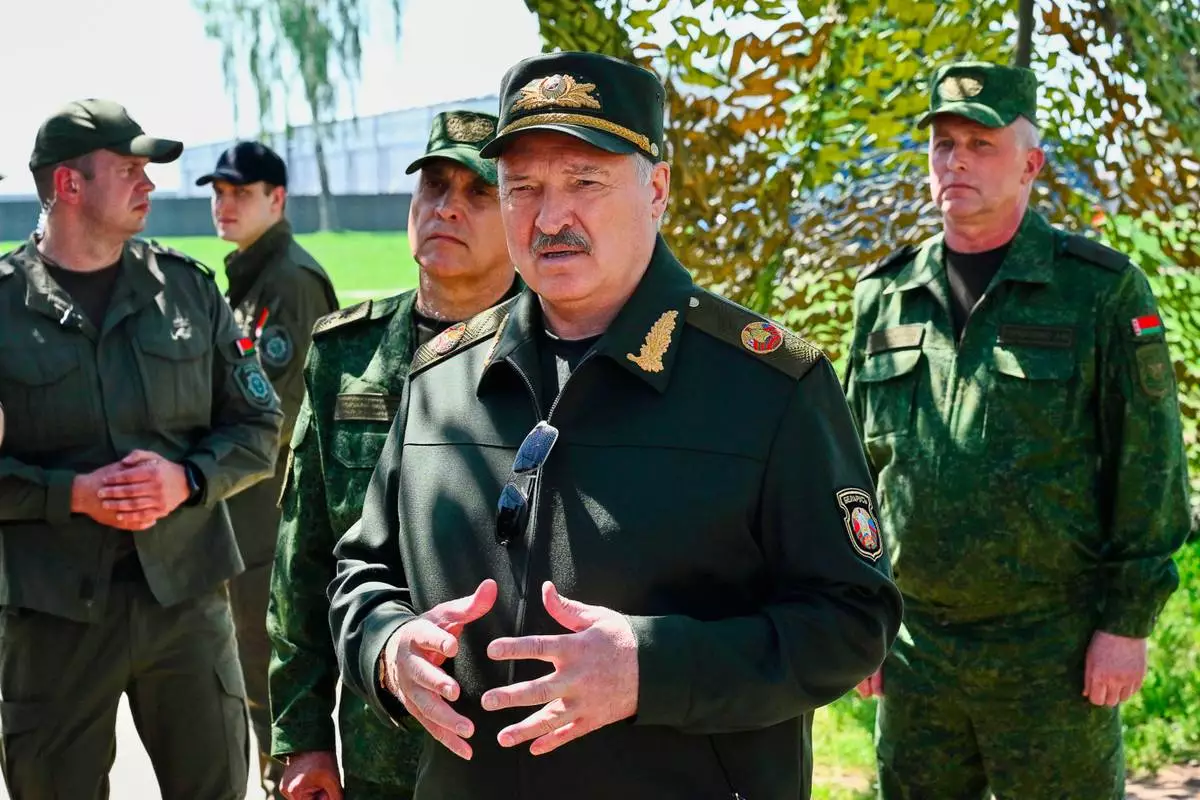
In this photo, released by Belarusian Presidential Press Service, Belarus' President Alexander Lukashenko, center, speaks to officers as he attends joint nuclear drills held by Russian and Belarusian armed forces in Asipovichy district of Belarus, Thursday, May 21, 2026. (Belarusian Presidential Press Service via AP)