WASHINGTON (AP) — Since the ceasefire between Iran and the U.S. was announced, leaders in President Donald Trump's administration have been quick to say Iranian military and arms capacity have been all but wiped out during weeks of fighting.
But there is also an acknowledgment that Tehran retains some capabilities, whether to strike back or defend itself.
Gen. Dan Caine, chairman of the Joint Chiefs of Staff, this week said the U.S. military has hit more than 13,000 targets. He listed high percentages for attacks or destruction to Iran's air defenses, navy and weapons factories.
However, the totals stop short of Iran’s military capabilities being “decimated” as the Republican president has asserted.
Independent data from Armed Conflict Location & Event Data, a U.S.-based group that tracks conflicts around the world, shows Iranian strikes persisted at a relatively steady and uninterrupted pace since the war began Feb. 28 through Wednesday.
Here's a look at what the U.S. says has been targeted, has been degraded or remains from Iran, by the numbers:
Caine told reporters on Wednesday at the Pentagon that many of Iran's air defenses have been destroyed with the U.S. striking more than 1,500 air defense targets, more than 450 ballistic missile storage facilities and 800 one-way attack drone storage facilities. He said, “All of these systems are gone.”
Defense Secretary Pete Hegseth similarly claimed that “Iran no longer has an air defense” and that “we own their skies” before conceding soon afterward that Iran “can still shoot — we know that.”
Hegseth later elaborated, saying that while the Iranians may “have a system here or there,” they no longer had an air defense “system that’s capable of defending their skies.”
Neither Caine nor Hegseth said what the remaining 20% of Iran’s air defenses looked like or which parts of the country have the ability to carry out the sporadic fire they described.
Caine offered no new details about what kind of weapon the Iranians used to shoot down a U.S. F-15E Strike Eagle last week. It was the first time an American military jet was shot down during the war, showing Tehran’s continued ability to hit back despite assertions from the Trump administration.
Trump described it on Monday as a “handheld shoulder missile, heat-seeking missile.”
Caine also told reporters that the military has sunk much of the Iranian fleet and 150 Iranian ships “are at the bottom of the ocean."
White House press secretary Karoline Leavitt went further, telling reporters Wednesday that the Iranian navy was “completely annihilated.”
However, Caine also noted that only half the paramilitary Revolutionary Guard’s small attack boats — ships the government used to swarm and harass warships and merchants in the Strait of Hormuz — have been sunk.
Caine also said that after more than 700 strikes, the military believed it has destroyed more than 95% of Iran's naval mines.
Since the U.S. has not said how large Iran's stockpile was before the war, it's unknown how many naval mines make up the remaining 5%. Semiofficial news agencies in Iran published a chart Thursday suggesting the Revolutionary Guard put sea mines into the Strait of Hormuz, a crucial trade route for oil, during the war.
The message is likely designed to be a pressure tactic as Iran, Israel and the United States head into negotiations this weekend in Pakistan. Independent analysts say they have seen no change in merchant traffic through the strait since the tenuous ceasefire began this week.
Caine said Wednesday that the military “destroyed Iran’s defense industrial base” while pointing to the fact that the U.S. and allies attacked “approximately 90% of their weapons factories.”
He also said, “nearly 80% of Iran’s nuclear industrial base was hit, further degrading their attempts to attain a nuclear weapon.”
While he noted that Iran was no longer able to produce certain components like solid rocket motors, he stopped short of saying that Iran could not eventually rebuild or get weapons in other ways or that the factories attacked had actually been destroyed or rendered unusable.
Trump acknowledged this possibility when he warned countries against arming Iran.
“A Country supplying Military Weapons to Iran will be immediately tariffed, on any and all goods sold to the United States of America, 50%, effective immediately,” Trump said in a social media post on Wednesday.
Meanwhile, Israel’s military pointed to how many drones or missiles it has been able to stop from landing. It said it had an interception rate of more than 90% through its aerial defense systems.
Over the decades, Israel has developed a sophisticated system capable of detecting incoming fire and deploying only if a projectile is headed toward a population center or sensitive military or civilian infrastructure.
Israeli leaders say the system isn’t 100% guaranteed but credit it with preventing serious damage and countless casualties.
Associated Press writer Sam Mednick in Tel Aviv, Israel, contributed to this report.

Workers remove debris at Tehran's Sharif University of Technology complex that Iranian authorities say was hit early Monday by a U.S.-Israeli strike, in Tehran, Iran, Monday, April 6, 2026. (AP Photo/Francisco Seco)
ARLINGTON, Texas (AP) — Houston Astros right-hander Tatsuya Imai and relievers Steven Okert and Alimber Santa combined to throw a no-hitter in a 9-0 win over the Texas Rangers on Monday night.
It was the first no-hitter in the major leagues since Shota Imanaga and two Chicago Cubs relievers combined for a 12-0 win over Pittsburgh on Sept. 4, 2024. No pitcher has tossed a complete-game no-hitter since Blake Snell for the San Francisco Giants against Cincinnati on Aug. 2, 2024.
The 23-year-old Santa fired two perfect innings and became the first pitcher to finish a no-hitter in his big league debut.
Imai went six innings in the 17th regular-season no-hitter in Astros history and fourth that was a combined effort. Houston also threw a no-hitter in the 2022 World Series when four pitchers combined against Philadelphia.
Ronel Blanco tossed the previous no-hitter for the Astros in a 10-0 victory over Toronto on April 1, 2024. In fact, Houston has authored three of the past seven major league no-hitters; Framber Valdez shut down Cleveland 2-0 on Aug. 1, 2023.
Okert worked the seventh after Imai got 16 outs over the last 16 batters he faced. He walked three of his first four batters but benefited from a double play in the first inning before settling into a groove.
Santa entered in the eighth and retired all six batters he faced. His 24th pitch was a called third strike against Brandon Nimmo that ended it after an ABS challenge by the batter was confirmed a strike.
BREWERS 5, CARDINALS 1
MILWAUKEE (AP) — Jacob Misiorowski matched a career high with 12 strikeouts and carried a no-hitter into the sixth inning as Milwaukee defeated St. Louis.
Christian Yelich hit a two-run homer and Andrew Vaughn went 3 for 4 as the Brewers extended their NL Central lead over St. Louis to 2 1/2 games.
Misiorowski (5-2) threw 57 pitches of at least 100 mph, which represented the most in a single game since pitch tracking began in 2008. The previous record for 100-mph pitches in a single game was 47 by Cincinnati’s Hunter Greene against St. Louis on Sept. 17, 2022.
He reached a top velocity of 103.4 mph while allowing one run, two hits and one walk in seven innings. His ERA improved to 1.83.
Misiorowski started the game by walking JJ Wetherholt, but the Cardinals wouldn’t get another runner on base until Pedro Pagés hit a bloop single to lead off the sixth. The Cardinals got a run later in the sixth to end Misiorowski’s streak of consecutive scoreless innings at 29 1/3.
Teddy Higuera owns the Brewers record with 32 straight scoreless innings in 1987.
PIRATES 2, CUBS 1
PITTSBURGH (AP) — Henry Davis hit a go-ahead solo home run in the seventh inning, and Pittsburgh sent Chicago to its ninth straight loss with a victory.
Davis turned on a 91 mph cutter from Cubs reliever Trent Thornton (2-1) and sent it well over the right-field fence for his fourth home run of the season.
Pittsburgh’s bullpen made it stand up. Wilber Dotel (1-0) tossed three scoreless innings in relief to pick up the victory. Gregory Soto worked a perfect ninth for his sixth save as the Pirates beat the Cubs for the third time in four tries so far this season.
Brandon Lowe had two hits for Pittsburgh, including an RBI double. Spencer Horwitz also had a pair of hits and a handful of excellent plays at first base, all of them against Cubs star Pete Crow-Armstrong. Horwitz was perfectly positioned to snatch a couple of line drives and then made a brilliant diving grab on a sharp grounder before tossing to Dotel covering first to rob Crow-Armstrong of a hit.
ORIOLES 9, RAYS 7, 13 INNINGS
BALTIMORE (AP) — Colton Cowser hit a two-run game-winning homer in the 13th inning — his second walk-off shot in as many days — to give Baltimore a win over AL East-leading Tampa Bay.
Cowser’s 425-foot blast off Jesse Scholtens (5-3) was just his third homer of the season and punctuated a wild victory in which the Orioles rallied three times in extra innings.
Pete Alonso and Jeremiah Jackson each singled in a run to tie it at 4-all in the 11th. Cowser scored the game-tying run to make it 5-all in the 12th on Gunnar Henderson’s grounder to first, a sequence originally called an out by plate umpire Ryan Additon before a replay challenge showed the sliding Cowser snuck an arm under Nick Fortes’ tag.
Then, Leody Taveras doubled and Jackson Holliday hit a sacrifice fly to tie it a 7 in the 13th, setting up Cowser’s drive that landed in the seats in right-center, mirroring his game-winning homer in Sunday’s 5-3 victory over Detroit in the first game of a doubleheader.
WHITE SOX 3, TWINS 1
CHICAGO (AP) — Munetaka Murakami homered, Anthony Kay pitched six sparkling innings and Chicago stopped Minnesota’s four-game win streak with a victory.
Drew Romo also connected for Chicago in the opener of a seven-game homestand. Rikuu Nishida singled in the fourth for his first hit in a successful big league debut.
The White Sox have won seven in a row against the Twins for the first time since an eight-game streak in 1995. The opener of the four-game series was the first meeting of the AL Central teams this season.
Brooks Lee homered for Minnesota, which had won six of seven overall. Zebby Matthews (1-2) allowed three runs and five hits in six innings.
Murakami tied it at 1 when he connected for his 18th homer in the first, a 375-foot drive to right. It was the first homer for the Japanese rookie since he went deep twice during an 8-3 victory over the Cubs on May 16.
YANKEES 4, ROYALS 3
KANSAS CITY, Mo. (AP) — Anthony Volpe answered Bobby Witt Jr.‘s go-ahead homer in the eighth with a two-run single in the ninth for New York, sending the Yankees to a 4-3 victory over the Kansas City Royals on Monday and extending their winning streak to 12 in the series.
Jake Bird nearly squandered a strong start by Will Warren when he gave up Witt’s tiebreaking shot inside the left-field foul pole leading off the eighth inning.
But the Yankees promptly rallied off Lucas Erceg (3-2), starting with Paul Goldschmidt’s broken-bat hit and Jazz Chisholm Jr.’s one-out double before Volpe’s timely single to left field.
Tim Hill (2-2) earn the win while David Bednar worked around a two-out walk in the ninth to earn his 12th save of the season.
REDS 7, METS 2
NEW YORK (AP) — Nick Lodolo won for the first time in four starts since returning from a blister, JJ Bleday and Tyler Stephenson homered off an ineffective Nolan McLean, and Cincinnati extended New York’ losing streak to four with a 7-2 victory Monday.
Mets star Juan Soto missed his second straight game because of illness and fellow outfielder Tyrone Taylor left with right hip pain after grounding out in the sixth inning. Taylor will undergo an MRI and is probably headed to the injured list, manager Carlos Mendoza said.
New York has scored four runs and struck out 41 times during its latest skid, dropping to 22-32 at the one-third mark — one shy of its season low of 11 games under .500 at 10-21. A big league-best 45-24 at the start of play on June 13 last year, the Mets are 60-87 since.
Lodolo (1-1) allowed one run and six hits with seven strikeouts and no walks, lowering his ERA from 7.20 to 5.57. He was sidelined from spring training until May 8 by a blister on his left index finger.
McLean (2-4) was charged with seven runs, five hits, two walks, two hit batters and one wild pitch in 3 1/3 innings, the shortest of his 19 big league starts. He has given up 13 earned runs in his last two outings, raising his ERA from 2.92 to 4.40.
DIAMONDBACKS 6, GIANTS 2
SAN FRANCISCO (AP) — Ketel Marte had four hits, including a tying double in the fifth inning and a two-run single in the sixth, and Merrill Kelly pitched seven strong innings to win his fourth straight start as surging Arizona beat San Francisco.
Kelly (5-3) allowed two runs on four hits, struck out four and walked two. He became the fourth pitcher in Arizona history to reach 1,000 innings.
It’s the second-longest winning streak of his eight-year career behind a stretch of five consecutive victories from May 15 to June 9, 2023. The veteran right-hander beat the Giants for the second time in six days and is 4-0 over his last six starts against San Francisco.
After Marte’s double in the fifth, Geraldo Perdomo singled one out later to put the Diamondbacks ahead 3-2. Adrian Del Castillo added an RBI single for Arizona, which won its third straight, ninth in 11 games and improved to 12-4 since May 9.
Corbin Carroll extended his majors-best and season-high hitting streak to 13 games. Marte, who has a nine-game hitting streak, produced three or more hits for a third consecutive game.
NATIONALS 10, GUARDIANS 2
CLEVELAND (AP) — Curtis Mead went deep twice for his first multi-homer game, Luis García Jr. finished a triple shy of hitting for the cycle and Washington hit six homers in a win over Cleveland.
James Wood, Jacob Young, and CJ Abrams joined García and Mead with long balls as the Nationals matched their highest homer output of the season, first set in a 10-4 victory over Cincinnati on May 12.
Wood hit a leadoff 412-foot homer on the sixth pitch of the game, and Mead added his first of the game two batters later, giving Washington a 3-0 lead before the first out was recorded.
Young started off the second inning with a solo shot and García added a two-run line-drive homer to right that extended Washington’s lead to 6-0.
PJ Poulin threw two innings as the Nationals’ opener, allowing two hits and one run. Zack Littell (4-4) worked seven innings of relief and allowed five hits and one run with seven strikeouts.
Tanner Bibee (0-7) gave up eight hits, seven runs, and five homers while striking out three in three innings.
PHILLIES 3, PADRES 0
SAN DIEGO (AP) — Kyle Schwarber struck again at Petco Park, hitting his major league-leading 21st home run to send Jesús Luzardo and Philadelphia to a win against San Diego.
Brandon Marsh added a two-run homer for the Phillies, who had just three hits as they opened a six-game trip through San Diego and Los Angeles. They scored only 14 runs in going 2-4 at home against Cincinnati and Cleveland.
Schwarber lined a full-count changeup from Griffin Canning (0-3) onto the party deck atop the right-field wall with one out in the first inning. Former teammate Nick Castellanos took a few steps back and watched it leave the yard at just a 20-degree launch angle.
Including the postseason, Schwarber has 11 homers in 26 career games at Petco Park, seven of them in his last 13 games here.
Schwarber was aboard on a leadoff single when Marsh homered to right with two outs in the seventh, his fifth.
Luzardo (4-4) allowed four hits, struck out six and walked two in six innings. Jhoan Duran pitched the ninth for his 10th save, completing a five-hitter.
MARLINS 8, BLUE JAYS 2
TORONTO (AP) — Janson Junk pitched five innings and won for the first time since April 28, Kyle Stowers and Javier Sanoja each had two doubles and two RBIs, and Miami extended their winning streak to four games by beating Toronto.
Canadian outfielder Owen Caissie went 2 for 4 and drove in a pair as Miami improved to 14-5 all-time at Rogers Centre.
Junk (3-5) allowed one run and eight hits, all singles. He walked none and struck out three.
Ernie Clement hit a solo home run for Toronto, but the Blue Jays lost their second straight after winning the previous four.
Toronto’s Trey Yesavage allowed five hits and a career-high five runs in a season-high 6 2/3 innings. The rookie right-hander had allowed just three total earned runs in five previous starts this season.
Yesavage (2-2) walked two and struck out six. All five hits off Yesavage were doubles.
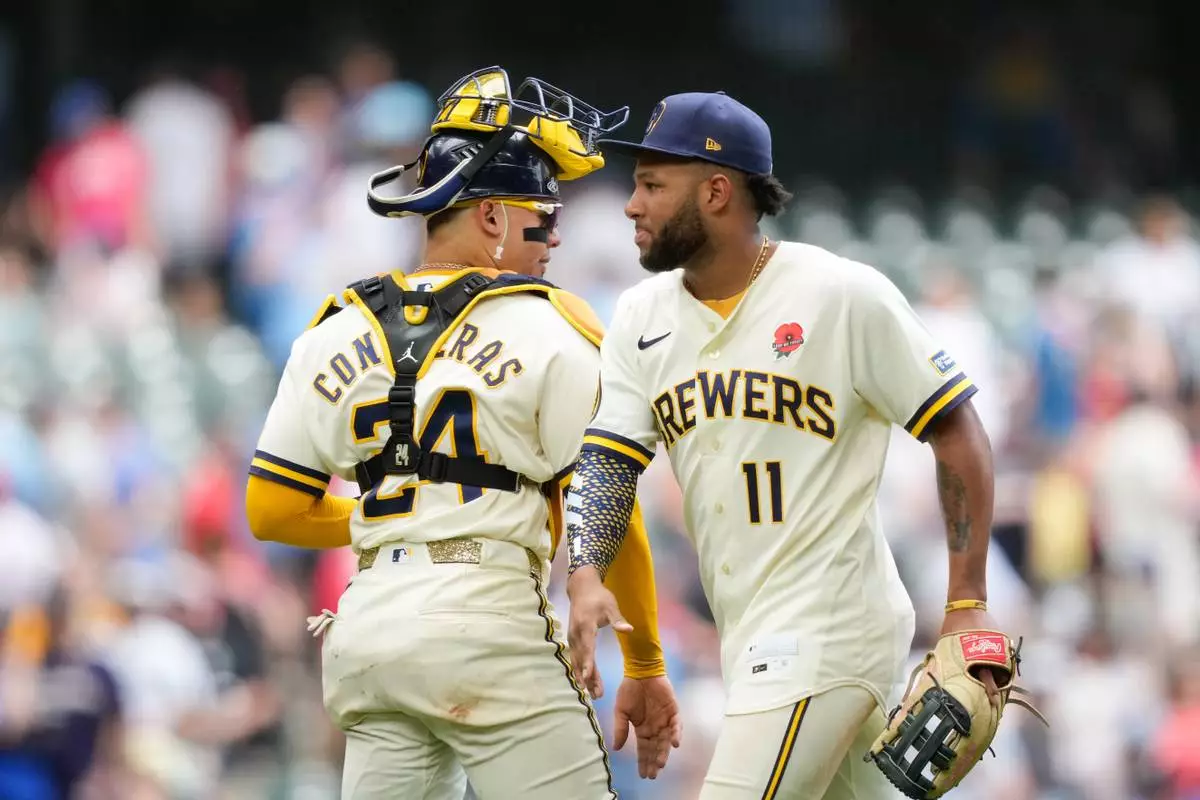
Milwaukee Brewers left fielder Jackson Chourio (11) low-fives catcher William Contreras (24) after their team defeated the St. Louis Cardinals in a baseball game Monday, May 25, 2026, in Milwaukee. (AP Photo/Kayla Wolf)