Skip to Content Facebook Feature Image

FAA says proper use of anti-drone lasers that prompted Texas airspace closures is safe for flights

News

FAA says proper use of anti-drone lasers that prompted Texas airspace closures is safe for flights
News

News

FAA says proper use of anti-drone lasers that prompted Texas airspace closures is safe for flights

2026-04-11 06:26 Last Updated At:14:10

Anti-drone lasers used near the southern border by the U.S. military and Homeland Security to combat cartel drones are safe and shouldn’t necessitate airport closures, the Federal Aviation Administration announced Friday after a review prompted by airspace closures in Texas earlier this year.

The FAA and Defense Department have signed an agreement outlining the safety precautions that they say will protect travelers anytime these lasers are used, but their statement didn't spell out what those safeguards will be.

The FAA didn’t immediately respond to questions seeking more details about the agreement.

In early February, the FAA closed the airspace around the El Paso airport for several hours after another agency used a counter-drone laser without notifying the aviation safety regulator. That left many travelers scrambling to find new flights. A second, more limited airspace closure later that month followed the military shooting down a drone owned by U.S. Customs and Border Protection.

A demonstration of the lasers conducted last month at the White Sands Missile Range in New Mexico convinced the FAA that they can be used safely.

"We will continue working with our interagency partners to ensure the National Airspace System remains safe while addressing emerging drone threats,” FAA Administrator Bryan Bedford said in a statement.

Drones are commonly used along the border by Mexican cartels looking to deliver drugs or surveil officers. Officials told Congress last summer that more than 27,000 drones were detected within 1,600 feet (500 meters) of the southern border in the last six months of 2024.

The use of armed drones regularly carry out devastating attacks in the Ukraine and Iran wars highlights the threat.

Lawmakers in Congress said they are glad to see the agencies working together better now. But Democratic senators who raised questions after the anti-drone laser uses in February say they need detailed answers before they can be sure the lasers are safe. The FAA has not yet held a briefing for Congress.

“It is absolutely critical that meaningful interagency collaboration continues — the FAA must be at the table whenever any counter-UAS (Unmanned Aircraft System) is deployed that could impact the safety of our national airspace,” said Rep. Rick Larsen, who is the ranking Democrat on the House Transportation and Infrastructure Committee.

In the second incident, the military used the laser to shoot down a “seemingly threatening” drone flying near the U.S.-Mexico border on Feb. 26. It turned out the drone belonged to Customs and Border Protection, lawmakers said.

That led the FAA to close the airspace around Fort Hancock, about 50 miles (80 kilometers) southeast of El Paso.

The Trump administration has said it was working to halt an incursion by Mexican cartel drones. U.S. Army Brigadier General Matt Ross said that this agreement will allow the use of the most advanced tools to defend the homeland.

“By working hand-in-hand with the FAA and our interagency partners, the Department of War is proving that these cutting-edge capabilities are safe, effective, and ready to protect all air travelers from illicit drone use in the national airspace,” Ross said.

The U.S. government has handed out more than $250 million to help states prepare to respond to drones before hosting World Cup matches and celebrations planned this summer for the country's 250th birthday.

Another $250 million in grants will be awarded later this year to strengthen the nation’s drone defenses.
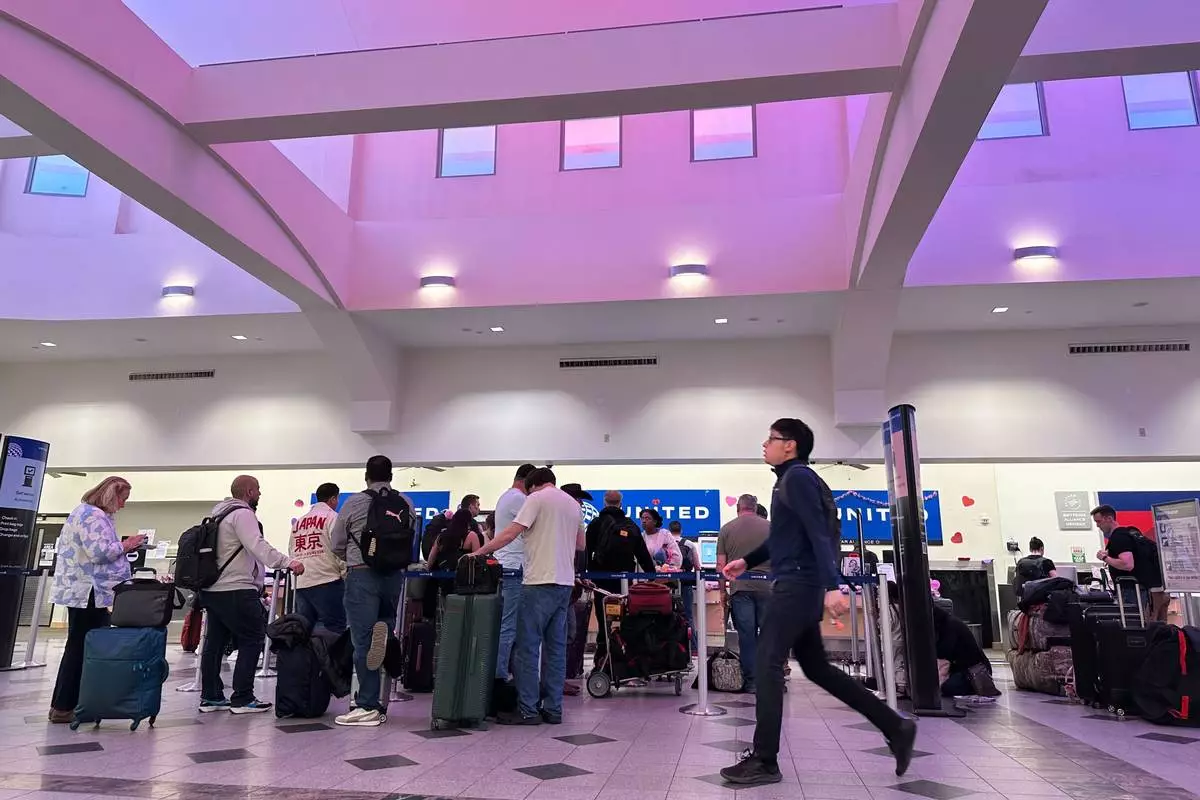
FILE - People stand in line at check-in counters at El Paso International Airport, Wednesday, Feb. 11, 2026, in El Paso, Texas. (AP Photo/Morgan Lee,File)

FILE - People stand in line at check-in counters at El Paso International Airport, Wednesday, Feb. 11, 2026, in El Paso, Texas. (AP Photo/Morgan Lee,File)

WASHINGTON (AP) — The U.S. military stopped a merchant vessel trying to break through its blockade of Iranian ports by firing a missile into its engine room, the U.S. Central Command said on Saturday.

The Gambia-flagged cargo ship Lian Star ignored more than 20 warnings from U.S. forces overnight as it tried to enter an Iranian port, the military said. The ship remained adrift in the Gulf of Oman and U.S. forces have not boarded it, said a U.S. official with knowledge of the situation, speaking on condition of anonymity to discuss military operations.

With the latest action, U.S. military has stopped six ships trying to breach the blockade. One was allowed to proceed. Another 116 ships have been redirected, the military said.

The U.S. launched the blockade on April 17 in response to Iran effectively closing the strait after the war in the Middle East began with U.S. and Israeli strikes on Feb. 28. A fragile ceasefire has held since April 7. Now the region awaits word on whether a deal can be reached to extend it by 60 days while talks would be held on Iran’s disputed nuclear program.

Events in the Strait of Hormuz, a key waterway between Iran and Oman, have shaken the global economy. Shipments of significant amounts of oil, natural gas and related supplies like fertilizer are largely stranded, increasing the strain on consumers and food producers.

The U.S. blockade seeks to limit Iran’s own shipments and further weaken its access to cash, creating more pain for its long-weakened economy.

U.S. President Donald Trump met with advisers on Friday but has yet to decide on whether to move ahead with a deal to extend the ceasefire and reopen the strait. Iran has said the deal had not been finalized.

Commercial traffic has quietly continued to flow through the strait, despite Iran's assertions that it must approve any transits, though at a much lower volume than before the war.

“Any violation of these regulations will place the security of their passage at serious risk,” Iran's joint military command said Saturday in a statement carried by state TV, warning that any military vessels trying to interfere with that would be targeted.

Iran has even charged tolls for transit as high as $2 million, which experts have called a violation of a principle of international maritime trade: freedom of peaceful navigation.

Qatar's deputy prime minister, Sheikh Saoud bin Abdulrahman bin Hassan bin Ali Al Thani, said on Saturday said that the Gulf nation opposes charging fees to transit, “but for certain times when they say they are going to use it for mine clearing or some usage of the fees for a temporary time, this is something that is negotiable, and it could be something that will help the transit of the Strait of Hormuz to be back to normal stage.”

The U.S. official previously told The Associated Press that the U.S. has not found or destroyed any mines in the strait.

Pro-government Iranian demonstrators wave Iranian flags and a portrait of the Supreme Leader Ayatollah Mojtaba Khamenei, right, and his slain father Ayatollah Ali Khamenei in a gathering at a square in Tehran, Iran, Friday, May 29, 2026. (AP Photo/Vahid Salemi)

Pro-government Iranian demonstrators wave Iranian flags and a portrait of the Supreme Leader Ayatollah Mojtaba Khamenei, right, and his slain father Ayatollah Ali Khamenei in a gathering at a square in Tehran, Iran, Friday, May 29, 2026. (AP Photo/Vahid Salemi)

Recommended Articles