LAS VEGAS (AP) — Denver has thrived in the uncomfortable, refusing to panic even when the opponent is dominating play.
Much of that is because of the freshman in the Pioneers' net.
Click to Gallery
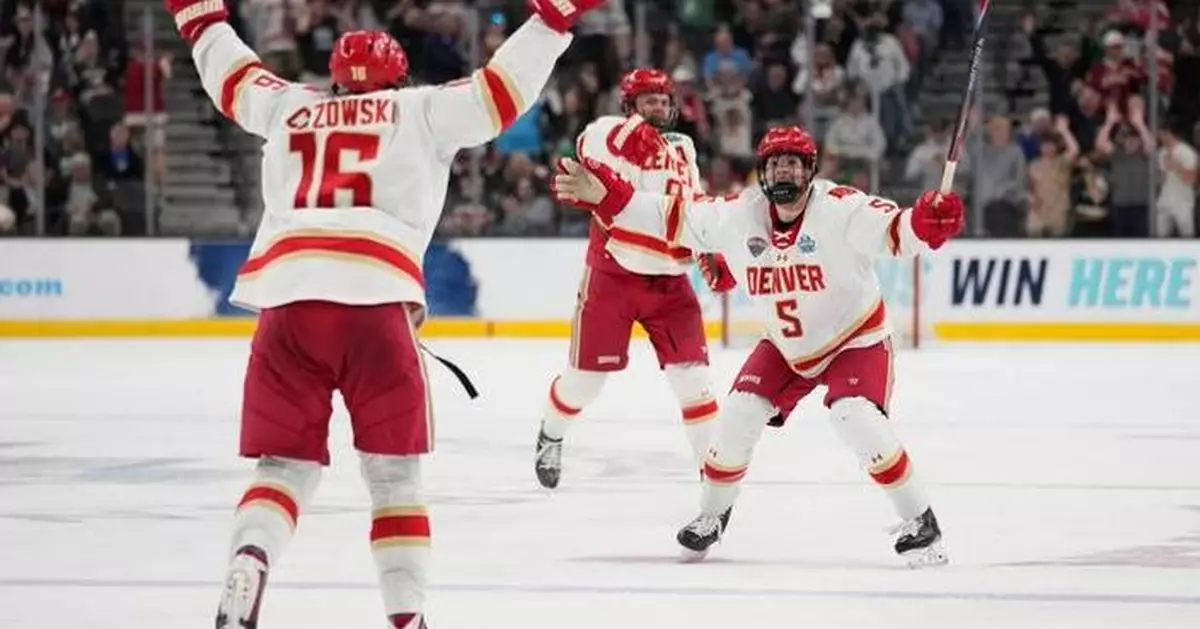
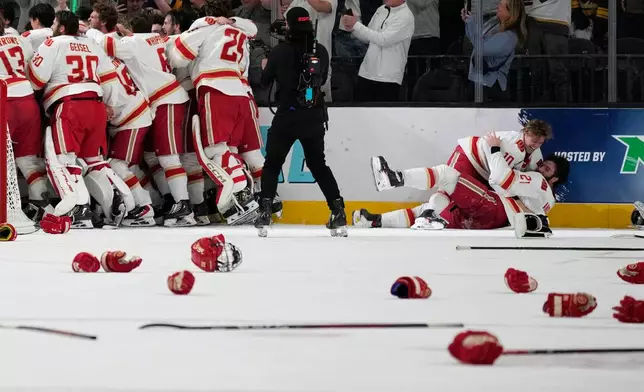
Denver players celebrate after defeating Wisconsin in the championship game at the NCAA Frozen Four men's college hockey tournament Saturday, April 11, 2026, in Las Vegas. (AP Photo/John Locher)
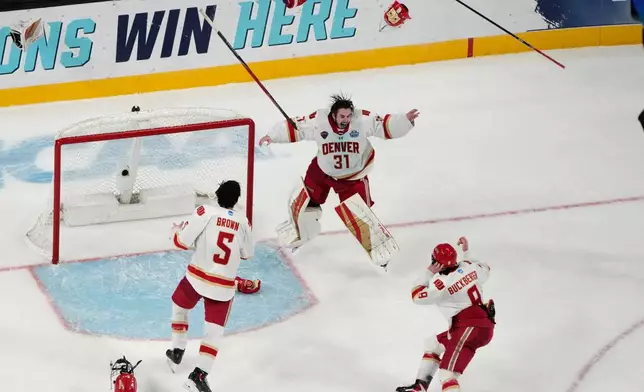
Denver goaltender Johnny Hicks (31) celebrates with teammates after defeating Wisconsin in the championship game at the NCAA Frozen Four men's college hockey tournament Saturday, April 11, 2026, in Las Vegas. (AP Photo/John Locher)
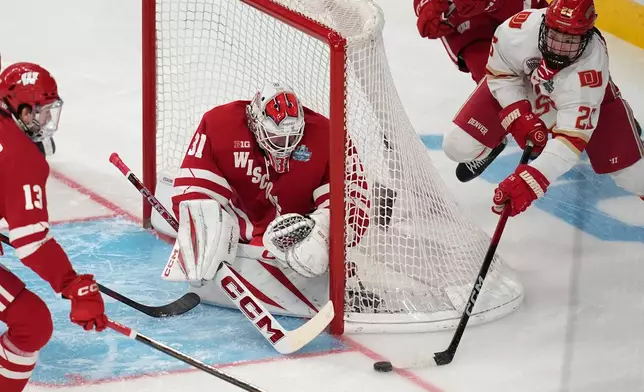
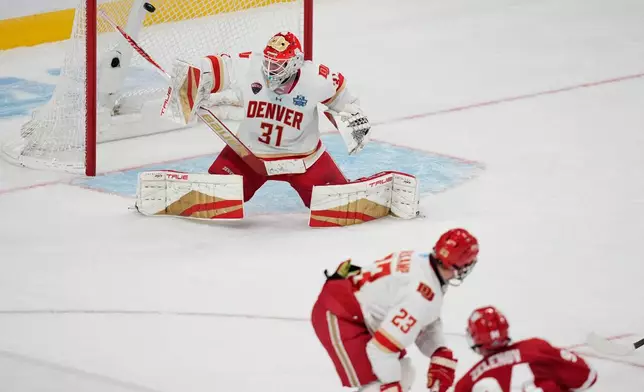
Denver forward Clarke Caswell (25) attempts a shot on Wisconsin goaltender Daniel Hauser (31) in the first period of the championship game at the NCAA Frozen Four men's college hockey tournament Saturday, April 11, 2026, in Las Vegas. (AP Photo/John Locher)
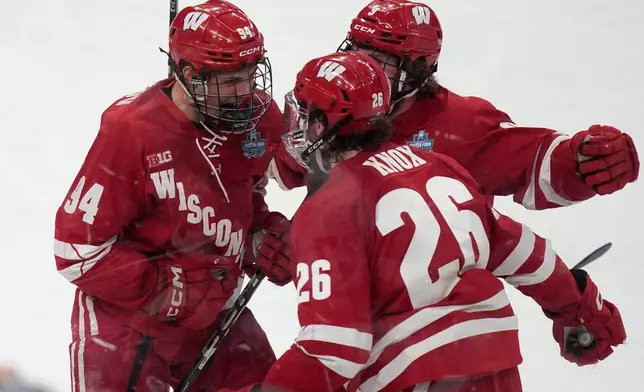
Wisconsin forward Vasily Zelenov, left, celebrates after scoring against Denver in the first period of the championship game at the NCAA Frozen Four men's college hockey tournament Saturday, April 11, 2026, in Las Vegas. (AP Photo/John Locher)
Wisconsin forward Vasily Zelenov (94) scores on Denver goaltender Johnny Hicks (31) in the first period of the championship game at the NCAA Frozen Four men's college hockey tournament Saturday, April 11, 2026, in Las Vegas. (AP Photo/John Locher)
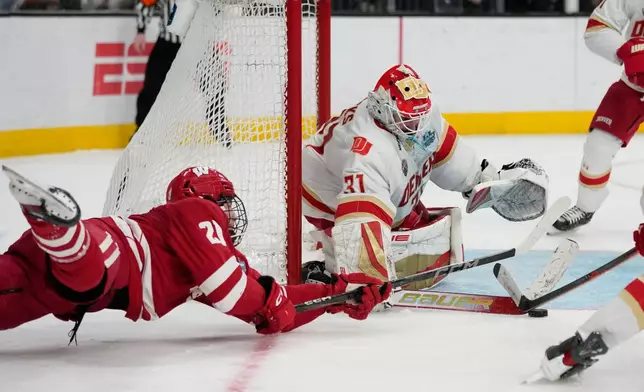
Wisconsin forward Ryan Botterill (21) dives to attempt a shot on Denver goaltender Johnny Hicks (31) in the second period of the championship game at the NCAA Frozen Four men's college hockey tournament Saturday, April 11, 2026, in Las Vegas. (AP Photo/John Locher)
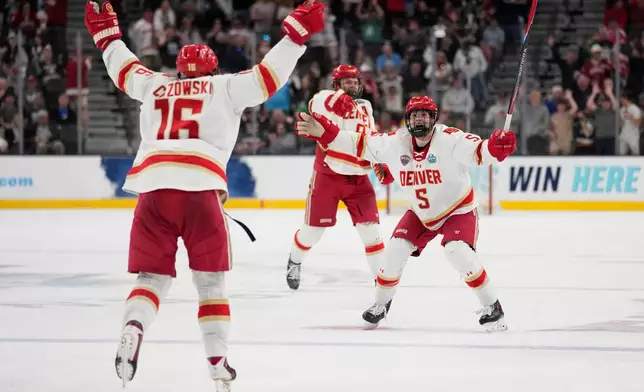
Denver players celebrate after Denver forward Kyle Chyzowski (16) scored against Wisconsin in the third period of the championship game at the NCAA Frozen Four men's college hockey tournament Saturday, April 11, 2026, in Las Vegas. (AP Photo/John Locher)
No goalie has been better than Johnny Hicks, and he is the main reason Denver is yet again the best team in college hockey.
Kyle Chyzowski tipped in a shot from the point with 5:52 left to back up another sensational performance from Hicks and rally Denver to a 2-1 victory over Wisconsin on Saturday for the Pioneers' third national championship in five years.
The victory also extended the Pioneers' record to 11 national titles overall and denied the Badgers their seventh overall and first since 2006.
“I’m so happy that we could get it done with this group,” said Hicks, fighting back tears. “We’ve gone through so much adversity, and I’m just so proud of this group.”
This also was a rare loss for a Big Ten Conference team in a championship game this academic year. That conference already is home to the current champions in football ( Indiana ), men’s basketball ( Michigan ) and women’s basketball ( UCLA ).
But the National Collegiate Hockey Conference remains the sport's premier league by claiming eight of the past 10 national champions. It doesn't have the glamour of the Big Ten or the resources that come from being on the national stage in football, but Denver coach David Carle said the collective effort to try to achieve greatness in hockey shows what can be accomplished.
“I think we’re the proof of concept that it’s still possible,” Carle said. "Do we have advantages over other places? I am not sitting up here crying poor that we don’t have things. But we are a small institution. We are very committed, though, to our hockey program and making it a great experience for our student-athletes, our fans and our alumni.
“You don’t have to be big in hockey to be good. You have to invest and you have to care and have the right people to do great things. In college athletics, I think a place like Denver should really be celebrated.”
Hicks continued his stellar play by making 29 saves, just two days after a personal-high 49 against Michigan. He did not lose in regulation since taking over as starter, going 16-0-1. Hicks entered this game leading the nation with a 1.20 goals-against average and .957 save percentage.
“Johnny Hicks is unbelievable,” Denver captain Kent Anderson said. “He’s undefeated. We couldn’t have done any of this without him. Tonight our group stuck with it, they believed in each other. Hickey was there for us every step of the way. He kept us in it. Just waited for us to score. Eventually we did.”
Hicks was named Most Outstanding Player after also receiving that honor in Denver's conference and regional tournaments.
“I was just playing off instinct,” Hicks said.
Rieger Lorenz scored the other goal for Denver.
Wisconsin's goal came from Vasily Zelenov, and Daniel Hauser stopped 13 shots.
Zelenov's blast from the left circle off the rush with 6:24 left in the first period put Wisconsin up 1-0, a lead that held up until 7:31 of the third.
The second goal never came, not only because of Hicks. Denver didn't provide a lot of clean looks and wound up blocking 31 shots.
“We needed, in my opinion, to get it to two,” Wisconsin coach Mike Hastings said. “We just couldn’t do that.”
That's when Kristian Epperson passed to defenseman Garrett Brown at the left point. His shot resulted in a rebound opportunity for Lorenz, who scored easily around Hauser into the open net.
Then it was a matter of finishing the job, which is what happened when Boston Buckberger delivered a one-timer from the right point that likely would have gone into the net even if Chyzowski hadn't gotten a stick on the puck.
Denver didn't have a shot on goal for the first 8 1/2 minutes and ended the first period with just two for the fifth time in a title game. The Pioneers also had two shots on goal in a period in 1963 against North Dakota. Minnesota was the most recent team to have such few shots, occurring three years ago against Quinnipiac.
The Pioneers managed just three more shots on goal in the second period against Wisconsin's forecheck, the Badgers outshooting them 21-5 through two periods.
It had a similar feel to Denver's 4-3 double-overtime victory over Michigan in Thursday night's semifinals. The Wolverines outshot the Denver 52-26, but the Pioneers found a way to force OT and win in extra time.
Wisconsin had hoped to match its women's team in winning the championship. Through two periods of play, the Badgers appeared well on their way and were clearly the better team.
Not so much in the third.
“A little shocked right now,” Wisconsin defenseman Ben Dexheimer said. “Definitely going to settle in here in the next few days.”
AP NHL: https://apnews.com/hub/nhl
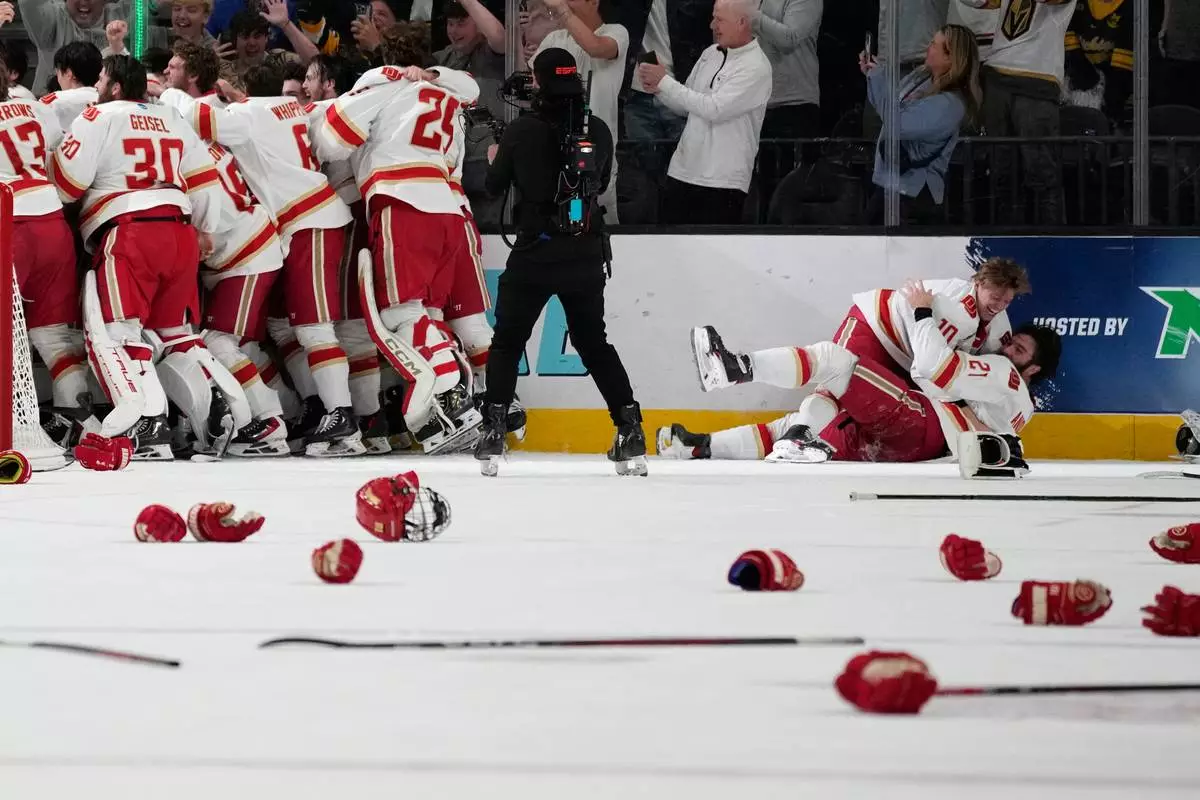
Denver players celebrate after defeating Wisconsin in the championship game at the NCAA Frozen Four men's college hockey tournament Saturday, April 11, 2026, in Las Vegas. (AP Photo/John Locher)
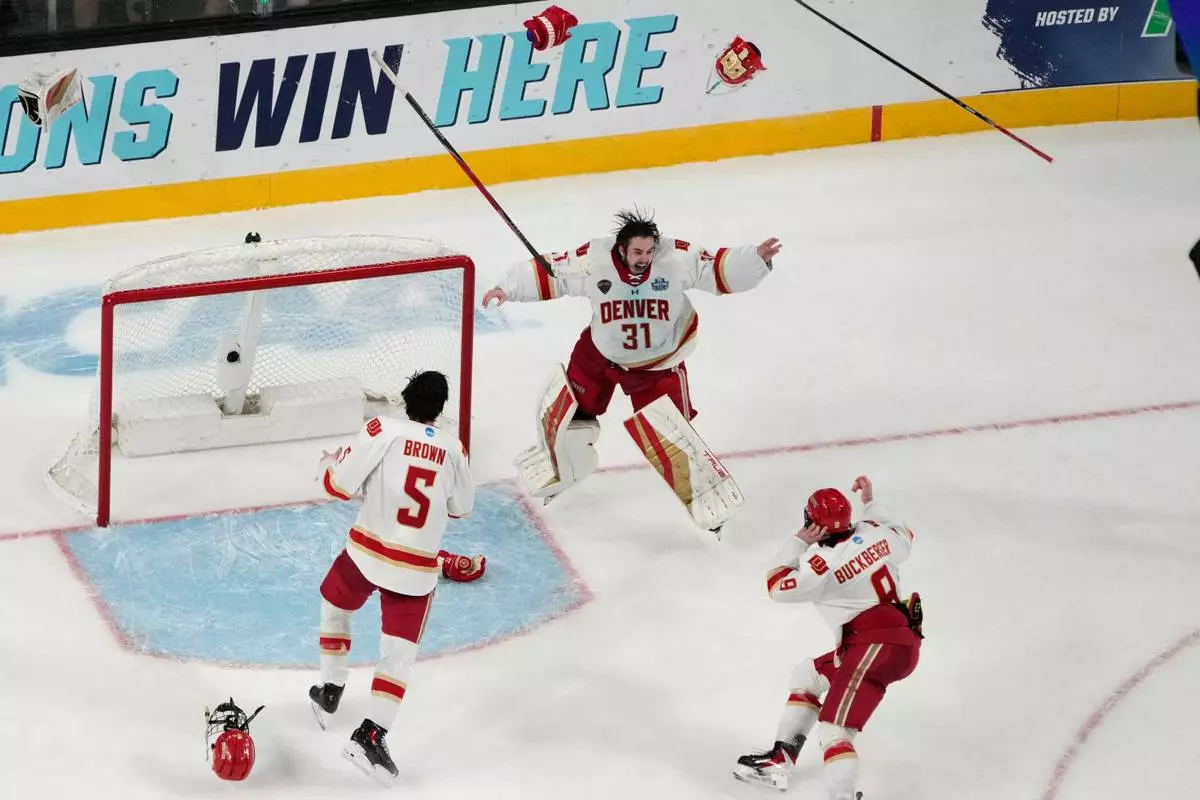
Denver goaltender Johnny Hicks (31) celebrates with teammates after defeating Wisconsin in the championship game at the NCAA Frozen Four men's college hockey tournament Saturday, April 11, 2026, in Las Vegas. (AP Photo/John Locher)
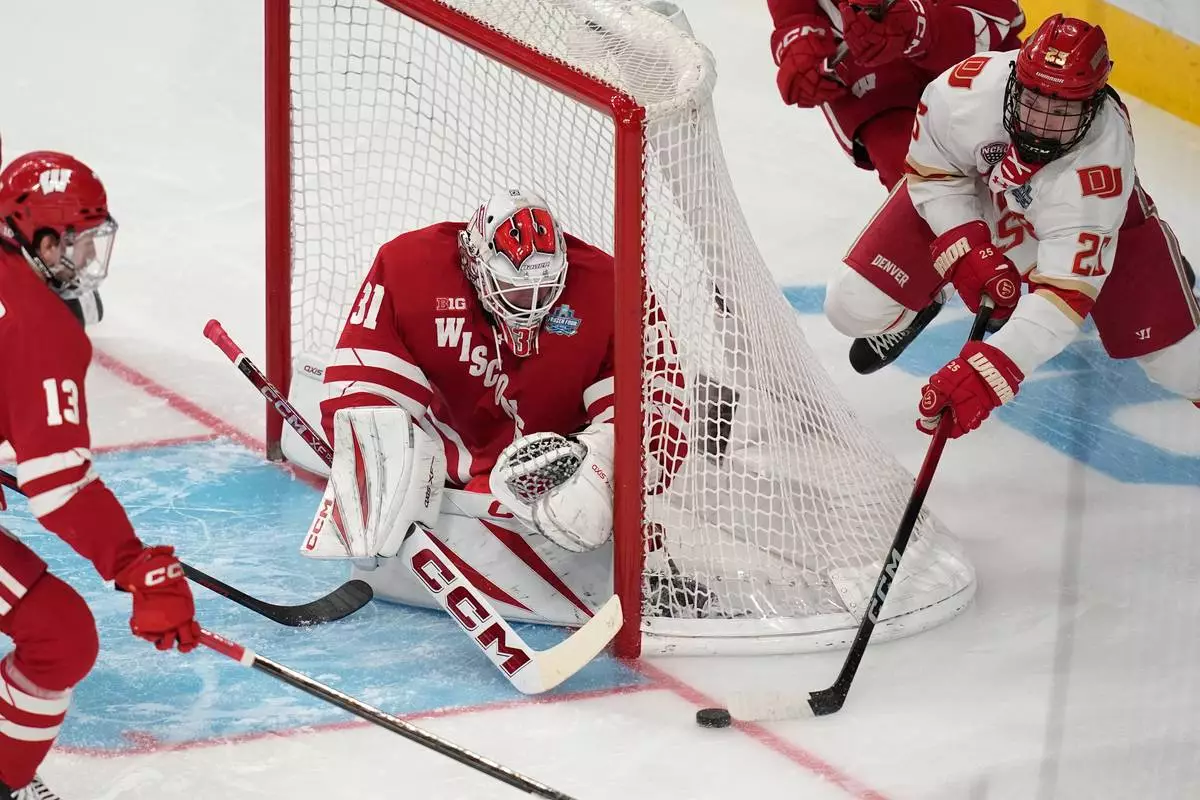
Denver forward Clarke Caswell (25) attempts a shot on Wisconsin goaltender Daniel Hauser (31) in the first period of the championship game at the NCAA Frozen Four men's college hockey tournament Saturday, April 11, 2026, in Las Vegas. (AP Photo/John Locher)
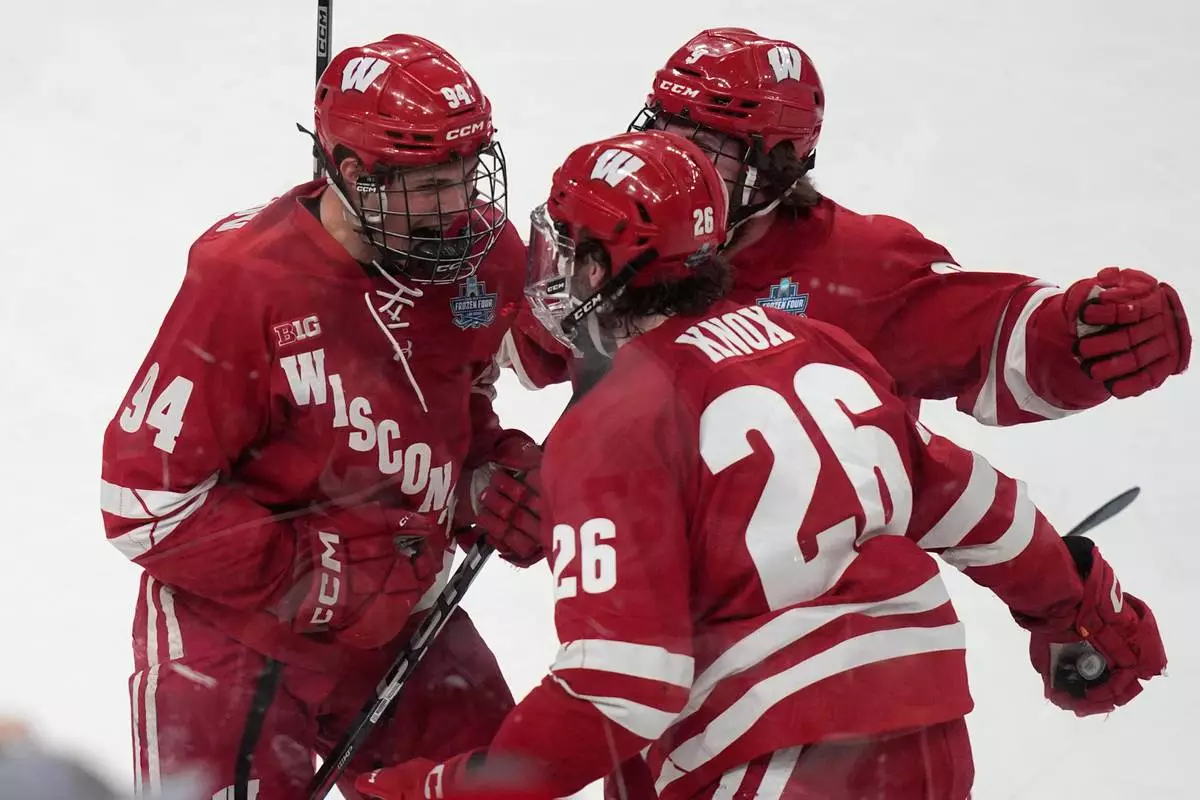
Wisconsin forward Vasily Zelenov, left, celebrates after scoring against Denver in the first period of the championship game at the NCAA Frozen Four men's college hockey tournament Saturday, April 11, 2026, in Las Vegas. (AP Photo/John Locher)
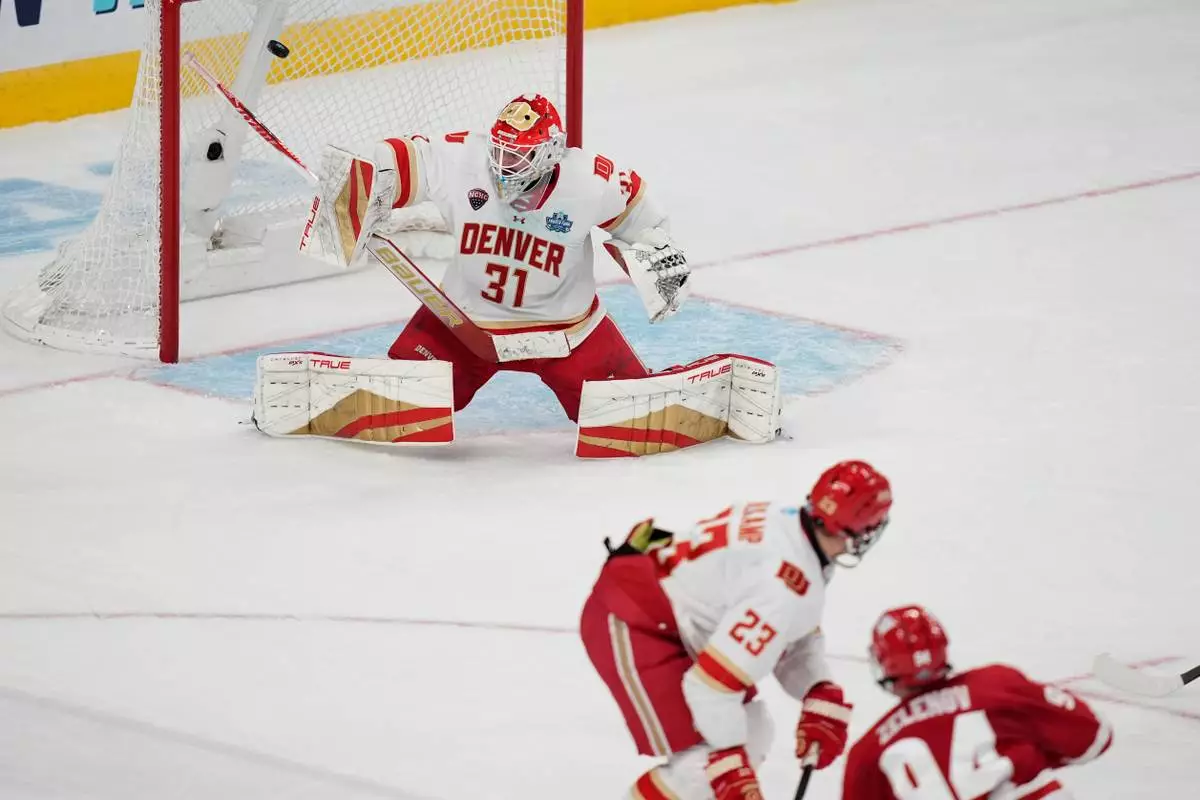
Wisconsin forward Vasily Zelenov (94) scores on Denver goaltender Johnny Hicks (31) in the first period of the championship game at the NCAA Frozen Four men's college hockey tournament Saturday, April 11, 2026, in Las Vegas. (AP Photo/John Locher)
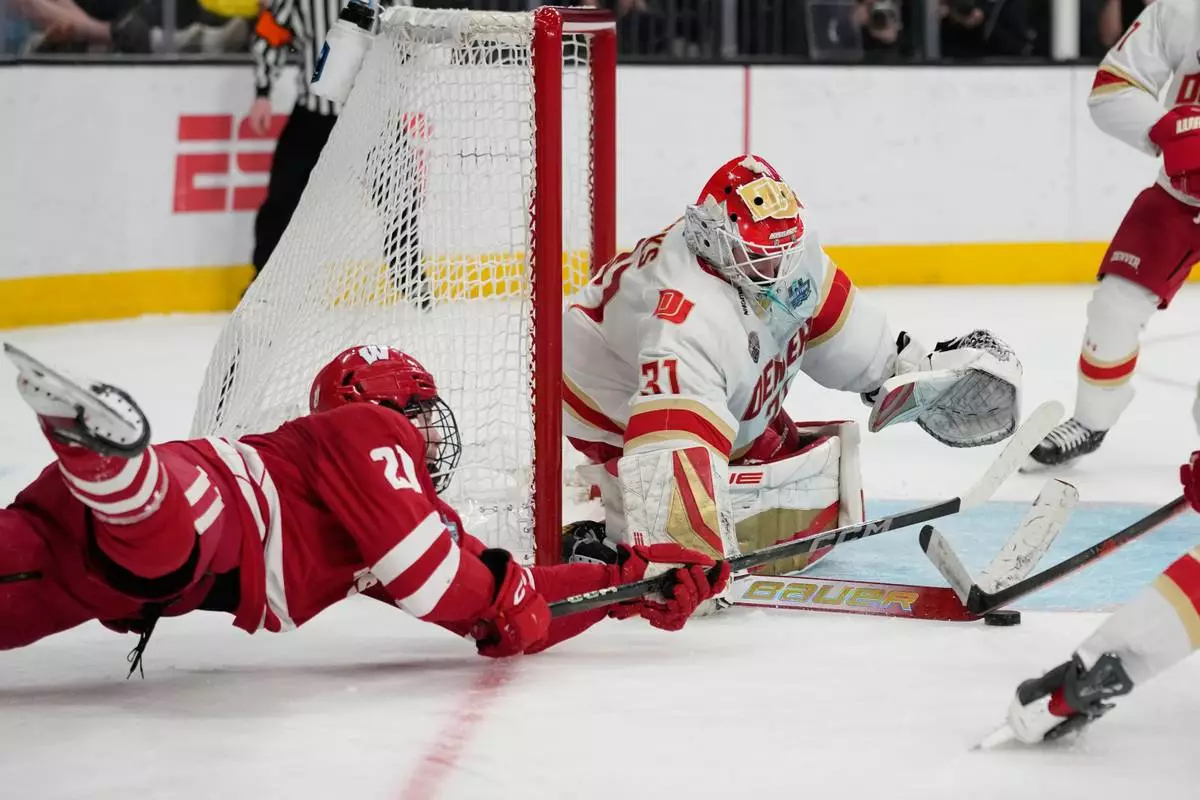
Wisconsin forward Ryan Botterill (21) dives to attempt a shot on Denver goaltender Johnny Hicks (31) in the second period of the championship game at the NCAA Frozen Four men's college hockey tournament Saturday, April 11, 2026, in Las Vegas. (AP Photo/John Locher)
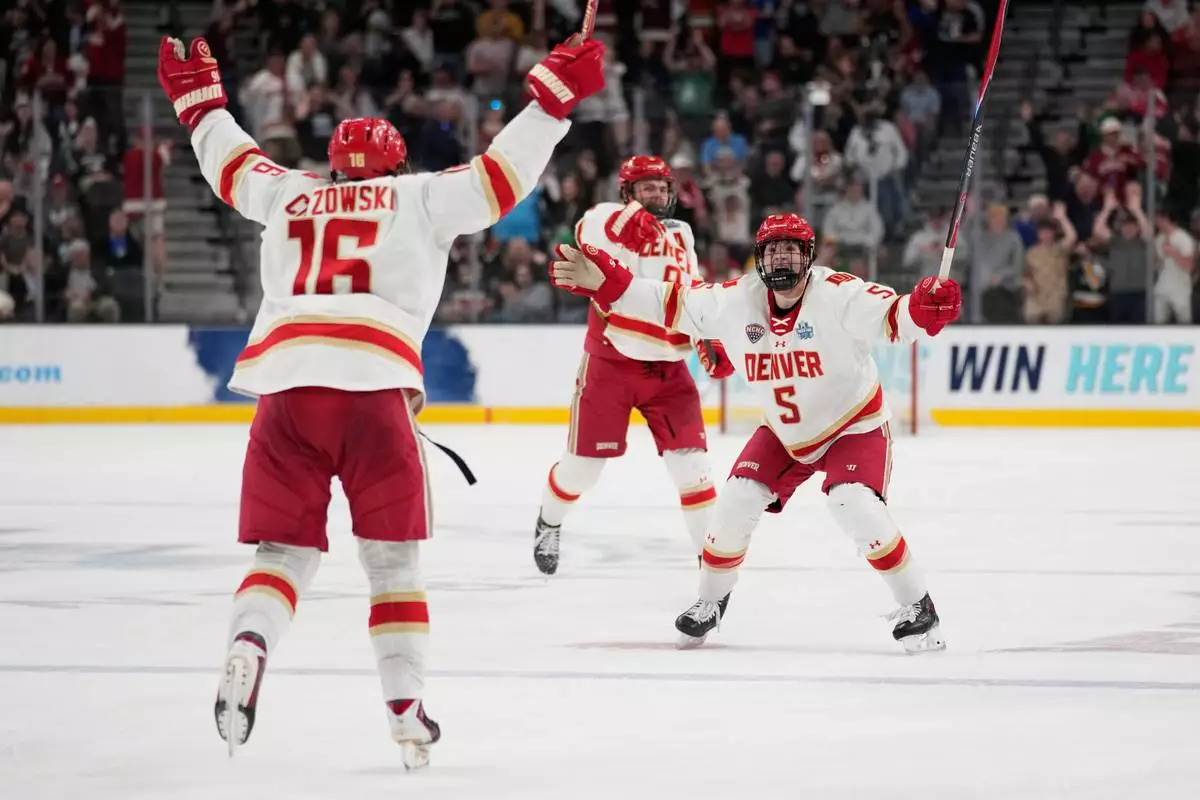
Denver players celebrate after Denver forward Kyle Chyzowski (16) scored against Wisconsin in the third period of the championship game at the NCAA Frozen Four men's college hockey tournament Saturday, April 11, 2026, in Las Vegas. (AP Photo/John Locher)
ISLAMABAD (AP) — U.S. Vice President J.D. Vance said negotiations ended early Sunday between the United States and Iran without a peace deal after the Iranians refused to accept American terms to not develop a nuclear weapon.
The third round of historic, face-to-face talks concluded days after a fragile, two-week ceasefire was announced as the war that has killed thousands of people and shaken global markets entered its seventh week.
The latest bargaining lasted 21 hours, Vance said, with the vice president in constant communication with U.S. President Donald Trump and others in the administration.
“But the simple fact is that we need to see an affirmative commitment that they will not seek a nuclear weapon, and they will not seek the tools that would enable them to quickly achieve a nuclear weapon,” Vance told reporters. “That is the core goal of the president of the United States. And that’s what we’ve tried to achieve through these negotiations.”
The vice president said he spoke with Trump “a half dozen times, a dozen times, over the past 21 hours” and also spoke with Secretary of State Marco Rubio, Treasury Secretary Scott Bessent and Adm. Brad Cooper, head of the United States Central Command.
“We were constantly in communication with the team because we were negotiating in good faith,” Vance said, speaking at a podium in front of a pair of American flags with special envoys Steve Witkoff and Jared Kushner to his side. “And we leave here, and we leave here with a very simple proposal, a method of understanding that is our final and best offer. We’ll see if the Iranians accept it.”
Trump had said he would suspend attacks against Iran for two weeks. Vance’s comments did not indicate what will happen after that time period expires or if the ceasefire will remain in place.
After his brief remarks, Vance boarded his government plane to leave Pakistan.
Two Pakistani officials said discussions between the heads of the delegations will resume after a break. Some technical personnel from both teams are still meeting, said the officials, who spoke on condition of anonymity because they were not authorized to brief the press.
Meanwhile, the U.S. military said two destroyers transited the Iran-gripped Strait of Hormuz ahead of mine-clearing work, a first since the war began. Iran’s state media, however, said the joint military command denied that.
“We’re sweeping the strait. Whether we make a deal or not makes no difference to me,” Trump told journalists as talks continued and the time approached 2 a.m. in Islamabad. He called negotiations “very deep.” Iranian state TV noted what it called “serious” differences.
The U.S. delegation led by Vance and the Iranian one led by Parliament Speaker Mohammad Bagher Qalibaf discussed with Pakistan how to advance the ceasefire already threatened by deep disagreements and Israel's continued attacks against the Iranian-backed Hezbollah in Lebanon, whose health ministry said the death toll has surpassed 2,000.
Since the Islamic Revolution in Iran in 1979, the most direct U.S. contact had been in 2013 when President Barack Obama called newly elected President Hassan Rouhani to discuss Iran’s nuclear program. Obama's secretary of state, John Kerry, and counterpart Mohammad Javad Zarif later met during negotiations toward the 2015 Iran nuclear deal — a process that lasted well over a year.
Now the far broader talks featured Vance, a reluctant defender of the war who has little diplomatic experience and warned Iran not to “try and play us,” and Qalibaf, a former commander with Iran's powerful Revolutionary Guard who has issued some of Iran's most fiery statements since fighting began.
Iran’s state-run news agency said the three-party talks began after Iranian preconditions, including a reduction in Israeli strikes on southern Lebanon, were met.
Iran's delegation told state television it had presented “red lines” in meetings with Pakistani Prime Minister Shehbaz Sharif, including compensation for damage caused by U.S.-Israeli strikes that launched the war on Feb. 28 and releasing Iran’s frozen assets.
The war has killed at least 3,000 people in Iran, 2,020 in Lebanon, 23 in Israel and more than a dozen in Gulf Arab states, and caused lasting damage to infrastructure in half a dozen Middle Eastern countries. Iran's grip on the Strait of Hormuz has largely cut off the Persian Gulf and its oil and gas exports from the global economy, sending energy prices soaring.
Reflecting the high stakes, officials from the region said Chinese, Egyptian, Saudi and Qatari officials were in Islamabad to indirectly facilitate talks. The officials spoke on condition of anonymity to discuss the sensitive matter.
In Tehran, residents told The Associated Press they were skeptical yet hopeful after weeks of airstrikes left destruction across their country of some 93 million people.
“Peace alone is not enough for our country because we’ve been hit very hard, there have been huge costs,” 62-year-old Amir Razzai Far said.
In his strongest words yet, Pope Leo XIV denounced the “delusion of omnipotence” fueling the war.
Iran’s closure of the Strait of Hormuz has proved its biggest strategic advantage in the war. Around a fifth of the world’s traded oil had typically passed through on over 100 ships a day. Only 12 have been recorded transiting since the ceasefire.
On Saturday, Trump said on social media that the U.S. had begun “clearing out” the strait.
“Today, we began the process of establishing a new passage and we will share this safe pathway with the maritime industry soon,” U.S. Central Command commander Adm. Brad Cooper later said. The U.S. statement about the destroyers added: "Additional U.S. forces, including underwater drones, will join the clearance effort in the coming days.”
Iranian Foreign Minister Abbas Araghchi had said Tehran was entering negotiations with “deep distrust” after strikes on Iran during previous talks. Araghchi, part of Iran’s delegation in Pakistan, said Saturday that his country was prepared to retaliate if attacked again.
Iran’s 10-point proposal ahead of the talks called for a guaranteed end to the war and sought control over the Strait of Hormuz. It included ending fighting against Iran’s “regional allies," explicitly calling for a halt to Israeli strikes on Hezbollah.
The United States’ 15-point proposal includes restricting Iran’s nuclear program and reopening the strait.
Israel pressed ahead with strikes in Lebanon after saying there is no ceasefire there. Iran and Pakistan have disagreed.
Negotiations between Israel and Lebanon are expected to begin Tuesday in Washington, Lebanese President Joseph Aoun’s office has said, after Israel's surprise announcement authorizing talks despite the countries lack of official relations.
But as thousands in Lebanon protested the planned negotiations on Saturday, Prime Minister Nawaf Salam said he had postponed a planned trip to Washington “in light of the current internal circumstances.” His absence should not affect talks as the first round is expected to be at the ambassadorial level.
Israel wants Lebanon's government to assume responsibility for disarming Hezbollah, much like was envisaged in a November 2024 ceasefire. But the militant group has survived efforts to curb its strength for decades.
Hezbollah joined the war in support of Iran in the opening days. Israel followed with airstrikes and a ground invasion.
The day the Iran ceasefire deal was announced, Israel pounded Beirut with airstrikes, killing more than 300 people in the deadliest day in Lebanon since the war began, according to the country's Health Ministry.
Castillo reported from Beijing, Magdy from Cairo, Anna from Lowville, New York, and Finley and Binkley from Washington. Josh Boak in Washington and Christopher Weber in Los Angeles contributed.
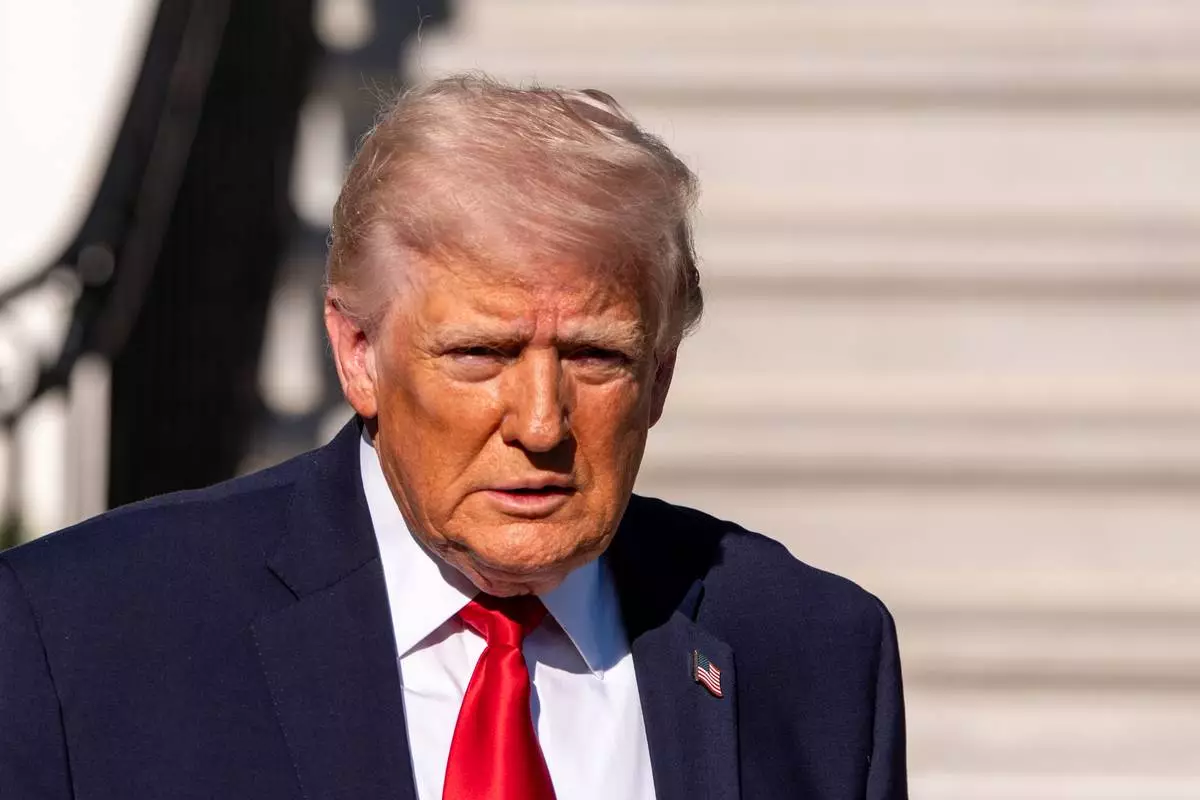
President Donald Trump speaks with reporters before departing on Marine One from the South Lawn of the White House, Saturday, April 11, 2026, in Washington. (AP Photo/Alex Brandon)
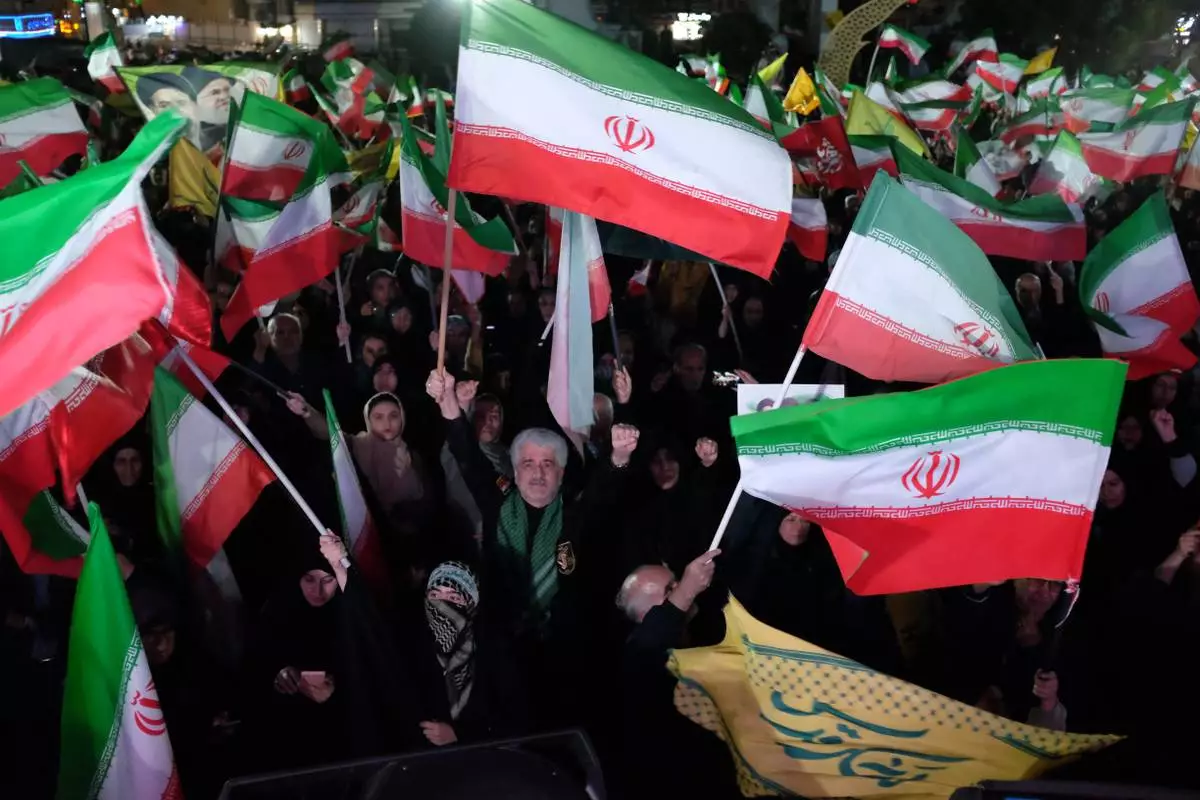
Pro-government demonstrators wave Iranian flags during a gathering in Tehran, Iran, Saturday, April 11, 2026. (AP Photo/Vahid Salemi)
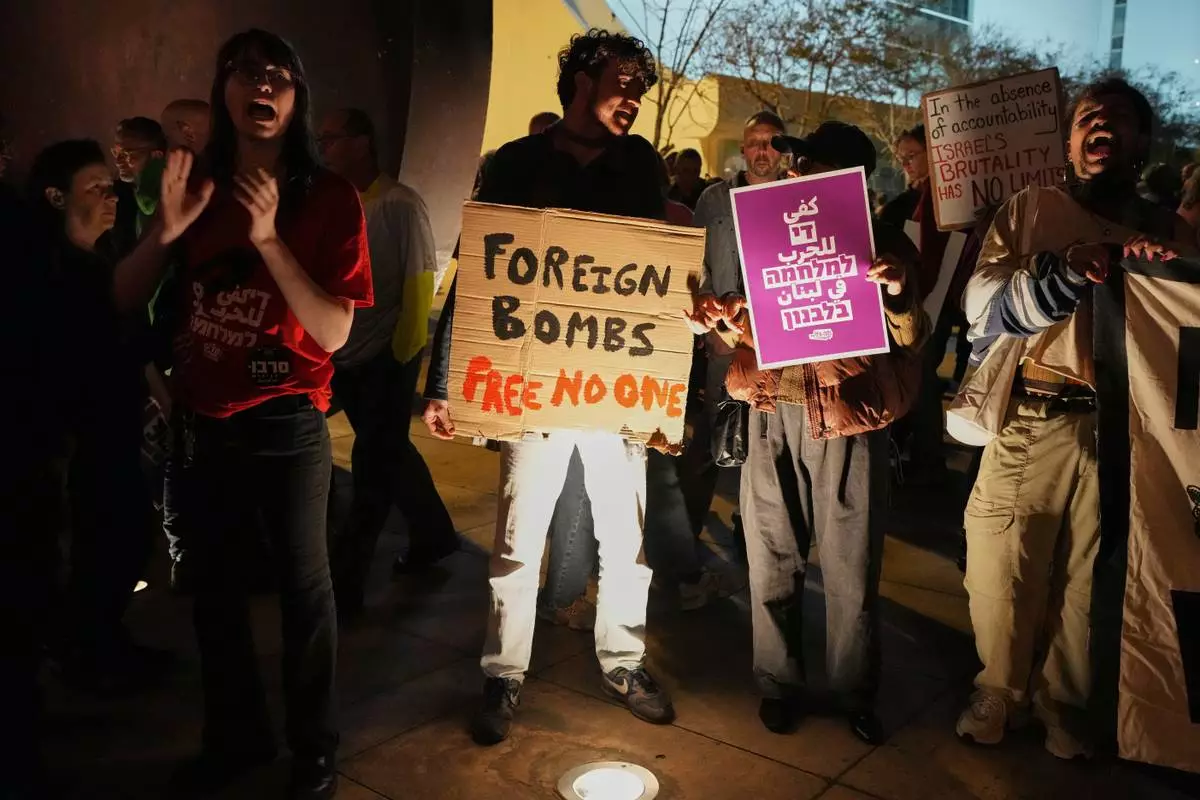
People take part in a protest calling for the end of the war, in Tel Aviv, Israel, Saturday, April 11, 2026. (AP Photo/Maya Levin)
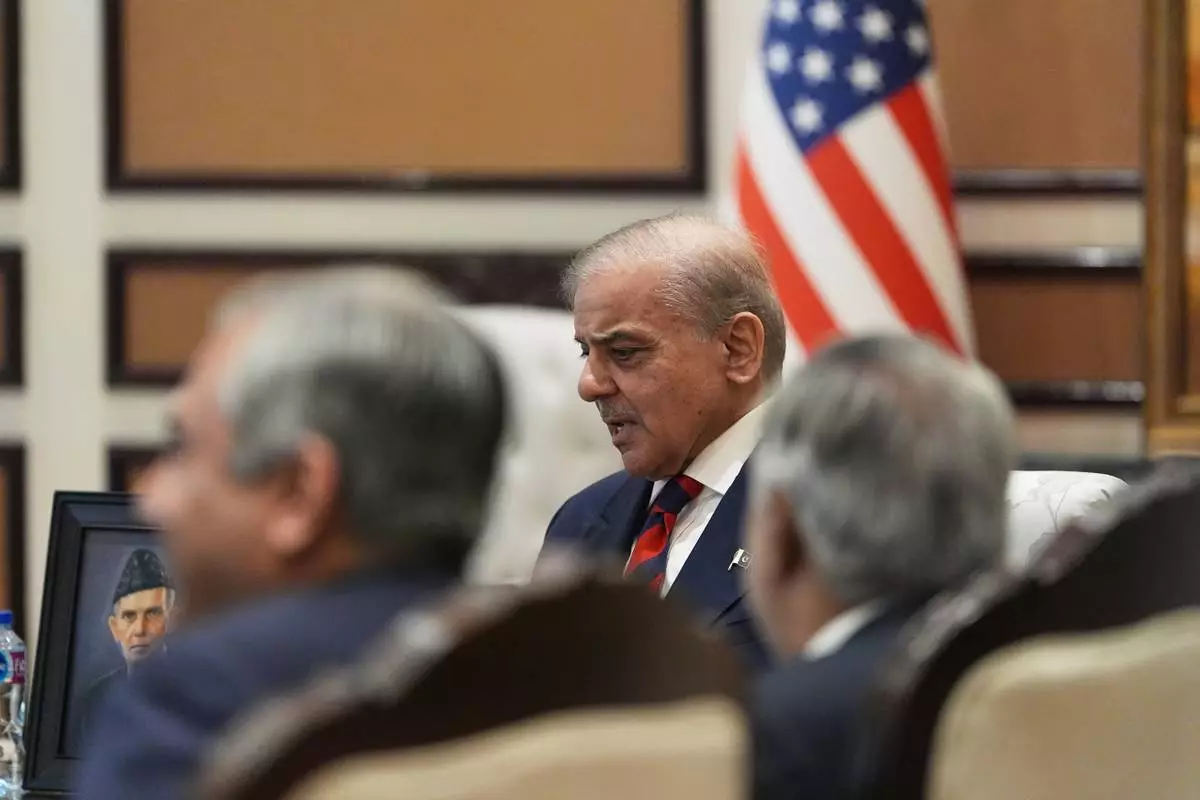
Pakistan's Prime Minister Shehbaz Sharif, meets with U.S. Vice President JD Vance, not pictured, about Iran, Saturday, April 11, 2026, in Islamabad. (AP Photo/Jacquelyn Martin, Pool)
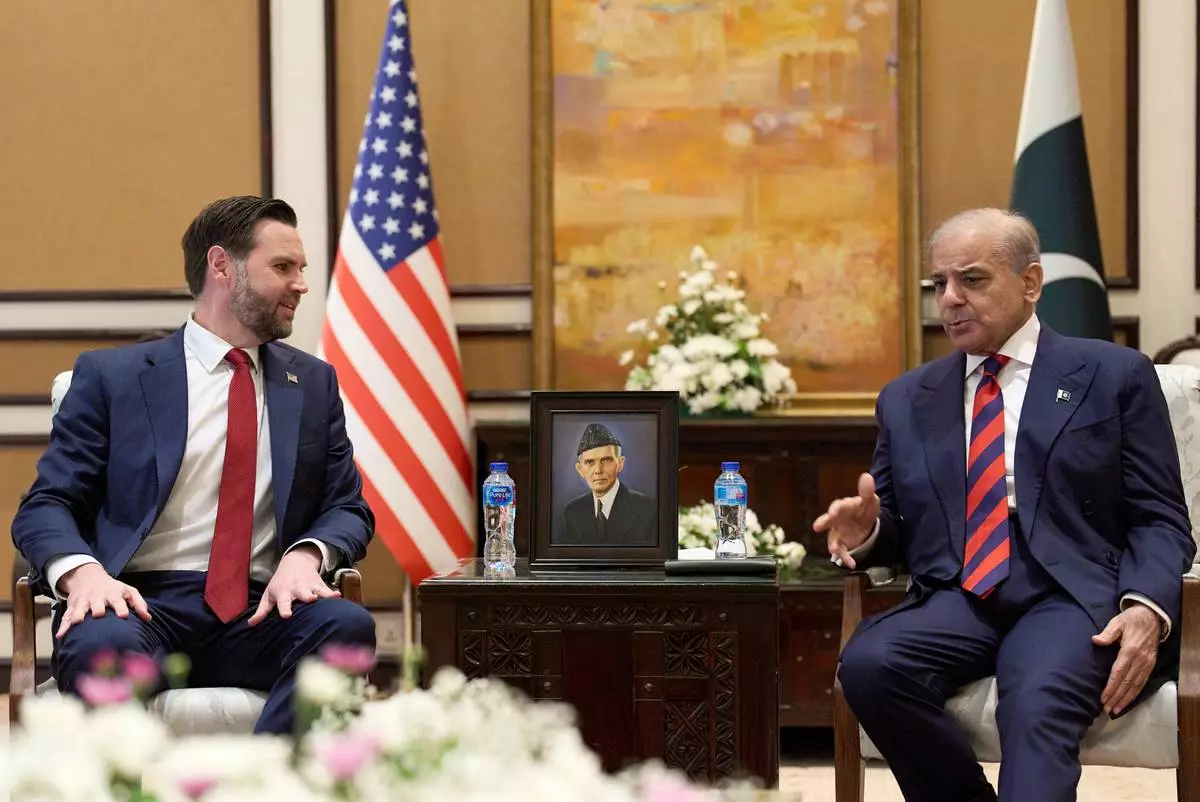
U.S. Vice President JD Vance meets with Pakistan's Prime Minister Shehbaz Sharif, Saturday, April 11, 2026, in Islamabad, for talks about Iran. (AP Photo/Jacquelyn Martin, Pool)
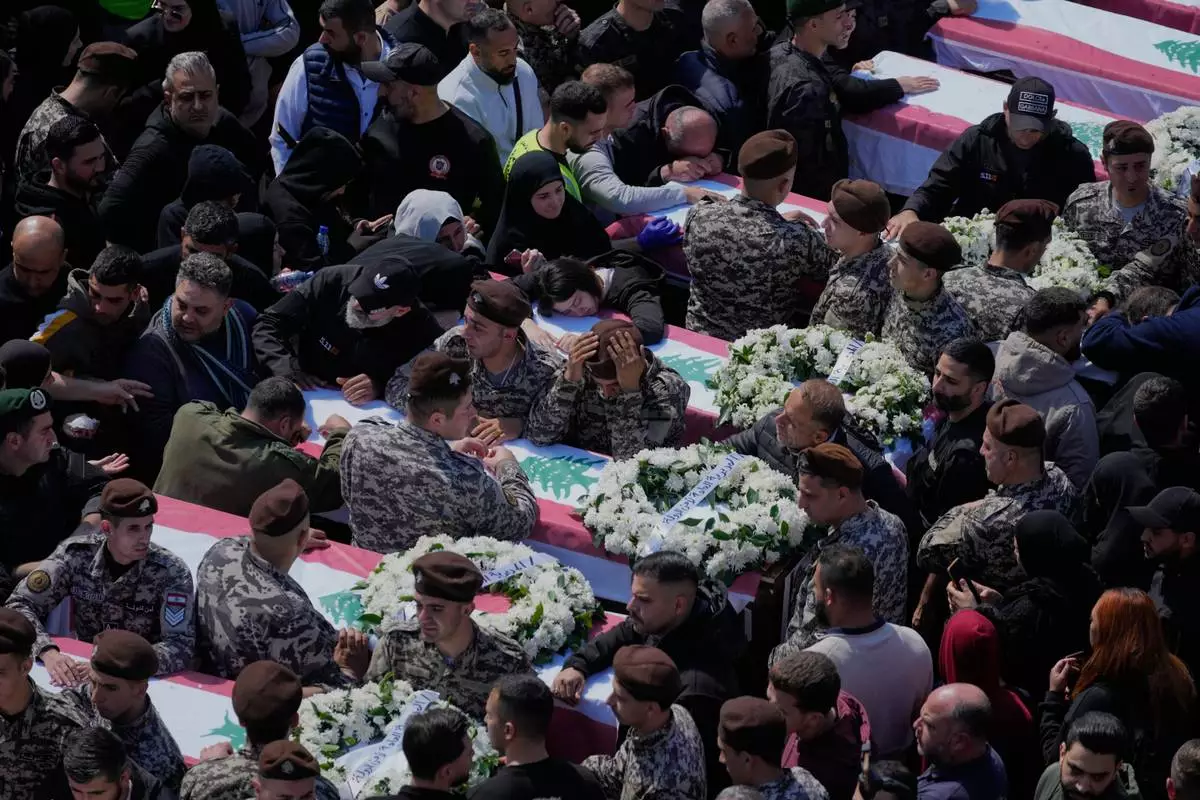
Colleagues mourn over the coffins during the funeral of 13 state security officers killed the previous day in an Israeli strike in the Lebanese coastal city of Sidon, Saturday, April 11, 2026. (AP Photo/Mohammed Zaatari)
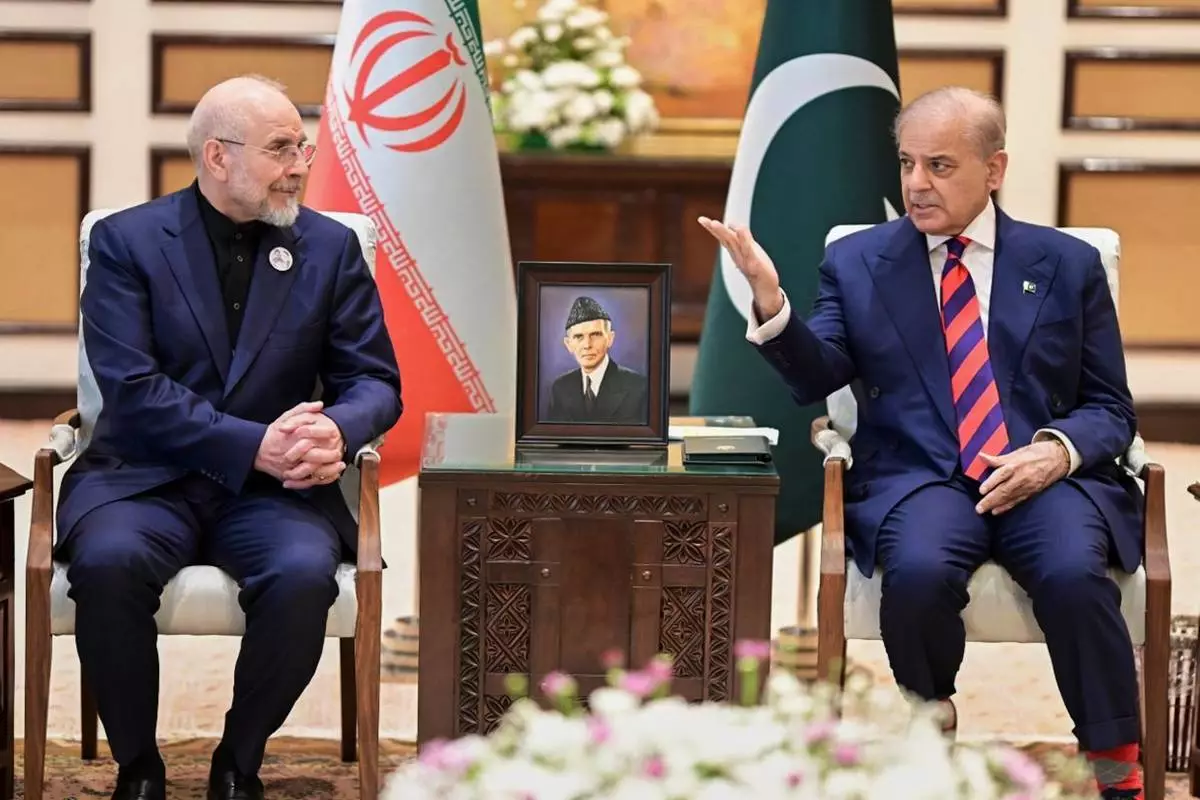
In this photo released by the Pakistan Prime Minister Office, Iran's Parliament Speaker Mohammad Bagher Ghalibaf, left, meets with hand with Pakistani Prime Minister Shehbaz Sharif, in Islamabad, Pakistan, Saturday, April 11, 2026 (Pakistan Prime Minister Office via AP)
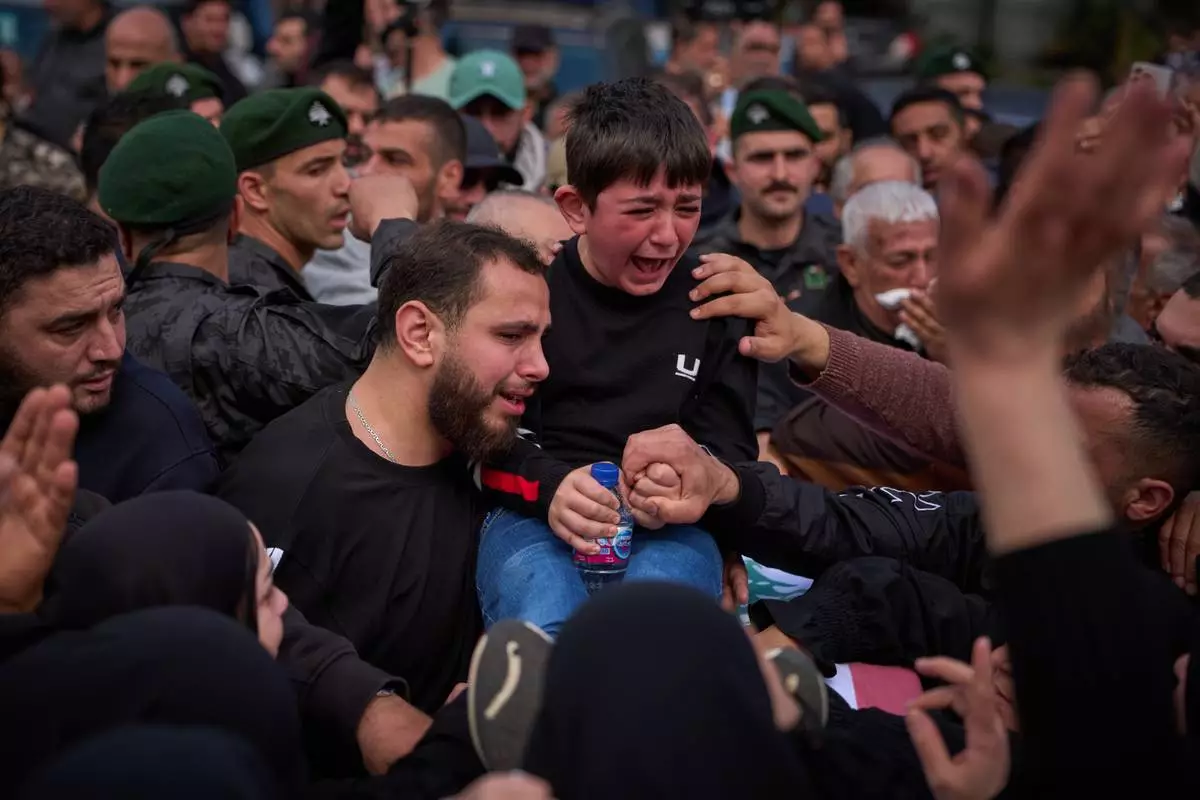
Mohammed, 8, weeps next to the coffin of his father, Hussein Makkah, during the funeral of 13 state security officers killed the previous day in an Israeli strike in Lebanon’s coastal city of Sidon, Lebanon, Saturday, April 11, 2026. (AP Photo/Emilio Morenatti)
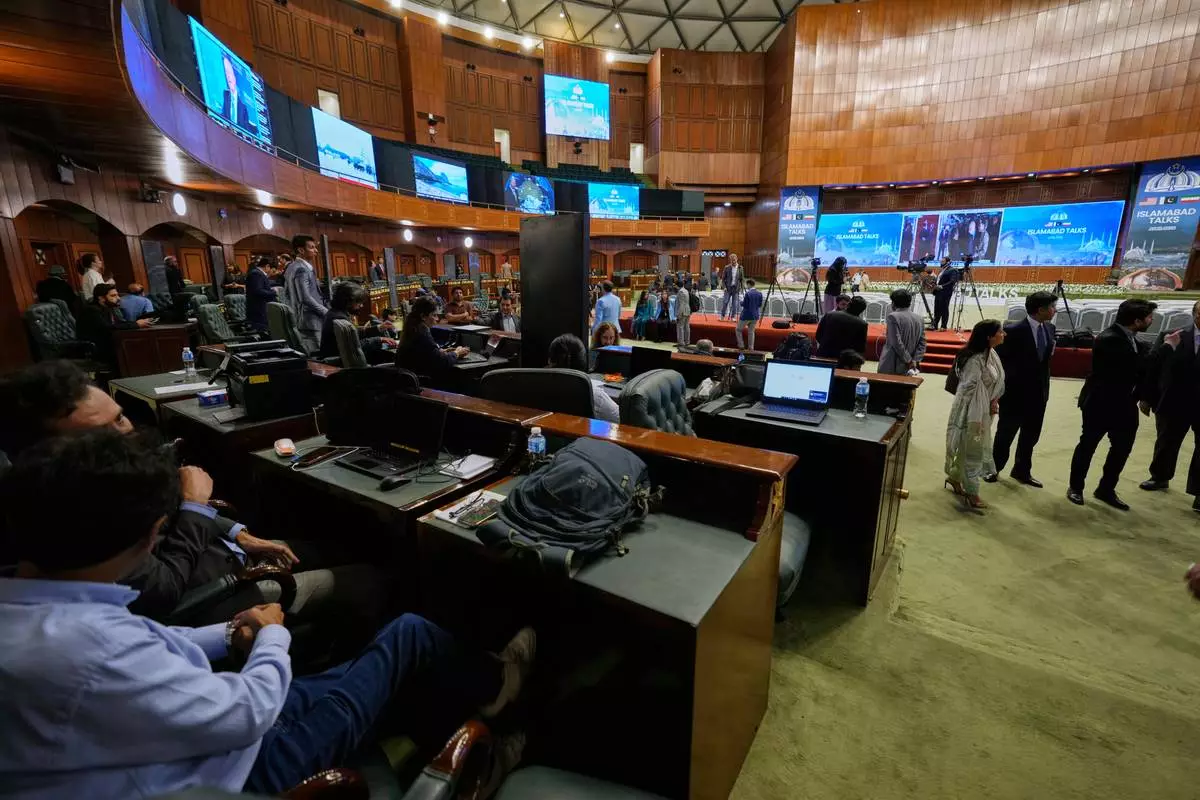
Members of the media work at a media center setup for the coverage of the US-Iran talks, in Islamabad, Pakistan, Saturday, April 11, 2026. (AP Photo/Anjum Naveed)
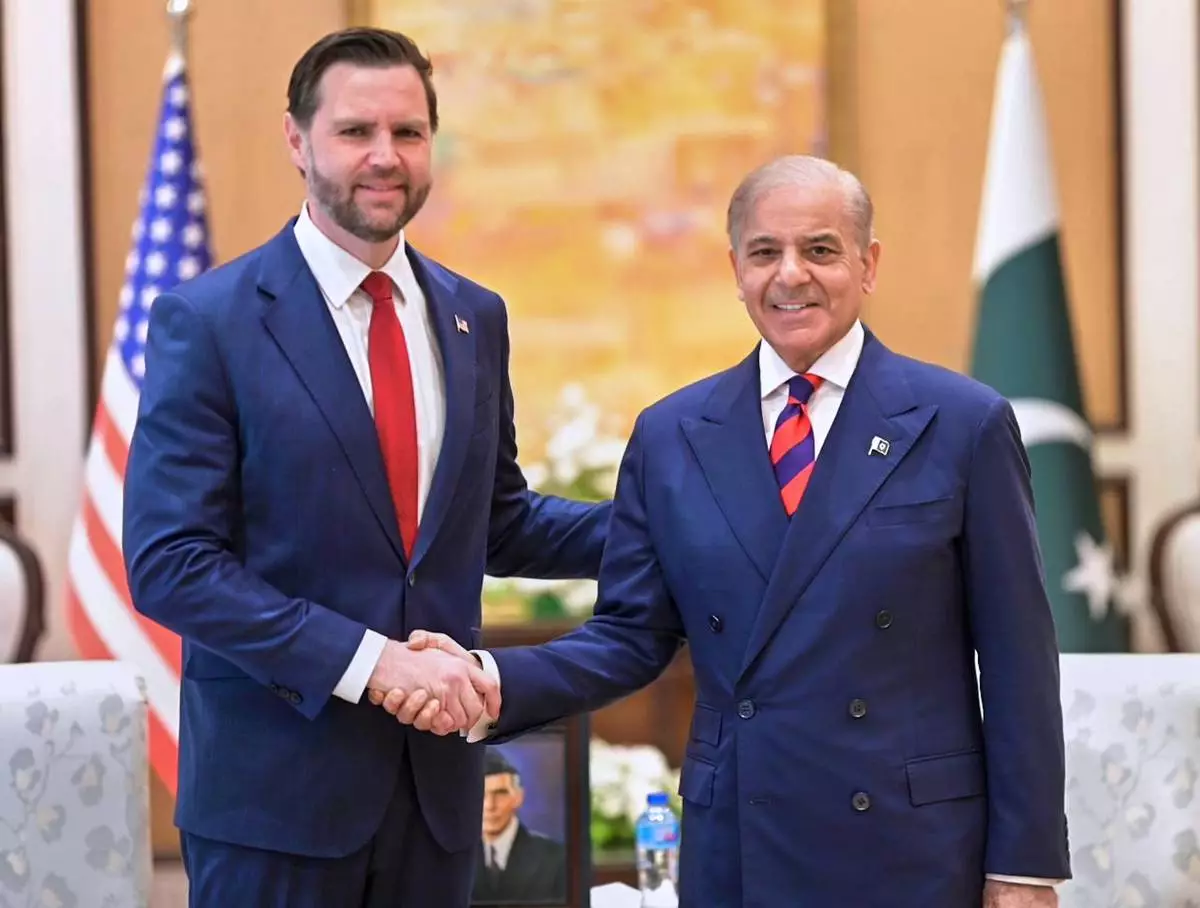
In this photo released by the Pakistan Prime Minister Office, U.S. Vice President JD Vance, left, shakes hand with Pakistani Prime Minister Shehbaz Sharif prior to their meeting, in Islamabad, Pakistan, Saturday, April 11, 2026 (Pakistan Prime Minister Office via AP)
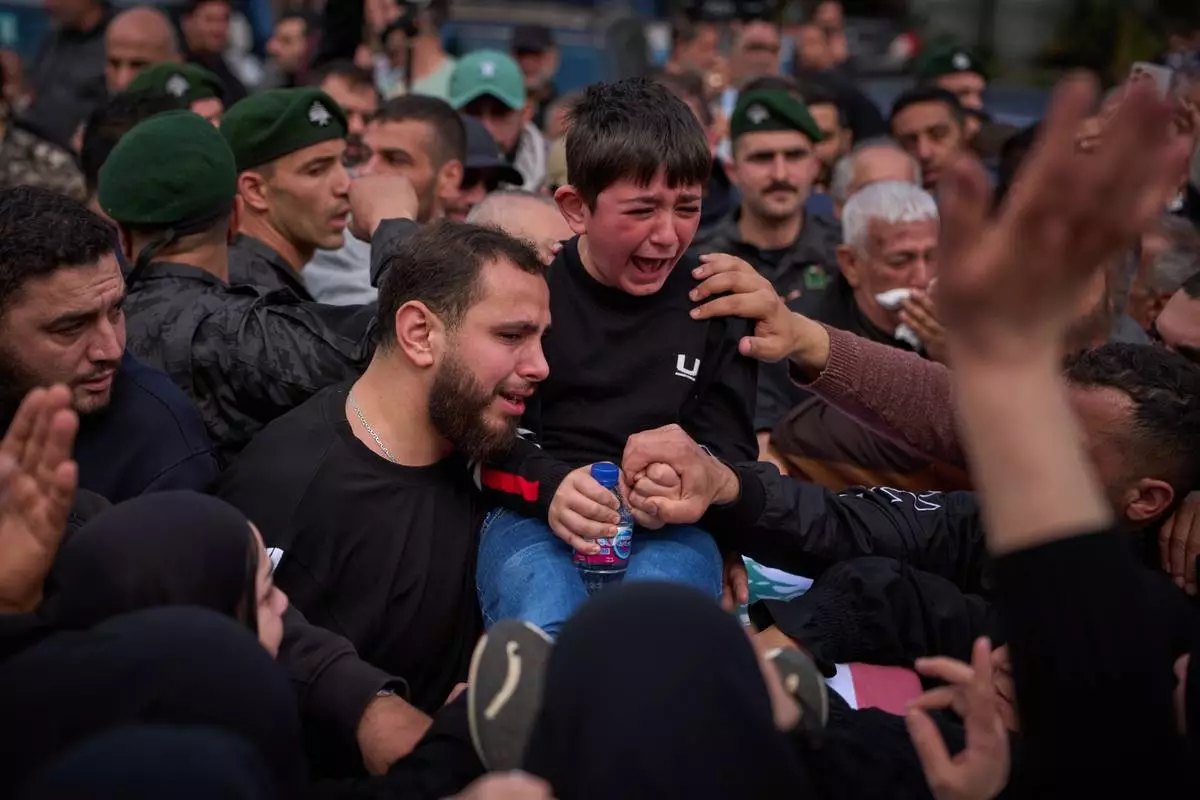
Mohammed, 8, weeps next to the coffin of his father, Hussein Makkah, during the funeral of 13 state security officers killed the previous day in an Israeli strike in Lebanon’s coastal city of Sidon, Lebanon, Saturday, April 11, 2026. (AP Photo/Emilio Morenatti)
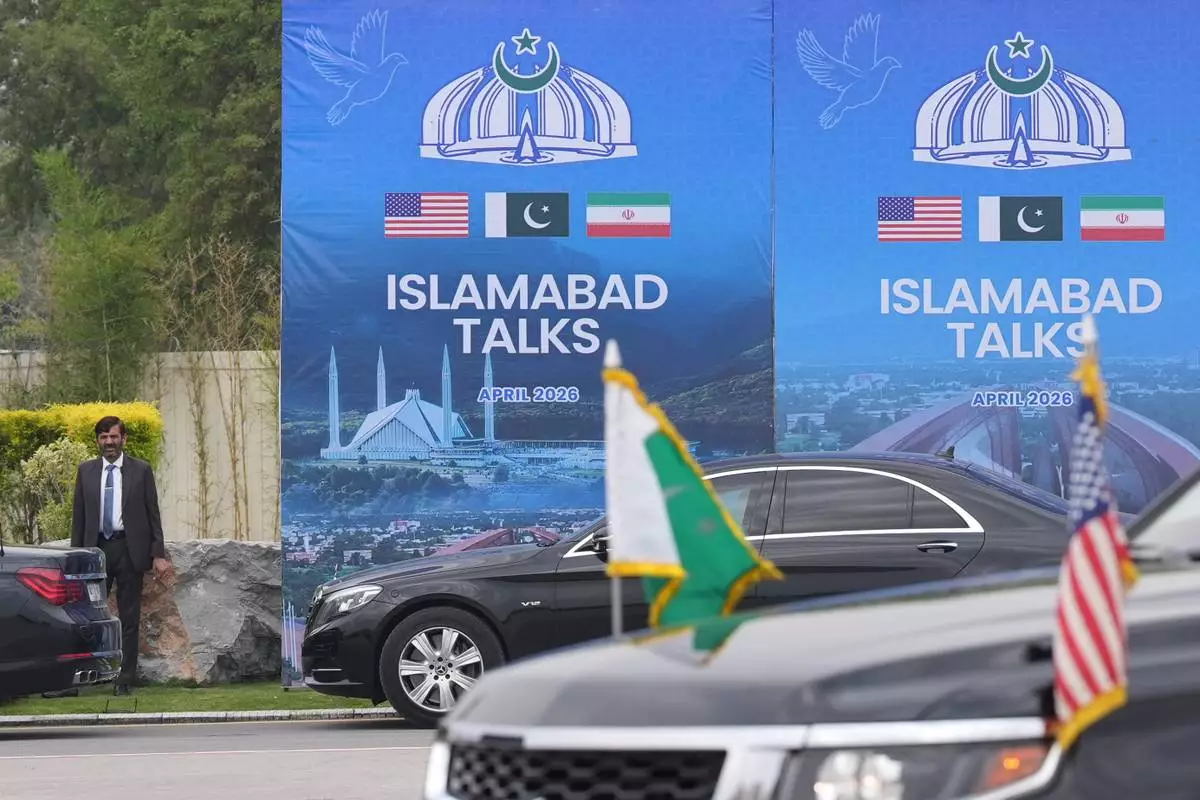
A Pakistani official is seen during the arrival of the U.S. Vice President JD Vance for talks with Iranian officials in Islamabad, Pakistan, Saturday, April 11, 2026. (AP Photo/Jacquelyn Martin, Pool)
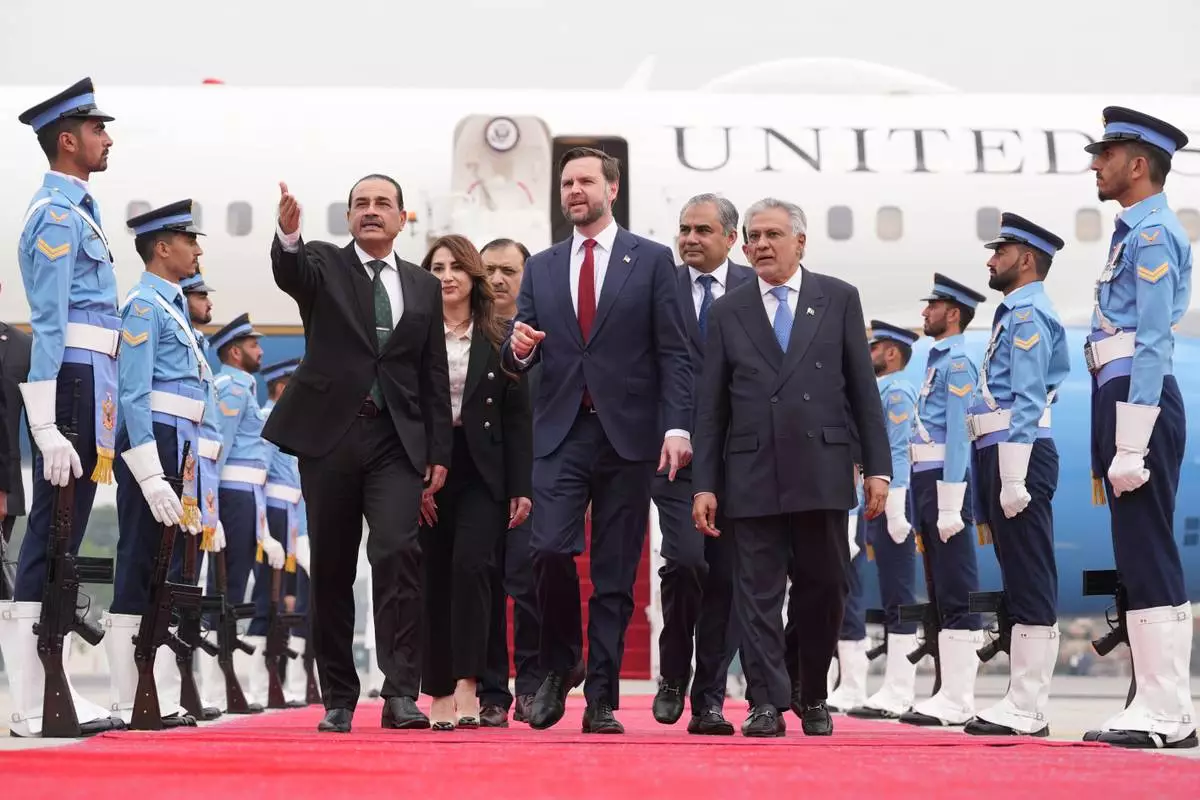
U.S. Vice President JD Vance, center, walks with Pakistan's Chief of Defence Forces and Chief of Army Staff Field Marshall Asim Munir, left, and Pakistani Deputy Prime Minister and Foreign Minister Mohammad Ishaq Dar after arriving for talks with Iranian officials in Islamabad, Pakistan, Saturday, April 11, 2026. (AP Photo/Jacquelyn Martin, Pool)
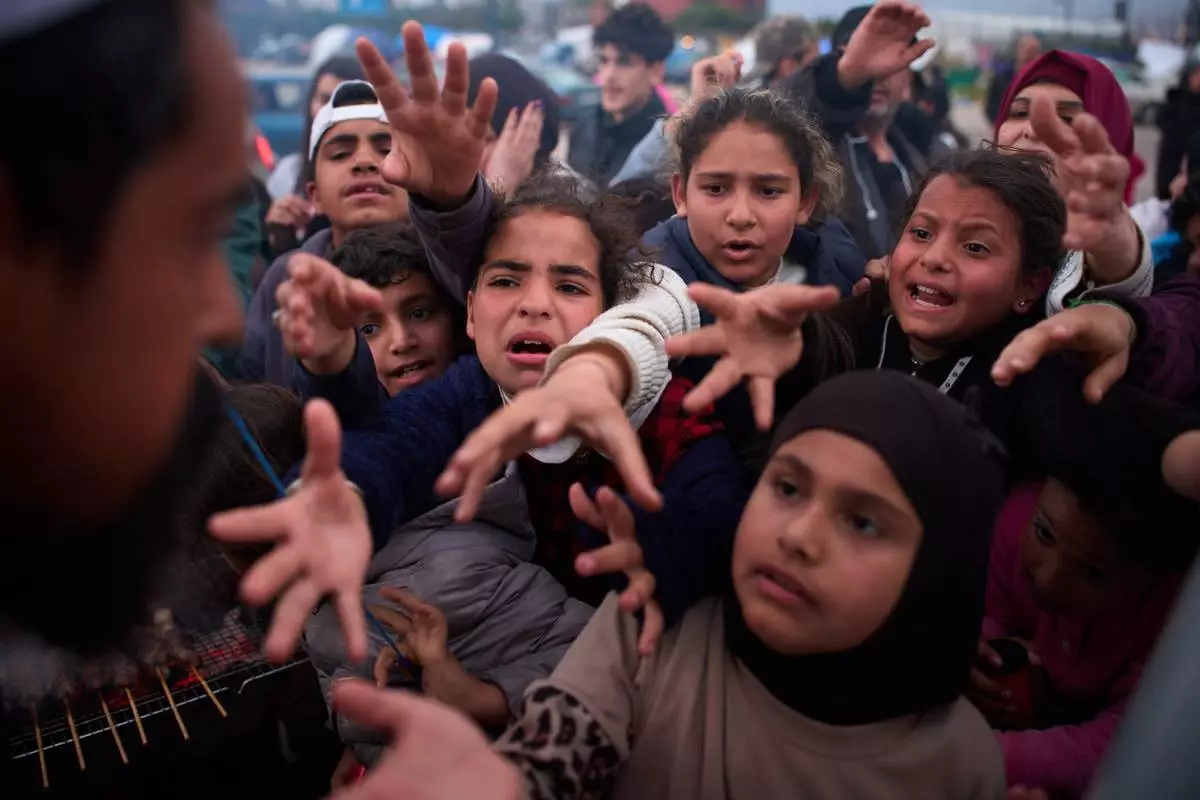
Displaced families extend their hands while waiting for donated food beside the tents they use as shelters after fleeing Israeli bombardment in southern Lebanon, in Beirut, Lebanon, Thursday, April 9, 2026. (AP Photo/Emilio Morenatti)
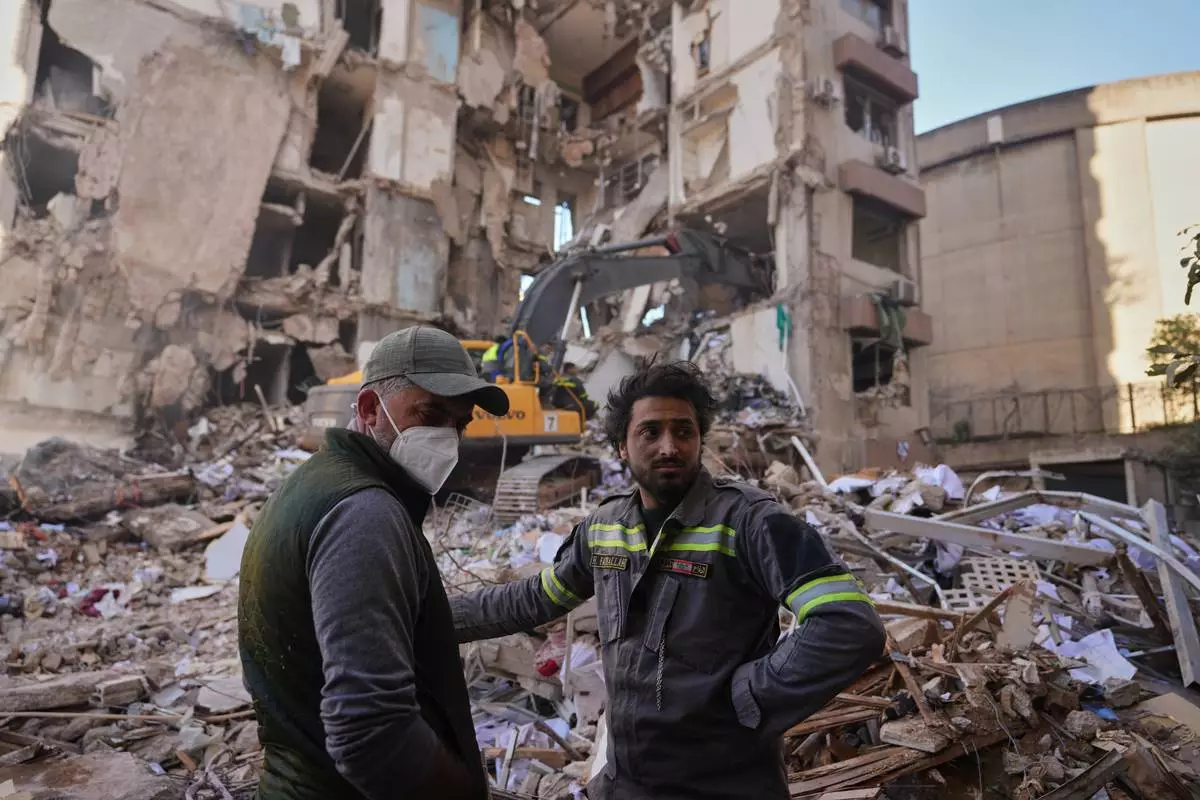
A Lebanese civil defense worker, right, stands with a resident at the site of a building destroyed in an Israeli airstrike a day earlier in central Beirut, Lebanon, Thursday, April 9, 2026. (AP Photo/Hassan Ammar)
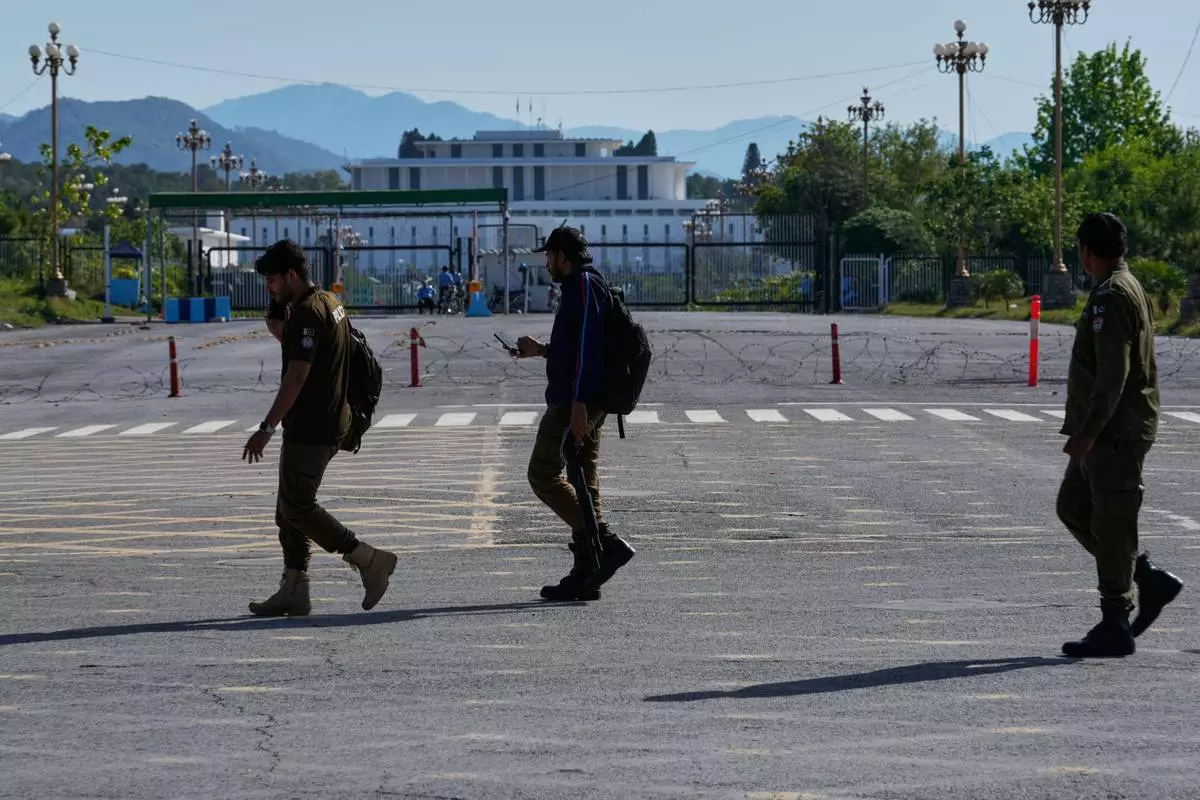
Police officers take position in Islamabad, Pakistan, to ensure security ahead of possible negotiations between Iran and the United States, Friday, April 10, 2026. (AP Photo/Anjum Naveed)
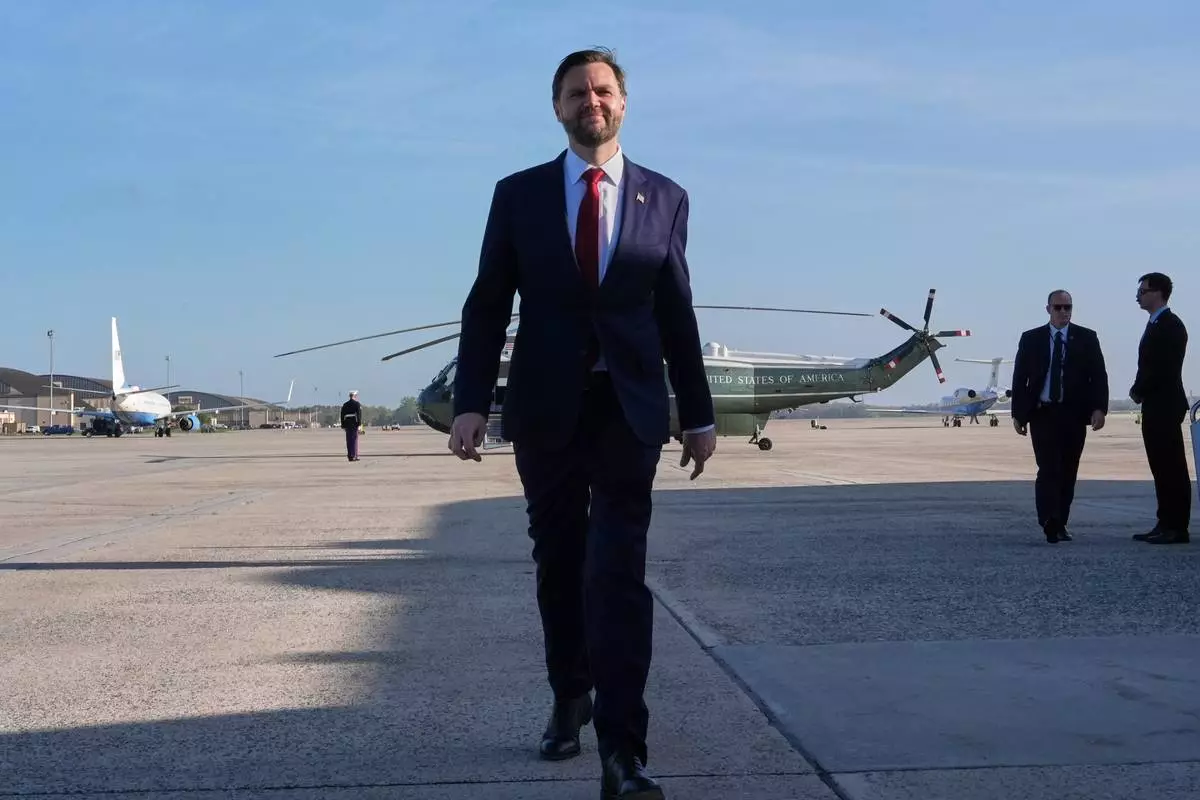
Vice President JD Vance walks to speak with the Press before boarding Air Force Two, Friday, April 10, 2026, at Joint Base Andrews, Md., for expected departure to Pakistan, for talks on Iran. (AP Photo/Jacquelyn Martin, pool)
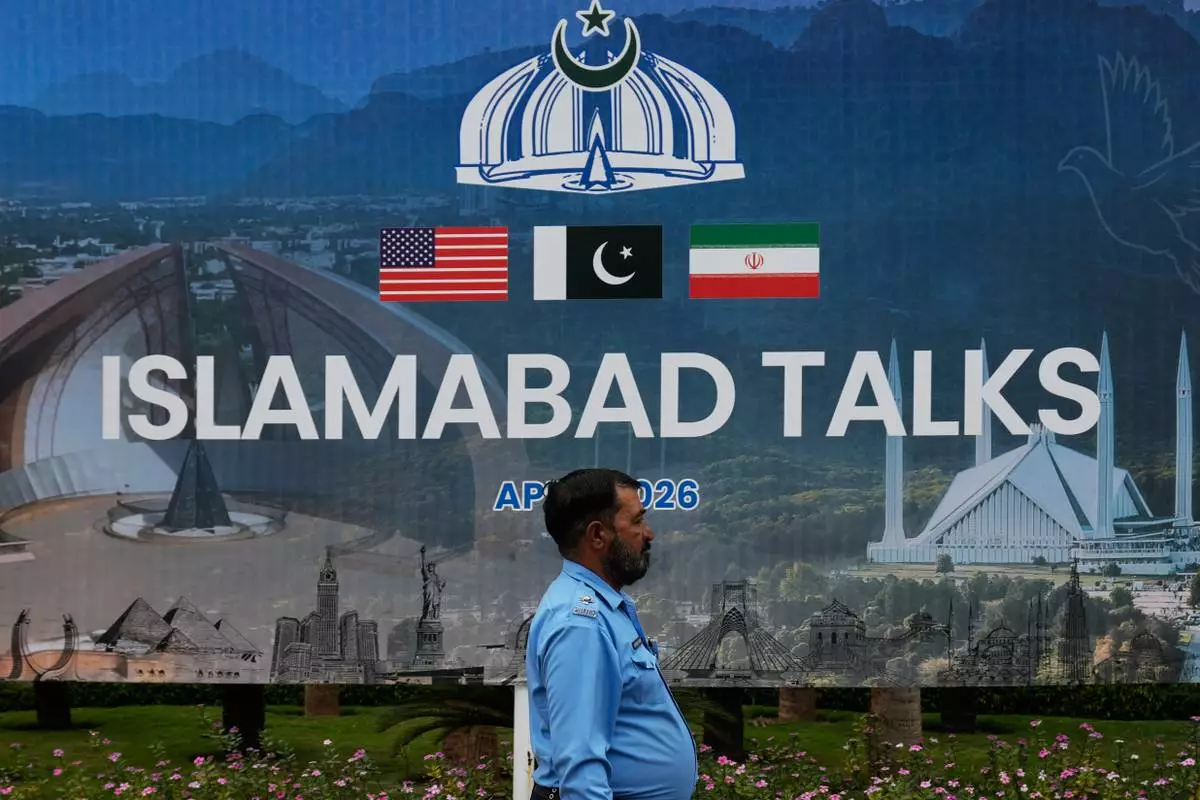
A police officer walks past a billboard regarding the United States and Iran negotiations, outside a media facilitation center in Islamabad, Pakistan, Saturday, April 11, 2026. (AP Photo/Anjum Naveed)