Skip to Content Facebook Feature Image

Safeguarding healthy minds

HK

HK

HK

Safeguarding healthy minds

2026-04-12 10:53 Last Updated At:10:53

“I was scared of not being able to sleep. The more I feared it, the harder it was to fall asleep. I tossed and turned all night, like a fish being fried,” said Mr Lai, a retired truck driver who suffered from insomnia for over 10 years.
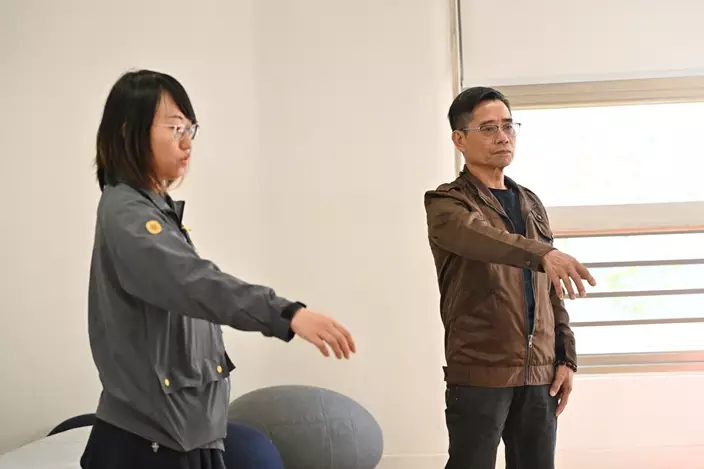
Mindfulness exercises: Mr Lai (right) receives low-intensity psychological therapy, including sleep and mindfulness sessions, which help him overcome years of insomnia. Image source: www.news.gov.hk

Mindfulness exercises: Mr Lai (right) receives low-intensity psychological therapy, including sleep and mindfulness sessions, which help him overcome years of insomnia. Image source: www.news.gov.hk

Irregular work hours led to exhausting days, dizziness and headaches that followed the sleepless nights.

The heavy toll eventually began confining him to his home, unable to enjoy his hobbies like singing and dancing.

“I knew taking sleeping pills was bad for my health. My memory was getting worse. I tried taking one pill, but if I woke up in the middle of the night, I would take another. If I still could not sleep, I would take more.”

Cycle ending

Seeking a way out of his struggle, Mr Lai visited the Tuen Mun District Health Centre last year for a mental health risk assessment under the Healthy Mind Pilot Project.

The results indicated symptoms of psychological distress and he was referred to the New Life Psychiatric Rehabilitation Association for follow-up.

Well-being Practitioner Yung Ka-yi said Mr Lai showed mild obsessive thoughts about sleep.

“He was told by his mind to change his posture when he was lying in his bed. He might also be asked to go to the washroom frequently, but in fact, he knew that it did not make sense,” she explained.

Professional support: Well-being Practitioner Yung Ka-yi (right) assists Mr Lai to improve his sleep routine. Image source: www.news.gov.hk

Professional support: Well-being Practitioner Yung Ka-yi (right) assists Mr Lai to improve his sleep routine. Image source: www.news.gov.hk

To address his chronic insomnia, the pilot project tailored a programme of low-intensity psychological therapy for Mr Lai. Over five sleep therapy sessions, he learned to correct persistent misconceptions.

“Many people believe they must get eight hours of sleep every night, which only causes anxiety and disrupts sleep,” Ms Yung explained.

The sleep therapy also taught Mr Lai to improve his sleep routine.

“Only go to bed when you truly feel sleepy,” Ms Yung advised. “If you are unable to fall asleep within 30 minutes, leave your bed to relax until you feel sleepy again, then try going back to bed.”

Mr Lai also attended six mindfulness therapy sessions, where he mastered relaxation techniques that could be done anywhere, anytime.

After six months, Mr Lai was finally able to get a good night’s sleep.

“I am so happy I can sleep until morning now. Sometimes I wake up in the middle of the night, but after practising deep breathing, I can fall back asleep,” adding that his wife and kids were astonished and said “You just went to bed, and you are already snoring!” - something that had never happened before.

Early intervention

In August 2024, the Health Bureau partnered with the New Life Psychiatric Rehabilitation Association and Mind HK to launch the Healthy Mind Pilot Project in Tuen Mun District Health Centre, Eastern and Yau Tsim Mong District Health Centre Expresses.

During health risk assessments, members of District Health Centres and District Health Centre Expresses also complete a mental health questionnaire to screen for depression and anxiety risks. Those in need are referred to non-governmental organisations (NGOs) for further assessments and follow-ups.

Yeung Tsui-yee, a clinical psychologist participating in the project noted that it has been instrumental in the early identification of, and intervention for, emotional health issues. Through low-intensity psychological therapy, participants learn to adjust thoughts and behaviours in their daily lives, helping them manage mild symptoms of depression or anxiety.

“We help them build up a more balanced life that is balanced between routine, pleasurable and important tasks to help them improve their mood and to maintain their daily functioning. For dealing with worries, this method is to help them notice that worry is here and it is affecting me, and we teach them skills to help them refocus.”

Early intervention: Clinical Psychologist Yeung Tsui-yee highlights that the pilot project aids in the early detection and intervention of emotional issues and helps participants manage mild symptoms of depression or anxiety. Image source: www.news.gov.hk

Early intervention: Clinical Psychologist Yeung Tsui-yee highlights that the pilot project aids in the early detection and intervention of emotional issues and helps participants manage mild symptoms of depression or anxiety. Image source: www.news.gov.hk

Psychological support

As of February 2026, about 48,800 individuals have undergone initial mental health assessments, of whom about 3,700 required further assessment.

Including those referred by NGOs, over 7,000 individuals have completed further assessments.

Of those evaluated, approximately 2,500 people were found to have normal emotional health.

Around 240 required referrals to specialised or high-intensity mental health services, while the remaining eligible participants could be arranged to receive low-intensity psychological therapy.

The project will gradually expand to nine district health centres starting this year.

Have you ever pulled into the driveway of your home or a parking lot spot and just ... stayed there?

Maybe it’s a few minutes, or half an hour. You might be scrolling on your phone, belting out a favorite song or just staring into the distance.

Scroll through TikTok and you’ll find countless videos of people wondering aloud why they're doing the same thing: arriving at work, home, the gym, and then just sitting in their car. Some get there early on purpose. Others stay long after they’ve parked.

The behavior is so common it’s become its own kind of ritual, one people are increasingly recognizing and sharing online.

It turns out, science has a few ideas for why people do this. Whether in a car, on a sidewalk or just outside a door, that temporary pause can act as a buffer between one part of the day and the next. And while there isn't an extensive body of research to back it up, experts say this can be good for you — if you keep a few things in mind.

“A lot of times we’re just going 100 miles an hour,” said Jenny Taitz, a clinical psychologist who runs her own practice in Beverly Hills. “But if we can literally stop, like slow down, take a step back, observe, proceed mindfully, maybe like a few minutes to reset between activities, it kind of gives you an ability to be intentional.”

Brief moments alone can help reset emotions when moving from one thing to another — like leaving work stress behind before coming home.

“By taking a brief little break, you can at least take a moment to relax and prepare before moving forward,” said psychologist Anthony Vaccaro with the University of North Carolina at Chapel Hill. Vaccaro sits in his parked car for a few minutes after arriving home from work, turning up the speakers to listen to just one more song.

People seek out these breaks to process, recalibrate and shake off the gloom. And doing it in a car make sense because “it's an in-between space,” according to psychologist Thuy-vy Nguyen with Durham University in England and founder of Solitude Lab, which studies how being alone affects and rejuvenates us.

The car is an environment people can have total control over, from the temperature to the music.

Scientists say taking brief moments to decompress during the workday and after can improve mood, sharpen focus and boost energy levels.

When it comes to breaks in the car, though, whether that pause helps — or hurts — depends on how the time is spent.

“If you’re in your car scrolling and thinking about something that’s upsetting to you or ruminating, you know, in your head spiraling, the parked car is not a reset. It’s the stressor,” said Taitz.

Scrolling on your phone can pull your attention toward what’s happening on the screen, which can in turn make it harder to decompress.

If sitting in a parked car has become a habit, be mindful of how you're spending the time. Take a few moments to slow your breathing, listen to a familiar song or make a simple plan for how you want to show up next — whether that's feeling calmer, more patient or more focused. Even a short pause can shift your state.

“You could change your blood pressure in five minutes,” Taitz said, referring to simple techniques like slowing your breathing or relaxing your body.

There’s a difference between a helpful reset and avoidance. If the parked car breaks are making you late for important meetings or dinner with friends, or it feels difficult to get out of the car and confront the rest of the day, they may do more harm than good — or indicate that something more serious is going on.

“It’s really about why you’re doing it, and whether it’s interfering with other aspects of your life. That’s really what’s going to determine whether this is a good or bad behavior for you,” Vaccaro said.

Decompressing in a car can be about more than just shaking off stress. The sheer volume of information people take in every day can make a quiet pause even more essential and rewarding.

“We’re always juggling so much, not taking a lot of time to slow things down,” Taitz said. “Trying to find those moments can allow for things to be happier and more joyful and fulfilling.”

Think of it less like stalling, and more like refueling.

The Associated Press Health and Science Department receives support from the Howard Hughes Medical Institute’s Department of Science Education and the Robert Wood Johnson Foundation. The AP is solely responsible for all content.

FILE - A driver sits in his car in an empty parking lot in Calama, Chile, Friday, April 14, 2023. (AP Photo/Rodrigo Abd, File)

FILE - A driver sits in his car in an empty parking lot in Calama, Chile, Friday, April 14, 2023. (AP Photo/Rodrigo Abd, File)

Recommended Articles