China's motorcycle industry is poised for greater technological innovation and growth after manufacturer Zhang Xue's eponymous ZXMOTO secured two victories at the Portuguese round of the Superbike World Championship (WSBK) about two weeks ago. When a French rider used Zhang's machine to secure double victories at the WSBK, toppling decades of European and Japanese dominance, industry insiders saw it as a telling sign: Chinese motorcycles are moving from "going global" to "competing at the highest level."
On March 28-29, French rider Valentin Debise, racing on ZXMOTO's 820RR-RS, won both Race 1 and Race 2 in the World SSP category at the Portimao circuit in Portugal, which runs as a support class to WSBK and features production-based bikes of 600cc or more.
This marks a historic breakthrough for Chinese high-end manufacturing, as WSBK has long been dominated by established European and Japanese marques such as Ducati and Yamaha. ZXMOTO's triumph is a powerful symbol of China's growing prowess in producing high-performance motorcycles.
Zhang Xue, founder and owner of motorcycle brand ZXMOTO based in southwest China's Chongqing Municipality, stressed that the localization rate of ZXMOTO's 820RR-RS exceeds 90 percent. At the same time, from engines and frames to electronic controls, domestic companies now have full-chain manufacturing capabilities, he said.
"I think for the industry, it is a cardiotonic. It makes us more confident that we can aim for the high end [of the market]. It's like a sample. Now that the sample has been set, everyone's confidence will be even stronger," he said.
The company's focus on innovation is a microcosm of China's rising investment in innovation, particularly from the private sector.
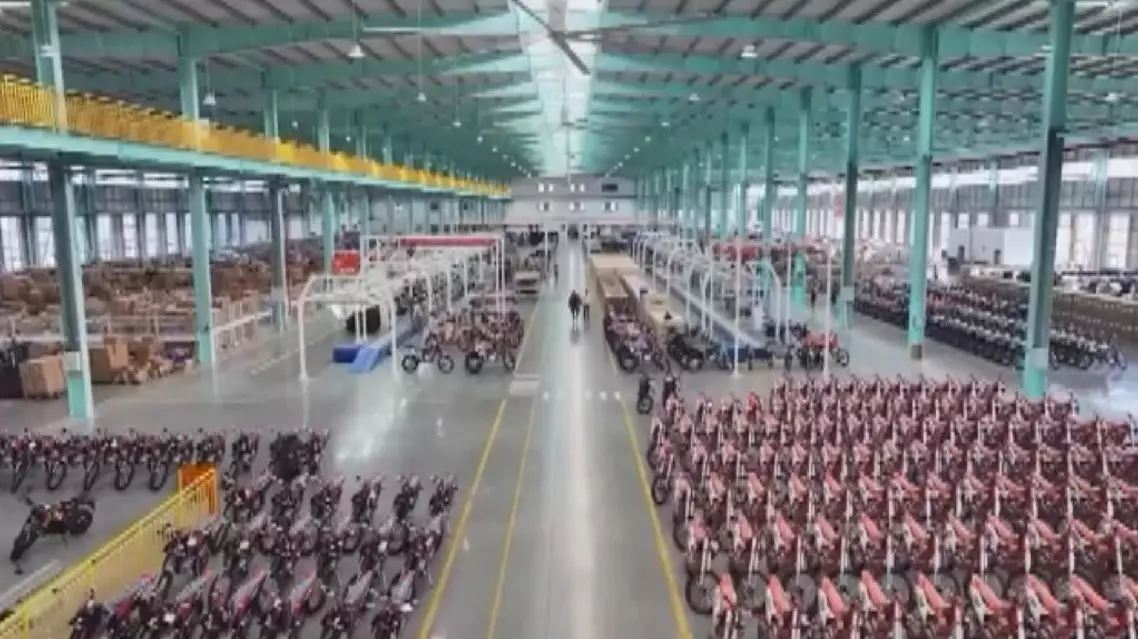
ZXMOTO's headline-grabbing success has also drawn attention to Chongqing, widely known as China's "motorcycle capital" and home to the company's base. The dense industrial network in the southwestern Chinese city, which boasts over 50 vehicle manufacturers and more than 400 component suppliers, enables rapid prototyping and mass production.
As Chongqing, along with other regions in China, rolls out incentive policies to build competitive industrial ecosystems through a high-quality business environment, a strong talent pool and targeted tax and administrative fee cuts, the burden on enterprises is being reduced, paving the way for greater innovation.
In Chongqing, a complete industrial ecosystem means motorbike companies can source every part, from engines to screws, within the local market, significantly cutting costs and saving time.
"Leveraging the strong capacity of the motorcycle industry in Chongqing, we keep promoting efficient coordination between motorcycle assembly enterprises, component suppliers, and research institutions, strengthening technological innovation in the directions of high-end development, electrification, and intelligentization. In 2025, the city's motorcycle output reached 7.857 million units, ranking the first among all cities nationwide," said Luo Tengfei, deputy director of the Automotive Industry Division of the Chongqing Municipal Commission of Economy and Information Technology.
XMOTO also exemplifies a typical case that has benefited from cross-regional cooperation amid China's push for building a unified national market. Beyond Chongqing, ZXMOTO's partner companies and research institutions are scattered across the country as the company leverages the strengths of high-level R&D and precision manufacturing clusters in the Pearl River Delta in south China, the Yangtze River Delta in east China, and the Beijing-Tianjin-Hebei region in north China.
After the news of the championship win went viral across the internet, Zhang's flagship product received widespread attention, and order volume saw a significant increase.
"Frankly speaking, orders have increased since the championship win. Previously, the sales volume was 300 units per day. Now it's been about half a month since the competition ended. During these two weeks, the daily sales volume has been growing by about three times," he said.
China's motorcycle industry poised for greater innovation, growth following WSBK wins