PARSIPPANY, N.J.--(BUSINESS WIRE)--Apr 13, 2026--
AdvanSix (NYSE: ASIX), an integrated chemistry company serving diverse end markets, today announced the appointment of Patrick C. Day as its Senior Vice President and Chief Financial Officer, effective April 27, 2026. Pat will report directly to Erin Kane, President and Chief Executive Officer of AdvanSix, and will be a member of the Company’s executive leadership team.
This press release features multimedia. View the full release here: https://www.businesswire.com/news/home/20260412681416/en/
“Pat is a proven finance leader with the experience needed to help guide AdvanSix through our next stage of growth and opportunity,” said Erin Kane, President and Chief Executive Officer of AdvanSix. “Pat’s appointment reflects our commitment to building strong leadership and financial capabilities to drive long-term value creation for our shareholders. He brings the right balance of operational and financial discipline, strategic insight and collaborative leadership to navigate the opportunities ahead.”
Day’s extensive experience includes enabling enterprise strategic growth, financial operational discipline and value creation in publicly traded, global industrial and chemical companies. He most recently served as Vice President of Financial Planning and Analysis and Investor Relations at FMC Corporation, where he led enterprise‑wide FP&A, strategic planning, forecasting, earnings analysis and investor communications. His background also includes senior global finance leadership roles at FMC, with earlier experience in Deloitte Consulting’s Finance Transformation practice and various finance roles with United Technologies Corporation. Pat holds a bachelor’s degree in finance from Elizabethtown College and a master’s degree in accounting and tax from the University of Connecticut.
“I am excited to join AdvanSix at a time when the company has a clear strategy and roadmap, strong momentum and a compelling opportunity ahead,” said Pat Day. “What drew me to AdvanSix is the combination of its portfolio of essential chemistries that power everyday life, a safety-focused culture intent on delivering impact and a leadership team with a clear emphasis on long-term value creation. AdvanSix is well positioned for the future, and I am excited to partner with the team to support disciplined performance and drive long-term growth.”
Day replaces Christopher Gramm, who has been serving as Interim Chief Financial Officer during the Company’s search for a permanent Chief Financial Officer. Chris will continue to serve as Vice President of Corporate Finance and Strategic Financial Planning & Analysis for AdvanSix.
About AdvanSix
AdvanSix is an integrated chemistry company that produces essential materials for our customers across diverse end markets. Our value chain of our five U.S.-based manufacturing facilities plays a critical role in global supply chains and enables us to innovate and deliver essential products for our customers across building and construction, fertilizers, agrochemicals, plastics, solvents, packaging, paints, coatings, adhesives, electronics and other end markets. Guided by our core values of Safety, Integrity, Accountability and Respect, AdvanSix strives to deliver best-in-class customer experiences and differentiated products in the industries of nylon solutions, plant nutrients, and chemical intermediates. More information on AdvanSix can be found at http://www.advansix.com.
Forward Looking Statements
This release contains certain statements that may be deemed “forward-looking statements” within the meaning of Section 21E of the Securities Exchange Act of 1934, as amended. All statements, other than statements of historical fact, that address activities, events or developments that our management intends, expects, projects, believes or anticipates will or may occur in the future are forward-looking statements. Forward-looking statements may be identified by words such as "expect," "anticipate," "estimate," “outlook,” "project," "strategy," "intend," "plan," "target," "goal," "may," "will," "should" and "believe" and other variations or similar terminology and expressions. Although we believe forward-looking statements are based upon reasonable assumptions, such statements involve known and unknown risks, uncertainties and other factors, many of which are beyond our control and difficult to predict, which may cause the actual results or performance of the Company to be materially different from any future results or performance expressed or implied by such forward-looking statements. Such risks and uncertainties include, but are not limited to: general economic and financial conditions in the U.S. and globally; the potential effects of inflationary pressures, tariffs or the imposition of new tariffs, trade wars, barriers or restrictions, or threats of such actions, changes in interest rates, labor market shortages and supply chain issues; instability or volatility in financial markets or other unfavorable economic or business conditions caused by geopolitical concerns, including as a result of new or proposed legislation or regulatory, trade or other policies in or impacting the U.S., the conflict between Russia and Ukraine, the conflicts in Israel, Gaza and Iran, and related uncertainty in the surrounding region, and the possible expansion of such conflicts; the effect of any of the foregoing on our customers’ demand for our products and our suppliers’ ability to manufacture and deliver our raw materials, including implications of reduced refinery utilization in the U.S.; our ability to sell and provide our goods and services; the ability of our customers to pay for our products; any closures of our and our customers’ offices and facilities; risks associated with increased phishing, compromised business emails and other cybersecurity attacks, data privacy incidents and disruptions to our technology infrastructure; risks associated with potential use of artificial intelligence in our operations or those of third party service providers; risks associated with operating with a reduced workforce; risks associated with our indebtedness including compliance with financial and restrictive covenants, and our ability to access capital on reasonable terms, at a reasonable cost, or at all, due to economic conditions or otherwise; the impact of scheduled turnarounds and significant unplanned downtime and interruptions of production or logistics operations as a result of mechanical issues or other unanticipated events such as fires, severe weather conditions, natural disasters, pandemics, geopolitical conflicts and related events; price fluctuations, cost increases and supply of raw materials; our operations and growth projects requiring substantial capital; growth rates and cyclicality of the industries we serve including global changes in supply and demand; failure to develop and commercialize new products or technologies; loss of significant customer relationships; adverse trade and tax policies; extensive environmental, health and safety laws that apply to our operations; hazards associated with chemical manufacturing, storage and transportation; litigation associated with chemical manufacturing and our business operations generally; inability to acquire and integrate businesses, assets, products or technologies; protection of our intellectual property and proprietary information; prolonged work stoppages as a result of labor difficulties or otherwise; failure to maintain effective internal controls; our ability to declare and pay quarterly cash dividends and the amounts and timing of any future dividends; our ability to repurchase our common stock and the amount and timing of any future repurchases; disruptions in supply chain, transportation and logistics; potential for uncertainty regarding qualification for tax treatment of our spin-off; fluctuations in our stock price; and changes in laws or regulations applicable to our business. You are cautioned not to place undue reliance on these forward-looking statements, which speak only as of the date of this release. Such forward-looking statements are not guarantees of future performance, and actual results, developments and business decisions may differ materially from those contemplated by such forward-looking statements as a result of a number of risks, uncertainties and other factors including those noted above and those identified in our filings with the Securities and Exchange Commission (SEC), including the risk factors in Part 1, Item 1A of our Annual Report on Form 10-K for the year ended December 31, 2025, as updated in subsequent reports filed with the SEC. All subsequent written or oral forward-looking statements attributable to us or persons acting on our behalf are qualified in their entirety by this paragraph. We do not undertake to update or revise any of our forward-looking statements.
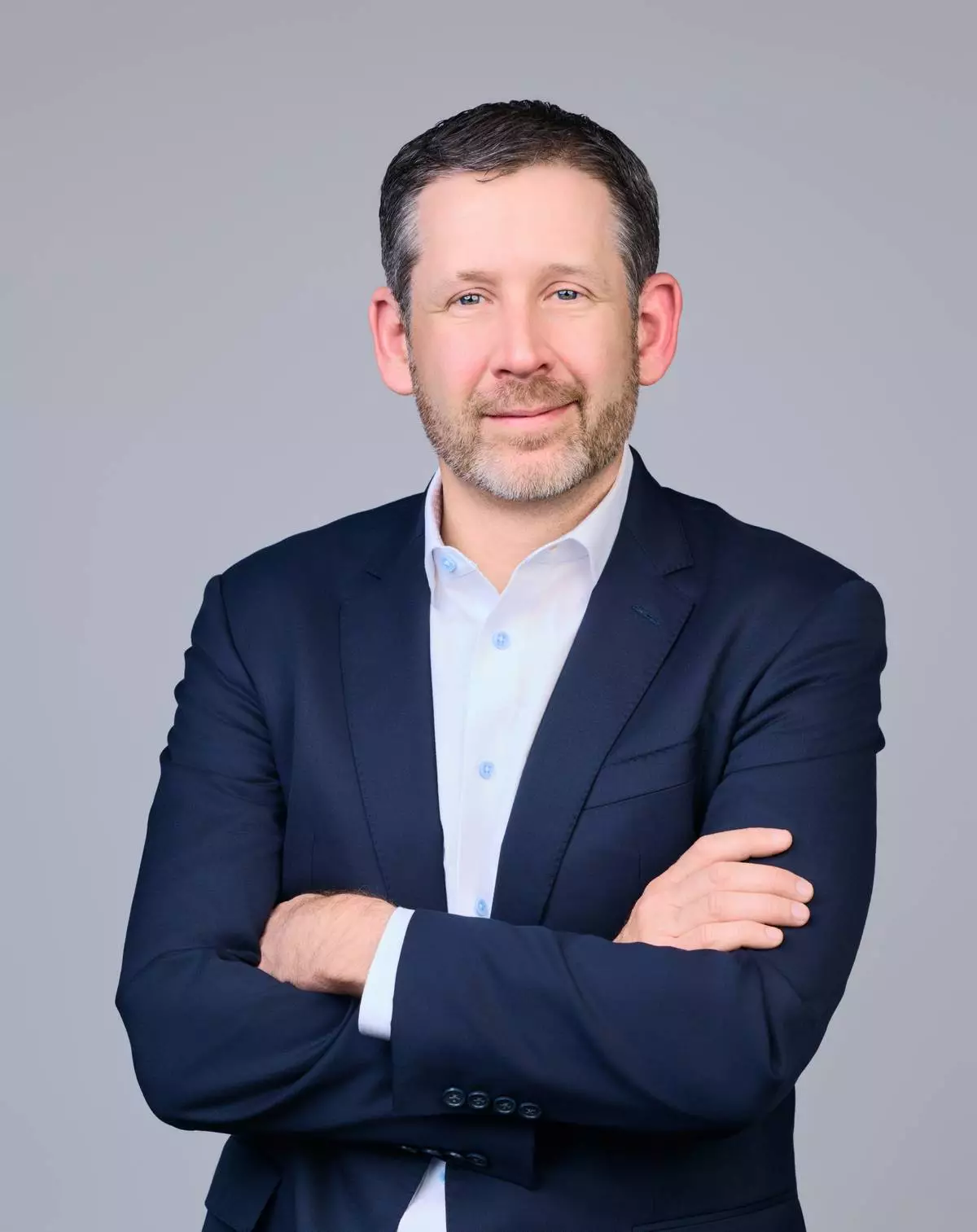
Patrick C. Day, Senior Vice President and Chief Financial Officer
The Pope pushed back Monday on President Donald Trump’s criticism of him over the U.S.-Israel war in Iran, telling reporters that the Vatican’s appeals for peace and reconciliation are rooted in the Gospel, and that he doesn’t fear the Trump administration.
Leo XIV's comments came as traffic through the Strait of Hormuz appeared to have come to a halt, an intelligence firm said, and oil prices resumed their climb after Trump announced on social media that the United States would blockade the waterway.
U.S. Central Command later said the blockade would involve all vessels entering or departing Iranian ports and coastal areas, and that it would still allow ships traveling between non-Iranian ports to transit the strait, a step down from the president’s earlier threat to blockade the entire strait.
Trump confirmed the timing and some details of the CENTCOM statement in a post on his social media site early Monday.
Iran’s Revolutionary Guard said the strait remained under Iran’s “full control” and was open for non-military vessels, but military ones would get a “forceful response,” two semiofficial Iranian news agencies reported.
The moves came after marathon U.S.-Iran ceasefire talks in Pakistan ended without an agreement, setting the stage for a showdown. Iranian parliament speaker, Mohammad Bagher Qalibaf, who led Iran’s side in the talks, addressed Trump in a statement on his return to Iran: “If you fight, we will fight.”
The war, which is entering its seventh week, has killed thousands of people and shaken global markets.
Here is the latest:
The coming days could be a stress test for the Strait of Hormuz and for the rules that are supposed to govern it, according to Sal Mercogliano, a maritime historian at Campbell University.
It remains unclear, he added, how the U.S. would track, intercept and board vessels moving from Iranian ports through the strait.
Any U.S. or Iranian attempt to choke off the waterway would run counter to the principle of freedom of navigation, said Mercogliano, who has testified before the U.S. Senate on commercial shipping and written for the U.S. Naval Institute.
“We are challenging the concept of freedom of the seas,” Mercogliano said on his “What’s Going on With Shipping?” podcast, which has more than 600,000 followers on YouTube.
Russia said Monday that a U.S. blockade of the Strait of Hormuz will likely hurt global markets.
Asked to comment on the U.S. announcement of a blockade on Iran’s ports and coastline, Kremlin spokesman Dmitry Peskov said: “Most likely, such actions will continue to negatively impact international markets, this can be assumed with a high degree of certainty.”
Peskov told reporters: “Many details remain unclear and incomprehensible, so I would refrain from making any substantive comments at this time.”
Iran’s Foreign Minister Abbas Araghchi has spoken by phone with his Saudi counterpart, Prince Faisal bin Farhan, Iranian semiofficial media reported.
The ministers discussed the talks between the U.S. and Iran in Pakistan which failed to achieve a deal, Mehr News agency said, without elaborating further.
An Israeli airstrike killed at least three Palestinians in central Gaza Strip early Monday, hospital authorities said.
The strike hit a Hamas-manned security point just after midnight in the eastern part of Deir al-Balah city, in central Gaza, according to the Al-Aqsa Martyrs Hospital which received the dead men. One Palestinian was also wounded in the strike.
The military did not immediately respond to a request for comment.
The deaths were the latest among Palestinians in the coastal enclave since an October fragile ceasefire deal attempted to halt a more than two-year war between Israel and Hamas in Gaza. While the heaviest fighting has subsided, the shaky ceasefire has seen almost daily Israeli fire.
Turkish Foreign Minister Hakan Fidan has said the U.S.-Iran ceasefire could be extended for 45 to 60 days to allow the negotiations to continue.
Fidan, whose country has supported mediations efforts, said the U.S. and Iranian delegations presented initial “maximalist” positions during the talks in Pakistan, adding that Iran is expected to review U.S. proposals and respond.
“If the parties make good progress, an additional ceasefire could be introduced — lasting 45 to 60 days — so that negotiations can continue,” he said in an interview with state-run Anadolu Agency. He cautioned however, that Israel remains “a factor” that could disrupt the negotiations. The nuclear issue could also become a sticking point, he said.
“If the nuclear matter turns into an all‑or‑nothing situation, especially regarding enrichment, we could face a serious obstacle,” Fidan said. “But hopefully, with the support of mediators and other countries, we will try to overcome this as well.”
A labor union said Monday that thousands of crew members stuck on vessels in and around the Strait of Hormuz are running short on basics and growing increasingly desperate.
Milind Kandalgaonkar, general secretary of the National Union of Seafarers of India, said that nearly 20,000 Indian crew members were stranded in the region.
“Many of these seafarers are reportedly facing acute shortages of food, potable water, and essential medical supplies,” he wrote in a letter to India’s national shipping board. He urged authorities to ensure supplies can reach the vessels, protect seafarers’ welfare and prepare evacuation plans if needed.
Tanker owners say the ceasefire has done little to ease conditions for mariners in the strait, where crews report dwindling food and fresh water.
Israel’s military said Monday said its troops have surrounded what they say is Hezbollah military infrastructure and have started ground operations
in the strategic southern Lebanese town of Bint Jbeil and its surrounding areas, killing over 100 Hezbollah fighters.
Hezbollah did not immediately publicly announce anyone killed among their ranks, and Israel did not immediately acknowledge any fatalities among their forces. Hezbollah has not commented on the developments.
On Sunday Hezbollah claimed at least five attacks on Israeli troops in the town and its outskirts with rockets, artillery, and exploding drones. According to the group’s statements, the Israeli troops were positioned near a school, a hospital, and juncture that surrounds the heart of Bint Jbeil. The Israeli military said it attacked Hezbollah forces.
The town overlooks the UN-mandated Blue Line that divides Israel and Lebanon, just over 2 miles away, making it a strategic point for the Iran-backed group.
German Chancellor Friedrich Merz has criticized the peace talks between the U.S. and Iran in Pakistan last week as not well prepared.
“I was not surprised by the decision to break off the talks in Islamabad,” he told reporters in Berlin on Monday.
“From the very beginning, I didn’t get the impression that they were really well prepared,” the chancellor said without further elaborating who exactly he was referring to with this criticism.
The U.S. blockade of Iranian ports could prompt the Iranian-backed Houthi rebels in Yemen to disrupt transit through Bab el-Mandeb Strait, an analyst has warned.
“If the U.S. moves to impose a blockade on Iranian ports and Iran starts feeling the pain, the Houthis are very likely to escalate in the Bab el-Mandeb,” said Ahmed Nagi, a senior analyst for Yemen at the International Crisis Group think-tank.
The closure of Bab el-Mandeb would add “another layer” of pressure on the global shipping industry, he said.
The offices of the Lebanese Red Cross in Tyre were hit by a drone strike on Monday, Lebanon’s state-run National News Agency reported.
The strike in the southern coastal city killed a wounded person being transported and damaged Red Cross vehicles. The Israeli military did not immediately reply to inquires from The Associated Press.
The funeral was being held on Monday for a Lebanese Red Cross volunteer killed on Sunday in an Israeli strike that hit his team while on a mission in Beit Yahoun.
The Lebanese Red Cross operates in war-torn southern Lebanon in coordination with the U.N. peacekeeping mission in Lebanon, UNIFIL, and the Lebanese military.
Japan’s Prime Minister Sanae Takaichi held telephone talks Monday with her Pakistani counterpart, Shehbaz Sharif, during which she expressed support for his mediation efforts for hosting U.S.-Iran talks in Islamabad.
Takaichi said she reiterated Japan’s position that what is most important is to promptly reach a final agreement and to de-escalate the situation through talks to ensure safe passages through the Strait of Hormuz.
Sharif said Pakistan hopes to cooperate with Japan in the effort, Takaichi said.
France and the U.K. will organize a conference with partners ready to contribute to a peaceful multinational mission to help restore navigation in the Strait of Hormuz, President Emmanuel Macron said.
In a post on X, Macron stressed “the need to restore free and unimpeded navigation through the Strait of Hormuz as quickly as possible.” He called for a “peaceful multinational mission,” adding: “This strictly defensive mission, separate from the warring parties to the conflict, is intended to be deployed as soon as circumstances permit.”
France and the U.K. have in recent years been working to set up an operation that would allow ships to cross the Strait of Hormuz once the fighting ends.
The roughly 17-cent (20 U.S. cent) per-liter reduction is intended to help cushion the impact of high energy prices linked to the Iran war.
Chancellor Friedrich Merz said Monday the measure “will very quickly improve the situation for drivers and businesses across the country, and especially for those who spend a great deal of time on the road, primarily for work-related reasons.”
Prime Minister Keir Starmer says Britain will not be part of a U.S. blockade of Iranian ports in response to the closing of the Strait of Hormuz. Starmer told BBC radio on Monday that “we’re not supporting the blockade” and “we’re not getting dragged into the war.”
He said U.K. efforts remain focused on reopening the key shipping route, whose closure has sent prices for oil and other commodities soaring.
Starmer spoke after U.S. President Donald Trump said Britain would send minesweepers to the strait.
Britain says it might help with mine-clearing in the waterway, but only after the fighting stops. Starmer said all Britain’s military capability is focused on getting the strait “fully open.” The U.K. is working with dozens of other countries on plans to restore security to shipping through the key oil route after the conflict.
Japan has expressed support for the U.S.-Iran talks held in Pakistan over the weekend and that it continues to closely watch further development in hopes of an early de-escalation.
Chief Cabinet Secretary Minoru Kihara told reporters Monday that his government believes that the most important thing is actually to achieve de-escalation, including ensuring the safe passage through the Strait of Hormuz.
“We hope a final agreement will be reached swiftly through diplomatic efforts,” Kihara said.
Kihara, asked if Japan is considering sending Japanese warships to join minesweeping effort in the key waterway, said nothing has been decided.
Southeast Asian countries urged the United States and Iran Monday to keep going with peace negotiations, enforce a ceasefire and restore the safe passage of ships, seafarers and aircraft in the Strait of Hormuz.
The foreign ministers of the Association of Southeast Asian Nations made the urgent plea as they held an emergency video conference, the second in recent weeks, to assess the impact of the war in the Middle East, including soaring fuel prices, and how they could cooperate in the face of global crises.
The 11-nation bloc reminded “the obligations of all states to resolve their differences through peaceful means, to respect the sovereignty and territorial integrity of all nations, to protect civilians and civilian infrastructure in armed conflicts.”
It called “for the full and effective implementation of the ceasefire, aimed at preventing further suffering and loss of lives, ensuring maritime security and freedom of navigation and overflight.”
Iran threatened ports in the Persian Gulf and the Gulf of Oman after the U.S. announced a blockade on Iran’s ports and coastline.
“Security in the Persian Gulf and the Sea of Oman is either for everyone or for NO ONE,” according to the Islamic Republic of Iran Broadcasting, IRIB. “NO PORT in the region will be safe,” the Iranian military said.
Oil prices started climbing and Asian markets mostly declined Monday as the U.S. military prepared to blockade ships bound for or coming from Iranian ports and transiting the Strait of Hormuz.
On Monday, benchmark U.S. crude jumped $6.71 or nearly 7% to $103.28 a barrel. Brent crude, the international standard, rose $6.20, or 6.5%, to $101.40 a barrel.
Oil prices have been rising as shipping through the strait has essentially stalled since late February. Brent crude oil, the international standard, has gone from roughly $70 per barrel before the war in late February to more than $119 at times.
Japan’s benchmark Nikkei 225 lost 0.7% to finish at 56,502.77. Australia’s S&P/ASX 200 shed 0.4% to 8,926.00. South Korea’s Kospi dipped 0.9% to 5,808.62. Hong Kong’s Hang Seng slipped 1.1% to 25,613.85, while the Shanghai Composite was little changed, inching up less than 0.1% to 3,988.56.
Iraq’s oil exports plunged in March to 18.6 million barrels, down from 99.87 million in February due to the closure of the Strait of Hormuz, according to official figures released Monday.
The state-run Organization for Marketing of Oil said revenues also have fallen to just $1.95 billion, down from over $6.81 billion.
The figures showed that exports from the Kurdistan Region through Turkey’s Ceyhan port also dropped to 1.27 million barrels, down from 5.55 million barrels in February.
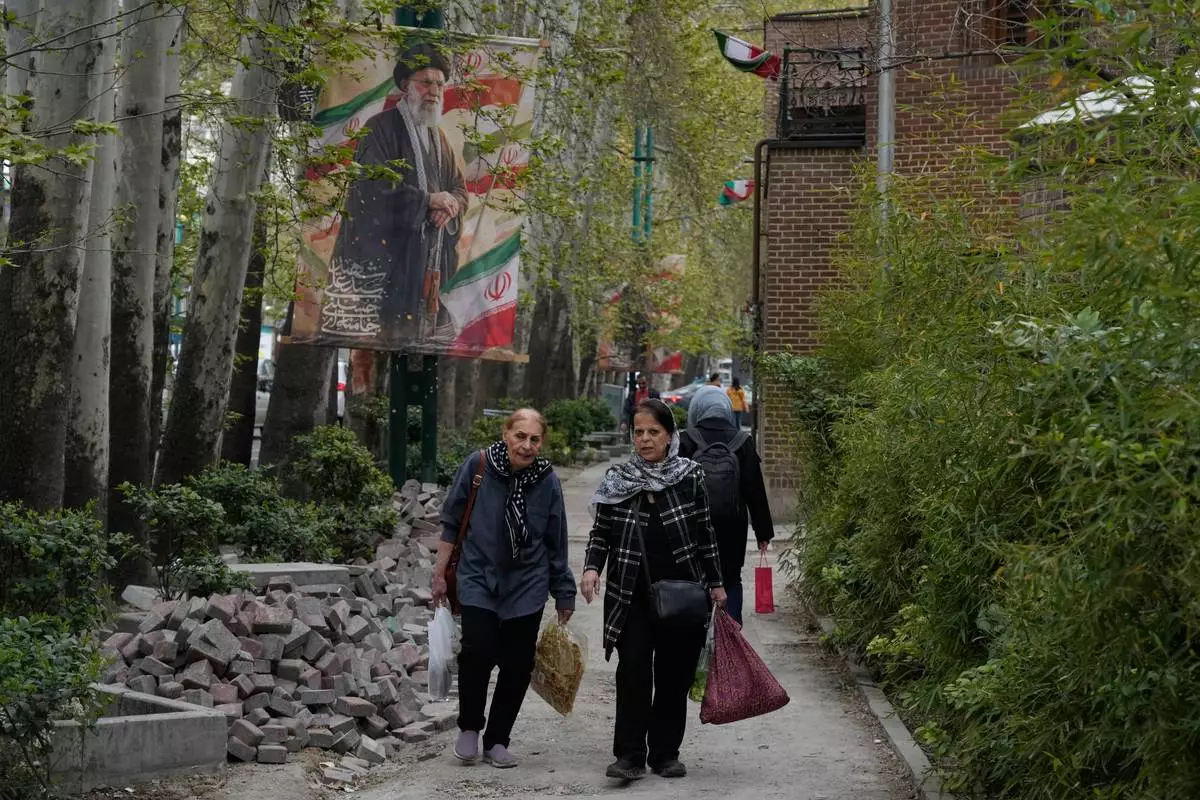
Women walk past a banner depicting the late Iranian Supreme Leader Ayatollah Ali Khamenei, who was killed in the U.S. and Israel strikes on Feb. 28, in northern Tehran, Iran, Sunday, April 12, 2026. (AP Photo/Vahid Salemi)
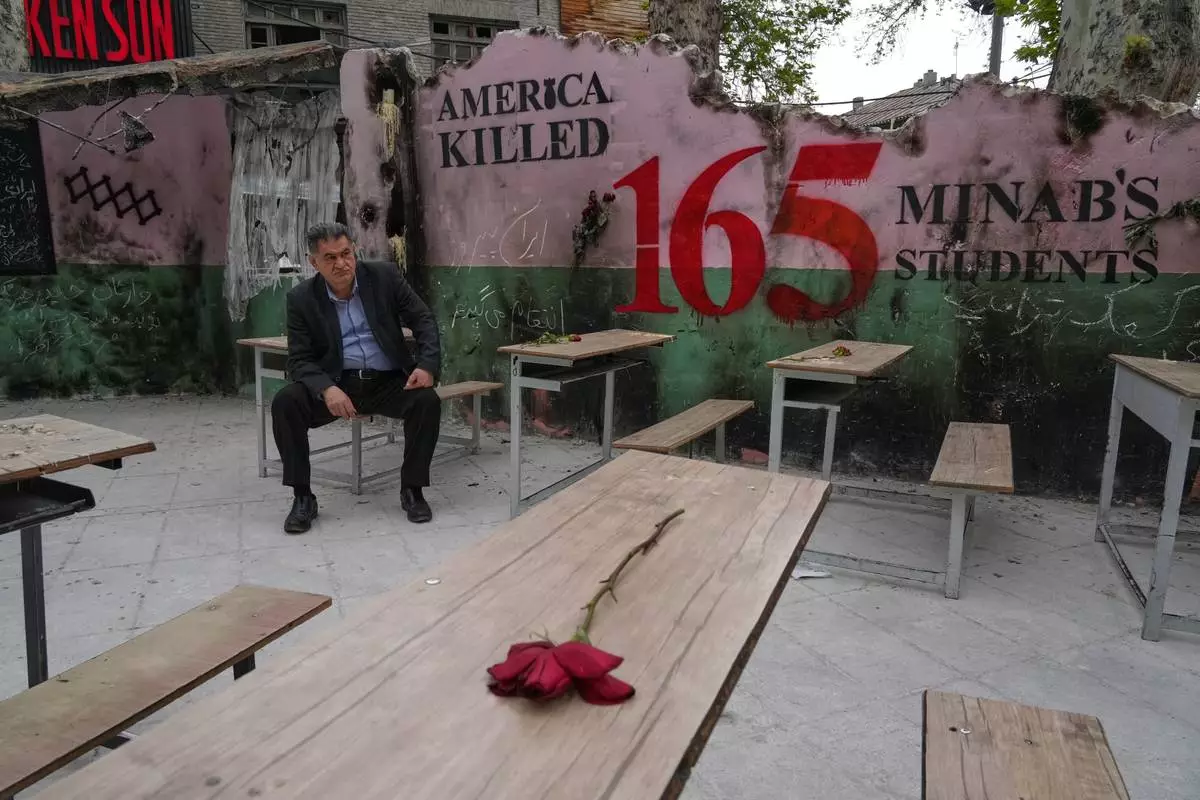
A man sits on a bench in a memorial, set for the school children who were killed during a strike on a school in southern town of Minab on Feb. 28, in northern Tehran, Iran, Sunday, April 12, 2026. (AP Photo/Vahid Salemi)
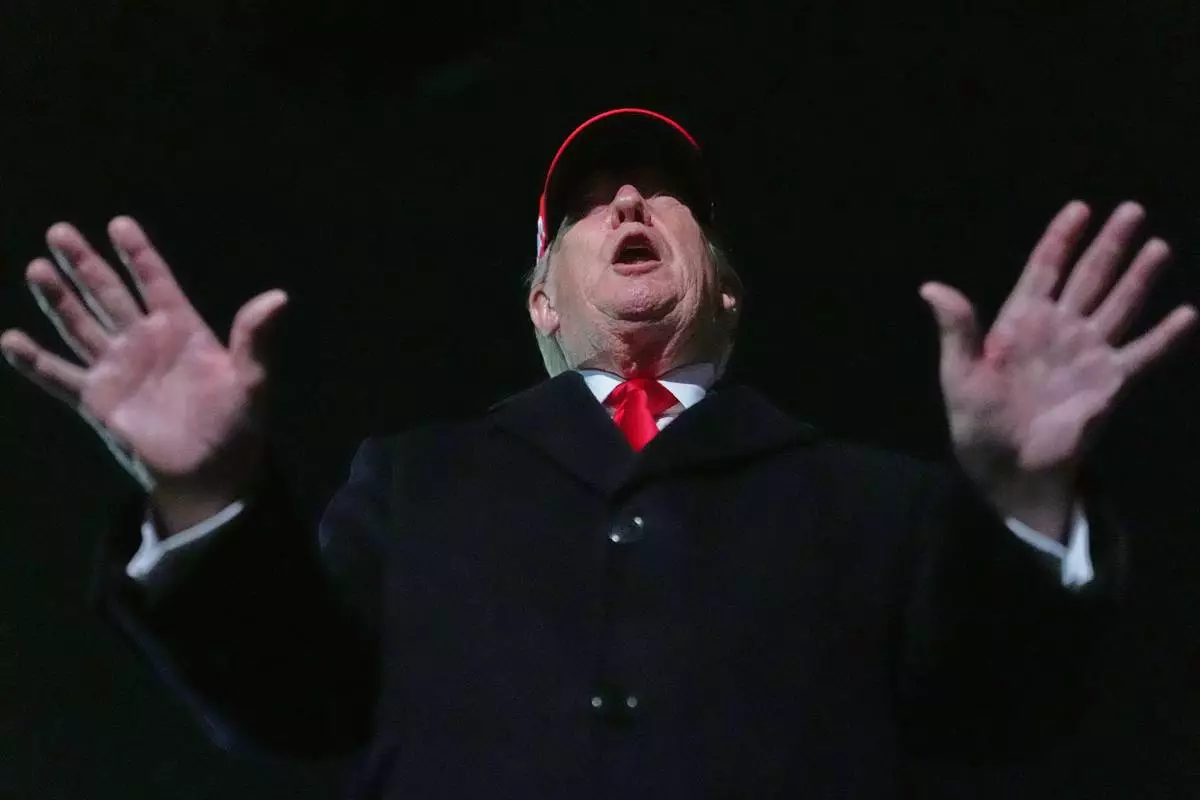
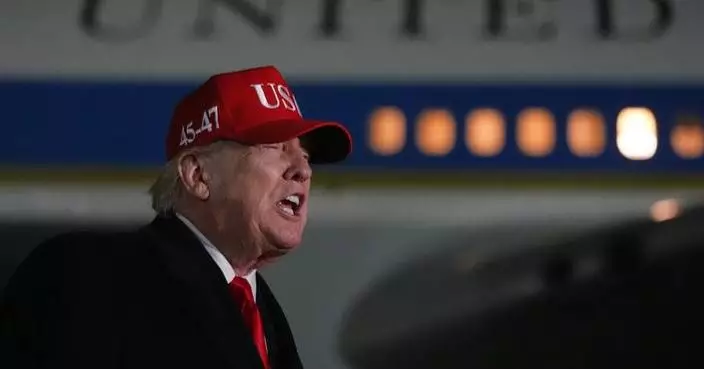
President Donald Trump speaks with reporters at Joint Base Andrews, Md., Sunday, April 12, 2026, after he returned from Miami. (AP Photo/Julia Demaree Nikhinson)

Mourners react during the funeral of 13 state security officers killed the previous day in an Israeli strike in Lebanon's coastal city of Sidon, Saturday, April 11, 2026. (AP Photo/Emilio Morenatti)