Skip to Content Facebook Feature Image

Mount Holyoke’s corpse flower blooms again, drawing crowds to its ‘rotting flesh’ stench

News

Mount Holyoke’s corpse flower blooms again, drawing crowds to its ‘rotting flesh’ stench
News

News

Mount Holyoke’s corpse flower blooms again, drawing crowds to its ‘rotting flesh’ stench

2026-04-16 03:03 Last Updated At:03:10

SOUTH HADLEY, Mass. (AP) — One person entered the lush, green Victorian-era greenhouse and smelled rotting eggs. Another said the odor evoked the memory of dissecting a dead bird. A third compared it to a stinky diaper baking in the sun.

“I was expecting it to smell bad, but it smelled genuinely like rotting flesh,” said Nyx DelPrado, a first-year student at Mount Holyoke College who visited its Talcott Greenhouse this week to see the blooming of a corpse flower. “Its name is accurate,” DelPrado added with a laugh, nose wrinkled, adding that it reminded them of the scent of a dissection.

More Images
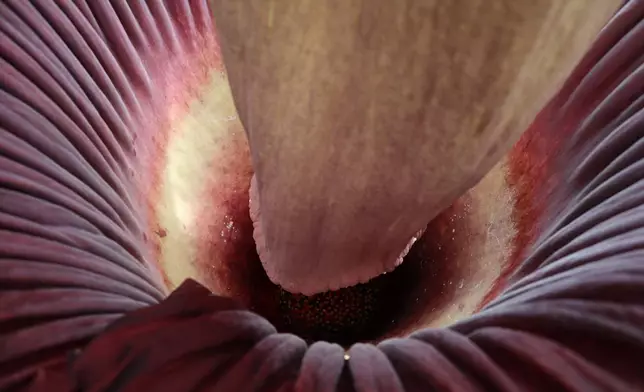
/// A close-up view shows the interior of the blooming corpse flower, or Amorphophallus titanum, known as "Pangy," at the Talcott Greenhouse on the campus of Mount Holyoke College in South Hadley, Mass., Tuesday, April 14, 2026. (AP Photo/Leah Willingham)
/// A close-up view shows the interior of the blooming corpse flower, or Amorphophallus titanum, known as "Pangy," at the Talcott Greenhouse on the campus of Mount Holyoke College in South Hadley, Mass., Tuesday, April 14, 2026. (AP Photo/Leah Willingham)

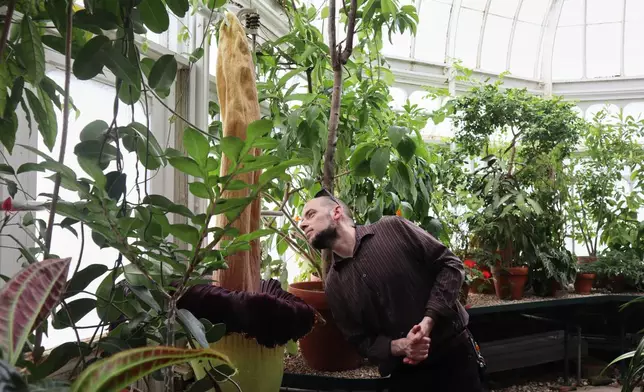
Michael Breton takes a closer look at the blooming corpse flower known as, "Pangy," at the Talcott Greenhouse on the campus in South Hadley, Mass., Tuesday, April 14, 2026. (AP Photo/Leah Willingham)
Michael Breton takes a closer look at the blooming corpse flower known as, "Pangy," at the Talcott Greenhouse on the campus in South Hadley, Mass., Tuesday, April 14, 2026. (AP Photo/Leah Willingham)

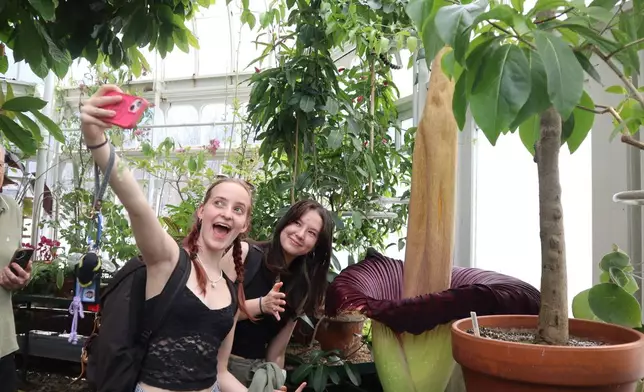
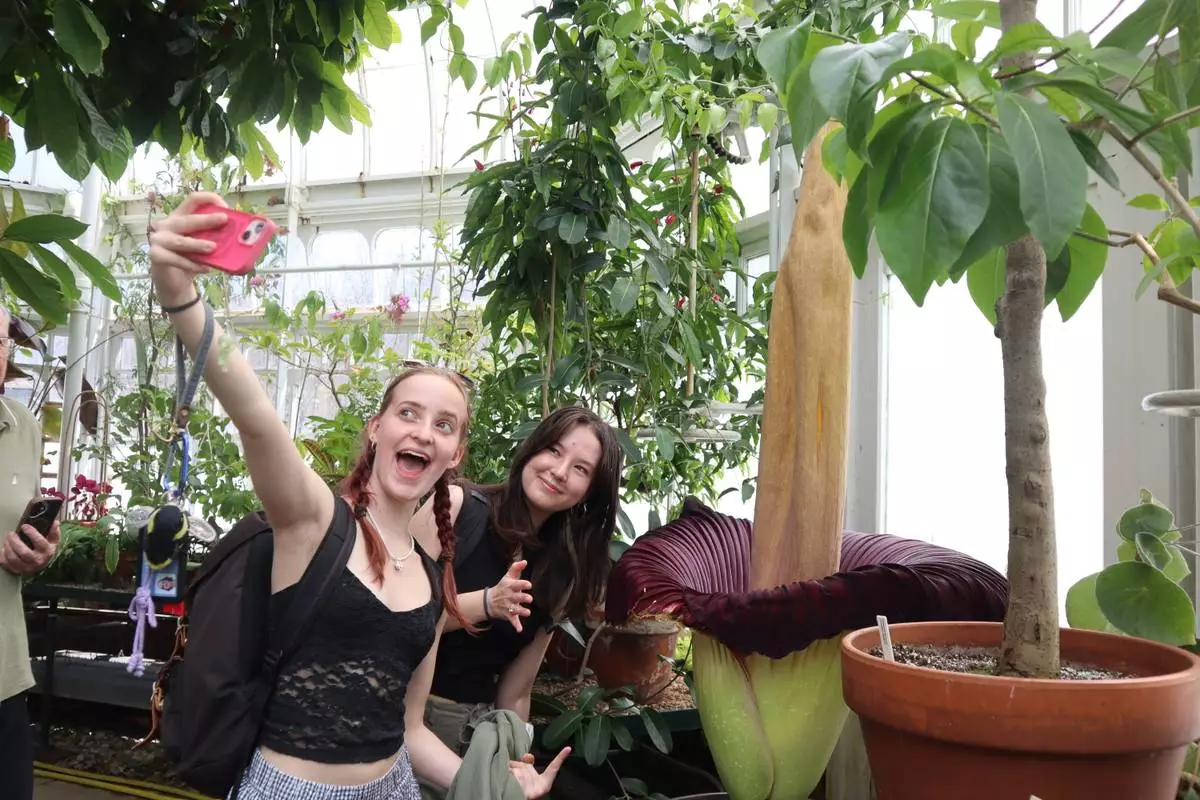
Students take a selfie with the blooming corpse flower known as "Pangy" at the Talcott Greenhouse on the campus of Mount Holyoke College in South Hadley, Mass., Tuesday, April 14, 2026. (AP Photo/Leah Willingham)
Students take a selfie with the blooming corpse flower known as "Pangy" at the Talcott Greenhouse on the campus of Mount Holyoke College in South Hadley, Mass., Tuesday, April 14, 2026. (AP Photo/Leah Willingham)

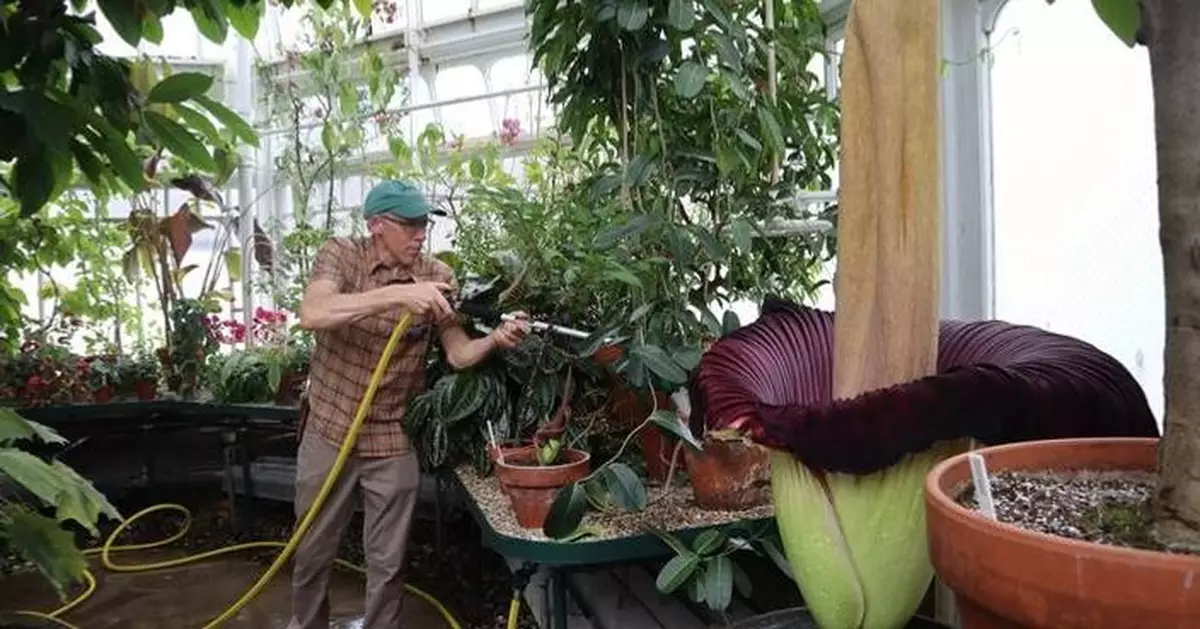
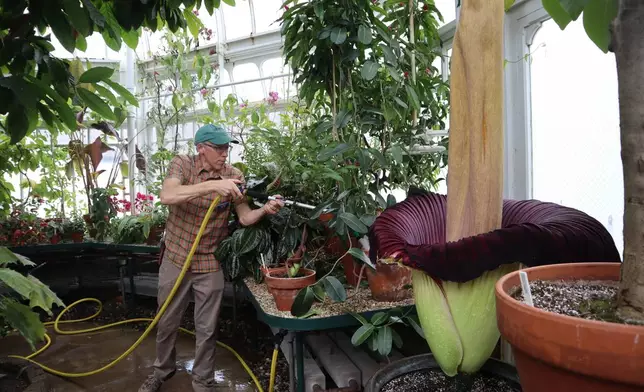
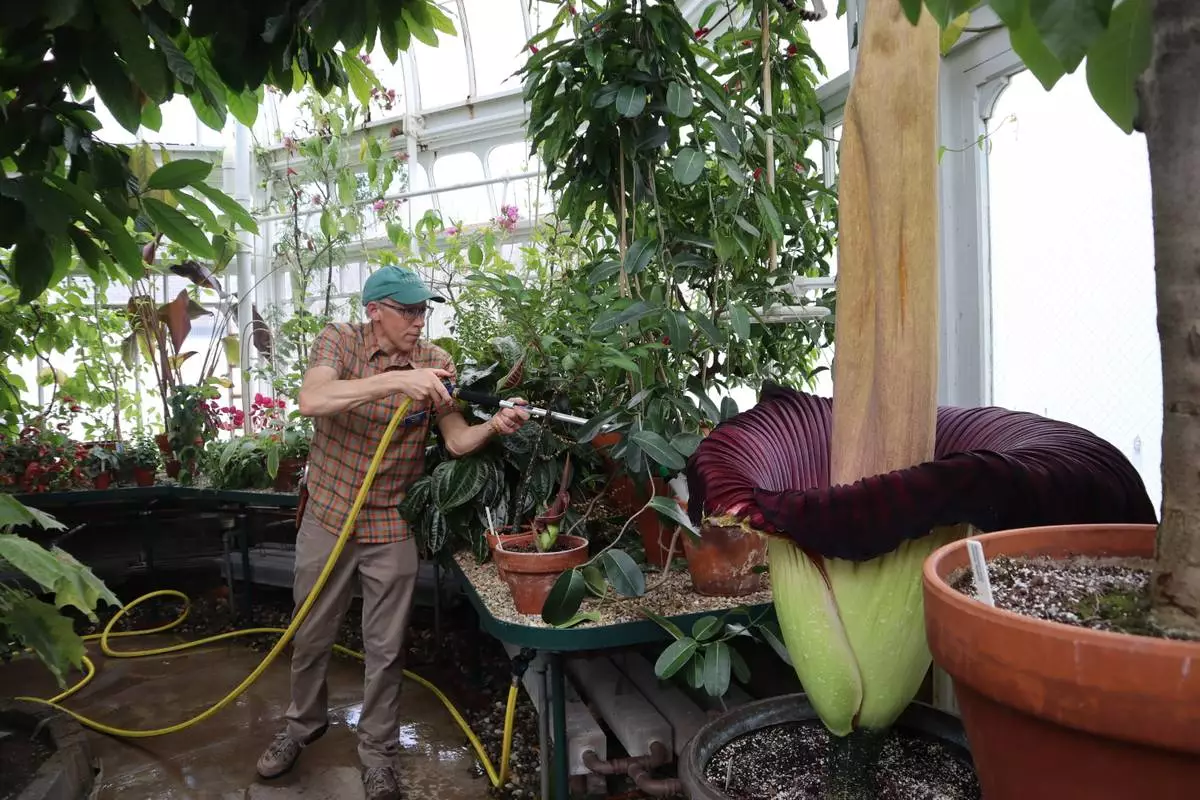
Tom Clark, greenhouse director and curator of Mount Holyoke College's botanic garden, waters plants nearby the blooming corpse flower known as "Pangy" at the Talcott Greenhouse on the campus in South Hadley, Mass., Tuesday, April 14, 2026. (AP Photo/Leah Willingham)
Tom Clark, greenhouse director and curator of Mount Holyoke College's botanic garden, waters plants nearby the blooming corpse flower known as "Pangy" at the Talcott Greenhouse on the campus in South Hadley, Mass., Tuesday, April 14, 2026. (AP Photo/Leah Willingham)

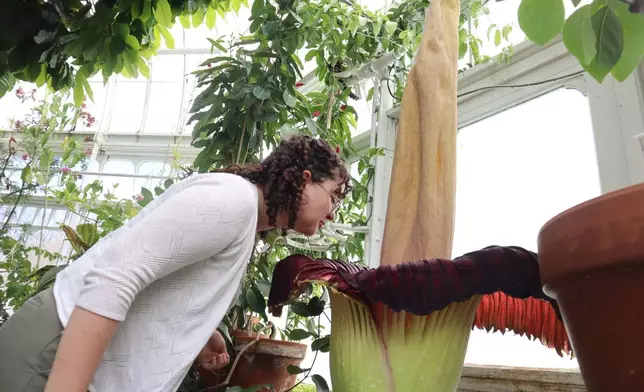
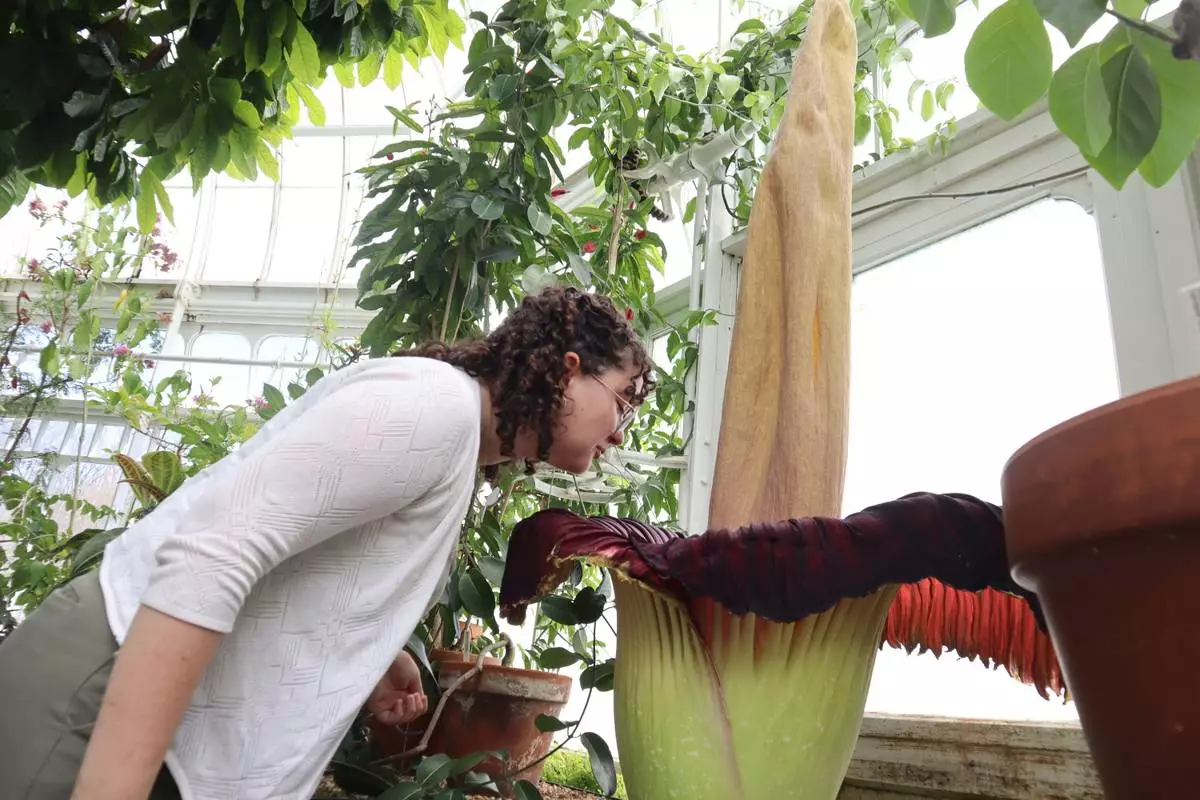
Caroline Murray, a senior at Mount Holyoke College, leans in to smell the blooming corpse flower known as "Pangy" at the Talcott Greenhouse on the campus in South Hadley, Mass., Tuesday, April 14, 2026. (AP Photo/Leah Willingham)

Caroline Murray, a senior at Mount Holyoke College, leans in to smell the blooming corpse flower known as "Pangy" at the Talcott Greenhouse on the campus in South Hadley, Mass., Tuesday, April 14, 2026. (AP Photo/Leah Willingham)

The corpse flower, or Amorphophallus titanum, is a rare tropical plant known for its foul odor. It's native to the rainforests of Sumatra and blooms infrequently and for only a brief window, releasing a pungent scent meant to mimic decaying flesh and attract pollinators such as flies and beetles. Nicknamed “Pangy,” the plant first bloomed at Mount Holyoke College in 2023, and its latest appearance has once again drawn crowds eager to witness — and smell — the fleeting spectacle.

What appears to be a single bloom is actually an enormous inflorescence, a cluster of many tiny flowers at the base of a tall central column called the spadix and surrounded by a deep purple, velvety spathe. Although the towering inflorescence withers after a few days, the same plant survives underground and can bloom again in future years.

Tom Clark, director and curator of the Mount Holyoke College Botanic Garden, said the plant’s infamous odor serves an important evolutionary purpose and has inspired a wide range of descriptions from visitors.

“A few people who have come in since have described the smell as being unbearable, tangy, like a trash can — it’s overwhelming,” Clark said. “But that odor is there for a purpose. It’s there to attract pollinators, flies in particular.”

The timing of corpse flower blooms is difficult to predict, often following years of dormancy. Over the past six weeks, Pangy grew rapidly, at times shooting up several inches a day before unfurling. The flower finally opened overnight Monday, and he and other staffers were met with its powerful scent as soon as they got to work the next day.

“Walking through the front door, we could smell it,” he said. “As we walked back to the greenhouse where it’s growing, the smell became stronger and stronger. It was just overwhelming — literally unbearable — to be back there with it. If you weren’t aware of this plant and walked into the greenhouse, you’d say, ‘What died in here?’”

“I didn’t know what the name meant. I thought it would smell like a corpse, but I don’t know what a corpse smells like,” said Mount Holyoke student Maheen Siddiqi, laughing after waiting in a growing line of people hoping to take a whiff of the flower. “And I smelled it and it smelled like really bad eggs or sulfur or something.”

Student Bryn Wickere said the smell was less overwhelming than anticipated. Still, Wickere described the towering bloom as “magnificent,” noting its deep color and velvety texture.

“I was actually expecting the smell to fill up the whole room, but it was more when you got up close and personal with her,” Wickere said.

Others found the smell more familiar than shocking.

“I would say it smells kind of like a compost pile, a little bit like a working farm,” said Caroline Murray, a Mount Holyoke senior. “I’m from Vermont, so I’m very used to the smell of the farm and manure.”

The spectacle drew visitors from near and far, including Michael Breton, who drove two hours and took a vacation day to see the bloom after tracking news alerts for years.

“If you see a news article, and it’s from two days ago, it’s gone, so you gotta run quick,” he said. He compared the scent to “a stinky diaper that’s been left out in the sun,” adding that despite the odor, the plant was “bright, beautiful and colorful. It’s a lovely plant.”

Clark said the bloom highlights the broader mission of the Talcott Greenhouse, which he called a “plant museum” that houses about 2,000 plant species — a small fraction of the estimated 350,000 to 400,000 plant species worldwide.

He called the event a “special opportunity" to impress upon visitors the diversity of the plant world, and some of the amazing adaptations species have to survive in their environment in unique ways.

By midday Tuesday, the odor had begun to dissipate as greenhouse vents were opened, offering visitors a less intense — though still memorable — experience. After the brief flowering period, the plant will gradually deteriorate and collapse. Because corpse flowers cannot pollinate themselves, seeds will only form if pollen from another titan arum is available.

For Namuuna Negi, a Mount Holyoke junior, the fleeting nature of the bloom added to the experience.

“The impermanence of it, I think. People like to be in on what’s happening,” Negi said. “If they hear something’s going to die soon, they want to go see it before that happens so they can talk about it later.”

/// A close-up view shows the interior of the blooming corpse flower, or Amorphophallus titanum, known as "Pangy," at the Talcott Greenhouse on the campus of Mount Holyoke College in South Hadley, Mass., Tuesday, April 14, 2026. (AP Photo/Leah Willingham)
/// A close-up view shows the interior of the blooming corpse flower, or Amorphophallus titanum, known as "Pangy," at the Talcott Greenhouse on the campus of Mount Holyoke College in South Hadley, Mass., Tuesday, April 14, 2026. (AP Photo/Leah Willingham)

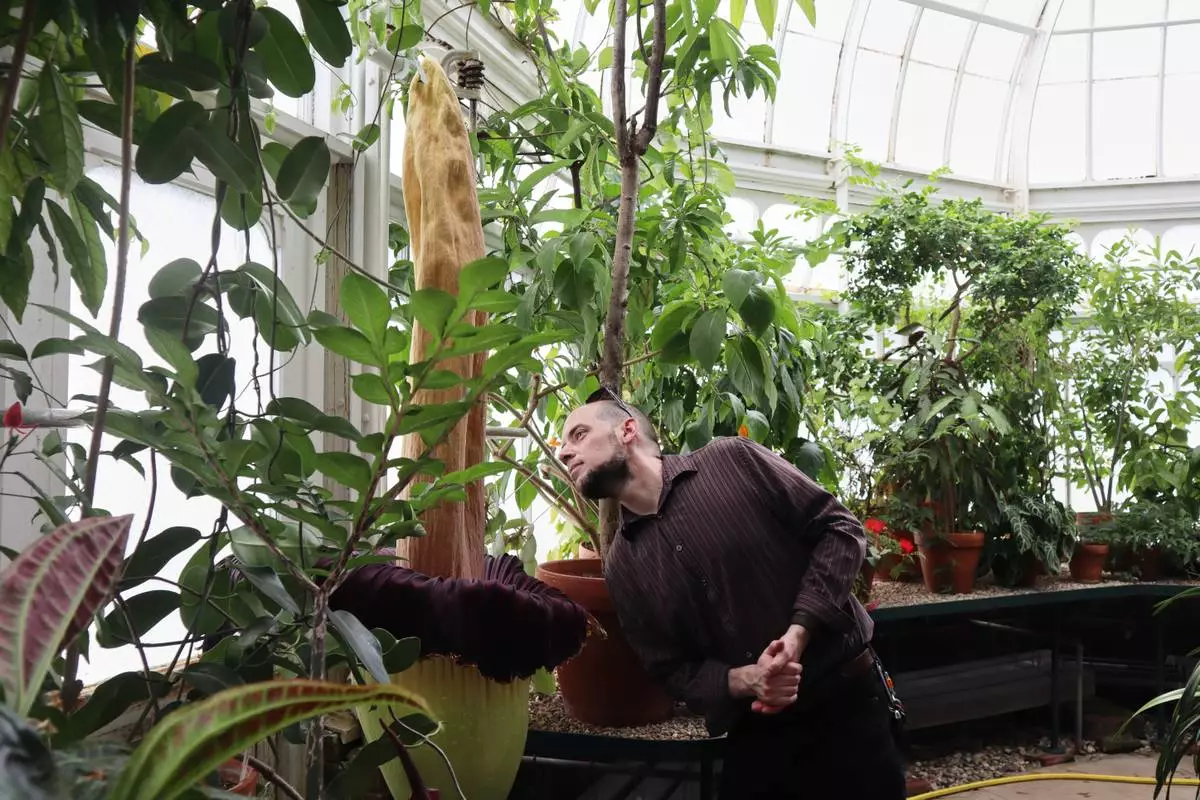
Michael Breton takes a closer look at the blooming corpse flower known as, "Pangy," at the Talcott Greenhouse on the campus in South Hadley, Mass., Tuesday, April 14, 2026. (AP Photo/Leah Willingham)
Michael Breton takes a closer look at the blooming corpse flower known as, "Pangy," at the Talcott Greenhouse on the campus in South Hadley, Mass., Tuesday, April 14, 2026. (AP Photo/Leah Willingham)

Students take a selfie with the blooming corpse flower known as "Pangy" at the Talcott Greenhouse on the campus of Mount Holyoke College in South Hadley, Mass., Tuesday, April 14, 2026. (AP Photo/Leah Willingham)
Students take a selfie with the blooming corpse flower known as "Pangy" at the Talcott Greenhouse on the campus of Mount Holyoke College in South Hadley, Mass., Tuesday, April 14, 2026. (AP Photo/Leah Willingham)

Tom Clark, greenhouse director and curator of Mount Holyoke College's botanic garden, waters plants nearby the blooming corpse flower known as "Pangy" at the Talcott Greenhouse on the campus in South Hadley, Mass., Tuesday, April 14, 2026. (AP Photo/Leah Willingham)
Tom Clark, greenhouse director and curator of Mount Holyoke College's botanic garden, waters plants nearby the blooming corpse flower known as "Pangy" at the Talcott Greenhouse on the campus in South Hadley, Mass., Tuesday, April 14, 2026. (AP Photo/Leah Willingham)


Caroline Murray, a senior at Mount Holyoke College, leans in to smell the blooming corpse flower known as "Pangy" at the Talcott Greenhouse on the campus in South Hadley, Mass., Tuesday, April 14, 2026. (AP Photo/Leah Willingham)

Caroline Murray, a senior at Mount Holyoke College, leans in to smell the blooming corpse flower known as "Pangy" at the Talcott Greenhouse on the campus in South Hadley, Mass., Tuesday, April 14, 2026. (AP Photo/Leah Willingham)

WASHINGTON (AP) — Residents of New Jersey’s 11th Congressional District will have a representative in Congress for the first time this year after a special election on Thursday to fill the House seat most recently held by Democratic Gov. Mikie Sherrill.

A Democratic victory in the Democratic-leaning district would further narrow the slim majority Republicans hold in the chamber.

The major party nominees to replace Sherrill are Democrat Analilia Mejia, a longtime progressive organizer and former Labor Department official, and Republican Joe Hathaway, a member of the Randolph Township Council.

Mejia, who had the early backing of progressive Sens. Bernie Sanders of Vermont and Elizabeth Warren of Massachusetts and Rep. Alexandria Ocasio-Cortez of New York, narrowly won the Feb. 5 Democratic special primary against a crowded field that included former Rep. Tom Malinowski and former Lt. Gov. Tahesha Way. Malinowski was attempting a comeback after losing a neighboring House seat in 2022.

Hathaway ran unopposed for the Republican nomination.

The war in Gaza, which began with the Hamas-led attack on Israel on Oct. 7, 2023, and support for Israel have been major issues in the campaign. A super PAC affiliated with the American Israel Public Affairs Committee spent more than $2.3 million to defeat Malinowski, who had questioned providing unconditional aid to the Israeli government. During a primary campaign forum, Mejia was the only candidate to indicate she believes Israel committed genocide in Gaza. She has also called Israeli Prime Minister Benjamin Netanyahu a war criminal. Hathaway has said the U.S. should stand “ in lockstep ” with Israel and opposes putting conditions on aid to an ally.

Mejia had raised about $1.1 million for the special primary and special election and had about $374,000 in her campaign account as of March 27. Hathaway had raised about $525,000 for his campaign and had about $109,000 in the bank.

Democrats have held an advantage in general elections in the district. Sherrill won reelection in 2024 with about 57% of the vote, while Democratic presidential nominee Kamala Harris carried the district with 53% at the top of the ballot.

More than half of the district’s 588 precincts are in Morris County, with about 39% in Essex County and 9% in Passaic County. The district’s portion of Essex County is heavily Democratic: Harris carried the area with 64% in 2024. President Donald Trump narrowly won the district’s share of Morris County by about 1 percentage point. He carried the district’s small portion of Passaic County with about 57% of its vote.

The Associated Press does not make projections and will declare a winner only when it’s determined there is no scenario that would allow the trailing candidates to close the gap. If a race has not been called, the AP will continue to cover any newsworthy developments, such as candidate concessions or declarations of victory. In doing so, the AP will make clear that it has not yet declared a winner and explain why.

New Jersey does not have automatic recounts, but candidates and voters may request and pay for them, with the cost refunded if the outcome changes. The AP may declare a winner in a race that is subject to a recount if it can determine the lead is too large for a recount or legal challenge to change the outcome.

Here are some of the key facts about the election and data points the AP Decision Team will monitor as the votes are tallied:

Polls close at 8 p.m. ET.

The AP will provide vote results and declare a winner in the special congressional election in the 11th District. In addition to the candidates named on the ballot, voters also have a write-in option.

Any voter registered in the 11th District may participate in the special election.

As of April 1, there were about 603,000 registered voters in the 11th Congressional District. Of those, about 230,000 were Democrats, about 165,000 were Republicans and about 204,000 were not affiliated with any party. The remainder were registered with various minor parties.

More than 68,000 ballots were cast in the Feb. 5 Democratic special primary and about 16,000 in the Republican contest.

About 394,000 votes were cast in the 2024 general election, with nearly half cast before Election Day.

As of Tuesday, about 58,000 votes had already been cast, including about 36,000 from Democrats, about 15,000 from Republicans and nearly 8,000 from unaffiliated voters.

In the Feb. 5 special primary, the AP first reported results at 8:04 p.m. ET, or four minutes after polls closed. The last update of the night was at 10:30 p.m. ET with about 91% of total votes counted. The AP called the race at 5:34 p.m. on Feb. 12.

All counties in New Jersey release most or all the results from early and absentee voting in the first vote update of the night, before any in-person Election Day results are released.

As of Thursday, there will be 201 days until this seat is up again in the 2026 midterm elections.

Follow the AP’s coverage of the 2026 election at https://apnews.com/projects/elections-2026/.

An American flag hangs outside the Office of the 11th Congressional District in the Longworth House Office Building in Washington on Thursday, April 2, 2026. (AP Photo/Robert Yoon)

An American flag hangs outside the Office of the 11th Congressional District in the Longworth House Office Building in Washington on Thursday, April 2, 2026. (AP Photo/Robert Yoon)

Recommended Articles