|
NAPA, Calif., April 16, 2026 /PRNewswire/ -- Kiwa PVEL, the independent lab for quality and reliability testing of solar photovoltaic (PV) modules, today announced a significant update to its photovoltaic (PV) module Product Qualification Program (PQP). The revisions directly address some of the fastest‑growing concerns for the global solar industry, including the rise of field failures related to spontaneous glass breakage, frame structural failures, and increasingly severe hail events.
"Across the industry, we continue to see increasing instances of spontaneous glass breakage in the field," said Tristan Erion-Lorico, Vice President of Sales and Marketing at Kiwa PVEL. "As manufacturers have pushed toward larger modules and thinner materials, these sudden breakage events have made it clear that more rigorous and statistically meaningful testing is needed. Our updated PQP now uses higher sample sizes and test‑to‑failure methodologies to better assess module durability."
New Test-to-Failure Methods Improve Module Breakage Insights
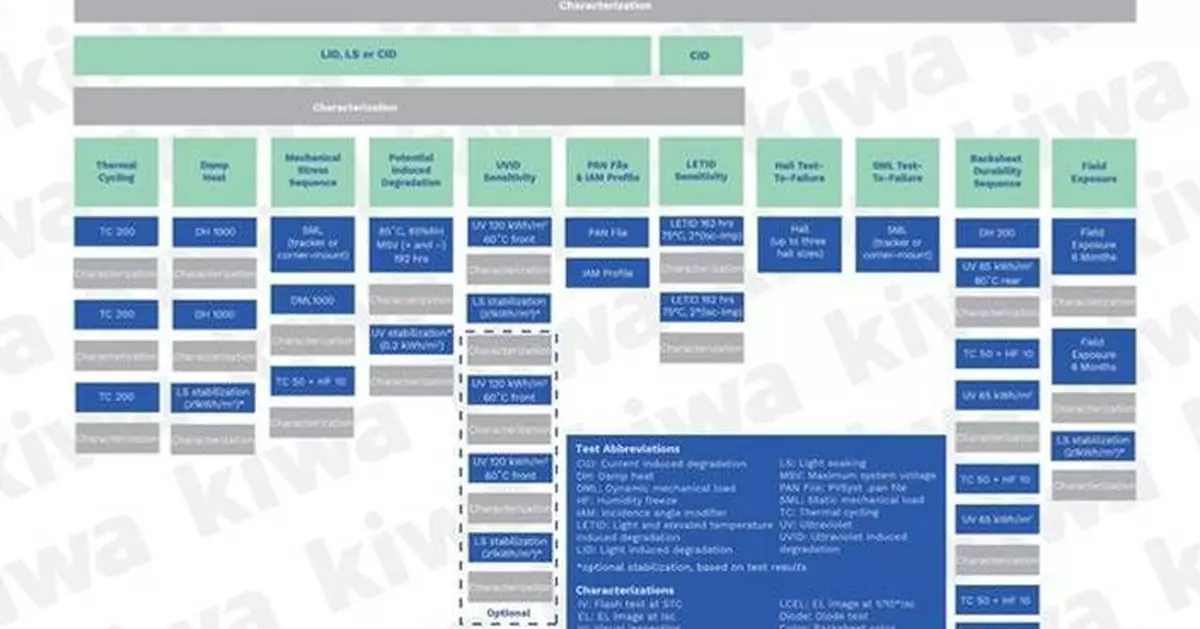
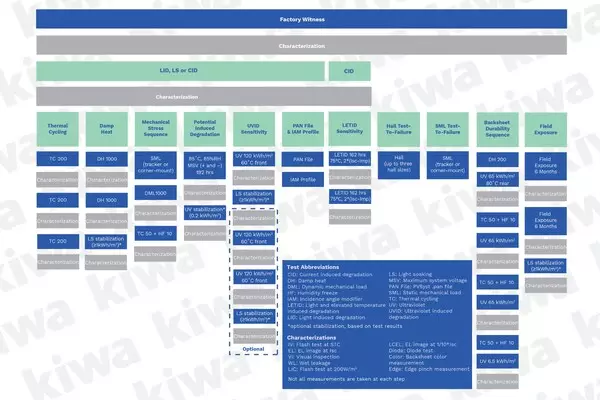
A key feature of the updated PQP is the introduction of test‑to‑failure (TTF) protocols for both static mechanical load (SML) and hail testing. The new SML-TTF complements the PQP's existing Mechanical Stress Sequences (MSS) by quantifying the dominant failure mode and achievable maximum load for each module design submitted for PQP testing. It also expands the test sample quantity to five additional SML-TTF samples, on top of the two MSS samples.
The Hail‑TTF protocol replaces the previous Hail Stress Sequence (HSS) in the PQP. The updated hail test increases the sample size to five modules and focuses on impact locations in the areas most prone to breakage, such as edges, corners, and junction box regions. Hail‑TTF greatly improves repeatability and comparability across manufacturers and glass suppliers, by escalating hail diameters until failure occurs, providing buyers with more quantifiable breakage thresholds.
Kiwa PVEL has also updated its PQP sample production witness process to more systematically verify critical frame and glass dimensions in factories, further reducing uncertainty related to material and assembly variability.
Updated Stabilization Processes
As n‑type technologies become dominant in the PV market, testing labs have encountered increased measurement uncertainty driven by metastability mechanisms. Kiwa PVEL's team spent the past years quantifying these effects and identified three distinct forms of metastability that can distort post‑test performance measurements:
- Slow dark‑storage degradation following Damp Heat testing
- Accelerated dark‑storage degradation following UV exposure and field exposure
- Potentially recoverable PID‑polarization degradation following voltage stress
To counter these effects, the updated PQP introduces final stabilization steps, including short doses of full‑spectrum light soaking and UV‑light soaking, after UVID, Field Exposure, Damp Heat, and PID testing. These steps ensure that post‑test flash measurements more accurately reflect true module behavior in the field.
Other PQP Updates
Several other refinements further enhance the PQP's relevance for modern day modules:
- Reduced LID sample size from 17 to 10 modules, justified by low and consistent LID values in recent years.
- Allowance for pre‑test current induced preconditioning (in addition to outdoor and indoor light‑soaking) to speed testing and improve scheduling flexibility.
- Streamlined UVID sequencing, eliminating the interim UV60 characterization in favor of a continuous 120 kWh/m2 exposure, with an option to extend up to 360 kWh/m2 for BOMs that show higher UVID susceptibility.
- Updated energy ratings following IEC61853-3/4 methodology, leveraging our high accuracy PAN and IAM testing data.
"Regularly iterating on the PQP makes it the most relevant test plan for today's module technologies and failure modes," said Kevin Gibson, Managing Director at Kiwa PVEL. "These updates allow module manufacturers to better showcase product reliability and performance on their current offerings. The new PQP also ensures that solar buyers receive meaningful, statistically robust and actionable data."
For more information, please visit kiwa.com/pvel/pqpv12.
About Kiwa PVEL
Kiwa PVEL is the leading reliability and performance testing lab for downstream solar project developers, financiers, and asset owners around the world. As part of the larger Kiwa Group, Kiwa PVEL's integrated services for the solar supply chain offer technical solutions for mitigating risk, optimizing financing and improving solar and energy storage systems performance throughout the project lifecycle.
Since 2012, Kiwa PVEL's Product Qualification Program (PQP) has been globally recognized for replacing assumptions about PV module performance with quantifiable metrics. Related data and consulting services offered by Kiwa PVEL provide vital procurement intelligence to a network of downstream solar buyers. Visit kiwa.com/pvel and kiwa.com/solar to learn more.
Contact:
Ashley Fallon
Head of Marketing
ashley.fallon@kiwa.com
NAPA, Calif., April 16, 2026 /PRNewswire/ -- Kiwa PVEL, the independent lab for quality and reliability testing of solar photovoltaic (PV) modules, today announced a significant update to its photovoltaic (PV) module Product Qualification Program (PQP). The revisions directly address some of the fastest‑growing concerns for the global solar industry, including the rise of field failures related to spontaneous glass breakage, frame structural failures, and increasingly severe hail events.
"Across the industry, we continue to see increasing instances of spontaneous glass breakage in the field," said Tristan Erion-Lorico, Vice President of Sales and Marketing at Kiwa PVEL. "As manufacturers have pushed toward larger modules and thinner materials, these sudden breakage events have made it clear that more rigorous and statistically meaningful testing is needed. Our updated PQP now uses higher sample sizes and test‑to‑failure methodologies to better assess module durability."
New Test-to-Failure Methods Improve Module Breakage Insights
A key feature of the updated PQP is the introduction of test‑to‑failure (TTF) protocols for both static mechanical load (SML) and hail testing. The new SML-TTF complements the PQP's existing Mechanical Stress Sequences (MSS) by quantifying the dominant failure mode and achievable maximum load for each module design submitted for PQP testing. It also expands the test sample quantity to five additional SML-TTF samples, on top of the two MSS samples.
The Hail‑TTF protocol replaces the previous Hail Stress Sequence (HSS) in the PQP. The updated hail test increases the sample size to five modules and focuses on impact locations in the areas most prone to breakage, such as edges, corners, and junction box regions. Hail‑TTF greatly improves repeatability and comparability across manufacturers and glass suppliers, by escalating hail diameters until failure occurs, providing buyers with more quantifiable breakage thresholds.
Kiwa PVEL has also updated its PQP sample production witness process to more systematically verify critical frame and glass dimensions in factories, further reducing uncertainty related to material and assembly variability.
Updated Stabilization Processes
As n‑type technologies become dominant in the PV market, testing labs have encountered increased measurement uncertainty driven by metastability mechanisms. Kiwa PVEL's team spent the past years quantifying these effects and identified three distinct forms of metastability that can distort post‑test performance measurements:
- Slow dark‑storage degradation following Damp Heat testing
- Accelerated dark‑storage degradation following UV exposure and field exposure
- Potentially recoverable PID‑polarization degradation following voltage stress
To counter these effects, the updated PQP introduces final stabilization steps, including short doses of full‑spectrum light soaking and UV‑light soaking, after UVID, Field Exposure, Damp Heat, and PID testing. These steps ensure that post‑test flash measurements more accurately reflect true module behavior in the field.
Other PQP Updates
Several other refinements further enhance the PQP's relevance for modern day modules:
- Reduced LID sample size from 17 to 10 modules, justified by low and consistent LID values in recent years.
- Allowance for pre‑test current induced preconditioning (in addition to outdoor and indoor light‑soaking) to speed testing and improve scheduling flexibility.
- Streamlined UVID sequencing, eliminating the interim UV60 characterization in favor of a continuous 120 kWh/m2 exposure, with an option to extend up to 360 kWh/m2 for BOMs that show higher UVID susceptibility.
- Updated energy ratings following IEC61853-3/4 methodology, leveraging our high accuracy PAN and IAM testing data.
"Regularly iterating on the PQP makes it the most relevant test plan for today's module technologies and failure modes," said Kevin Gibson, Managing Director at Kiwa PVEL. "These updates allow module manufacturers to better showcase product reliability and performance on their current offerings. The new PQP also ensures that solar buyers receive meaningful, statistically robust and actionable data."
For more information, please visit kiwa.com/pvel/pqpv12.
About Kiwa PVEL
Kiwa PVEL is the leading reliability and performance testing lab for downstream solar project developers, financiers, and asset owners around the world. As part of the larger Kiwa Group, Kiwa PVEL's integrated services for the solar supply chain offer technical solutions for mitigating risk, optimizing financing and improving solar and energy storage systems performance throughout the project lifecycle.
Since 2012, Kiwa PVEL's Product Qualification Program (PQP) has been globally recognized for replacing assumptions about PV module performance with quantifiable metrics. Related data and consulting services offered by Kiwa PVEL provide vital procurement intelligence to a network of downstream solar buyers. Visit kiwa.com/pvel and kiwa.com/solar to learn more.
Contact:
Ashley Fallon
Head of Marketing
ashley.fallon@kiwa.com
** This press release is distributed by PR Newswire through automated distribution system, for which the client assumes full responsibility. **
Kiwa PVEL Releases Major Update to PV Module Product Qualification Program to Better Address Module Breakage
SHENZHEN, China, April 16, 2026 /PRNewswire/ -- vivo today announced the launch of X300 FE, a lightweight flagship engineered for leading imaging performance. Designed for the modern urban explorer who demands professional-grade imaging, productivity, and uncompromising performance in a portable form factor, X300 FE integrates the vivo ZEISS Co-engineered Imaging System, advanced AI capabilities, and long-term software support within a compact flat design. By combining flagship-level imaging hardware, all-day battery endurance, and seamless ecosystem connectivity in a lightweight body, X300 FE redefines what a light flagship device can achieve without compromise.
A Pro-grade Telephoto in Your Pocket
X300 FE features a 50 MP ZEISS Super Telephoto Camera, a 50 MP ZEISS Main Camera, and a 110° Ultra-Wide Low-Distortion Camera. Designed to support a wide range of creative scenarios, from urban travel photography to dynamic concerts, the system delivers clarity, accurate color rendering, and flexible focal coverage.
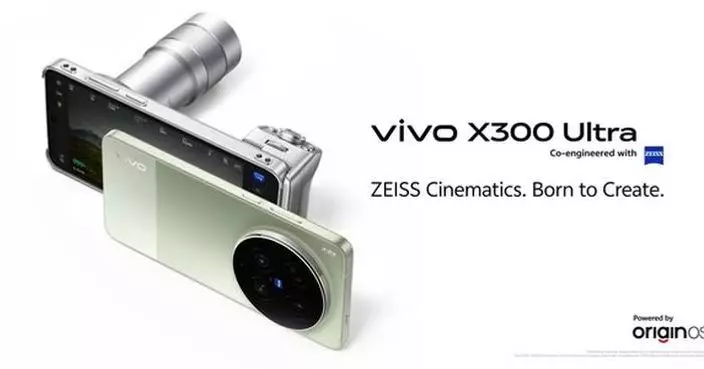
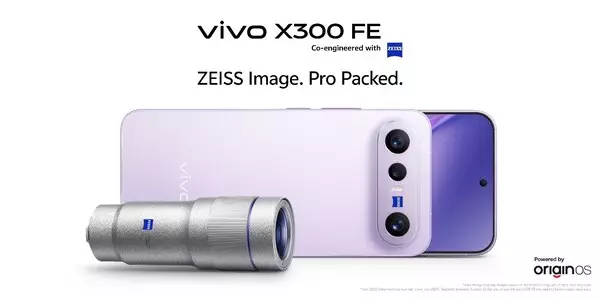
The 50 MP ZEISS Super Telephoto Camera enhances long-distance photography, bringing subjects closer with preserved detail and depth. For the first time in the FE series, users can extend to a 200 mm equivalent focal length with the vivo ZEISS Telephoto Extender Gen 2. Built on a compact Kepler-based optical architecture, the vivo ZEISS Telephoto Extender Gen 2 integrates 15 high-transmittance glass elements in 2 groups. Compared with the previous generation, the weight has been reduced from 210g to 153g, without compromising optical quality. This improved portability makes it ideal for capturing distant performers at concerts or sporting events with great detail and immersion.
Powered by AI True Clarity Engine, which combines NICE 3.0 Optical Reconstruction Engine, MAGIC 2.0 Image Restoration Engine, and Magic Cloud, X300 FE improves image detail and texture reconstruction across diverse shooting conditions, delivering clearer results even in challenging light or long-range capture.
Stage Mode is optimized for concerts and live events, combining telephoto hardware with algorithm tuning to capture subjects clearly under complex lighting conditions. Powered by the Telephoto Magic 2.0 algorithm and GTR 3.0 optimizations, Ultra-Clear Stage Photography significantly enhances telephoto portrait clarity, rendering facial details with lifelike precision, accurate color reproduction, soft tonal transitions, and vibrant yet balanced saturation. Dual-View Stage Video further enables users to record both the stage and their reactions simultaneously, preserving every spotlight moment with greater energy and emotional depth. Additionally, Flash Portrait enhances low-light performance with adaptive zoom flash, delivering balanced illumination and realistic skin tones, ensuring both the stage and the user's personal concert experience are captured in stunning detail.
Street Photography Mode celebrates the beauty of imperfection, encouraging users to capture fleeting, unpolished moments with authentic human presence. By preserving natural grain, subtle motion blur, and ambient light variations, it conveys the atmosphere and emotional depth beyond technical perfection. ZEISS Multifocal Portrait provides multiple classic focal lengths from 23 mm to 100 mm for natural-looking portraits with refined background separation. X300 FE also supports a variety of video formats to meet diverse creative demands: 4K at 60fps for effortless daily vlogging, 4K at 120fps for remarkably crisp and clear footage, and 8K at 30fps for stunning, ultra-high-definition detail.
Moreover, the AI Creative Camera brings a new dimension of creative freedom and playfulness to the X300 FE. By seamlessly blending AI Portrait with a diverse suite of artistic styles ranging from Travel Portraits and Anime to Stage aesthetics, it empowers users to weave a powerful narrative into every frame. Complementing these tools is a robust set of AI-driven features, including AI Magic Move, AI Image Expander, AI Reflection Erase, and AI Erase, all designed to maximize creative flexibility and streamline post-processing efficiency.
Dynamic Comfort, Inside and Out
X300 FE follows a clean and compact flat-design philosophy, offering a lightweight, comfortable feel that fits naturally in the hand. Its 6.31-inch flat display features ultra-narrow bezels, presenting a symmetrical front profile that combines confidence in one-handed use with refined elegance. At just 191g and 7.99 mm thin, the device delivers a sense of lightness and effortless handling, while the metallic back with matte texture and soft color gradients reflects a sophisticated, contemporary aesthetic. The overall design balances youthful vibrancy with a premium finish, creating a visually pleasing and tactilely comfortable experience from every angle.
The Metallic Sand AG glass back with upgraded matte texture provides a smoother tactile feel and improved fingerprint resistance. The Dynamic Camera Module is harmoniously integrated through a floating, droplet-shaped cold-sculpting process, creating a seamless transition between the camera module and the phone body.
X300 FE is available in four sophisticated colorways that capture urban energy and emotion: Mist Purple, Glow White, Luxe Black, and Urban Olive. Each color is developed to reflect contemporary urban aesthetics, balancing subtle texture with refined tonal depth. Aerospace-grade aluminum framing ensures the device maintains structural resilience without compromising portability.
That sense of comfort and sophistication continues smoothly on the inside. Complementing its design, X300 FE comes with OriginOS 6, vivo's latest operating system that redefines the cross-platform experience by breaking down ecosystem barriers. It creates a fluid hardware-to-software loop that delivers a truly unified, 'one-experience-across-all-devices' feel that is always within reach. It offers a comprehensive vivo Office Kit for seamless, enhanced productivity across Windows, Mac, and iPad, alongside One-Tap Transfer for iPhone and the intuitive Origin Island for intelligent intent recognition. This interconnected digital life is fortified by robust vivo Security and a dedicated Private Space, establishing an exclusive, secure sanctuary for users' critical files, photos, and applications through advanced isolation. Finally, the system ensures peak performance longevity through the Origin Smooth Engine, delivering exceptionally fluid interactions and a guaranteed 5-Year Smooth Experience that maintains flagship responsiveness over time.
Mighty Performance in a Compact Frame
X300 FE is powered by the flagship Snapdragon® 8 Gen 5 platform, ensuring fast data access, efficient multitasking, and stable responsiveness across demanding scenarios, from gaming to content creation.
To sustain performance, X300 FE features an advanced Efficient VC Liquid Cooling System with a 4005 mm² vapor chamber and high-performance thermal graphite, maintaining stable temperatures and consistent frame rates even under extended high-load use.
Despite its slim body, X300 FE integrates a 6500 mAh BlueVolt Battery, supported by 90W FlashCharge and 40W Wireless Charge for rapid power recovery while maintaining long-term battery stability. 4th-Gen Silicon Anode Technology and the intelligent Energy Efficiency Engine enhance energy density and charging efficiency without compromising safety or lifespan.
With IP68 and IP69 Dust and Water Resistance, X300 FE combines flagship-level performance with structural durability, adapting to diverse daily environments while preserving its compact profile. For long-term reliable use, X300 FE comes with five years of OS upgrades, seven years of security maintenance, and five years of smooth experience.
| 1 Unless otherwise specified, all data is based on our technical design parameters, laboratory test results, and supplier test data. Some data may be peak performance data. Actual performance may vary depending on software version, specific test environment, and phone model. |
| 2 Pixel value may vary under different camera modes and is subject to actual usage. |
| 3 Actual dimensions and weight may vary due to processes variations, measurement methods, material supplies, and production batches. |
| 4 This product has been tested under controlled laboratory conditions and is rated as IP68 and IP69 under IEC standard 60529. The dust and water resistance is not permanent and may be reduced with daily use. Damage caused by liquid ingress is not covered by warranty. |
| 5 X300 FE features a single-cell design: typical capacity is 6500 mAh (3.75V), with a typical energy of 24.38 Wh; rated capacity is 6350 mAh (3.75V), with a rated energy of 22.34 Wh. |
| 6 AI features and cross-device transfer functions may vary according to local regulatory requirements. For details, please refer to the official vivo website in your country. |
1 Unless otherwise specified, all data is based on our technical design parameters, laboratory test results, and supplier test data. Some data may be peak performance data. Actual performance may vary depending on software version, specific test environment, and phone model.
2 Pixel value may vary under different camera modes and is subject to actual usage.
3 Actual dimensions and weight may vary due to processes variations, measurement methods, material supplies, and production batches.
4 This product has been tested under controlled laboratory conditions and is rated as IP68 and IP69 under IEC standard 60529. The dust and water resistance is not permanent and may be reduced with daily use. Damage caused by liquid ingress is not covered by warranty.
5 X300 FE features a single-cell design: typical capacity is 6500 mAh (3.75V), with a typical energy of 24.38 Wh; rated capacity is 6350 mAh (3.75V), with a rated energy of 22.34 Wh.
6 AI features and cross-device transfer functions may vary according to local regulatory requirements. For details, please refer to the official vivo website in your country.
About vivo
vivo is a technology company that creates great products based on a design-driven value, with smart devices and intelligent services as its core. The company aims to build a bridge between humans and the digital world. Through unique creativity, vivo provides users with an increasingly convenient mobile and digital life. Following the company's core values, which include Benfen*, user-orientation, design-driven value, continuous learning and team spirit, vivo has implemented a sustainable development strategy with the vision of developing into a healthier, more sustainable world-class corporation.
While bringing together and developing the best local talents to deliver excellence, vivo is supported by a network of R&D centers in Shenzhen, Dongguan, Nanjing, Beijing, Hangzhou, Shanghai, Xi'an and more cities, focusing on the development of state-of-the-art consumer technologies, including 5G, artificial intelligence, industrial design, imaging system and other up-and-coming technologies. vivo has also set up an intelligent manufacturing network (including those authorized by vivo), with an annual production capacity of nearly 200 million smartphones. As of now, vivo has branched out its sales network across more than 60 countries and regions, and is loved by more than 500 million users worldwide.
*"Benfen" is a term describing the attitude on doing the right things and doing things right – which is the ideal description of vivo's mission to create value for society.
Stay informed of latest vivo news at https://www.vivo.com/en/about-vivo/news
** This press release is distributed by PR Newswire through automated distribution system, for which the client assumes full responsibility. **

vivo Unveils X300 FE: Bringing ZEISS Super Telephoto Camera to a Compact Design

vivo Unveils X300 FE: Bringing ZEISS Super Telephoto Camera to a Compact Design
vivo Unveils X300 FE: Bringing ZEISS Super Telephoto Camera to a Compact Design