Iranian President Masoud Pezeshkian on Wednesday condemned U.S.-Israeli attacks on Iranian civil facilities including schools and hospitals as unjustifiable under international law and humanitarian principles.
Iran does not seek war and instability and always insists on dialogue and constructive engagement with other countries, Pezeshkian said in a meeting with a group of medical staff in Tehran.
Pezeshkian condemned the U.S.-Israeli war against Iran, saying Iran had committed no crime.
"When they [the United States and Iran] attack schools, and maternity wards in hospitals, they don't respect any humanitarian principles. It's shameful and the world needs to see this. They claim we are terrorists, but they are the real terrorists who massacre anyone, anywhere, anytime they want. Now they stand on the stage and talk about human rights. It's shameful," he said.
Pezeshkian stated that the unity and cohesion of the Iranian people had thwarted enemy plots. He also praised the professionalism shown by the Iranian Red Crescent Society during the war.
The 40-day U.S.-Israeli attacks on Iran, starting Feb 28, killed Iran's then Supreme Leader Ali Khamenei, along with senior military commanders and more than 3,000 civilians. Iran responded with waves of missile and drone strikes targeting Israel and U.S. assets in the Middle East.
A two-week ceasefire between Iran and the United States took effect on April 8. Lengthy talks between Iranian and U.S. delegations were later held in Pakistan's Islamabad, but failed to produce an agreement.

Attacks targeting civil facilities unjustifiable under international law: Iranian president
The International Monetary Fund (IMF) has warned that global fiscal policy is coming under mounting pressure amid elevated debt levels and growing risks.
In its latest Fiscal Monitor report released Wednesday, the IMF said fiscal management is becoming increasingly challenging against a backdrop of trade fragmentation, intensifying geopolitical tensions, evolving sovereign debt markets and the buildup of structural vulnerabilities.
While global public debt dynamics showed no improvement in 2025, the outbreak of conflict in the Middle East has added a new source of fiscal pressure to an already fragile global landscape, the report noted.
Global gross government debt rose to nearly 94 percent of GDP in 2025 and, on current trajectories, is projected to reach 100 percent by 2029 -- a level previously reached only in the aftermath of World War II.
Concerns extend beyond the sheer scale of global debt to the shrinking fiscal space under current policy direction. The global fiscal buffer has effectively vanished, falling from more than 1 percent of GDP a decade ago to near zero today.
In addition, interest payments have risen sharply in just four years, from about 2 percent to nearly 3 percent of global GDP.
The IMF said the fiscal outlook has deteriorated further since its April 2025 Fiscal Monitor, with global debt-at-risk three years ahead now approaching 117 percent of GDP, underscoring heightened downside risks.
The Middle East conflict could further strain public finances through higher food and energy prices, tighter financial conditions, weaker economic activity, and rising defense outlays. In a scenario of prolonged conflict, global debt-at-risk could increase by an additional 4 percentage points, the IMF warned.
In the United States, the general government deficit currently stands at between 7 and 8 percent of GDP, with no debt consolidation plan in sight. Gross debt is projected to reach 142 percent of GDP by 2031.
The conflict also risks reinforcing adverse financial and commodity price dynamics, adding to macroeconomic pressures in emerging market and developing economies.
With the window for orderly fiscal adjustment narrowing, the IMF urged countries to adopt more forward-looking and structurally anchored fiscal policies as they cope with the effects of energy price shocks.
It called on the United States to stabilize its debt trajectory through measures on both revenue and expenditure, urged European governments to reconcile rising defense commitments with aging-related spending pressures by reprioritizing expenditures, and advised emerging markets to address contingent liabilities, phase out costly fuel subsidies and broaden their tax bases.
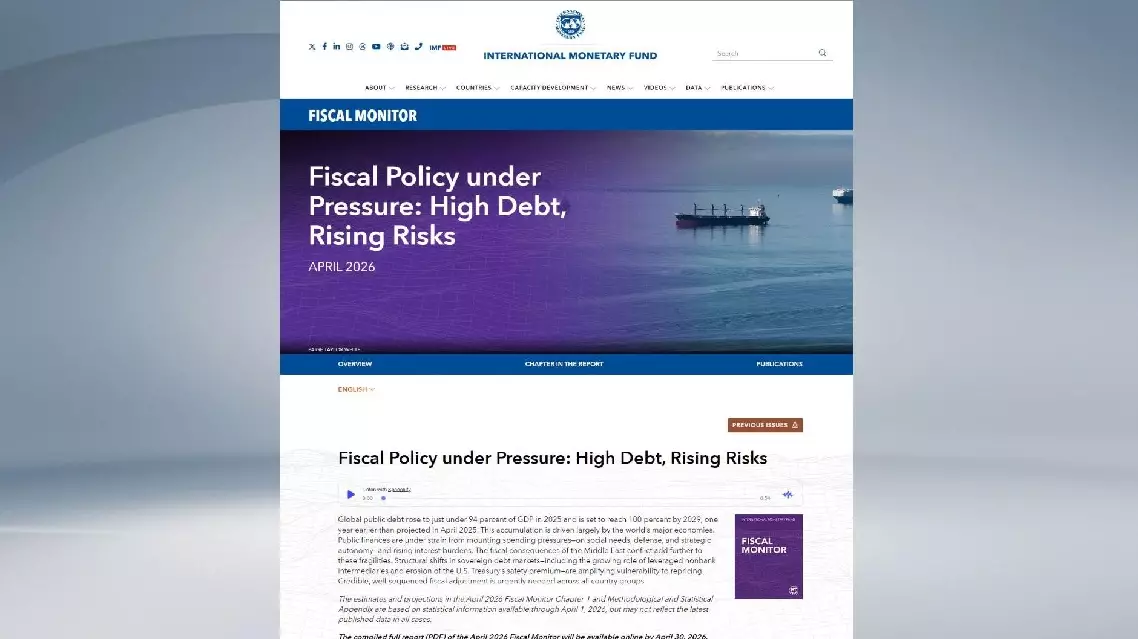
High debt, rising risks put global fiscal policy under pressure: IMF