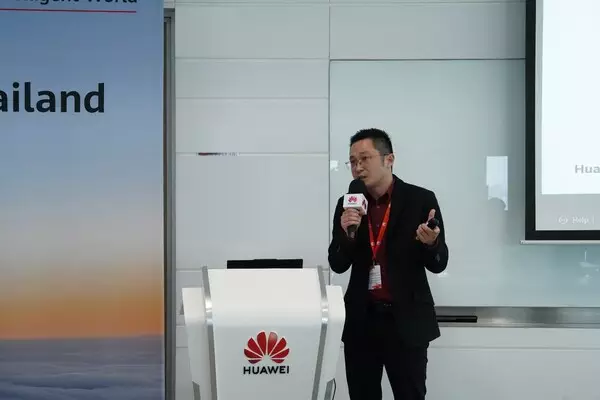
BANGKOK, April 19, 2026 /PRNewswire/ -- Huawei Cloud Thailand in collaboration with The Thai Life Assurance Association, hosted an executive forum bringing together more than 30 senior executives and technology leaders from leading insurance companies. The initiative reflects Huawei Cloud's commitment to strengthening its role as a strategic partner in advancing Thailand's digital and AI-driven economy, supporting insurance companies in accelerating secure, flexible, and scalable digital transformation through cloud-native infrastructure, advanced database technologies, and industry-specific solutions.
The event served as a platform for industry leaders to exchange insights on the future of the insurance industry in the era of cloud and AI-driven innovation, while exploring how cloud and AI technologies can modernize core insurance systems and enhance operational stability and resilience.
Driving the Future of Digital Insurance
As the insurance industry continues to accelerate its digital transformation, insurers are under increasing pressure to modernize legacy systems in order to support real-time services, rapidly growing data volumes, and evolving customer expectations.
Huawei Insurance Day event aims to position Huawei Cloud as a Strategic Digital Transformation Partner for the insurance industry, helping insurance companies build secure, scalable, and resilient digital infrastructures that can support long-term business growth.
During the event, Huawei Cloud showcased its end-to-end capabilities for the insurance sector, including cloud infrastructure, cloud-native databases, and specialized industry solutions designed to support mission-critical insurance systems.
Key Solutions for Insurance Digital Transformation
Digital Core Insurance Solution
A modernization solution that transform insurance companies migrate from legacy system such as AS/400 systems to cloud-native architectures with A next-generation core insurance architecture that enables insurers to rapidly launch new products, enhance system flexibility, simplifying maintenance and improve overall customer experience.
GaussDB for Mission-Critical Insurance Systems
Huawei's enterprise-grade database that has been trusted by large financial organization globally, including Thailand. GaussDB designed to support critical workloads with high reliability, security and performance across multiple data centers on Huawei Cloud.
Piyatida Itiravivongs, President of Huawei Cloud Thailand said:
"Digital transformation has become a strategic priority for the insurance industry. Huawei Cloud is committed to supporting insurers in building a strong digital service by combining cloud infrastructure, advanced database technologies, and industry-specific solutions to improve operational efficiency and deliver better customer experiences."
Meanwhile, Huang Hu, Solution Architect of Sinosoft, said:
"Sinosoft has extensive experience in developing technology platforms for the insurance industry. Through our collaboration with Huawei Cloud, we have successfully modernized insurance systems by adopting cloud-based architectures, helping organizations enhance the performance and stability of their core insurance platforms while supporting long-term business growth.
The success of these projects demonstrates the strong synergy between Sinosoft's insurance technology expertise and Huawei Cloud's advanced cloud infrastructure. We hope the experience and case studies shared at this event will provide valuable insights for insurance companies in Thailand as they accelerate their journey toward digital insurance."
Thailand's insurance industry is entering a new era in which digital technologies play an increasingly important role in enhancing operational efficiency and improving customer services. Forums such as this provide a valuable platform for industry stakeholders to exchange knowledge and perspectives on emerging technologies and innovations in cloud and digital infrastructure. Such knowledge sharing supports insurance companies in Thailand as they prepare for the ongoing evolution of the digital insurance landscape.
Huawei Cloud will continue to invest in cloud innovation to support the financial services and insurance sectors with secure, reliable, and scalable technologies, enabling sustainable business growth in the digital economy.
About Huawei Cloud Thailand
Huawei Cloud Thailand is a leading cloud service provider committed to accelerating Thailand's digital transformation under the mission of "In Thailand, For Thailand." According to the latest report from Gartner, Huawei Cloud is ranked No.2 by revenue in Thailand's Infrastructure as a Service (IaaS) market, solidifying its position as one of the most trusted and fastest-growing international cloud providers in the country.
As the first international public cloud vendor to establish local data centers in Thailand, Huawei Cloud now operates three Availability Zones, ensuring high reliability and low-latency connectivity for local users. Leveraging Huawei's 30-plus years of expertise in ICT infrastructure, it integrates cutting-edge Artificial Intelligence (AI), Cloud-Native 2.0, and Big Data technologies to empower over 40 government agencies and thousands of enterprises across the Kingdom. By building a robust digital ecosystem and fostering local talent, Huawei Cloud aims to drive Thailand's "Digital Economy" forward, bringing cloud and intelligence to every corner of the country for a fully connected, intelligent future.
For more information, please visit Huawei Cloud Thailand online at
https://www.huaweicloud.com/intl/th-th/ or follow us on:
https://www.facebook.com/HuaweiCloudTH
https://www.youtube.com/@HuaweiCloudAPAC
** This press release is distributed by PR Newswire through automated distribution system, for which the client assumes full responsibility. **
Huawei Cloud Strengthens Thailand's Insurance Industry with Next-Generation Digital Technologies

Huawei Cloud Strengthens Thailand's Insurance Industry with Next-Generation Digital Technologies
SHANGHAI, April 18, 2026 /PRNewswire/ -- JinkoSolar, the global leading PV and ESS supplier, has officially launched a lightweight module solution specifically designed for low-load-bearing roofs—the Jinko "Light Diamond" lightweight, high-strength module, based on its Tiger Neo 3.0 technology platform.
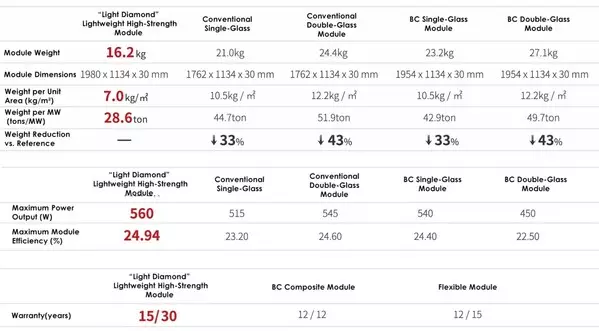
Module weight: 16.2 kg
Module dimensions: 1980 × 1134 × 30 mm
Weight density: 7 kg/m²— 40% weight reduction compared with conventional double-glass modules (12.2 kg/m²);
Maximum power: 560 W;
Maximum module efficiency: 24.94%
Applications: Suitable for older factory buildings, temporary structures, light-gauge steel roofs, power plant coal sheds, and buildings with load restrictions.
Five Key Advantages:
Advantage 1: Ultra-Lightweight with Guaranteed Strength
JinkoSolar's "Light Diamond" lightweight, high-strength modules weigh only 7 kg per square meter, representing a weight reduction of over 40% compared to conventional double-glass modules. The total module weight for a 1 MW project is only 28.6 tons, a reduction of approximately 20 tons compared to BC double-glass modules. This means that a large number of roofs that previously required reinforcement or were unsuitable for installation can now be directly fitted with solar panels without any structural modifications.
Advantage 2: 24.94% High Efficiency—Lightweight and High-Performance
A common flaw among most lightweight modules on the market is that they prioritize weight reduction at the expense of power generation efficiency. JinkoSolar's "Light Diamond" lightweight, high-strength modules break this trade-off.
JinkoSolar's "Light Diamond" lightweight, high-strength modules deliver a maximum power output of 560 watts and an ultra-high efficiency of 24.94%, whereas flexible modules or BC composite modules only reach 450 to 460 watts—a single-module power increase of over 100 watts. This means a higher-capacity solar power plant can be installed on the same roof area. More importantly, the higher power output directly leads to optimized system costs: fewer modules are required, reducing Balance of System (BOS) costs for mounting structures, cables, combiner boxes, and other components; installation time is shortened, lowering labor costs; and overall BOS costs are further reduced by 3% to 5% compared to conventional lightweight solutions.
This is not a lightweight module born of compromise, but a high-efficiency module that takes performance to the next level.
Advantage 3: Reduced Weight Without Compromising Quality—Backed by a 30-Year Power Warranty
The key concern with lightweight modules is whether their reduced weight compromises reliability. JinkoSolar's "Light Diamond" lightweight, high-strength modules address this concern with technology and data.
In terms of structural reinforcement, the modules utilize 1.6mm lightweight glass to reduce weight while maintaining light transmittance; the frame features reinforced channel design with increased thickness, enhancing overall mechanical strength; and the encapsulation process uses reinforced adhesive film, significantly improving sealing performance, resistance to humidity and heat, and resistance to micro-cracks.
In terms of load certification, the maximum front-side load capacity is 3,600 Pa—equivalent to withstanding 3.6 meters of snow accumulation—and the module can withstand impacts from 25mm hailstones without damage. The maximum back-side load capacity is 2,400 Pa, equivalent to withstanding Category 12 winds. In the face of extreme weather, it provides a robust safety barrier.
In terms of long-term reliability metrics, the temperature coefficient is -0.26%/°C, resulting in lower power generation losses at high temperatures; the power output warranty spans 30 years, which is 12–15 years longer than that of flexible or composite modules; first-year degradation does not exceed 1%, with annual degradation of 0.35%, both of which outperform industry averages.
Advantage 4: Save Money, Time, and Effort
The lightweight design of JinkoSolar's "Light Diamond" lightweight, high-strength modules not only reduces physical weight but also systematically optimizes total lifecycle costs.
Compared to conventional module reinforcement solutions, JinkoSolar's "Light Diamond" lightweight, high-strength modules save approximately 0.5 yuan per watt in reinforcement costs, equivalent to a savings of about 500,000 yuan per MW. The construction period is reduced from over 40 days to 8–10 days—a 75% reduction. There is no need to halt production, thereby avoiding operational losses, and the approval process is simplified, eliminating the need for structural modification approvals.
Taking a 1 MW project as an example, the savings on reinforcement costs amount to approximately 500,000 yuan, the construction period is shortened by more than 30 days, and the avoided production downtime losses—which can reach hundreds of thousands of yuan depending on the company's scale—significantly boost the project's internal rate of return (IRR) and markedly shorten the payback period. For retrofit projects involving older factory buildings, the greatest advantage of Jinko's "Light Diamond" lightweight, high-strength modules is that installation can proceed without halting production; companies can maintain normal operations while the solar power plant is installed on the roof simultaneously, ensuring both objectives are met.
Advantage 5: Strong Demand, a Blue Ocean Market
According to industry statistics, China has over 6 billion square meters of existing commercial and industrial rooftop space, with load-restricted roofs accounting for more than 30% of this total—representing a potential market of nearly 2 billion square meters. Based on an installation density of 100 watts per square meter and a system cost of 1.5 yuan per watt, the theoretical installation capacity exceeds 200 GW, with a market size surpassing 300 billion yuan.
The renovation of old factory buildings, the upgrading of cultural and creative parks, and distributed solar systems on light-gauge steel roofs—these scenarios that were previously unsuitable for installation are now becoming a new blue ocean for PV growth. Whoever can be the first to deliver truly reliable products will be able to capture this market.
Application Scenarios
1) Renovation of Old Industrial Buildings: This is the primary application scenario. Industrial buildings constructed in the last century, as well as power plant coal sheds, carports, and simple rural supermarkets, often have limited roof load-bearing capacity and structurally deteriorated roofs that cannot safely support additional weight. Jinko's "Light Diamond" lightweight, high-strength modules can be installed without structural reinforcement and do not disrupt production during renovation, making them the preferred solution for the green retrofitting of old industrial buildings.
2) Cultural and Creative Parks and Commercial Complexes: With insufficient roof load-bearing capacity, the need to maintain operations, and aesthetic requirements, Jinko's "Light Diamond" lightweight, high-strength modules—which are lightweight, efficient, and reliable—are a perfect fit for these scenarios.
3) Light-Gauge Steel Roofs and Color-Coated Steel Sheet Roofs: Light-gauge steel roofs, commonly used in modern industrial facilities, inherently lack sufficient load-bearing capacity. Jinko's "Light Diamond" lightweight, high-strength modules, weighing just 7 kg per square meter, enable the installation of solar panels on these roofs.
4) Special buildings with load restrictions: Such as space frame structures, arched roofs, and agricultural greenhouses, Jinko's "Light Diamond" lightweight, high-strength modules can easily adapt to these structures.
** This press release is distributed by PR Newswire through automated distribution system, for which the client assumes full responsibility. **
JinkoSolar Officially Launches "Light Diamond" Lightweight, High-Strength Module
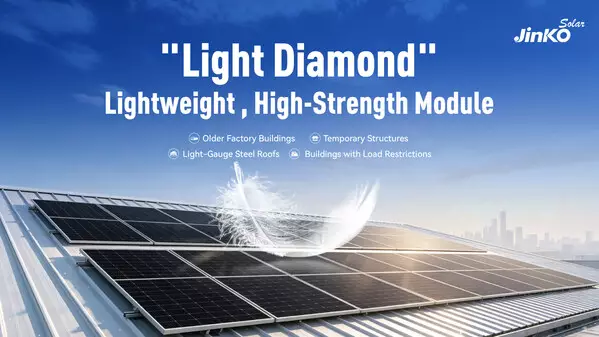
JinkoSolar Officially Launches "Light Diamond" Lightweight, High-Strength Module