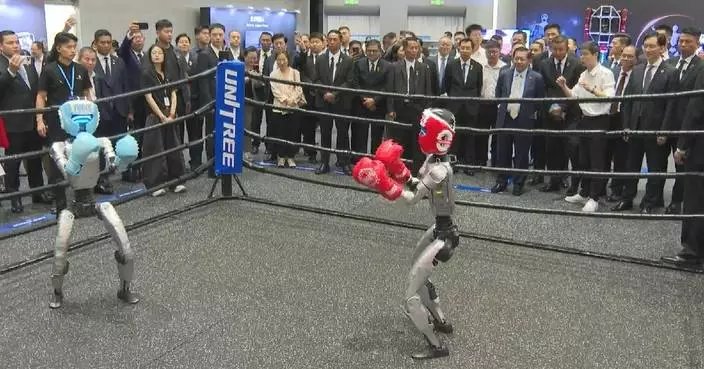
China's robotics sector is accelerating expansion on the global stage, with the eastern province of Anhui, an emerging manufacturing powerhouse, reporting a 30-fold increase in robot production over the past decade.
At the forefront of this momentum is Wuhu City in Anhui, home to the country's first national-level robotics industry cluster.
On the production floor of AiMOGA Robotics in Wuhu, a new generation of quadruped robots is preparing for going on international markets. Featuring 13 degrees of freedom in its joints, the robot dog is capable of carrying a 5-kilogram payload while operating for up to two hours on a single charge.
Designed to navigate complex terrains including shrubbery, gravel and inclines, the robot can access confined spaces beyond human reach. Equipped with night-vision lighting, it has become a preferred solution for overseas clients seeking automated security patrols at industrial facilities and residential properties.
Its adorable design has also made it a popular companion assistant for families.
Besides the robot dog, AiMOGA also exports a kind of humanoid robots, each of which is about 1.67 meters tall. They can support interaction in 11 languages, enabling seamless service across diverse cultural and linguistic markets.
"Our humanoid robots and robotic dogs have now been exported to more than 30 other countries and regions. In Europe, we've achieved batch deliveries to the UK, Poland and Italy. These bulk shipments signal that our products have reached a significant level of sophistication," said Shen Xiantian, overseas sales manager at AiMOGA Robotics.
The evolving landscape of China's robot exports is further reflected in customs clearance data.
According to Fang Yu, an officer at the Wuhu Customs, the tariff code system now includes 13 distinct categories for robotics, up from just five a decade ago.
"Currently, the customs declaration system includes as many as 13 distinct tariff items related to robots. For instance, the category for 'collaborative robots' was newly added in 2023, while multiple additional items, such as those for 'intelligent bionic robots' and 'cleaning robots', were introduced in 2026. This clearly reflects the continuous expansion of application scenarios for Chinese-made robots," Fang said.
Industry analysts observe that Chinese robotics manufacturers are steadily strengthening their competitiveness through greater precision in engineering, deeper specialization for niche applications, and enhanced intelligence via AI integration.
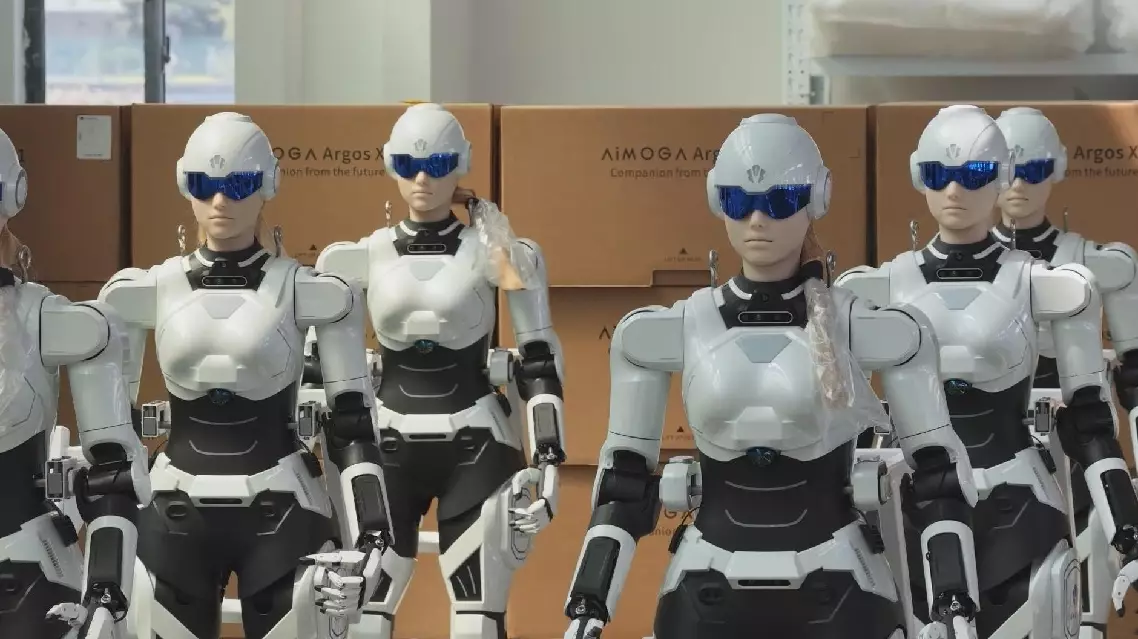
Chinese robots accelerate global expansion with diversified application scenarios
Chinese robots accelerate global expansion with diversified application scenarios
A clean energy program aiming to explore the abundant solar resources in an arid town in northwest China via smart technology has transformed the town into a vibrant green power hub.
Thanks to advanced smart grid systems, energy storage and initiating regional new energy training sessions introduced by the program, Minning Town in Yinchuan City of Ningxia Hui Autonomous Region has achieved a 24-hour supply of 100 percent green electricity since 2024, pioneering a new model for rural revitalization.
Designated as the first "Green Electricity Town" in the region, Minning Town boasts the largest and most fully equipped new energy training school in northwest China, where students are engaged in lessons around a disassembled wind-driven generator.
The Ningxia Lineng New Energy Vocational Skills Training School also offers trainees access to energy storage and power transformation equipment of different generations and technical characteristics.
Leveraging its abundant solar and wind power facilities, a training base has been established for the trainees in the town.
"Trainees can learn theories in the morning at school, and then go to stations nearby for some practices in the afternoon," said Xing Bowen, manager of the school.
With the annual sunshine duration reaching 3,000 hours, residents in the town have utilized local solar resources to increase their income.
In Yuanlong Village, the roofs of 1,922 households installed with photovoltaic panels have become a unique sight.
"Since our roof photovoltaic industry started grid-connected operation in 2016, residents in Yuanlong Village have leased their roofs out to enterprises. As a result, each household earns a rent of 480 yuan every year, and it also brings a collective income of nearly 1 million yuan to our village," said Ma Keyu, secretary of the Party branch in Yuanlong.
Besides roofs, many villages there have made full use of their idle land, while raising livestock animals under solar panels.
Wind turbines have been also put up on the desertified land around the town to synergize with solar panels to generate electricity.
To ensure a stable power supply at night or when wind stops, the town is equipped with 40 battery compartments that consist of around 200,000 battery cells. The facilities can reserve 180,000 kilowatt-hours of electricity and release 180,000 kilowatt-hours at one time, meeting the daily needs of 24,000 households.
A homegrown smart power dispatching system has been applied for the first time in the town.
"The system works as a smart brain for our power grid. It can predict when the wind is the heaviest and when the sunshine is the strongest, as well as power consumption of residents. It can ensure green power supply by automatically arranging the operations of wind and solar power facilities and reserve stations and dispatching power in real time," said Wang Erqing, deputy director of the Power Dispatching and Control Center of State Grid Yinchuan Power Supply Company.
Since 2024, the town has achieved an annual supply of 566 million kilowatt-hours of green electricity, saving 69,500 tons of coal, and reducing carbon dioxide emissions by 192,700 tons, with the utilization efficiency of new energy exceeding 95 percent.
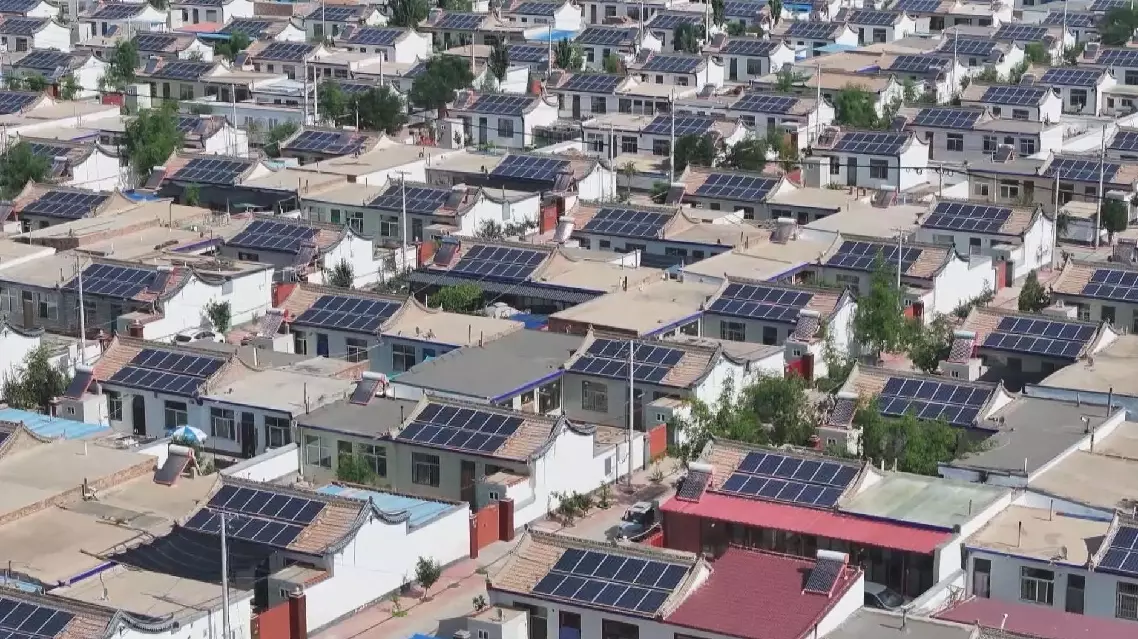
Clean energy program turns arid town in northwest China into green power hub