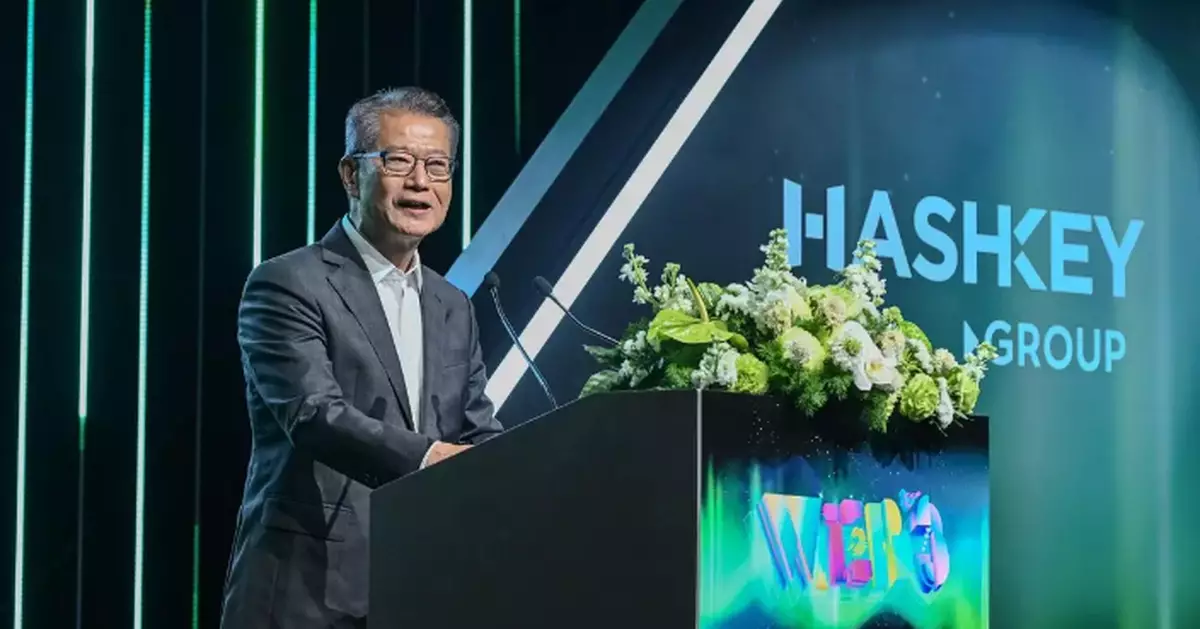
Speech by FS at Hong Kong Web3 Festival 2026
Following is the speech by the Financial Secretary, Mr Paul Chan, at the Hong Kong Web3 Festival 2026 today (April 20):
(Deputy to the People's National Congress, Vice Chairman to All-China Federation of Industry and Commerce, Chairman and Chief Executive Officer of Wanxiang Group, Mr Lu Weiding), Dr Xiao (Chairman and Chief Executive Officer of HashKey Group, Dr Xiao Feng), distinguished guests, ladies and gentlemen,
Good morning.
It is a pleasure to join you at the Hong Kong Web3 Festival 2026 - a gathering of dreamers, innovators and investors who are exploring and building the next generation of financial and technological infrastructure.
When Web3 meets digital intelligence
We are meeting at an important moment, as 2026 is very much a turning point. On the one hand, Web3 is maturing, with its applications extending into more parts of the real economy. Around the world, financial institutions are increasingly using digital assets and tokenisation to enhance efficiency, cut costs, shorten settlement times, and devise innovative products for clients.
More types of assets - from money and bonds to real assets and future income - are being represented in tokens that can move easily and come in smaller, more accessible units. This is creating new ways to invest, fund projects, and share risks across a wider community of participants.
On the other hand, driven by AI, universal connection and omnipresence of data, digital intelligence is being embedded into the economy. The rise of agentic AI this year is another remarkable milestone. They can analyse information, make decisions, and carry out actions on their own, including interacting directly with other systems.
No doubt, the intersection of Web3 and AI is a game changer. We can expect a future where AI agents analyse information and act at machine speed, making full use of blockchain infrastructure in the background. Together, they will lift transaction efficiency to a new level, reshaping a wide range of activities - from finance and trade to wealth management, supply chain operations and logistics.
The issues to be addressed
This combination will create massive new opportunities. But it also raises a number of issues that we must address together.
First, the speed gap. If AI can act in milliseconds, then the related infrastructure, including payments and settlement systems, must keep pace. Transactions cannot wait for days, or even hours. But here, the challenge is not only about technology. In the global Web3 environment, we also need common standards and close cross-border co-operation, so that activity can be recognised, processed and supervised in a broadly consistent way across jurisdictions.
Second, human control and security. Agentic AI has the ability to make decisions autonomously. This means that we must ensure that its behaviour remains predictable, traceable and open to human intervention. We need clear guardrails so that people stay in control; and so that misuse, manipulation or cascading errors can be detected and stopped in time.
Third, regulation and accountability. As AI-driven activity moves across many platforms, products and markets, we must make sure that regulation and governance frameworks follow suit so that investors, users and consumers are properly protected. With the growing power of AI, we must also address risks such as cybersecurity threats, scams and system bias in a co-ordinated way.
Above all, decentralisation and digital intelligence do not mean weaker accountability or lower standards. Instead, they can enable smarter ways to build compliance and oversight into the financial system, strengthening its overall integrity.
Hong Kong's vision and pathway
In light of these developments, you may be interested in the position that Hong Kong takes. Let me set out our approach.
On Web3 and AI, Hong Kong's approach has been clear and consistent. Under the "one country, two systems" principle, Hong Kong, as an international financial centre, embraces innovation and new technologies. Web3, tokenisation and AI are now becoming important building blocks for the future of mainstream finance. Our doors are open to Web3 entrepreneurs and institutions worldwide who want to build and scale their business here.
As we chart our course in these areas, a few principles will continue to guide our strategy and policies.
First, we maintain a balanced, forward looking regime guided by the principle of "same activity, same risks, same regulation", with a strong focus on risk management and investor protection.
Second, we believe that the real value of blockchain technology and digital assets lies in solving real-life problems, reducing costs, speeding up settlements, improving transparency and making financial services more inclusive.
Third, we are firmly pro innovation. Indeed, our regulators carry a dual mandate: prudent regulation and market facilitation. They work side by side with innovators through sandboxes and pilots, testing new tools in a controlled environment, identifying risks early and providing timely, practical feedback.
These principles are central to our approach to digital assets. An example is stablecoins, for which we issued two issuer licences earlier this month. Stablecoins have significant potential to address long-standing pain points in economic activity, especially in cross-border trade and payments. At the same time, we must firmly protect users, the wider public and the stability of the financial system. That is why we have adopted a prudent, step-by-step approach, with a strong compliance culture and capability as a prerequisite for any stablecoin issuer.
We are taking the lead in encouraging more tokenisation. We have issued multiple rounds of tokenised green and infrastructure bonds amounting to over US$2 billion. These transactions have helped demonstrate how tokenisation can improve settlement efficiency and broaden market participation. We have now regularised such issuances.
We are determined to drive more innovative use cases in tokenisation. For example, building on Project Ensemble, the HKMA (Hong Kong Monetary Authority) launched EnsembleTX last November. This pilot allows market participants to use tokenised deposits in money market fund transactions, and to manage liquidity and treasury positions in real time.
With AI becoming such a powerful force, our mission is to harness it to empower different industries. We call this "AI+". That is why, as outlined in this year's Budget, we will establish the Committee on AI+ and Industry Development Strategy. The convergence of Web3 and AI, and the opportunities and challenges they create for finance and other sectors, will be one focus area for this Committee.
Closing
Looking ahead, there is still much to do as we enter an accelerated phase of Web3 and AI. This will require us to encourage and support more innovative applications, while continuously learning from experience and enhaning our frameworks to keep pace with change.
By maintaining an open and balanced attitude, I am confident that Hong Kong will become a hub where the next generation of technologies are developed, applied and scaled - ambitiously and responsibly.
I invite all of you - innovators, entrepreneurs and investors - to join us as we move forward.
On this note, I wish the Hong Kong Web3 Festival every success, and all of you the best of health and business. Thank you very much.
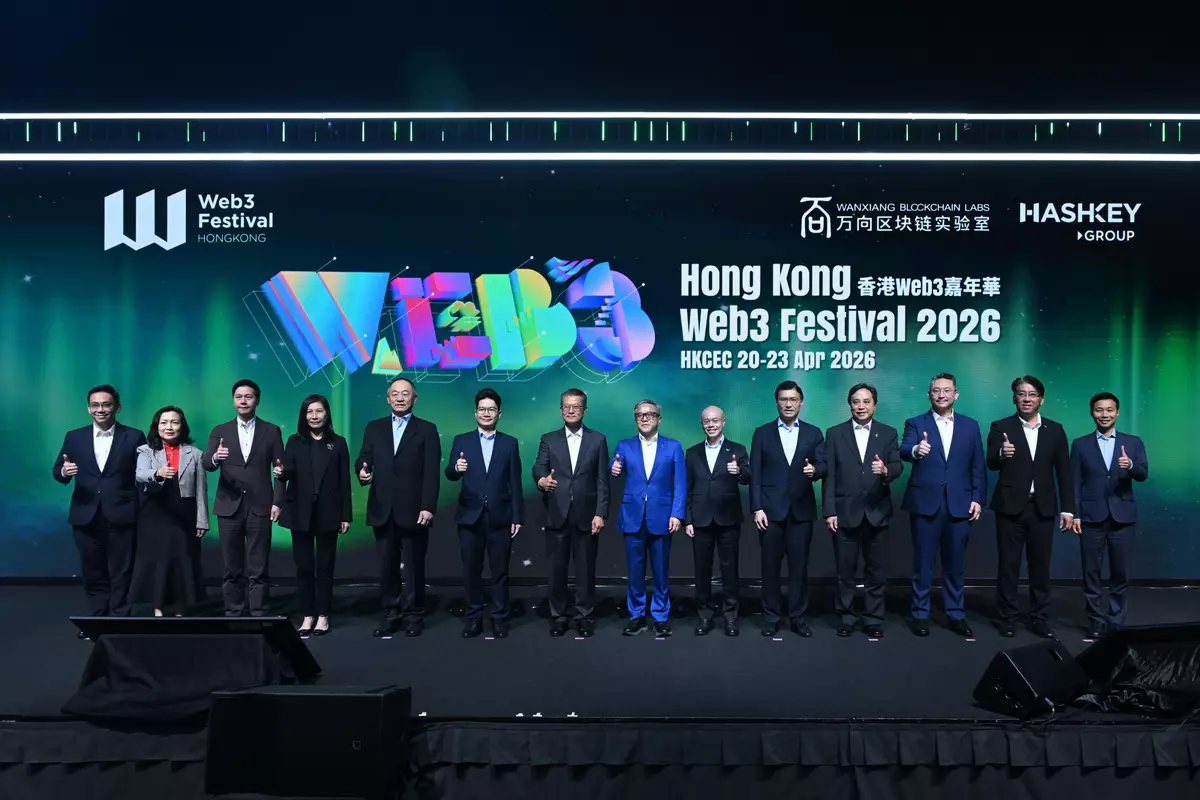
The Financial Secretary, Mr Paul Chan, attended the Hong Kong Web3 Festival 2026 today (April 20). Photo shows Mr Chan (seventh left); Deputy to the People’s National Congress, Vice Chairman to All-China Federation of Industry and Commerce, Chairman and Chief Executive Officer of Wanxiang Group, Mr Lu Weiding (seventh right); the Chairman and Chief Executive Officer of HashKey Group, Mr Xiao Feng (fifth left), and other guests at the event. Source: HKSAR Government Press Releases
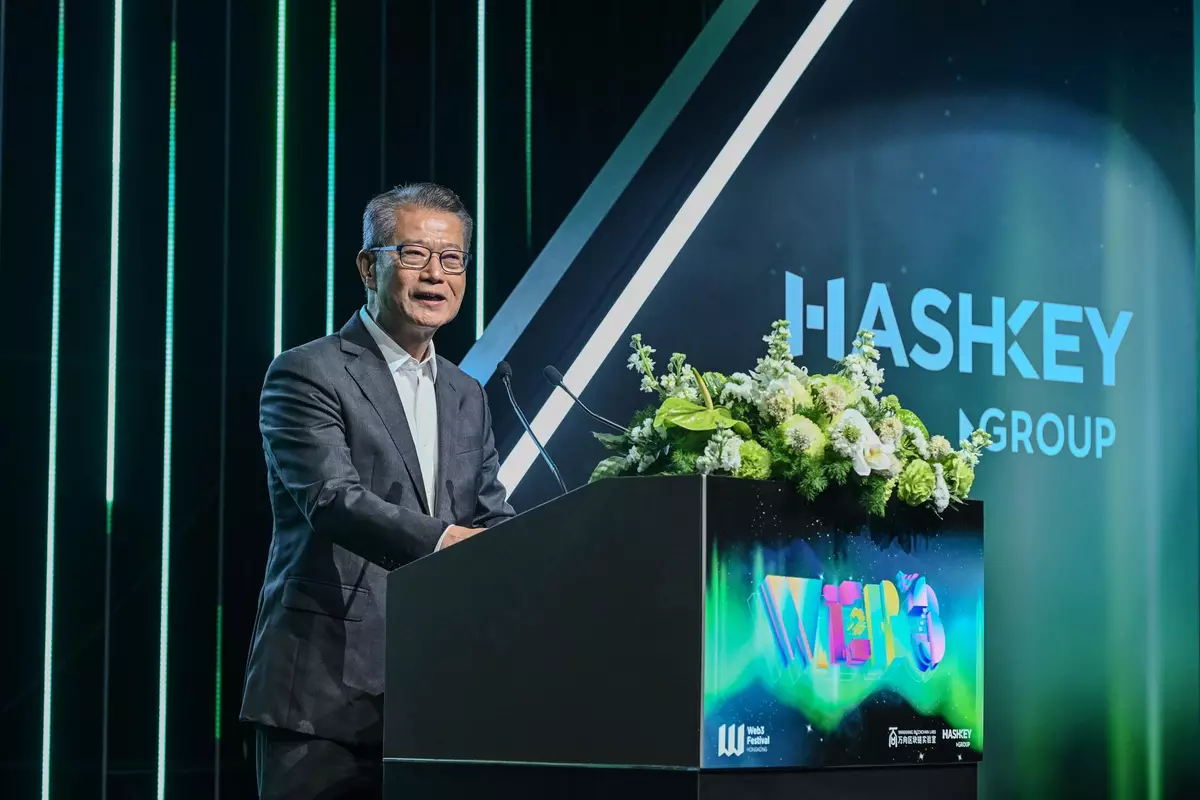
The Financial Secretary, Mr Paul Chan, speaks at the Hong Kong Web3 Festival 2026 today (April 20). Source: HKSAR Government Press Releases