A half-marathon pitting humans against humanoid robots in Beijing on Sunday is not just a race, but also a real-world testing ground for algorithms, hardware and computing power before mass production, deployment and delivery.
More than 300 humanoid robots competed in the 21-kilometer race in Yizhuang in the capital's south, running in parallel tracks with human athletes to avoid collisions. From autonomous navigation to endurance and speed, every step on the course is a test of real-world deployment.
It's the second edition of the event, and nearly 40 percent of the contestants navigated the race autonomously instead of being directed by remote control. The race's inaugural edition last year was riddled with mishaps, and most robots were unable to finish.
The fastest robots are on track to complete the half marathon in under an hour, compared to last year's best time of two hours and 40 minutes, more than double the time of the human winner of the conventional race.
That would mark a record-breaking improvement, and China's humanoid robotics is advancing rapidly, becoming faster, more stable, and increasingly autonomous.
A red-clad robot, developed by Chinese smartphone maker Honor, took the title in just 50 minutes and 26 seconds, besting all 12,000 human competitors and even surpassing the human world record for a half-marathon, set by Ugandan runner Jacob Kiplimo last month, by nearly seven minutes.
It was a clean sweep for Honor's robots, which also took second and third place medals on the podium.
Du Xiaodi, an engineer of Honor Terminal Co.,Ltd., said the robots used liquid cooling technology adapted from its smartphones. He believes humanoid robots would eventually reshape many industries, including manufacturing.
"We can transfer key technologies developed in competition like liquid cooling into industrial applications. It's similar to how racing helped drive innovation in the early automotive industry," said Du.
International teams also underscored the growing role of global collaboration through events like this.
"I really enjoyed my collaboration with one of the universities of China and I'm looking forward to making some further and I hope we can create more opportunities like this in the future," said Etienne, member of the Paris-Saclay University team.
Industry insiders say the path to commercialization may be closer than many expect.
"The timeline for mass production, deployment, and delivery is continuing to shorten. Once we move into real-world applications, development accelerates, creating a flywheel effect and lower costs drive wider adoption," said Liang Hongjun, deputy director of the Equipment Division at the Beijing Municipal Bureau of Economy and Information Technology
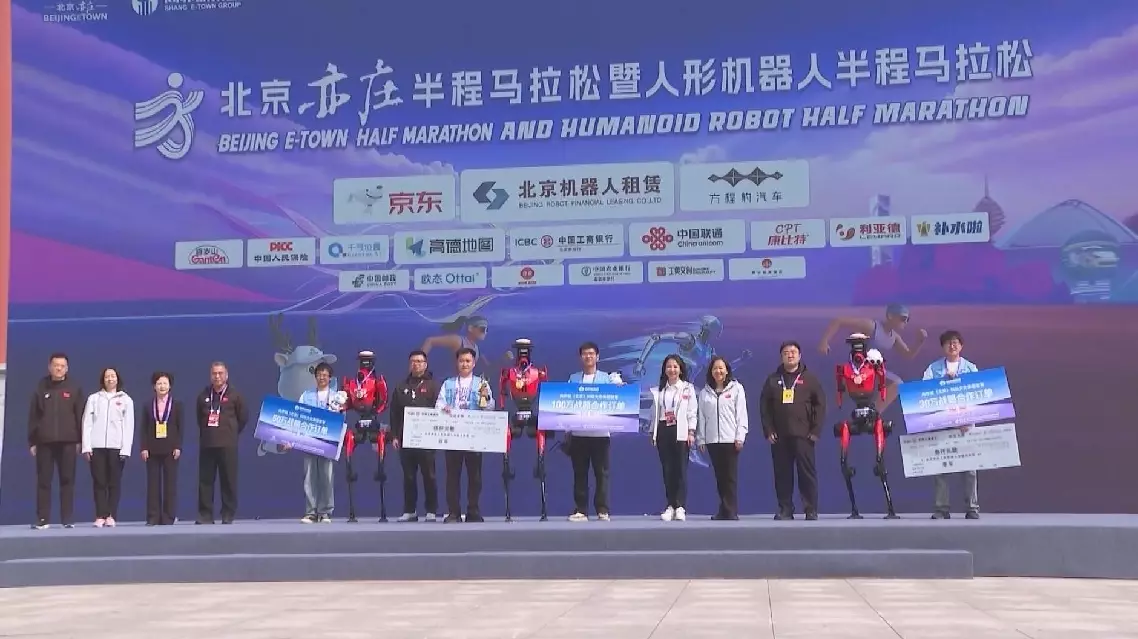
Beijing's robot half-marathon serves as testing ground for humanoid mass production