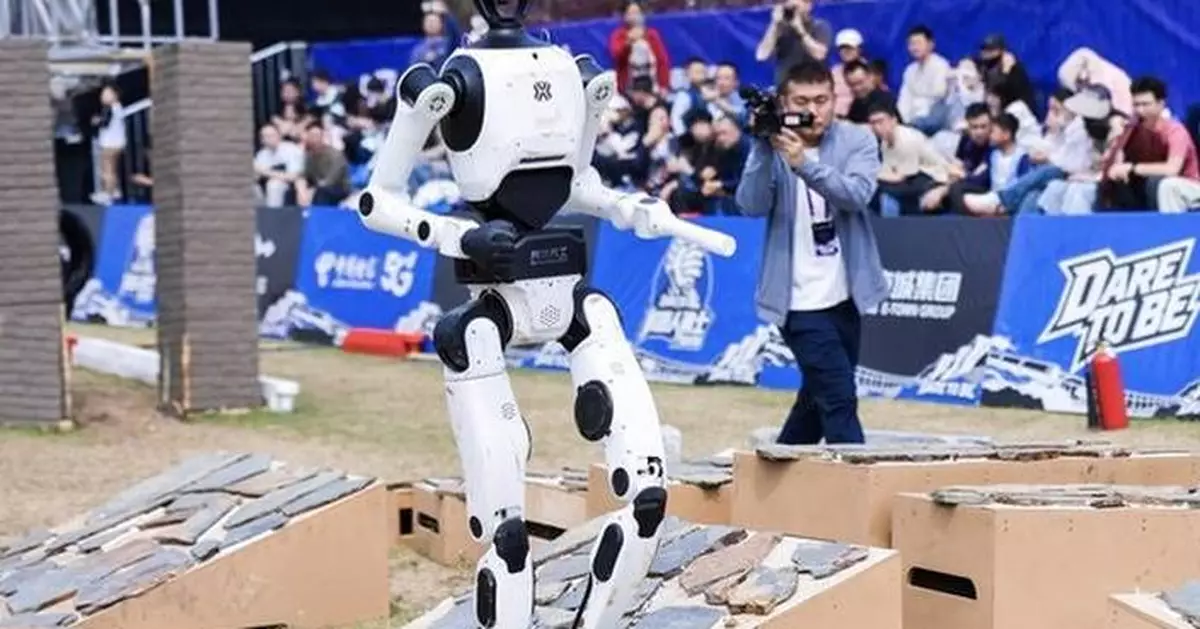
BEIJING, April 20, 2026 /PRNewswire/ -- On April 18, the inaugural Beijing Yizhuang Robot Warrior Challenge concluded. Beijing Innovation Center of Humanoid Robotics (X-Humanoid) entered the competition with Embodied Tien Kung 3.0. The full-size general-purpose humanoid robot completed the course fully autonomously, successfully navigating multiple competition tasks designed around real-world high-risk scenarios, including pendulum traversal, forward progression, and barrier breaching and obstacle clearance. It achieved the highest overall score, becoming the first winner of a fully autonomous Robot Warrior Challenge and receiving the Warrior Intelligent Mobility Award.
Following its victory in the 2025 humanoid robot marathon, X-Humanoid again took the top spot, establishing itself as a dual-title winner. As the only full-size robot in the competition, Embodied Tien Kung 3.0 outperformed more agile small humanoid robots, marking a critical leap from basic locomotion to real-world operational capability.
During the event, X-Humanoid not only fielded four teams of its own, but also worked with joint laboratory teams from several universities, including Hunan University and Renmin University of China. Through the open interface provided by X-Humanoid, the teams carried out further development based on Embodied Tien Kung 3.0's developer accessibility, reduced sim-to-real gap, high performance potential, and ease of tuning. Together, they generated validation data and repeatable development approaches for scaling robotic deployment in post-earthquake recovery, chemical operations, firefighting, and other high-risk scenarios.
A Hard-Core Victory in Full Autonomy: From Passive Execution to Active Decision-Making
The competition course closely mirrored real disaster environments, including unstructured terrain, dynamic obstacles, fine manipulation, and high-impact motion challenges. Most participating robots still required manual remote assistance, preset routes, or on-site intervention, while Embodied Tien Kung 3.0 operated fully autonomously, powered by its proprietary "Wise KaiWu" embodied intelligence platform, achieving closed-loop operation across perception, planning, control, and fault recovery, with no human intervention, no remote control, and no preset scripts.
Four Core Technologies: The Embodied-Intelligence Strength Behind the Championship
• Embodied Hierarchical Control Architecture: Deep Integration of Cognitive Decision-Making and Motion Execution
Based on the "Wise KaiWu" platform's coordinated architecture, the high-level autonomy stack is responsible for environmental understanding and task decision-making, while the low-level control layer handles motion generation and real-time execution. Through high-speed, low-latency communication, the two operate in a closed loop, translating high-level decisions into stable, precise, human-like full-body motion. This enables fully autonomous, continuous, and robust operation in unstructured, high-disturbance, multi-task environments, eliminating reliance on pre-programmed behaviors and human intervention, and enabling real-time translation of decision-making into precise, goal-directed motion.
• Multimodal Terrain Perception and Environmental Understanding: Centimeter-Level Modeling, Millisecond-Level Response
Faced with complex environments, Embodied Tien Kung 3.0 uses an end-to-end perception-to-motion model, integrating multimodal sensor input and directly learning motion decision-making and control strategies from raw observations, enabling a unified pipeline from perception to action.
• Precise Foot Placement and Integrated Autonomous Decision-Making and Planning: Global Optimization with Step-by-Step Control
Based on an integrated architecture combining global semantic path planning with local foot placement optimization, the robot manages both path-level decisions and real-time step execution, coordinating body posture and joint motion under complex constraints to ensure stable and continuous traversal in narrow passages and dynamic environments.
• Highly Dynamic Full-Body Motion Control: Stable, Continuous, and Highly Resistant to Disturbance
With an integrated stand-walk-run control framework driven by reinforcement learning and imitation techniques, Embodied Tien Kung 3.0 delivers smooth, stable movement across continuous obstacles, with strong disturbance resistance and posture recovery. The team was also among the first in the industry to achieve highly dynamic full-body motion control during physical interaction, enabling the robot to maintain coordination and stability under direct contact with the environment, and significantly expanding its operational capability in complex scenarios.
Accelerating Deployment in High-Risk Scenarios: From Competition Champion to Industry Pioneer
The Robot Warrior Challenge was modeled on real rescue and hazardous-operation scenarios, testing performance in earthquake debris, chemical hazard environments, and collapsed structures. X-Humanoid focuses on fully autonomous systems designed for real-world use, and through open hardware/software interfaces, development tools, and shared code frameworks, continues to reduce barriers to development and deployment. This breakthrough not only extends the use of these systems into emergency response and hazardous operations, but also provides mature, transferable solutions for industrial manufacturing, logistics, and commercial services, supporting deployment across a broad range of real-world environments and use cases, and accelerating the transition of embodied intelligence from controlled testing to practical, real-world operation.
For more information, please visit https://www.x-humanoid.com/.
** This press release is distributed by PR Newswire through automated distribution system, for which the client assumes full responsibility. **
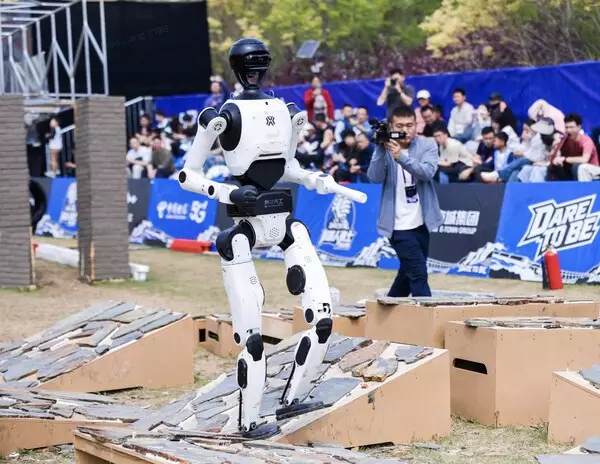
X-Humanoid's Embodied Tien Kung 3.0 Wins Beijing Robot Warrior Challenge with Fully Autonomous Run