TORONTO (AP) — Allyson Simpson scored at 2:42 in overtime as the New York Sirens played spoiler in defeating the Toronto Sceptres 1-0 on Tuesday night.
Kayle Osborne stopped 21 shots for New York, which came in three points back of the Sceptres and needed a regulation win to avoid being eliminated from playoff contention.
Click to Gallery
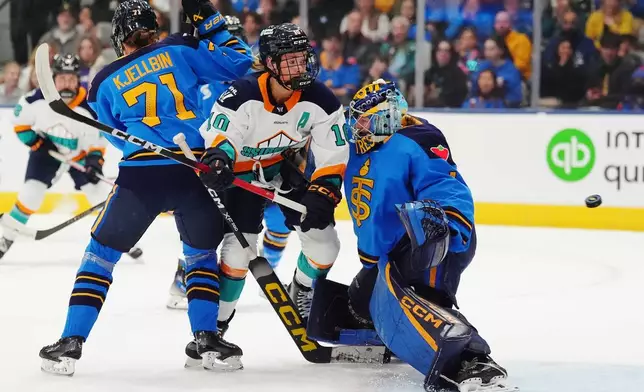
New York Sirens' Sarah Fillier (10) runs into Toronto Sceptres goaltender Raygan Kirk (1) as the puck enters the net and Sceptres' Anna Kjellbin (71) defends during the first period of an PWHL hockey game in Toronto on Tuesday, April 21, 2026. (Frank Gunn/The Canadian Press via AP)
Toronto Sceptres' Renata Fast (14) is taken down by New York Sirens' Maddi Wheeler (18) during the first period of an PWHL hockey game in Toronto on Tuesday, April 21, 2026. (Frank Gunn/The Canadian Press via AP)
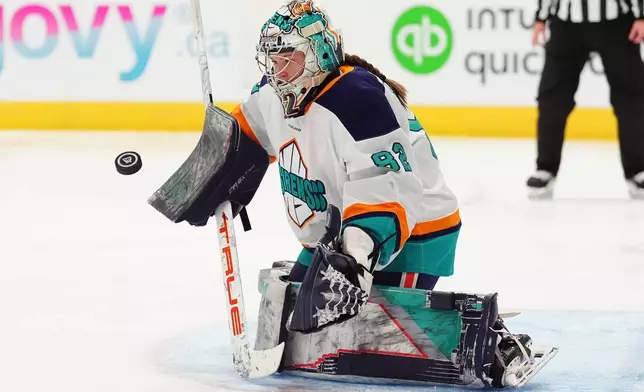
New York Sirens goaltender Kayle Osborne (82) makes a save against the Toronto Sceptres during the second period of an PWHL hockey game in Toronto on Tuesday, April 21, 2026. (Frank Gunn/The Canadian Press via AP)
Toronto Sceptres' Kali Flanagan (centre) checks New York Sirens' Maddi Wheeler (18) as Sceptres' Anna Kjellbin (71) looks on during the third period of an PWHL hockey game in Toronto on Tuesday, April 21, 2026. (Frank Gunn/The Canadian Press via AP)
Toronto Sceptres goaltender Raygan Kirk (1) makes a save as New York Sirens' Sarah Fillier (10) tries to get her stick on the puck during first period PWHL hockey game in Toronto on Tuesday, April 21, 2026. (Frank Gunn/The Canadian Press via AP)
The overtime result ended the Sirens’ postseason hopes.
Raygan Kirk made 32 saves for Toronto, which remained one point behind the Ottawa Charge for the fourth and final playoff spot.
The Sceptres would have moved past the Charge for that spot with a regulation win, but will instead wait to see Ottawa’s result against Boston on Wednesday. If the Charge win in regulation, the Sceptres will be eliminated.
Toronto did not play with the urgency of a team with a playoff berth on the line. The Sceptres had four shots through 20 minutes and just 10 through 40 minutes. The Sceptres came in with the worst offense in the league, seven goals behind last-place Seattle (58) and the second-worst power play. But coming off a 2-0 win over Minnesota on Sunday on the strength of two power-play goals — a first for the season — Toronto failed to carry the momentum over.
Entering Tuesday, Kirk had three shutouts in her last six starts since March 15 with a .968 save percentage during that stretch. Three of the five goals she allowed in her last six games came against New York in her only start against the Sirens this season.
Sirens: Visit the Boston Fleet on Saturday.
Sceptres: Visit the Ottawa Charge for the regular-season finale on Saturday.
AP women’s hockey: https://apnews.com/hub/womens-hockey
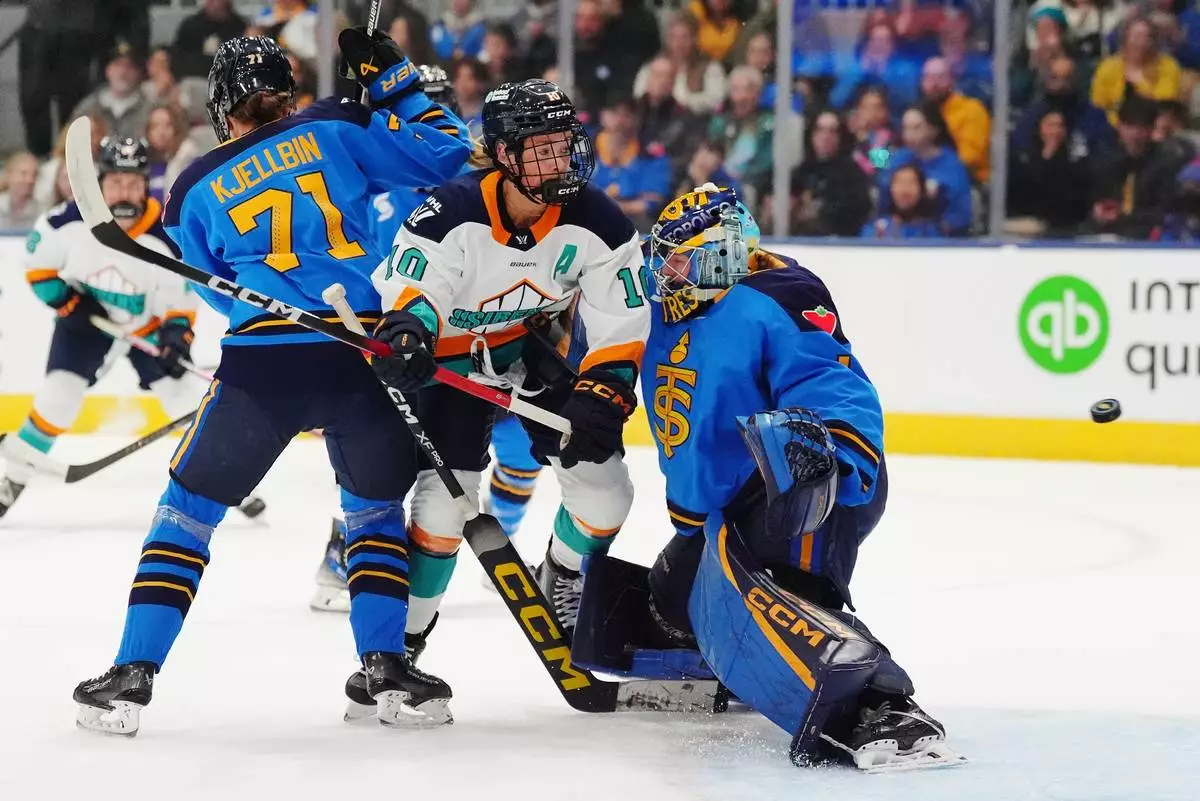
New York Sirens' Sarah Fillier (10) runs into Toronto Sceptres goaltender Raygan Kirk (1) as the puck enters the net and Sceptres' Anna Kjellbin (71) defends during the first period of an PWHL hockey game in Toronto on Tuesday, April 21, 2026. (Frank Gunn/The Canadian Press via AP)

Toronto Sceptres' Renata Fast (14) is taken down by New York Sirens' Maddi Wheeler (18) during the first period of an PWHL hockey game in Toronto on Tuesday, April 21, 2026. (Frank Gunn/The Canadian Press via AP)

New York Sirens goaltender Kayle Osborne (82) makes a save against the Toronto Sceptres during the second period of an PWHL hockey game in Toronto on Tuesday, April 21, 2026. (Frank Gunn/The Canadian Press via AP)

Toronto Sceptres' Kali Flanagan (centre) checks New York Sirens' Maddi Wheeler (18) as Sceptres' Anna Kjellbin (71) looks on during the third period of an PWHL hockey game in Toronto on Tuesday, April 21, 2026. (Frank Gunn/The Canadian Press via AP)

Toronto Sceptres goaltender Raygan Kirk (1) makes a save as New York Sirens' Sarah Fillier (10) tries to get her stick on the puck during first period PWHL hockey game in Toronto on Tuesday, April 21, 2026. (Frank Gunn/The Canadian Press via AP)
Virginia voters approved a mid-decade redistricting plan Tuesday that could boost Democrats’ chances of winning four additional U.S. House seats in November’s midterm elections that will decide control of the closely divided Congress.
The constitutional amendment narrowly backed by voters bypasses a bipartisan redistricting commission to allow the use of new districts drawn by Virginia’s Democratic-led General Assembly. But the public vote may not be the final word. The state Supreme Court is considering whether the plan is illegal in a case that could make the referendum results meaningless.
The Virginia redistricting referendum marked a setback for President Donald Trump, who kicked off a national redistricting battle last year by urging Republican officials in Texas to redraw districts. The goal was to help Republicans win more seats in the November elections and hold on to a narrow House majority in the face of political headwinds that typically favor the party out of power during midterm elections.
But the Virginia redistricting referendum could help nullify Republican gains elsewhere.
“Virginia just changed the trajectory of the 2026 midterms,” Democratic state House Speaker Don Scott said in a celebratory statement. “At a moment when Trump and his allies are trying to lock in power before voters have a say, Virginians stepped up and leveled the playing field for the entire country.”
Democratic Virginia Gov. Abigail Spanberger, who campaigned for the new map, quickly shifted her attention to the November election.
“I understand the urgency of winning congressional seats as a check on this President, and I look forward to campaigning with candidates across the Commonwealth working to earn Virginians’ trust," she said in a statement.
The redistricting in Texas led to a burst of redistricting nationwide. So far, Republicans believe they can win up to nine more House seats in newly redrawn districts in Texas, Missouri, North Carolina and Ohio. Democrats think they can win up to five more seats in California, where voters approved a similar mid-decade redistricting effort last November, and one more seat under new court-imposed districts in Utah.
Democrats hope to offset the rest of that gap in Virginia, where they decisively flipped 13 seats in the state House and won back the governor’s office last year.
Tuesday’s narrow victory for Democrats contrasted with last fall's vote in California, where a Democratic redistricting plan passed by a nearly 29-point margin.
“As we saw in California, when voters have a say, they are rejecting Republicans’ attempt to rig the system,” said U.S. Rep. Suzan DelBene, of Washington state, who is chair of the Democratic Congressional Campaign Committee.
Republicans pledged to continue the battle over Virginia's new map in court.
“Serious legal questions remain about both the wording of this referendum and the process used to put it before voters,” Virginia House Republican Minority Leader Terry Kilgore said. “Those questions have not been resolved, and they now move where they belong: to the courts.”
U.S. Rep. Richard Hudson, of North Carolina, who is chair of the National Republican Congressional Committee, said the "close margin reinforces that Virginia is a purple state that shouldn’t be represented by a severe partisan gerrymander.”
The back-and-forth redistricting battle also could continue in Florida, where the Republican-led Legislature is to convene April 28 for a special session that could result in more favorable congressional districts for Republicans.
The campaign over Virginia’s redistricting referendum focused heavily on fairness.
Republicans argued that it was unfair to gerrymander Virginia’s districts to Democrats’ advantage. But Democrats argued that they were creating a fairer election landscape nationally by counteracting Republican gerrymandering elsewhere.
Matt Wallace, of Alexandria, said he voted for the Democratic redistricting amendment “to help balance the scales a bit until things get back to normal.”
But Ruth Ann McCartney, who voted in the town of South Hill just a few miles north of the North Carolina border, said she cast her ballot against the amendment.
“I look at it more as we don’t have the population as northern Virginia,” she said. “And as a rural area, we just need to be heard.”
In Virginia, Democrats currently hold six of the 11 U.S. House seats under districts that were imposed by the state Supreme Court in 2021 after a bipartisan commission failed to agree on a map based on the latest census data.
The new plan could help Democrats win as many as 10 seats. Five seats are anchored in the Democratic stronghold of northern Virginia, including one stretching out like a lobster to consume Republican-leaning rural areas. Revisions to four other districts across Richmond, southern Virginia and Hampton Roads dilute the voting power of conservative blocs in those areas. And a reshaped district in parts of western Virginia lumps together three Democratic-leaning college towns to offset other Republican voters.
Democrats portrayed the Virginia redistricting as a response to Trump. Ads for the “yes to redistricting” campaign featuring former President Barack Obama flooded the airwaves.
But opponents of the redistricting also distributed campaign materials citing statements from Obama and Spanberger, who had both criticized gerrymandering in the past.
Congressional redistricting typically is done once a decade after each census.
In 2020, Virginia voters approved a constitutional amendment meant to diminish political gamesmanship by shifting redistricting responsibilities away from the legislature.
But lawmakers endorsed a new constitutional amendment allowing mid-decade redistricting last fall, then passed it again in January as part of a two-step process that requires an intervening election in order for an amendment to be placed on the ballot. The measure allows lawmakers to redistrict until returning the task to a bipartisan commission after the 2030 census.
In February, they passed a new U.S. House map to take effect pending the outcome of the redistricting referendum.
Republicans have filed multiple legal challenges against the redistricting effort.
A Tazewell County judge ruled that the redistricting push was illegal for several reasons. Circuit Court Judge Jack Hurley Jr. said lawmakers failed to follow their own rules for adding the redistricting amendment to a special session. He ruled that their initial vote failed to occur before the public began casting ballots in last year’s general election and thus didn’t count toward the two-step process. And he ruled that the state failed to publish the amendment three months before that election, as required by law.
If the state Supreme Court agrees with the lower court, the referendum results could be rendered moot.
Associated Press writers Allen G. Breed in South Hill, Virginia, Gary Fields in Alexandria, Virginia, and Lisa Mascaro in Washington contributed to this report.
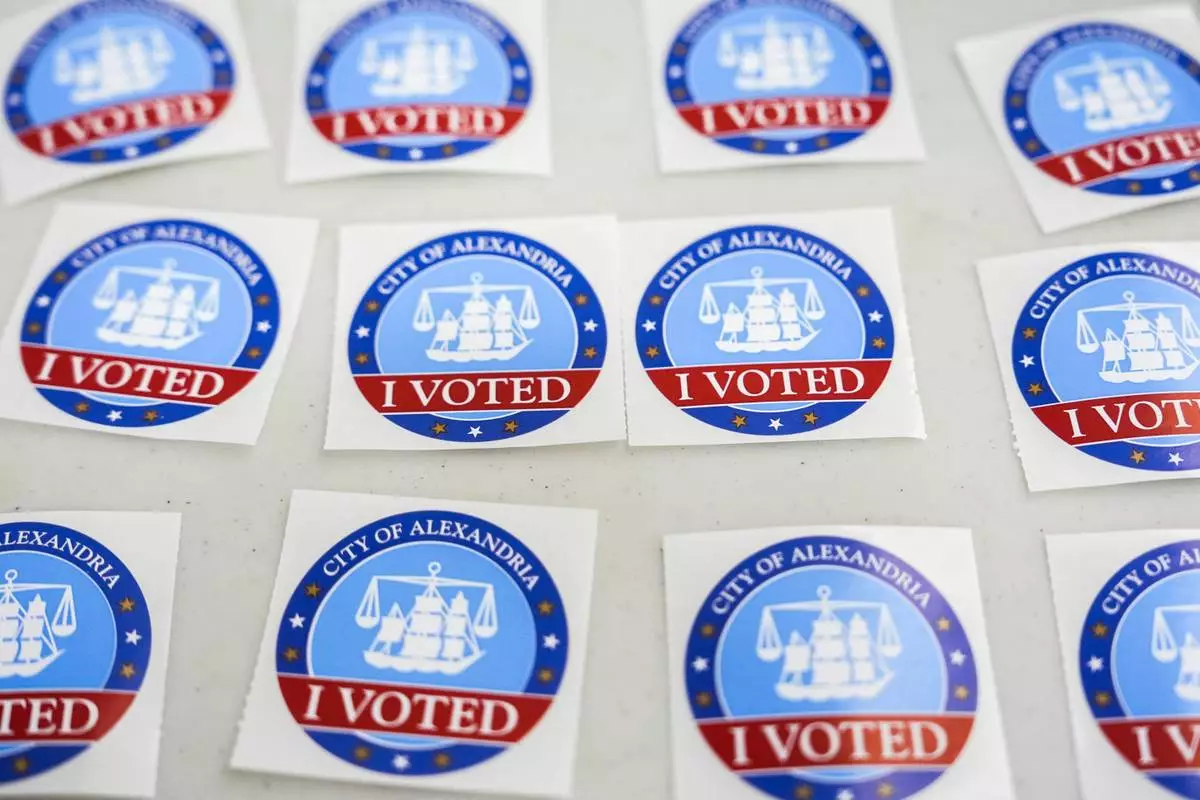
"I Voted" stickers are laid out on a table at Lyles-Crouch Traditional Academy on election day for the Virginia redistricting referendum, Tuesday, April 21, 2026, in Alexandria, Va. (AP Photo/Julia Demaree Nikhinson)
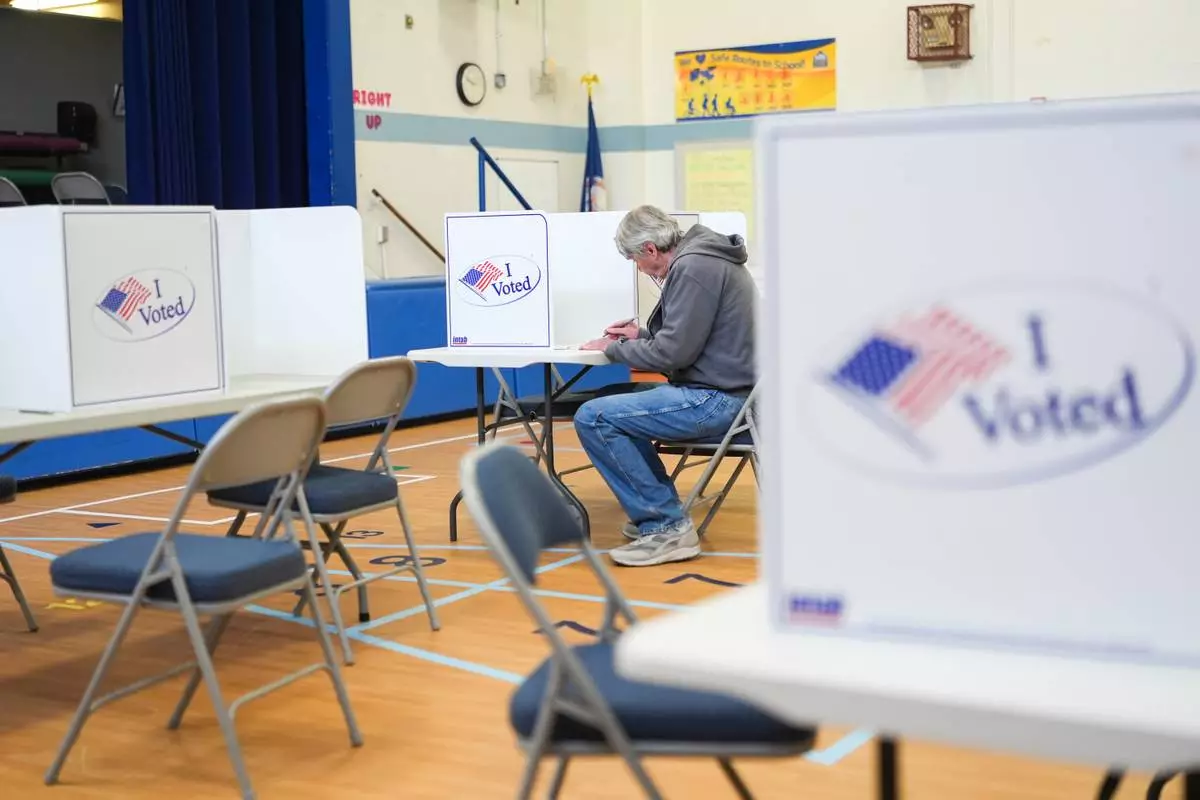
A person votes in the Virginia redistricting referendum at Lyles-Crouch Traditional Academy, Tuesday, April 21, 2026, in Alexandria, Va. (AP Photo/Julia Demaree Nikhinson)
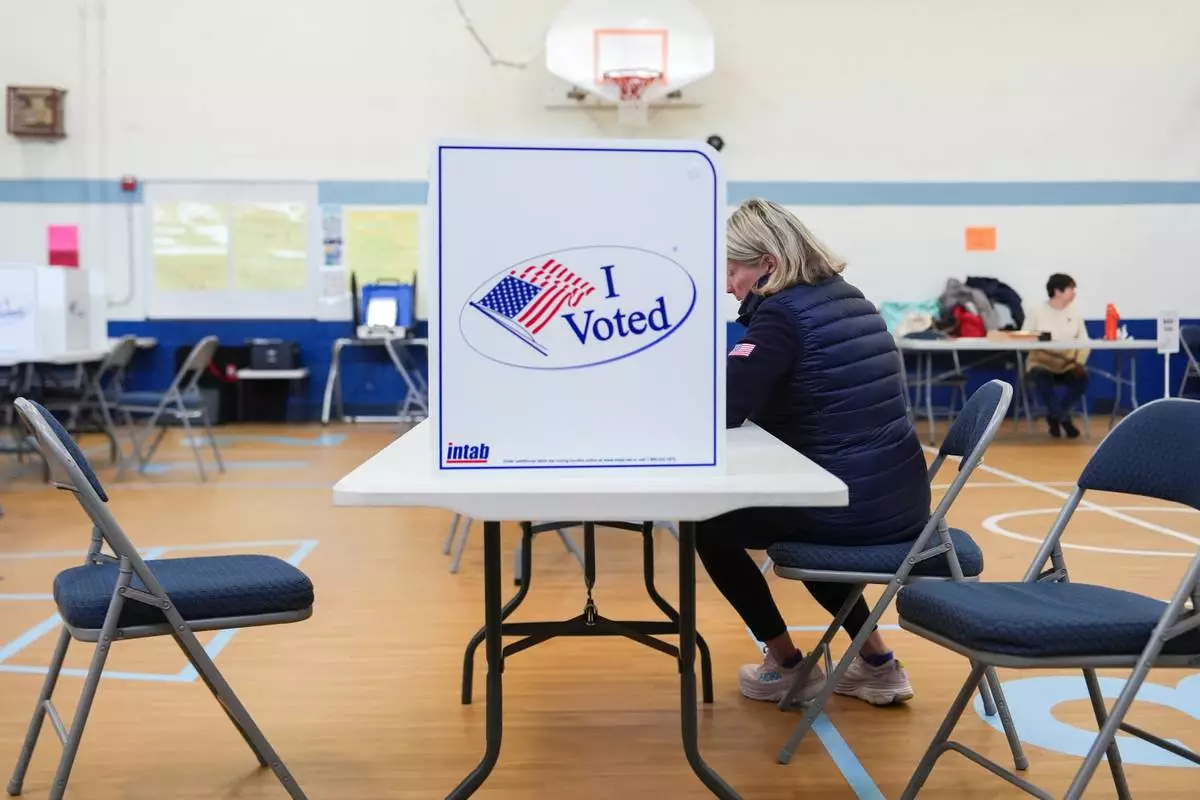
A person votes in the Virginia redistricting referendum at Lyles-Crouch Traditional Academy, Tuesday, April 21, 2026, in Alexandria, Va. (AP Photo/Julia Demaree Nikhinson)
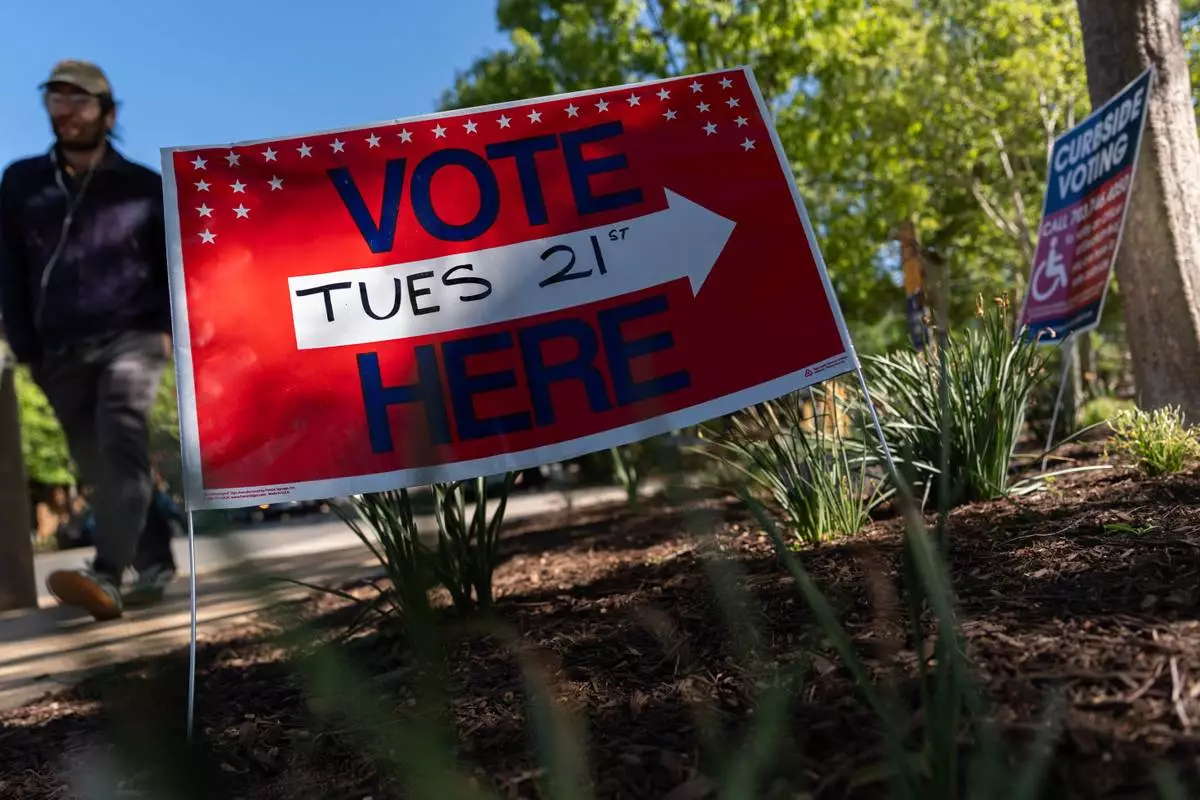
A person walks to vote in the Virginia redistricting referendum at Lyles-Crouch Traditional Academy, Tuesday, April 21, 2026, in Alexandria, Va. (AP Photo/Julia Demaree Nikhinson)