The international community, especially Japan's neighboring countries, must remain highly vigilant against and firmly resist the Japanese government's reckless moves of "neo-militarism", to jointly safeguard regional and global peace, says a China Media Group commentary published on Wednesday.
An edited English version of the commentary is as follows:
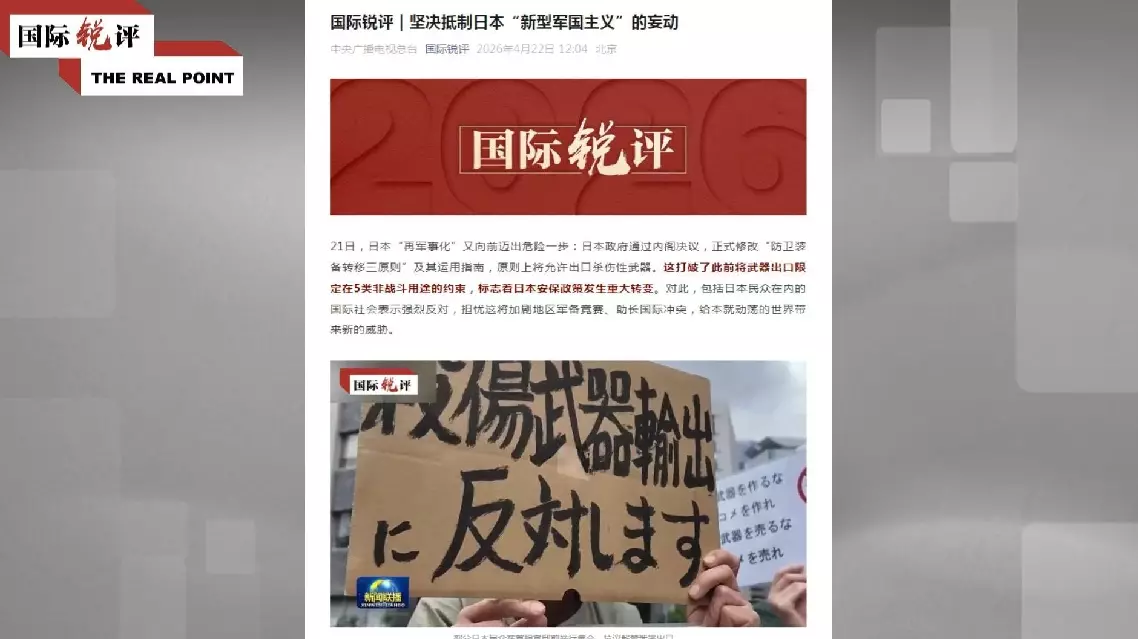
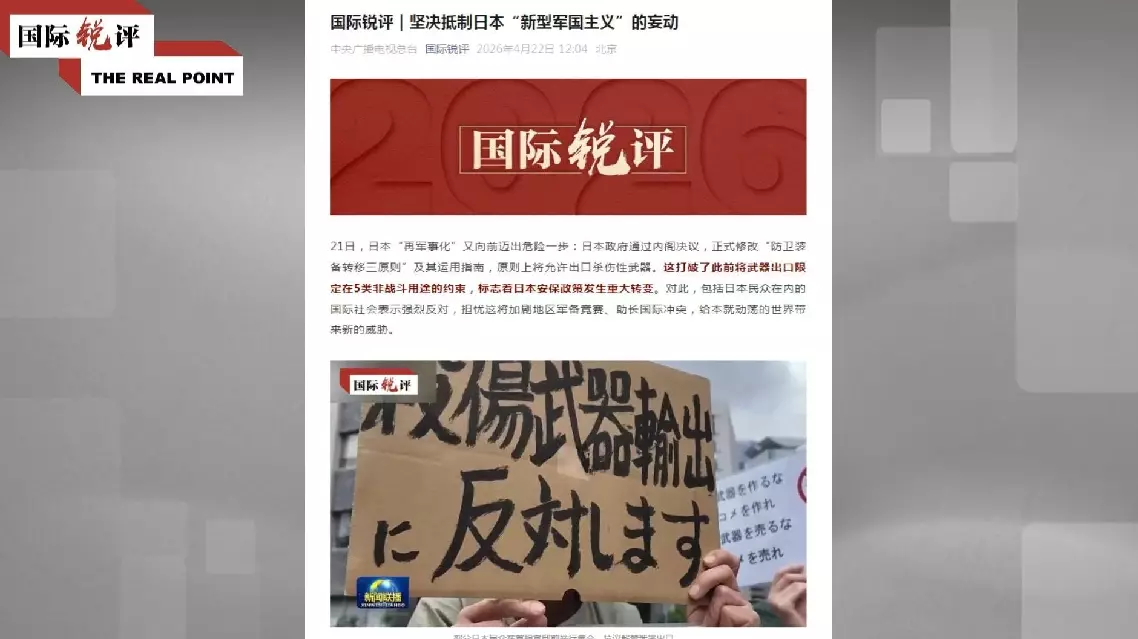
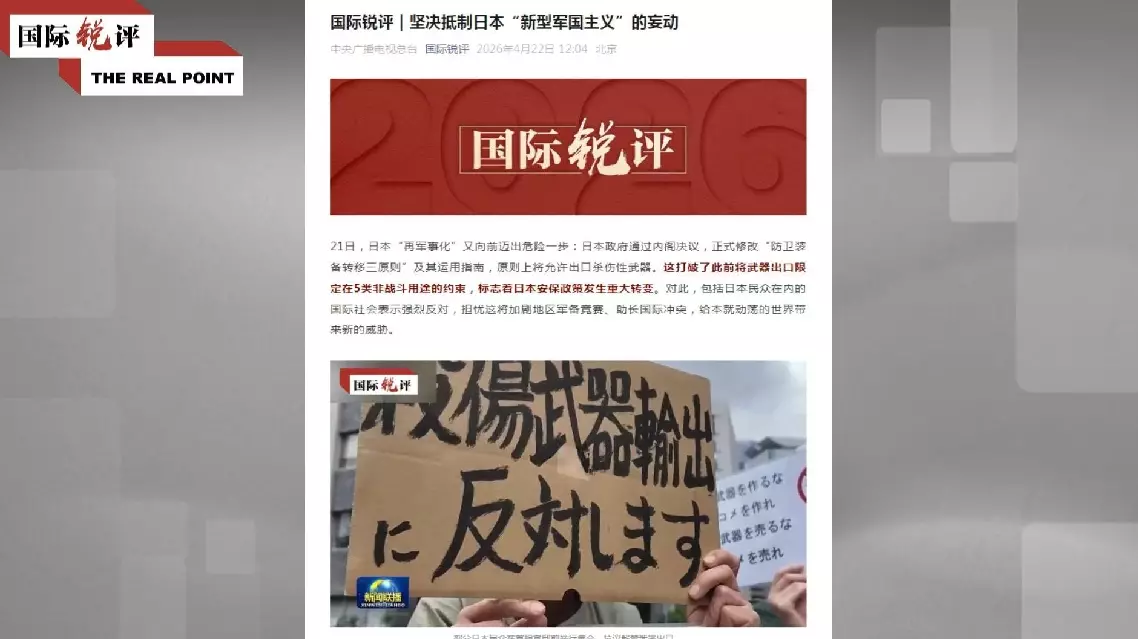
On Tuesday, the Japanese government took another dangerous step forward in its "remilitarization" drive by approving a cabinet resolution, officially revising the Three Principles on Transfer of Defense Equipment and Technology and their implementation guidelines to allow overseas sales of weapons, including those with lethal capabilities.
The Japanese government's decision to scrap rules that limit defense equipment exports to five non-combat categories marks a significant shift in the country's defense policy.
In response, the international community, including some Japanese people, have expressed strong opposition, worrying this will exacerbate regional arms race, fuel international conflicts, and bring new threats to the already turbulent world.
Japan was a defeated country in World War II. International legal documents such as the Cairo Declaration, the Potsdam Declaration, and the Japanese Instrument of Surrender explicitly prohibit Japan from rearming.
After the surrender, Japan adopted the Three Principles of Arms Exports, a strict ban on the export of arms.
However, as right-wing forces in Japan gained strength, this restrictive policy had been eroded until it was replaced by the Three Principles on Transfer of Defense Equipment and Technology in 2014, which has also been repeatedly revised by the Japanese government to ease export restrictions.
Since Japanese Prime Minister Sanae Takaichi took office, Japan's "remilitarization" has accelerated.
Regarding the lifting of the ban on the export of lethal weapons, Japanese Chief Cabinet Secretary Minoru Kihara said at a press conference on Tuesday that Japan will "uphold the fundamental principles of a peaceful nation that have been built over more than 80 years since the end of the war."
The Japanese official's rhetoric cannot conceal the nature of the move that has further hollowed out the pacifist ideals embedded in the country's constitution and trampled on the post-war international order.
The Chinese Foreign Ministry has said that the international community, including China, will remain highly vigilant against and firmly resist Japan's reckless moves of "neo-militarism".
The South Korean Foreign Ministry has called on Japan to adopt defense and security policies that uphold the spirit of its pacifist constitution and contribute to peace and stability in the region.
Russian Deputy Minister of Foreign Affairs Andrey Rudenko has noted the potential negative impact of Japan's "remilitarization" on regional stability in the Asia-Pacific and its implications for the security interests of neighboring countries.
Xiang Haoyu, a distinguished research fellow at the Department for Asia-Pacific Studies of the China Institute of International Studies, has pointed out that by fully easing restrictions on arms export, the Japanese government has deviated from the country's post-war "pacifist" stance and broken through the "exclusively defense-oriented principle" in a bid to boost its domestic economy, expand its military industry, and gain geopolitical influence.
In 2024, the total sales of five Japanese military industrial companies, including Mitsubishi Heavy Industries and Kawasaki Heavy Industries, reached 13.3 billion U.S. dollars, a sharp increase of 40 percent over the previous year, according to data from the Stockholm International Peace Research Institute.
As changes unfold across the world at a faster pace and as global and regional disputes continue, Japan, having lifting restrictions on the export of lethal weapons, will inevitably seek to expand its share of the global arms export market and promote the export of offensive equipment such as missiles, armored vehicles, and warships to open up space for intervention in international disputes.
This will break the regional security balance, intensify arms races, and even lead to the export of war, endangering world peace and security.
For its neighbors, Japan is now a real threat.
In pursuit of the "normalization of Japan," the country's far-right forces have been hyping up the so-called "China threat" rhetoric and have been actively cooperating with the so-called "Indo-Pacific Strategy" of the United States over the past few years.
Regarding the revision, the Japanese government specifically listed two scenarios: when the U.S. military needs weapons to maintain a favorable balance of power in the Indo-Pacific region and when like-minded countries need weapons after a war breaks out in areas related to Japan's security.
This means that in the future, Japan will regard Asia-Pacific countries as key targets in the export of weapons and military technologies, further binding itself with external alliance to contain and threaten China.
Last week, Australia and Japan signed the "Mogami Memorandum" in Melbourne on Australia's general purpose frigate project based on the upgraded Japanese Mogami-class design.
The ships will be built by Mitsubishi Heavy Industries, with the first warship scheduled for delivery in 2029.
Japanese media suggest that this essentially means Japan will export frigates to Australia.
Furthermore, Japan's defense cooperation with the Philippines has also become increasingly close in recent years.
According to an agreement reached between the two countries in 2024, Japan will build several multi-role response vessels for the Philippines, with delivery expected within the next two years.
From openly proclaiming "Any contingency for Taiwan is a contingency for Japan," to sending Self-Defense Force destroyers to the Taiwan Strait, from Takaichi sending a ritual offering to the Yasukuni Shrine in the capacity of the prime minister, to continuously increasing defense budget to a new high, and from pushing for constitutional revisions to removing the ban on the export of lethal weapons: Pushed by the far-right forces, the rise of "neo-militarism" is gaining increasing traction in Japan.
World War II is not a distant part of history yet. Japan has brought profound disasters to the region and the rest of the world, and now it has completely torn off its disguise and accelerated its "remilitarization" drive.
The international community, especially Japan's neighboring countries, must remain highly vigilant and join hands to resist Japan's "neo-militarism", prevent Japan from restarting its war machine, and jointly safeguard regional and global peace and tranquility.
Japan's reckless neo-militarism moves call for vigilance, resistance from regional countries: commentary
Japan's reckless neo-militarism moves call for vigilance, resistance from regional countries: commentary
Japan's reckless neo-militarism moves call for vigilance, resistance from regional countries: commentary