Province adds three unicorns, expands high-growth pipeline
Hangzhou accounts for 83% as new entrants and startups scale up
HANGZHOU, China, April 24, 2026 /PRNewswire/ -- Zhejiang's roster of unicorn companies has expanded to 58 as of April 2026, highlighting the province's growing role as a hub for emerging technologies and industrial upgrading.
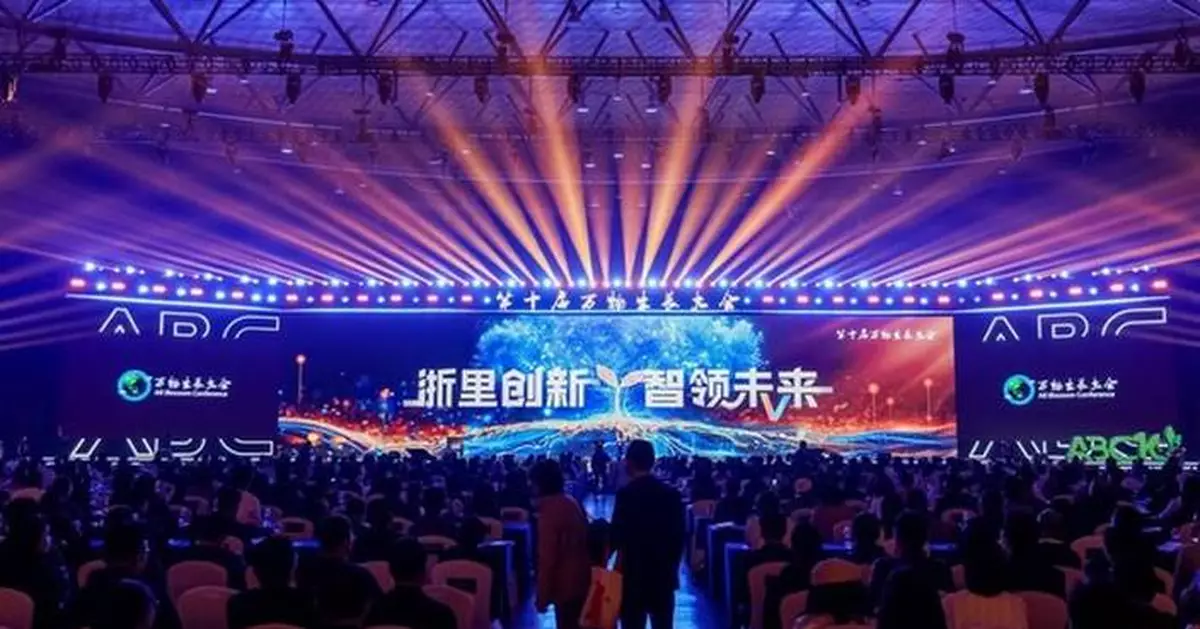
The latest rankings, released at the 10th All Blossom Conference in Hangzhou on April 23, show companies spread across seven cities, including Hangzhou, Ningbo, Jiaxing, Jinhua, Shaoxing, Taizhou and Wenzhou.
While Hangzhou, Ningbo and Jiaxing remain the top three hubs, the broader distribution points to a more geographically balanced innovation landscape. The province's unicorn count rose by three from a year earlier.
Hangzhou continues to dominate the landscape, home to 48 of Zhejiang's unicorns, up from 44 last year—when it already accounted for roughly four out of every five such startups.
The annual rankings also include tiered lists of "future unicorns," valued between $100 million and $1 billion, and early-stage "seed unicorns" worth $10 million to $100 million.
Together, they map a full pipeline of high-growth companies across sectors such as artificial intelligence, embodied intelligence, life sciences, new energy, semiconductors, advanced manufacturing and aerospace, and have become a key barometer of Zhejiang's startup ecosystem.
Among the top 100 future unicorns, integrated circuits lead with 22 companies, followed by artificial intelligence and life sciences with 19 each. Advanced manufacturing accounts for 16 firms, new energy and materials 15, and next-generation information technology nine.
In the seed unicorn category, new energy and life sciences each count 22 companies, ahead of advanced manufacturing with 19, while AI, next-generation IT and semiconductors each have 11 firms, and aerospace-related companies total four.
Against that provincial backdrop, Hangzhou remains the clear center of gravity—continuing to generate both the largest share of unicorns and the deepest pipeline of emerging startups.
The city added eight companies to its unicorn ranks on April 23, bringing the total to 48, according to the same conference ranking.
The new entrants—Hailiang Technology Services, Geener Microelectronics, Spirit AI, Geespace, Sunrise, Seepin, DEEP Robotics and Simplexity Robotics—span sectors from semiconductors and robotics to commercial aerospace.
As of April, Hangzhou accounted for 83% of Zhejiang's unicorns, up from 80% a year earlier, underscoring its outsized role in the province's innovation economy.
The conference also released a list of 413 quasi-unicorns—companies typically valued between $100 million and $1 billion—including 50 new additions.
Several firms, such as Diagens Biotechnology, Manycore Tech, Mirxes, Promisemed, Saint Bella, Tide Pharmaceutical, Tongshifu and ISV, exited the list after scaling into unicorn status or completing initial public offerings.
Quasi-unicorns are concentrated in sectors aligned with Hangzhou's broader "296X" industrial strategy. Life sciences lead with 118 firms, followed by next-generation information technology with 78 and AI and embodied intelligence with 50—together accounting for about 60% of the total.
The "296X" is an industrial cluster blueprint the city introduced in October 2025 in an effort to speed up the integration of technological and industrial innovation.
More than half of both unicorns and quasi-unicorns—255 companies—are classified as nationally recognized "specialized and refined" enterprises, including 20 unicorns and 235 quasi-unicorns, reflecting a structured pipeline of high-growth firms.
Since 2018, Hangzhou's unicorn count has risen from 26 to 48, while quasi-unicorns have expanded from 105 to 413, underscoring sustained growth in its innovation-driven economy.
** This press release is distributed by PR Newswire through automated distribution system, for which the client assumes full responsibility. **
Zhejiang unicorn ranks grow to 58 as Hangzhou tightens lead, top ranking shows