The director general of the Olympic Council of Asia (OCA) has praised Sanya's efforts in hosting the ongoing 6th Asian Beach Games, commending the hospitality of the city.
Being held from April 22 to 30 in south China's Hainan Province, the Games feature 14 sports, 15 disciplines and 62 events. It is the second time China has hosted the Asian Beach Games after the 2012 edition in Haiyang of east China's Shandong Province.
In an interview with China Central Television (CCTV), Husain Al Musallam, the OCA director general, said he not only witnessed the excitement both inside and outside the venues, but also felt the development and vitality of the tropical resort city.
"I was walking on the street, talking to some people in small shops and small restaurants and cafes. They were very happy to see people coming to Sanya, representing different countries or regions in Asia to compete in Sanya. And they were very, very nice with the athletes," said Al Musallam.
He also thanked China's for its unwavering support for the development of competitive sports in the region.
"From the support of the government to the sport inside China, I am not talking about coaches, I am not talking about sports facilities, but in general the support to the sport. And this is a fantastic policy because sport is connected to health, sport is connected to economy, sport is connected to tourism, and sport is connected to trade, to everything. I would like to thank the government of the People's Republic of China for their support for the Olympic movement in Asia and to OCA," he said.

OCA director general lauds hospitality of Sanya, host city of Asian Beach Games
The Sudan conflict now in its fourth year has pushed millions into poverty, even forcing some families to rely on animal fodder to survive.
Fighting between the Sudanese Armed Forces and the paramilitary Rapid Support Forces (RSF) erupted in April 2023, following months of escalating tensions between Abdel Fattah al-Burhan, the army chief and head of Sudan's ruling council, and Mohamed Hamdan Dagalo, the RSF commander and al-Burhan's former deputy.
Nearly 6.9 million Sudanese were pushed into extreme poverty in 2023 alone, according to the United Nations Development Programme (UNDP). Currently, around 70 percent of the population are estimated to live in poverty in the country, compared with 38 percent before the war, said UNDP Resident Representative in Sudan Luca Renda.
At the Tawila Camp in North Darfur State, Salha Musa, a displaced widow from El Fasher, is struggling to provide her six children with minimal resources.
Water is available from wells, but other essential services are absent. Inflation and scarcity have forced families to rely on unconventional foods. Everyday staples have disappeared from local markets, leaving vulnerable families at risk of malnutrition.
"Since we arrived in Tawila a month ago, we've been suffering from a severe lack of services, except for water, which we draw from wells. We have no other services here, and we desperately need assistance. Our children aren't receiving an education, and I'm a nurse, but I can't find work," said Salha.
The UNDP warns that Sudan's economy has collapsed under the weight of the ongoing conflict, with GDP falling sharply and more than 13 million people displaced. Extreme poverty rates now surpass those of the 1980s.
"Life is incredibly difficult for us poor people. If we don't have money, what are we supposed to do? Will we starve to death? After the price of corn flour became so high, we stopped buying it. I don't know why they're raising prices or hoarding goods. Flour has completely disappeared from the markets here. After that, flour became expensive and unavailable," said Summia Ahmed, another displaced woman from El Fasher, adding that her family has even started relying on "Ombaz", a kind of animal fodder, as their food.
UNDP projections show that peace could lift millions out of extreme poverty, but delays and continued conflict risk locking the country into decades of low growth and deprivation.
For families like Salha's and Summia's, the road ahead remains uncertain, as conflict continues to dictate daily survival in Sudan.
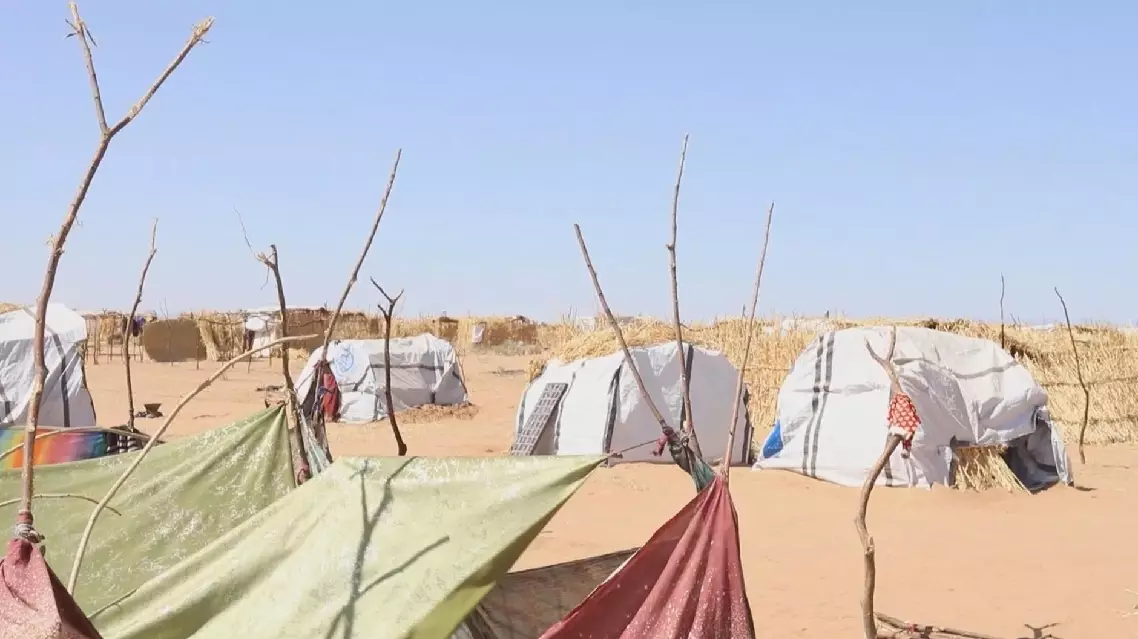
Sudan conflict pushes millions into poverty